

Keeping a home comfortable throughout the year can be expensive, especially when outdated heating and cooling equipment struggles to maintain consistent indoor temperatures. Many homeowners are now considering more efficient alternatives that provide both heating and cooling through a single system. Heat pump installation offers a practical option by using electricity to transfer heat between indoor and outdoor environments rather than generating most of its heating energy through combustion. When properly designed and installed, a heat pump can deliver dependable comfort while potentially reducing energy consumption.
However, choosing the right system requires more than selecting equipment with an impressive efficiency rating. Successful heat pump installation depends on climate conditions, property insulation, correct equipment sizing, installation quality, and household heating requirements. Understanding these factors can help homeowners compare available technologies, evaluate costs, and determine whether upgrading to a heat pump makes financial and practical sense for their property.
What Is Heat Pump Installation?
Heat pump installation is the process of selecting, positioning, connecting, and commissioning equipment that transfers heat to provide indoor heating and, in many systems, cooling.
Unlike conventional furnaces that generate heat through combustion, heat pumps move thermal energy from one location to another.
During heating operation, an air-source heat pump extracts available heat from outdoor air and transfers it indoors.
In cooling mode, many systems reverse the process and move heat from the home to the outside environment.
Because heat is transferred rather than produced primarily through electrical resistance, heat pumps can deliver more thermal energy than the electrical energy they consume under suitable operating conditions.
How Does a Heat Pump Work?
Most residential heat pumps operate through a refrigeration cycle.
The main components generally include a compressor, refrigerant, heat exchangers, an expansion device, and system controls.
During heating, the refrigerant absorbs energy from a lower-temperature source.
The compressor increases refrigerant pressure and temperature, allowing heat to be transferred to the indoor environment.
Afterward, the refrigerant passes through the remaining cycle components and repeats the process.
The exact arrangement depends on the system design.
Types of Residential Heat Pumps
Common technologies include:
- Air-source heat pumps.
- Air-to-water heat pumps.
- Ductless mini-split heat pumps.
- Ducted central heat pumps.
- Ground-source geothermal heat pumps.
- Water-source heat pumps.
- Hybrid or dual-fuel systems.
Each technology has different installation requirements.
Consequently, the best choice depends on the property’s characteristics, climate, and budget.
7 Powerful Benefits of Heat Pump Installation
A properly selected heat pump can offer several advantages compared with certain conventional heating and cooling systems.
However, actual results depend on the building and equipment.
1. Improved Heating and Cooling Efficiency
Energy efficiency is one of the main reasons homeowners consider heat pump installation.
Heat pumps transfer existing thermal energy rather than relying entirely on fuel combustion or electrical resistance.
Under suitable conditions, this allows them to deliver multiple units of heat for each unit of electricity consumed.
Understanding Heat Pump Efficiency
Heating performance is often described using the coefficient of performance, or COP.
A COP of 3 means the system delivers approximately three units of heat for each unit of electrical energy consumed under the specified conditions.
However, COP changes with outdoor temperature, operating conditions, and system configuration.
Seasonal efficiency ratings provide a broader comparison.
For U.S. residential equipment, common ratings include HSPF2 for heating and SEER2 for cooling.
Higher ratings generally indicate greater efficiency under standardized testing conditions.
Nevertheless, real-world performance depends heavily on installation quality.
2. Heating and Cooling From One System
Many heat pumps provide both heating and cooling.
This can reduce the need for separate heating and air conditioning equipment.
During warmer months, a reversible heat pump operates similarly to an air conditioner.
When temperatures fall, the system changes operating mode to provide heat.
As a result, homeowners can manage seasonal comfort through one integrated system.
However, some air-to-water configurations require additional components to provide cooling.
Therefore, cooling capability should be confirmed before installation.
3. Potentially Lower Energy Bills
Heat pump installation may reduce operating costs when replacing certain less efficient systems.
For example, switching from electric resistance heating to an appropriately designed heat pump can substantially reduce electricity required for space heating.
However, replacing a gas furnace produces a different financial comparison.
Natural gas prices, electricity rates, climate, and equipment efficiency all influence costs.
Why Savings Vary
Several factors affect the financial outcome:
- Existing heating system.
- Local electricity prices.
- Gas or oil costs.
- Outdoor temperatures.
- Building insulation.
- Thermostat settings.
- Equipment efficiency.
- Installation quality.
Consequently, homeowners should request realistic operating-cost estimates rather than relying on universal savings percentages.
4. More Consistent Indoor Comfort
Variable-speed heat pumps can adjust output according to heating and cooling demand.
This may help maintain steadier indoor temperatures than certain fixed-capacity systems.
Instead of repeatedly operating at full output, suitable equipment can run at lower capacity when less heating or cooling is required.
However, comfort depends on proper system sizing and airflow.
An incorrectly installed heat pump may still create temperature imbalances.
5. Reduced On-Site Combustion
Electric heat pumps do not burn natural gas, oil, or propane during normal heat pump operation.
This eliminates on-site combustion emissions from the heat pump itself.
However, a home’s overall emissions depend on the electricity generation mix and the full equipment lifecycle.
Hybrid systems using combustion backup have additional considerations.
Heat pump installation may support household decarbonization goals, but the environmental benefit should be assessed realistically.
6. Flexible Installation Options
Modern heat pumps are available in several configurations.
Homes with existing ductwork may use ducted systems.
Properties without ducts may benefit from ductless mini-splits.
Air-to-water systems can serve certain radiator or underfloor heating arrangements.
Ground-source systems provide another option where suitable land or drilling access exists.
This flexibility allows heat pump installation to accommodate different building types.
However, not every configuration is appropriate for every property.
7. Potential Long-Term Property Value
Energy-efficient improvements may appeal to some property buyers.
A properly installed heat pump can provide modern heating and cooling capabilities.
However, there is no universal guarantee that installation will increase resale value by a specific amount.
Property value depends on location, housing conditions, energy prices, buyer preferences, and broader market factors.
Therefore, homeowners should prioritize practical comfort and operating benefits rather than assuming a guaranteed return through resale.
Different Types of Heat Pump Installation
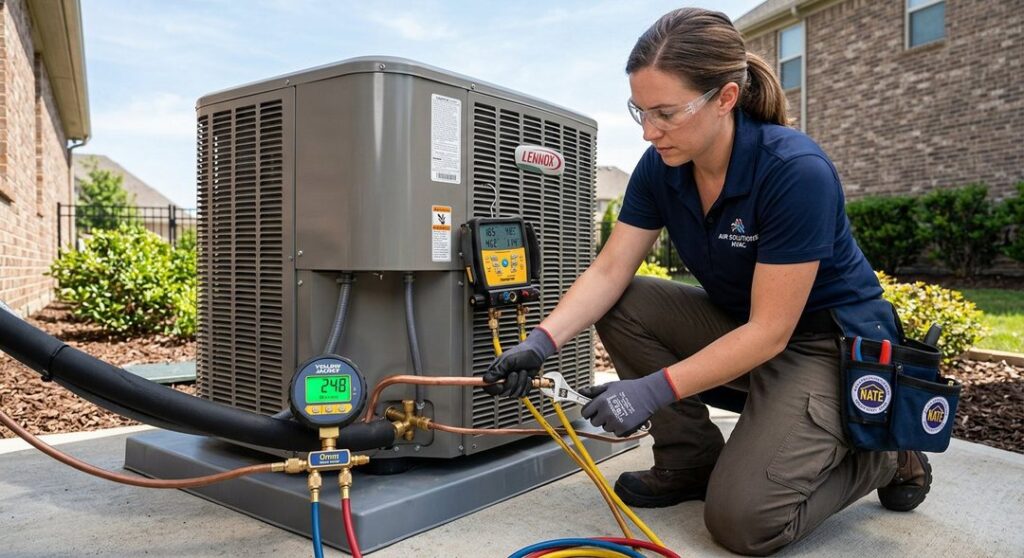
Selecting the correct system is essential for long-term performance.
Air-Source Heat Pump Installation
Air-source heat pumps extract heat from outdoor air.
They are commonly used in residential properties because they generally require less site disruption than ground-source systems.
Modern cold-climate models can provide useful heating performance at low outdoor temperatures.
However, heating capacity and efficiency still vary with weather conditions.
Ductless Mini-Split Installation
Ductless systems use one or more indoor units connected to an outdoor unit.
They are often suitable for homes without central ductwork.
Additionally, they can provide individual zone control.
However, indoor unit placement affects comfort and appearance.
Ducted Heat Pump Installation
Ducted systems distribute conditioned air through existing or newly installed ductwork.
They may be suitable for replacing central air conditioning and certain furnace configurations.
However, duct condition and sizing must be evaluated.
Leaky or poorly designed ducts can reduce efficiency.
Air-to-Water Heat Pump Installation
Air-to-water systems transfer heat into water used for space heating and, in some configurations, domestic hot water.
They are common in certain European residential applications.
However, radiator sizing, flow temperatures, and hot water storage requirements influence system design.
Ground-Source Heat Pump Installation
Ground-source systems exchange heat with the earth through buried pipework.
They can provide efficient operation because underground temperatures are relatively stable.
However, installation may involve excavation or drilling.
As a result, upfront costs can be higher.
Heat Pump Types Compared
| Heat Pump Type | Primary Application | Main Advantage | Important Consideration |
|---|---|---|---|
| Air-source | General residential heating and cooling | Flexible installation | Outdoor temperature affects performance |
| Ductless mini-split | Homes without ducts | Individual zone control | Indoor unit placement |
| Ducted heat pump | Central HVAC replacement | Uses compatible ductwork | Duct condition matters |
| Air-to-water | Hydronic heating | Works with suitable water-based systems | Emitter and flow temperature requirements |
| Ground-source | Whole-home heating and cooling | Stable ground heat exchange | Higher installation complexity |
| Hybrid system | Mixed heating arrangements | Multiple heating options | Controls and fuel economics |
The best system should be selected through a professional assessment.
How Much Does Heat Pump Installation Cost?
Heat pump installation costs vary considerably by country, region, property size, and system type.
Equipment capacity, labor, electrical upgrades, ductwork, and site preparation all influence pricing.
Typical U.S. Installation Cost Ranges
The following figures are broad planning estimates rather than current local quotations.
| System Type | Illustrative Installed Cost |
|---|---|
| Single-zone ductless mini-split | $3,000–$8,000 |
| Multi-zone ductless system | $7,000–$18,000+ |
| Ducted air-source heat pump | $6,000–$16,000+ |
| Cold-climate air-source system | $8,000–$20,000+ |
| Ground-source geothermal system | $15,000–$40,000+ |
Actual prices may fall outside these ranges.
Additionally, existing equipment removal, electrical modifications, and difficult access can increase costs.
What Affects Installation Pricing?
Major factors include:
- Home size and heating load.
- Equipment type.
- System efficiency.
- Number of indoor units.
- Existing ductwork.
- Electrical capacity.
- Refrigerant line requirements.
- Installation location.
- Permit requirements.
- Local labor costs.
Therefore, an accurate quotation requires a property-specific evaluation.
Heat Pump Installation Process Step by Step
Professional installation involves several stages.
Although the exact process differs between systems, most projects follow a similar structure.
Step 1. Home Energy and Heating Assessment
The contractor evaluates the building’s heating and cooling needs.
This includes reviewing insulation, windows, air leakage, occupancy, and local climate.
A proper assessment helps determine suitable equipment capacity.
Step 2. Heat Load Calculation
Correct sizing is essential.
In the United States, residential load calculations commonly reference ACCA Manual J methodology.
Other countries use different recognized standards.
The contractor should calculate heating and cooling demand rather than simply selecting equipment based on floor area.
Step 3. Equipment Selection
The installer recommends equipment based on the calculated requirements.
Relevant considerations include efficiency, heating capacity, noise, and compatibility.
Step 4. Site Preparation
The installation location must provide suitable support and access.
Outdoor units require appropriate clearance and drainage.
Indoor components must also be positioned correctly.
Step 5. Equipment Installation
Qualified technicians install the indoor and outdoor components.
This may involve mounting equipment, connecting refrigerant lines, completing electrical work, and configuring controls.
Step 6. System Testing
The contractor should verify proper operation.
Testing may include airflow, electrical checks, refrigerant-related procedures, and control performance.
Step 7. Homeowner Instruction
Before completion, the installer should explain system operation, thermostat settings, maintenance, and warranty requirements.
Proper user understanding supports efficient performance.
Why Correct Heat Pump Sizing Matters
Sizing is one of the most important technical decisions in heat pump installation.
An oversized system may cycle inefficiently or create comfort problems.
An undersized system may struggle during demanding weather.
Problems With Oversized Equipment
Excessive capacity can contribute to short cycling in some configurations.
This may affect comfort and efficiency.
However, variable-speed equipment can manage part-load operation differently from fixed-capacity systems.
Problems With Undersized Equipment
An undersized heat pump may require more backup heating or fail to meet peak demand.
The result can be higher operating costs or reduced comfort.
Why Square Footage Is Not Enough
Two homes with identical floor areas may have different heating needs.
Insulation, air leakage, windows, orientation, and climate all matter.
Therefore, professional load calculations are essential.
Heat Pump Installation for Older Homes
Older properties can often accommodate heat pumps, but additional planning may be necessary.
Insulation Improvements
Poor insulation increases heating demand.
Improving insulation may allow a smaller heat pump to meet comfort requirements.
However, the cost-effectiveness of upgrades depends on the building.
Existing Radiators
Air-to-water systems may require radiator evaluation.
Some existing radiators are suitable, while others may need replacement or modification.
Electrical Capacity
Certain installations require electrical upgrades.
A qualified electrician should assess the existing system.
Limited Outdoor Space
Outdoor unit placement may be challenging in densely built areas.
Noise, clearance, drainage, and local regulations must be considered.
Heat Pump Installation vs Gas Furnace
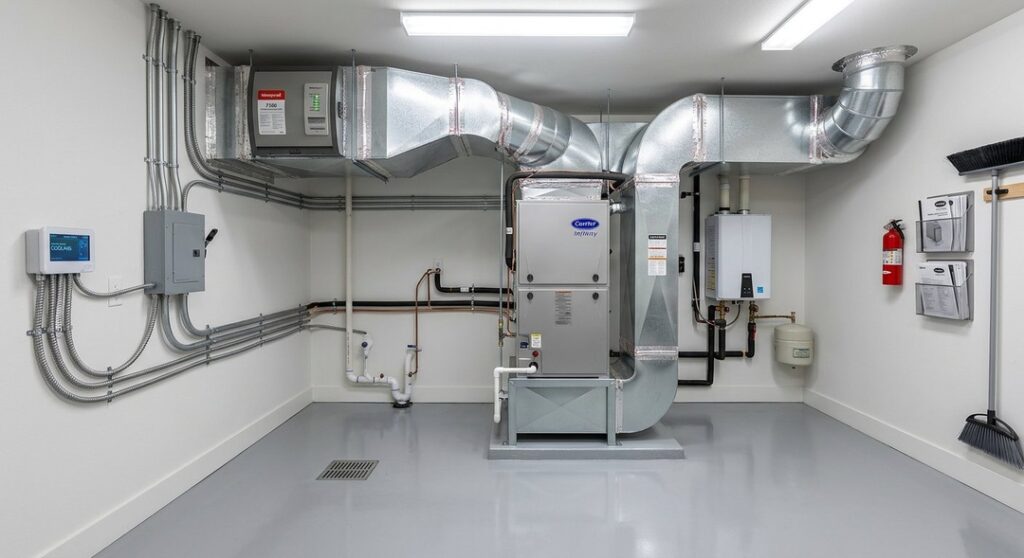
Heat pumps and gas furnaces use different heating methods.
| Feature | Heat Pump | Gas Furnace |
|---|---|---|
| Primary energy source | Electricity | Natural gas |
| Heating method | Transfers heat | Combustion |
| Cooling capability | Often included | Requires separate cooling equipment |
| On-site combustion | None in electric-only operation | Yes |
| Efficiency measurement | COP or HSPF2 | AFUE |
| Cold-weather performance | Model-dependent | Generally strong heating output |
| Operating cost | Depends on electricity and efficiency | Depends on gas price and efficiency |
| Installation needs | Electrical and refrigerant systems | Gas supply and venting |
The most suitable system depends on climate, infrastructure, energy prices, and household priorities.
Can Heat Pumps Work in Cold Climates?
Yes. Modern cold-climate heat pumps can operate in freezing conditions.
However, performance varies by model.
Cold-Weather Heating Capacity
As outdoor temperatures fall, some air-source systems lose heating capacity.
Cold-climate designs are engineered to maintain useful output at lower temperatures.
Nevertheless, homeowners should review manufacturer performance data for relevant local temperatures.
Defrost Cycles
Outdoor heat exchangers may accumulate frost during heating.
Heat pumps use defrost cycles to manage this condition.
Temporary changes in operation during defrosting can be normal.
Backup Heating
Some installations include electric resistance or combustion backup.
Backup requirements depend on system design and local climate.
A qualified contractor should explain the operating strategy.
Heat Pump Installation and Home Insulation
Heat pump efficiency is influenced by the building envelope.
Attic Insulation
Insulation reduces heat transfer through roof structures.
Improving inadequate attic insulation can reduce heating and cooling demand.
Wall Insulation
Wall performance affects indoor temperature stability.
However, suitable retrofit methods depend on building construction.
Air Sealing
Reducing uncontrolled air leakage may improve comfort.
Nevertheless, ventilation and combustion safety requirements must be considered.
Windows and Doors
Window performance and air leakage can influence heating demand.
Appropriate improvements may complement a heat pump upgrade.
Heat Pump Running Costs and Energy Savings
Operating costs depend on electricity consumption and local tariffs.
A heat pump with high seasonal efficiency may use less energy than electric resistance heating.
However, financial savings depend on the system being replaced.
Electricity Prices
Regional electricity rates vary.
Time-of-use tariffs may influence operating costs.
Thermostat Settings
Consistent settings can support efficient operation.
However, the best approach depends on equipment and controls.
Climate Conditions
Very cold weather may reduce air-source heat pump efficiency.
Actual seasonal performance should be considered.
Maintenance
Dirty filters and neglected components can reduce efficiency.
Regular care helps preserve intended operation.
Heat Pump Installation Incentives and Rebates
Government incentives may reduce upfront costs in some locations.
However, eligibility rules and funding availability change.
United States Incentives
Federal, state, and utility programs may support eligible heat pump projects.
For 2026 installations, homeowners should verify current federal tax law rather than assuming incentives available in previous years still apply.
In particular, the federal Energy Efficient Home Improvement Credit under Section 25C is not available for property placed in service after December 31, 2025, under the legislation enacted in 2025.
Some state, utility, or other programs may still be available.
United Kingdom Incentives
Eligible homeowners in England and Wales may be able to access support through the Boiler Upgrade Scheme.
However, current grant amounts, eligibility conditions, and available funding should be confirmed through official government guidance.
Local Utility Programs
Some electricity providers offer rebates or technical assistance.
Availability varies by location.
Homeowners should verify eligibility before purchasing equipment.
Choosing a Professional Heat Pump Installer
Installation quality strongly influences performance.
Verify Licensing
Contractor licensing requirements vary by jurisdiction.
Confirm that the installer meets applicable requirements.
Check Refrigerant Qualifications
In the United States, technicians handling regulated refrigerants may require EPA Section 608 certification.
Other countries have different qualification requirements.
Request Load Calculations
A professional proposal should explain equipment sizing.
Avoid relying solely on the capacity of the previous system.
Compare Written Quotations
Request detailed estimates identifying equipment, labor, and additional work.
Review Warranty Conditions
Manufacturer and labor warranties may differ.
Understand coverage and exclusions.
Check Relevant Experience
Ask whether the contractor has installed similar systems in comparable homes.
Common Heat Pump Installation Mistakes
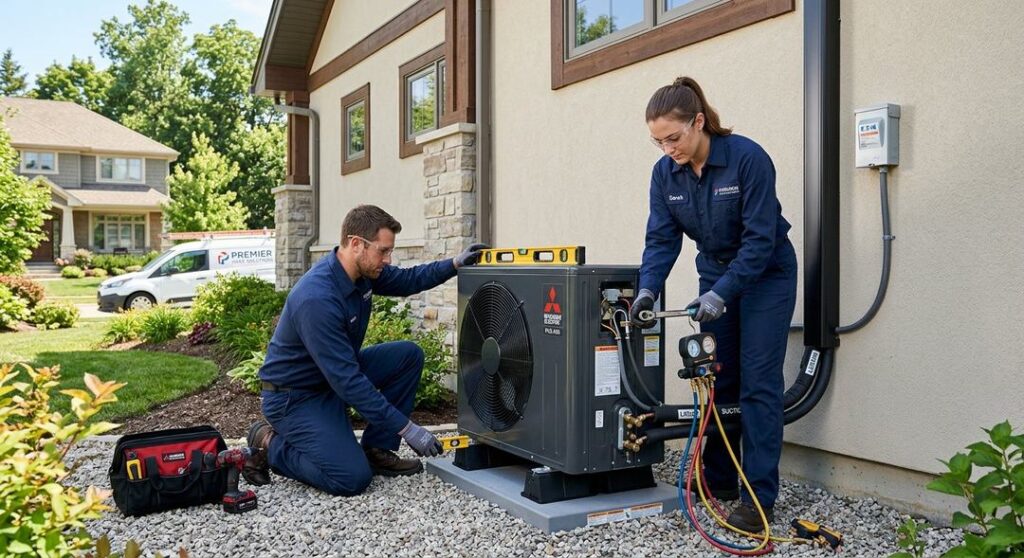
Avoiding errors can improve system reliability.
Incorrect Equipment Sizing
Oversized or undersized systems may create comfort problems.
Poor Outdoor Unit Placement
Restricted airflow can reduce performance.
Inadequate Ductwork
Leaky ducts may waste conditioned air.
Improper Refrigerant Procedures
Incorrect refrigerant charge can affect efficiency and reliability.
Inadequate Electrical Planning
Electrical systems must safely support equipment requirements.
Ignoring Condensate Drainage
Poor drainage can cause moisture problems.
Skipping Commissioning
Installation should include appropriate testing and verification.
Heat Pump Maintenance After Installation
Routine maintenance helps systems operate reliably.
Clean or Replace Filters
Follow manufacturer recommendations.
Dirty filters can restrict airflow.
Keep Outdoor Units Clear
Remove debris and maintain required clearance.
Avoid damaging components.
Monitor Unusual Noises
Unexpected sounds may indicate maintenance needs.
Check Drainage
Ensure condensate systems function correctly.
Schedule Professional Servicing
Inspection frequency depends on equipment and manufacturer guidance.
Follow Warranty Requirements
Some warranties include maintenance conditions.
Keep relevant records.
How Long Does Heat Pump Installation Take?
Installation time depends on project complexity.
A straightforward ductless installation may be completed relatively quickly.
However, larger projects involving multiple indoor units, duct modifications, or electrical upgrades may require additional time.
Ground-source installations can involve excavation or drilling.
Therefore, scheduling should be based on the actual scope of work.
Factors Affecting Project Duration
Important considerations include:
- Equipment availability.
- Permit approvals.
- Site accessibility.
- Electrical modifications.
- Existing system removal.
- Ductwork requirements.
- Weather conditions.
- Commissioning procedures.
A contractor should provide a realistic schedule before work begins.
Is Heat Pump Installation Worth It in 2026?
Heat pump installation can be worthwhile for homeowners seeking efficient heating and cooling.
However, its financial value depends on the existing system, local energy prices, installation cost, and building condition.
When a Heat Pump May Be a Good Choice
A heat pump may suit homeowners who:
- Need to replace aging HVAC equipment.
- Want heating and cooling from one system.
- Currently use electric resistance heating.
- Have suitable electrical infrastructure.
- Can improve inadequate insulation.
- Value efficient temperature control.
- Plan to remain in the property long enough to benefit.
When Additional Assessment Is Necessary
Careful evaluation is particularly important when:
- The home has substantial heat loss.
- Electrical upgrades are expensive.
- Existing radiators are undersized.
- Outdoor installation space is limited.
- Energy prices make savings uncertain.
- The property has unusual heating requirements.
The best decision should follow a property-specific assessment.
The Future of Residential Heat Pump Technology
Heat pump technology continues to develop.
Manufacturers are improving cold-weather performance, controls, and equipment efficiency.
Variable-Speed Compressors
Variable-speed technology allows some systems to adjust output according to demand.
This may improve comfort and part-load efficiency.
Cold-Climate Improvements
Equipment designed for lower temperatures is expanding the range of suitable applications.
Smart Controls
Connected thermostats and monitoring systems may help manage operation.
However, compatibility and data privacy should be considered.
Refrigerant Changes
The HVAC industry is transitioning toward refrigerants with lower global warming potential in certain equipment categories.
Technicians must follow applicable safety and environmental requirements.
Integrated Home Energy Systems
Some homes combine heat pumps with solar generation, energy storage, or advanced controls.
However, financial benefits depend on system design and local tariffs.
FAQ’s
1. How Much Does Heat Pump Installation Cost?
Heat pump installation costs vary by system type, home size, labor, and required modifications. U.S. residential projects may range from several thousand dollars to much more.
2. Is Heat Pump Installation Worth It?
Heat pump installation may improve efficiency and comfort, especially when replacing electric resistance heating. Actual savings depend on energy prices and property conditions.
3. Can a Heat Pump Heat an Entire House?
Yes. A properly sized heat pump can provide whole-home heating when the building and distribution system are suitable.
4. How Long Does Heat Pump Installation Take?
Installation time varies. Simple projects may take a short period, while complex systems involving electrical or ductwork modifications require longer.
5. Do Heat Pumps Work in Freezing Temperatures?
Yes. Modern cold-climate heat pumps can operate in freezing weather, although heating capacity and efficiency depend on the model and outdoor conditions.
6. Does Heat Pump Installation Require New Ductwork?
Not always. Ducted systems may use suitable existing ducts, while ductless mini-splits operate without conventional central ductwork.
Conclusion
Heat pump installation offers homeowners a practical opportunity to improve heating and cooling efficiency while maintaining comfortable indoor conditions throughout the year. By transferring heat rather than generating it primarily through combustion, heat pumps can provide efficient temperature control when properly selected and installed. However, successful results depend on accurate equipment sizing, building insulation, climate suitability, electrical infrastructure, and professional installation quality. Understanding these factors helps homeowners evaluate potential benefits without relying on unrealistic savings claims or assuming that one system works equally well in every property.
Before committing to heat pump installation, homeowners should arrange a detailed property assessment, compare written quotations, review equipment performance, and investigate current local incentives. Choosing qualified installers and maintaining the system according to manufacturer guidance can also support reliable operation over time. Whether replacing an aging furnace, upgrading electric heating, or improving whole-home comfort, a carefully planned heat pump project can provide lasting practical value while supporting more efficient residential energy use.
Leave a Reply