
For most of the last century, lawn care meant one thing: a person, a machine that burned fuel, and a lost Saturday morning. That picture is changing faster than most people realize. Artificial intelligence and automation have crept into the yard without much fanfare, and the tools doing the work now look very different from the ones our parents used. Robotic mowers trim grass while owners sleep. Sensors decide when to water.
Battery-powered equipment from brands like NEWTOP has replaced the roar and smell of gas engines with something quieter and smarter. None of this arrived with a big launch event. It just slowly became normal.
The rise of the robotic mower
Robotic mowers are the most visible sign of this shift. Early models were clumsy and needed boundary wires buried around the lawn so they could tell where the grass ended. The newer ones use GPS, cameras, and onboard AI to map a yard on their own, avoid obstacles, and change their cutting pattern based on how fast the grass is growing. Some can tell the difference between a garden bed and a patch of turf. Others slow down near a child’s toy or a sleeping dog. The result is a lawn that stays cut without anyone touching a handle, and clippings so fine they feed the soil instead of clogging a bag.
What makes these machines interesting is not just that they mow. It is that they learn. A robotic mower that runs the same yard for a season starts to understand which areas grow faster, where it tends to get stuck, and how weather changes the schedule. That kind of pattern recognition used to take a human with years of experience. Now it happens quietly inside a machine about the size of a house cat.
Water, sensors, and the end of guesswork
Watering has always been a guessing game. Too little and the lawn browns. Too much and you waste money and drown the roots. Smart irrigation systems have taken the guessing out of it. These systems pull local weather data, read soil moisture through buried sensors, and water only when the ground actually needs it. If rain is on the way, they skip the cycle. If a heat wave hits, they adjust on their own without anyone touching a dial.
The savings add up quickly. Some homeowners report cutting their water use by a third or more after switching to a sensor-driven setup. For regions with drought restrictions, that is not just a nice bonus. It can be the difference between keeping a lawn alive and watching it die. And because the system runs on real data instead of a fixed timer, the grass tends to look healthier too, since it gets water on its own schedule rather than a human’s rough guess.
AI working behind the scenes for the pros
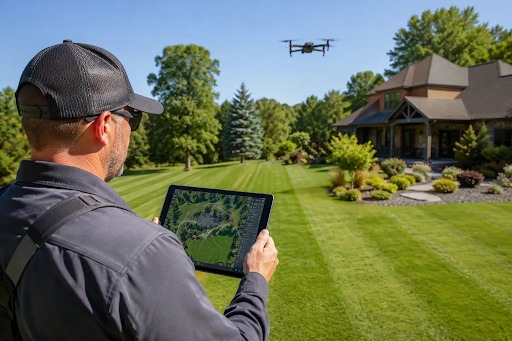
Homeowners notice the robots and the sprinklers. The bigger changes are happening on the business side, where landscaping companies use AI to run their operations. Route planning software works out the fastest way to hit twenty properties in a day, cutting fuel costs and drive time. Some crews send up drones with cameras to survey large properties, spot dry patches or pest damage from above, and plan treatment before a single boot touches the grass.
There are also apps that let a crew photograph a yard and get an instant estimate for materials and labor. Image recognition measures the square footage and identifies plant types on its own. What once needed a site visit and a notepad now takes a few taps on a phone. For small landscaping businesses, this kind of tool levels the field against larger competitors who could once afford full-time estimators and no one else could.
The quiet partnership between battery power and automation
Automation and battery technology grew up together, and that is no accident. A robotic mower cannot run on a gas engine. It needs a battery, a charging dock, and the electronics to manage both. As lithium batteries got cheaper and started lasting longer, the door opened for a whole category of cordless, automated equipment that simply was not practical before.
This shift changed what people expect from their tools. A cordless trimmer or blower that runs for an hour on a charge, stays quiet, and needs almost no maintenance is now the baseline rather than the luxury. Fewer moving parts means fewer things break. No oil changes, no spark plugs, no pull cord that refuses to start on a cold morning. The equipment just works, which is exactly what automation promised in the first place.
What it means for the rest of us
The honest truth is that most of this technology aims at convenience, not at replacing the satisfaction some people find in yard work. If you enjoy mowing your own lawn, nothing here stops you. But for the growing number of people who treat lawn care as a chore, or who physically cannot manage it anymore, these tools are genuinely useful. An older homeowner who can no longer push a mower can keep a tidy yard with a robot. A busy family can water smartly without ever thinking about it.
There are trade-offs worth naming. Smart equipment costs more upfront. It leans on apps and connectivity, which sometimes fail at the worst moment. And a robot mowing your lawn is one more device quietly collecting data about your home. These are real concerns, and anyone buying in should weigh them honestly instead of assuming newer always means better.
Where this is heading
The next few years will likely blur the line between individual smart tools and fully connected outdoor systems. Picture a yard where the irrigation talks to the mower, the mower reports turf health to an app, and the app orders the right fertilizer before you run out. Pieces of that already exist. Stitching them together is mostly a matter of time and software.
For now, the transformation stays quiet. There was no single moment when lawn care went high tech. It happened one battery, one sensor, and one small robot at a time. The Saturday morning ritual is not dead, but it is optional in a way it never was before. And for a lot of people, that quiet shift is exactly the kind of progress worth having.
READ ALSO: 10 Ton Bridge Crane for Sale Factory Direct Price & Fast Delivery
Leave a Reply