
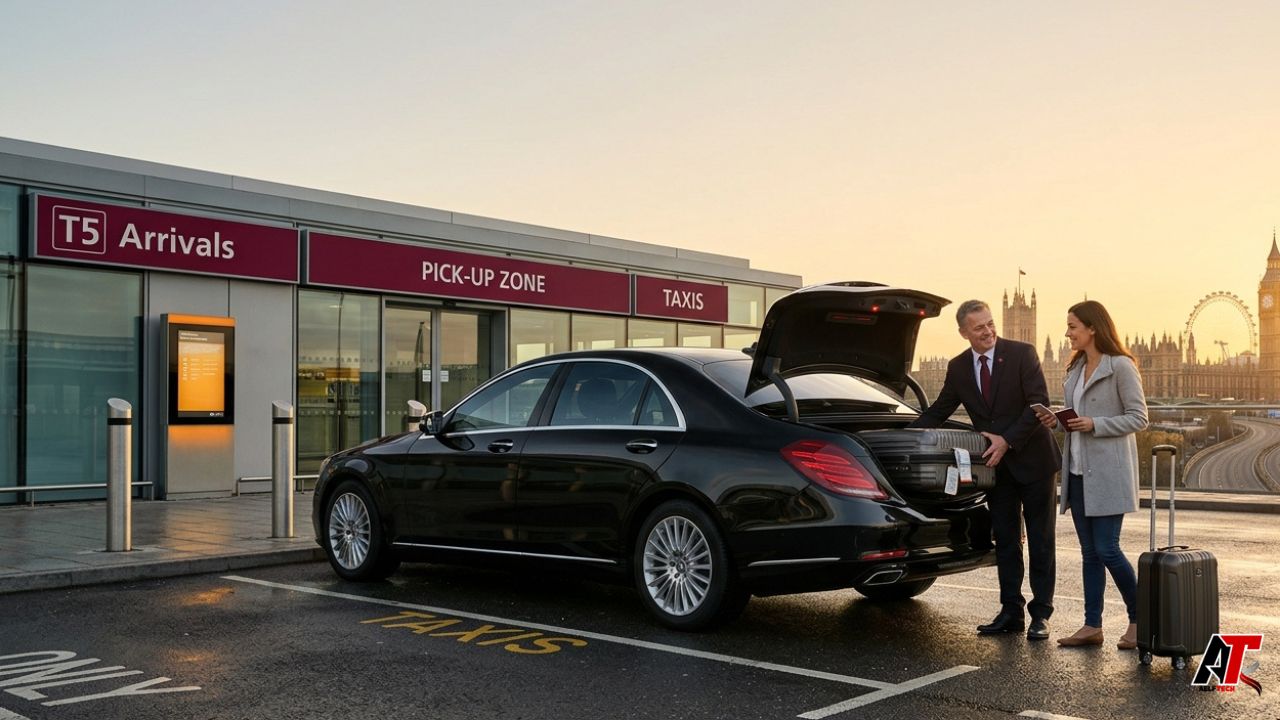
Landing at Heathrow can feel like the final step of a long journey, but you still have to reach your hotel, apartment, office, or home in London. Heathrow is exceptionally well connected by rail, Underground, coach, and road. Yet the easiest option is not always the one with the shortest advertised travel time or the lowest ticket price. For many passengers, the easiest option is the one that removes decisions, transfers, stairs, luggage handling, and uncertainty.
That is why a pre-booked London Heathrow Airport taxi can be such a practical choice. A driver collects you at the airport and takes you directly to your final address. There is no need to study a rail map after an overnight flight, change trains with heavy bags, or work out how to travel from Paddington to a hotel on the other side of the city.
This guide explains where a taxi genuinely makes travel easier, how it compares with Heathrow Express, the Elizabeth line, and the Piccadilly line, and what you should check before booking. It also keeps the comparison honest: a taxi is not automatically the cheapest or fastest option for every passenger, but it is often the simplest door-to-door solution.
The Quick Answer: Is a Taxi Really the Easiest Option?
For passengers carrying luggage, travelling with children, arriving late, visiting London for the first time, managing limited mobility, or sharing the journey with a group, the answer is often yes. The taxi handles the complete trip between the terminal and the exact destination. Public transport usually handles only the main part of the route, leaving you to complete one or more transfers, walks, or short taxi rides.
Heathrow’s official travel information shows that Heathrow Express can reach Paddington in about 15 minutes, the Elizabeth line can reach central London in under 45 minutes, and the Piccadilly line generally reaches central London in under an hour. Those are strong alternatives. However, station-to-station time is not the same as total door-to-door time. Your hotel may be nowhere near Paddington, and the final part of the trip can add walking, waiting, and another fare.
1. A Taxi Takes You to the Exact Door
The clearest advantage is direct travel. Central London is a broad area rather than one single destination. Westminster, Kensington, Soho, Bloomsbury, the City, South Bank, Canary Wharf, and King’s Cross all require different onward routes from major rail terminals.
A train may deliver you quickly to Paddington or another central station, but it does not necessarily deliver you close to your accommodation. You might still need the Tube, a bus, a taxi, or a walk over uneven pavements. With a taxi, your destination is the postcode you provide. That matters when your hotel entrance is on a side street, your rental apartment has a specific check-in point, or your meeting is at an office rather than a landmark.
2. You Avoid Transfers, Stairs, and Station Navigation
London’s transport network is useful, but it can be demanding when you are tired or unfamiliar with it. A route that appears simple online may involve long station corridors, lifts that are temporarily unavailable, escalators, crowded platforms, and a walk between lines. Even step-free routes can require more time than expected.
A taxi removes most of that mental and physical effort. Once you meet the driver, the route planning is no longer your task. You can sit down, secure your belongings, and recover from the flight while the driver deals with traffic and navigation. For first-time visitors, this can make the arrival feel controlled rather than chaotic.
3. Luggage Stays With You From Terminal to Destination
Airport luggage changes the travel calculation. A small backpack is easy to take onto a train. Two large suitcases, a cabin bag, a pushchair, sports equipment, or several family bags are different. On public transport, every transfer means lifting, rolling, watching, and repositioning those items.
In a suitable taxi or private-hire vehicle, luggage goes into the boot once and comes out at the destination. You do not have to keep a suitcase stable on a moving train, carry it through a ticket barrier, or make space in a crowded carriage. When booking, state the number and approximate size of bags honestly so the operator can provide a saloon, estate car, MPV, or larger vehicle that actually fits your group.
4. It Is Often the Most Comfortable Choice After a Long Flight
Comfort can be easy to dismiss until you have spent eight or ten hours on an aircraft. A private vehicle gives you a seat, personal space, climate control, and a quieter environment. You can check messages, speak with family, or simply rest without monitoring stops and announcements.
5. Families and Groups Can Travel Together
Public transport fares are usually attractive for one person, but a taxi becomes more competitive when several passengers share the vehicle cost. More importantly, the group remains together. Nobody has to rush through a closing train door, find space in a different carriage, or wait while one person carries a pushchair up a staircase.
Families should ask about child seats while booking rather than assume one will be available. UK law contains limited exceptions for children travelling in taxis and private-hire vehicles, but an appropriate child restraint is still the safer arrangement. Reserve the correct seat in advance or confirm whether the operator allows you to use your own.
6. Pre-Booking Helps With Late, Early, or Delayed Flights
Heathrow operates around international schedules, while not every public transport service runs at the same frequency throughout the night. The Piccadilly line’s normal operating window is generally around 5:00 a.m. to 11:30 p.m., with Night Tube service on Friday and Saturday nights that does not serve every terminal. Engineering works and service disruption can also affect a planned route.
A reputable airport-transfer booking can be arranged for an early departure or late arrival. Many operators request the flight number so they can monitor actual landing time. However, you should still read the waiting-time policy carefully. Flight tracking does not always mean unlimited free waiting after immigration or baggage reclaim.
7. A Fixed Quote Can Make the Budget Easier to Understand
Traditional London black cabs use a meter, and the final fare can rise when traffic is slow. Transport for London lists a broad typical range for journeys between Heathrow and central London, reflecting differences in traffic, time, and exact destination. A licensed pre-booked private-hire operator may instead provide a fixed quote before travel.
Fixed pricing is useful only when you confirm what the quote includes. Ask whether airport parking, terminal pickup, waiting time, congestion-related charges, a larger vehicle, child seats, and additional stops are included. Save the confirmation email or message. The cheapest headline number is not necessarily the lowest final price if important charges are added later.
Taxi vs. Rail: What the Comparison Really Looks Like
| Option | Main time | Typical cost | Best for | Main limitation |
| Taxi/private hire | 30–60+ min | Varies; broad TfL black-cab range | Door-to-door; luggage, families, groups | Traffic affects time and metered fare |
| Heathrow Express | About 15 min to Paddington | From £10 when booked in advance | Fast trip to Paddington | You may still need another journey to your final address |
| Elizabeth line | Under 45 min to central London | About £13.90 to Zone 1 | Good balance of price, speed, and reach | Luggage and onward walking or transfers may still be required |
| Piccadilly line | Usually under 60 min | From about £5.50 | Budget-conscious solo travellers | Slower, busier, and less comfortable with heavy luggage |
Times and fares are indicative and may change. Check live services and obtain an exact taxi quote before travelling.
When a Taxi Makes the Most Sense
- You have several bags: The reduction in lifting and transfers may justify the extra cost.
- You are travelling as a family or group: One correctly sized vehicle keeps everyone together and lets the fare be shared.
- Your destination is not close to Paddington or a direct rail stop: Door-to-door travel avoids a complicated final leg.
- You are arriving late or leaving very early: A confirmed pickup can be easier than working around reduced services.
- You have mobility or energy limitations: Fewer corridors, stairs, platforms, and pavement sections can transform the journey.
- You value predictability: A booking confirmation, planned vehicle, and defined pickup process reduce arrival-day decisions.
When Public Transport May Be Better
A taxi should not be presented as the universal winner. A solo traveller with one light bag, a destination near an Elizabeth line station, and a flexible schedule may save substantial money by using rail. Someone travelling directly to Paddington may find Heathrow Express both faster and simpler. During severe road congestion, a train can also offer a more predictable arrival time.
How to Book Safely and Avoid Airport-Transfer Problems
London private-hire vehicles must be booked in advance through a licensed operator. Transport for London says the booking confirmation should identify important details such as the vehicle registration, driver’s first name, and private-hire licence number. Never accept an unsolicited ride from someone approaching passengers in the terminal.
- Verify the operator: Use Transport for London’s taxi and private-hire search tools when possible.
- Request a written quote: Confirm the pickup terminal, exact destination, date, time, passenger count, and luggage.
- Check the meeting instructions: Know whether the driver will wait in arrivals, at a designated point, or in a car park.
- Read the delay and waiting policy: Ask when free waiting begins and what happens after it ends.
- Match the vehicle and driver: Before entering, compare the registration and driver details with your confirmation.
- Keep a contact number: Airport Wi-Fi and mobile roaming can fail, so save the number before flying.
A service such as LondonAirport-Taxi allows travellers to review airport-transfer options and request a booking, but the same due diligence should apply to every provider. Read the current terms, verify licensing, obtain the complete price, and confirm the pickup method before you travel.
A Simple Booking Checklist
☐ Flight number and scheduled arrival time
☐ Correct Heathrow terminal
☐ Full London address and postcode
☐ Number of adults and children
☐ Required child-seat type
☐ Number and size of suitcases
☐ Accessible-vehicle or mobility requirements
☐ Included waiting time and parking
☐ Cancellation and amendment terms
☐ Driver and vehicle confirmation process
Frequently Asked Questions
How long does a taxi take from Heathrow to Central London?
Transport for London gives an indicative journey time of roughly 30 to 60 minutes, but roadworks, peak traffic, weather, the terminal, and the exact destination can extend the trip. Build extra time into airport departures.
Is a taxi cheaper than the Elizabeth line?
Usually not for one passenger. The Elizabeth line is generally much cheaper. A taxi may become more reasonable per person for a group, especially when the rail route would require additional fares or a final taxi.
Should I pre-book or take a black cab from the rank?
Both can be legitimate. A black cab offers immediate availability from an official rank and uses a meter. A licensed pre-booked private-hire service can provide a planned pickup and may offer a fixed quote. Choose based on price transparency, waiting time, vehicle size, and your arrival needs.
Final Verdict
A taxi is the easiest way to travel between Heathrow Airport and Central London when ease means one vehicle, one booking, minimal luggage handling, and delivery to the exact door. It is especially persuasive for families, groups, first-time visitors, passengers with several bags, and anyone arriving at an awkward hour.
Rail remains an excellent choice and may be faster or far cheaper. The right comparison is therefore not “taxi versus train” in the abstract. It is the total experience from the aircraft terminal to your actual London destination. When convenience, comfort, and reduced effort matter more than securing the lowest possible fare, a well-vetted taxi booking is difficult to beat.
For more practical digital and travel-focused guides, visit aelftech.com.
Leave a Reply