
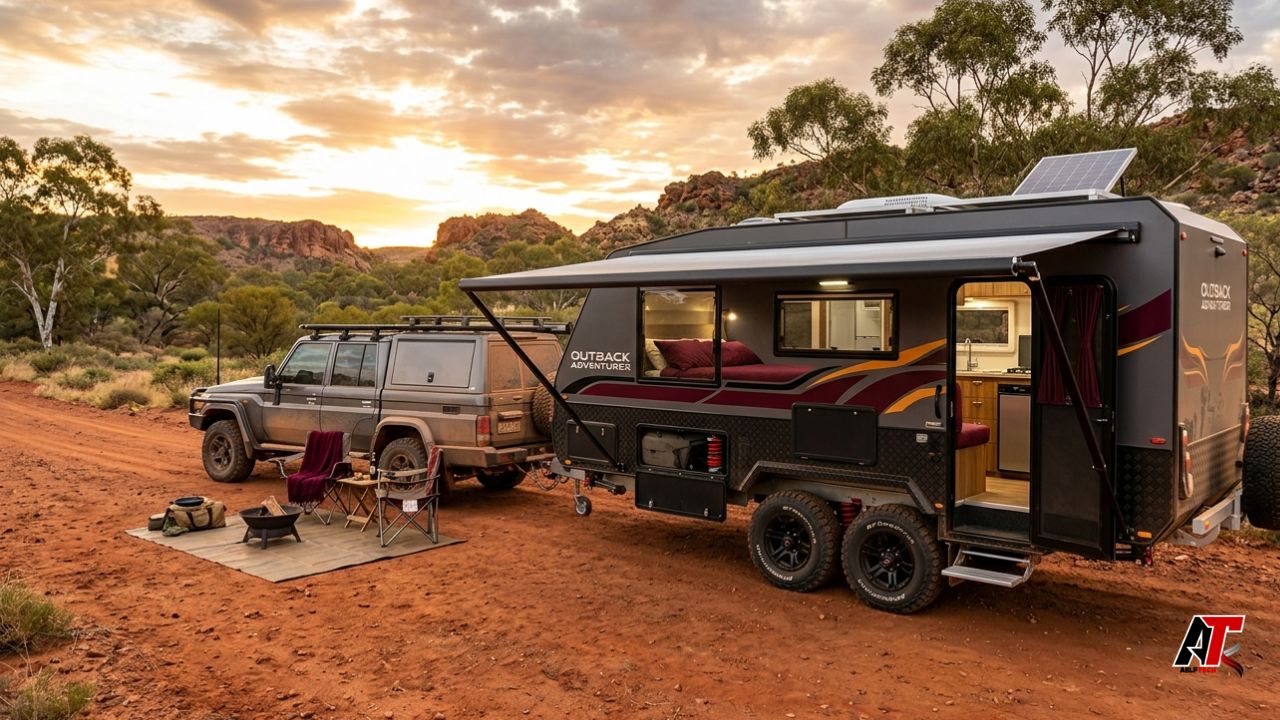
An off-road caravan is more than a holiday cabin on wheels. It must carry water, energy, food, clothing, and recovery equipment while coping with corrugations, dust, heat, long distances, and campsites far from powered facilities. At the same time, it still needs to provide a comfortable bed, practical kitchen, usable bathroom, and enough storage for everyday touring.
Atlas offers two main positions within this market. The RVO is presented as an off-road caravan, while the RVX is promoted as a full off-road caravan with a more extensive equipment package. Understanding the difference requires looking beyond decals and ground clearance. Buyers should examine the chassis, suspension, coupling, power system, water capacity, body construction, floorplan, payload, and suitability of the tow vehicle.
What Are Atlas Caravans?
The Atlas range is sold through Off Track RV in Australia and is aimed at travellers who want a combination of off-road engineering and residential comfort. The dealer currently separates the range into the RVO and RVX model lines. The RVO provides an off-road platform, while the RVX adds equipment intended for more demanding touring and longer off-grid stays. [1]
The supplied Atlas Caravans
listing is useful for viewing current stock and model information. However, specifications can change between model years, floorplans, dealer orders, and customer-selected options. A buyer should always compare the actual compliance plate, written build sheet, warranty documents, and physical caravan rather than relying only on a general model description.
RVO Versus RVX: The Basic Difference
The simplest way to understand the range is to think of the RVO as the entry point into Atlas off-road touring and the RVX as the more comprehensively equipped full off-road option. That distinction does not mean the RVO is basic or that the RVX can travel anywhere without limits. It indicates a difference in intended use, standard equipment, and the level of off-grid preparation.
The RVX specification page currently lists equipment such as a DO35 coupling, 17-inch wheels, 12-inch brakes, 3.5-tonne Cruisemaster airbag suspension, raised chassis configuration, tank protection, reverse camera, and a substantial solar and battery package. These features support rough-road travel and remote camping, but capability still depends on loading, tyre pressures, speed, route conditions, driver judgement, and maintenance. [2]
Construction and Exterior Protection
A caravan travelling on corrugated or unsealed roads experiences constant vibration and twisting loads. Atlas RVX specifications list an aluminium frame, composite aluminium walls, a one-piece fibreglass roof, honeycomb flooring, protective lower cladding, and plated tank protection. Together, these elements are intended to provide a strong body, reduce vulnerable joints, and protect components from gravel and debris. [2]
Construction quality cannot be judged from a materials list alone. Buyers should inspect sealing around windows, roof hatches, locker doors, vents, awning brackets, and plumbing penetrations. Door alignment, cabinet movement, exposed wiring, water-line support, and the finish under the chassis can reveal how carefully the caravan has been assembled. A pre-delivery inspection should include a water test and a demonstration of every appliance and system.
Chassis, Coupling, Suspension, and Brakes
Off-road capability begins underneath the caravan. The RVX page lists a 6×2 main frame, 6-inch A-frame, raised configuration, DO35 coupling, 12-inch brakes, and Cruisemaster airbag suspension. An articulating coupling allows greater movement between the tow vehicle and caravan than a conventional ball coupling, while independent or off-road-oriented suspension can improve wheel control on uneven terrain. [2]
Airbag suspension may also assist with levelling and ride-height management, depending on the system and operating instructions. It does not remove the need to slow down on corrugations or inspect components after difficult travel. Suspension arms, bushes, airbags, shock absorbers, wheel bearings, tyres, brake wiring, and fasteners remain service items. Owners should follow the manufacturer’s pressure, torque, lubrication, and inspection requirements.
How Much Off-Road Capability Do You Really Need?
The term “off-road” can describe very different conditions. One buyer may only travel on maintained gravel roads to national-park campsites. Another may plan long corrugated tracks, steep approaches, creek crossings, sand, or remote station roads. Before choosing a model, list the actual routes you expect to use and ask the dealer whether those conditions are consistent with the caravan’s design and warranty.
Approach angle, departure angle, ground clearance, rear overhang, track width, tyre construction, suspension travel, and protection for plumbing and tanks all influence practical capability. A long caravan may offer more living space but can be harder to place on tight tracks. A tall, heavy setup can also change stability and access. Full off-road equipment expands possibilities; it does not make a caravan indestructible or replace route planning.
Atlas Layout Options Explained
The RVX range currently shows numerous floorplans, from compact 18-foot and 19-foot configurations through 21-foot and 22-foot layouts. The model codes include alternatives such as rear-door, front-door, club-lounge, side-club, family, queen-bed, and bunk-oriented arrangements. The exact meaning and availability should be confirmed on the current floorplan drawings. [2]
Shorter layouts may be easier to tow, store, and manoeuvre, while longer models usually provide more bench space, seating, bathroom room, and storage. Couples may prefer an island bed, café dinette, or rear club lounge. Families should assess bunk access, privacy, seating capacity, clothing storage, and whether the bathroom remains usable when beds are occupied. A floorplan should be tested as a living space, not viewed only as a diagram.
How to Evaluate a Floorplan in Person
Walk through the caravan as if you were camping. Open the fridge while someone is seated. Stand in the kitchen and imagine preparing a meal. Check whether drawers collide with doors, whether the bathroom can be used comfortably, and whether two people can move past each other. Sit at the table, lie on the bed, and inspect access to overhead cupboards.
Storage position is as important as storage volume. Heavy tools and batteries placed far forward or rearward can affect ball load and stability. External lockers should suit hoses, leads, levelling equipment, chairs, and recovery gear. Internal storage should keep frequently used items accessible without requiring the bed or lounge to be dismantled.
Power and Off-Grid Electrical Capability
The RVX specification page lists 1,000 watts of solar, an 800Ah Projecta lithium battery system, a 40-amp MPPT solar regulator, and an inverter/charger. It also lists 12-volt, 240-volt, USB, entertainment, lighting, and appliance features. This is a substantial platform for travellers who want to camp away from mains power. [2]
Battery capacity alone does not guarantee unlimited power. Air conditioning, induction cooking, microwaves, hot-water systems, and other high-draw appliances can consume energy quickly. Solar output varies with weather, season, panel angle, shade, dust, and temperature. Ask for the usable battery capacity, inverter continuous rating, charging sources, alternator requirements, monitoring system, cable protection, and expected runtime for major appliances.
Water Storage, Plumbing, and Remote Camping
The listed RVX plumbing package includes two 95-litre fresh-water tanks, a 100-litre grey-water tank, an external shower, instant hot water, a water pump, and protected tanks. For remote travel, this storage can support longer stays than a small touring van, but actual duration depends on the number of travellers and how water is used. [2]
Water also adds considerable weight. Filling 190 litres adds roughly 190 kilograms before food, luggage, gas, tools, bikes, and accessories are considered. Buyers should check whether tanks can be isolated, drained, cleaned, and monitored separately. Inspect hose routing and protection, and ask how the system is winterised or maintained when the caravan is stored.
Interior Comfort and Everyday Livability
Atlas RVX specifications combine off-road equipment with residential features such as double-glazed windows, an innerspring pillow-top mattress, soft-close drawers, a compressor fridge, washing machine, convection microwave with air-fryer function, air conditioning, fans, television, audio system, premium tapware, and a one-piece fibreglass shower. [2]
A long equipment list is valuable only when the interior works for the owner. Check ventilation, mattress dimensions, kitchen preparation space, lighting, seating support, bathroom storage, and cleaning access. Travellers who cook outside may value external power and entertainment points more than a large internal kitchen. Buyers who tour in cold or hot climates should ask about insulation, window performance, heating, cooling, and energy use.
Towing Weights and Tow-Vehicle Compatibility
The towing decision should be made from measured weights, not the model name or advertised tare alone. Transport for NSW advises caravan owners to identify ATM, GTM, tow capacity, tow-ball weight, and gross combination mass, and to weigh both the caravan and towing vehicle. Water, gas, dealer accessories, tools, food, passengers, and personal gear all use available payload. [3]
Ball load also forms part of the tow vehicle’s payload. A vehicle may have a high maximum towing rating yet exceed its gross vehicle mass or rear-axle limit once passengers, cargo, accessories, and ball load are included. Before purchase, request the expected finished tare and ball weight for the exact build. After loading for travel, use suitable scales or a weighbridge and compare every result with the compliance plates and vehicle limits.
Safety and Preparation Before Remote Travel
A well-equipped caravan still needs preparation. Test brakes, lights, breakaway equipment, reversing camera, water pumps, charging systems, gas appliances, and alarms before departure. Inspect tyre age and condition, wheel-nut torque, suspension fasteners, hoses, wiring, and underbody protection. Carry equipment suitable for the route, which may include tyre repair tools, a compressor, spare fuses, recovery boards, water, communications, and first-aid supplies.
The Western Australian Safe Towing Guide emphasises correct loading, suitable coupling, safety chains, brakes, tyres, mirrors, and driving techniques. Speed should be reduced for wind, gravel, corrugations, descents, and limited visibility. Route conditions can change after rain, flooding, grading, or heavy traffic, so local advice remains important. [4]
What to Check Before Buying an Atlas Caravan
Begin with the intended use. Decide how many people will travel, how long you want to camp without services, and which roads you genuinely plan to use. Then compare the RVO and RVX on suspension, power, water, body protection, layout, payload, warranty, and price rather than assuming the highest specification is automatically the best choice.
Inspect the exact caravan and request a detailed written list of standard features, options, exclusions, model-year changes, and delivery weight. Confirm appliance warranties, servicing locations, roadside support, spare-parts access, and the conditions that apply to off-road use. Ask for demonstrations of the electrical display, airbag controls, water tank selectors, hot water, awning, heating or cooling, and all external connections.
Who Is an Atlas Caravan Best Suited To?
An Atlas caravan may suit couples and families who want a comfortable Australian-built-style touring environment with stronger off-road and off-grid features than a conventional highway caravan. The RVO may appeal to buyers who need off-road capability without the full RVX equipment package. The RVX is more likely to attract travellers planning extended remote stays and wanting higher-capacity electrical, water, suspension, and protection features.
The right choice is not determined by the longest floorplan or the largest battery. A compact layout with sufficient payload may be better for difficult access and frequent movement. A larger van may suit long stays and family travel but require a more capable tow vehicle and more careful route planning. Matching the caravan to the traveller is more important than buying features that will rarely be used.
Conclusion
Atlas caravans combine off-road construction, multiple layouts, off-grid systems, and comfortable interiors. The RVO and RVX give buyers different entry points, while the RVX specification demonstrates how suspension, coupling, solar, lithium storage, water capacity, composite construction, and protective equipment can be brought together for remote touring.
The final decision should be based on the exact build, loaded weight, tow-vehicle limits, preferred floorplan, travel conditions, and warranty. Inspect the caravan in person, request current specifications, weigh the complete setup, and learn how every system operates before heading away. For more practical guides covering technology, travel equipment, and purchasing decisions, readers can visit aelftech.com.
Leave a Reply