
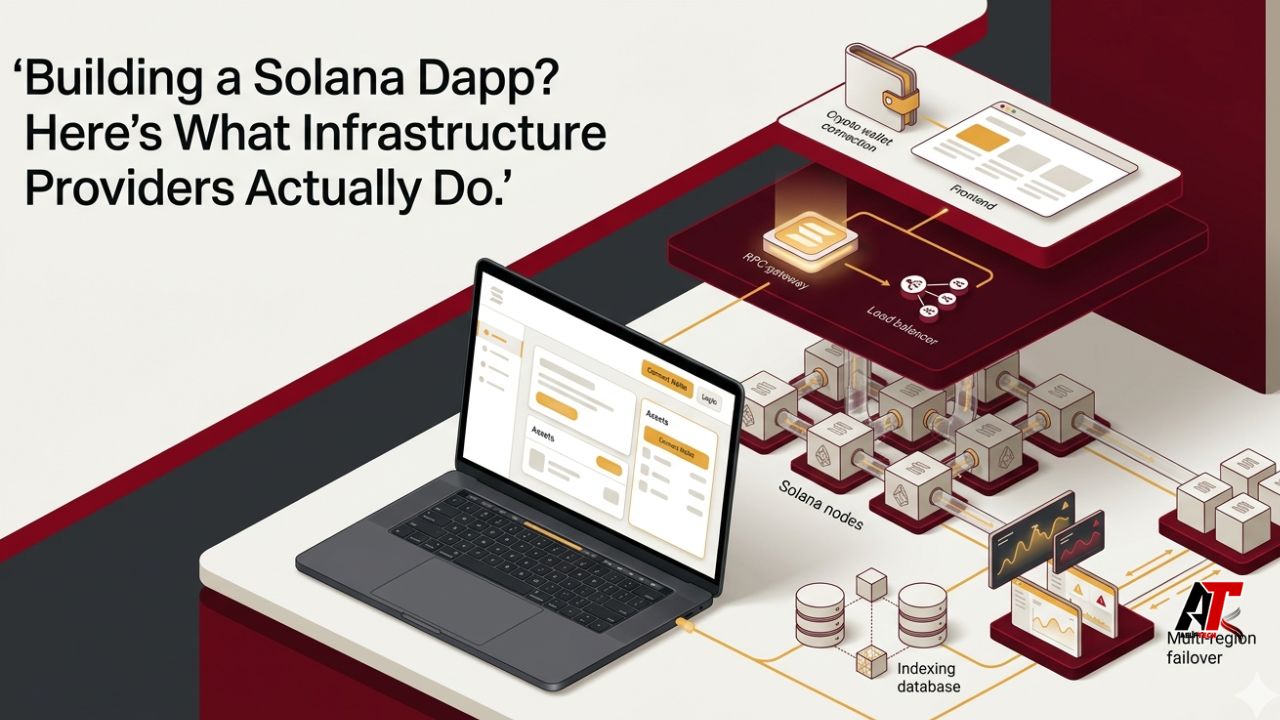
A Solana decentralized application can feel simple to a user: connect a wallet, load account data, sign a transaction, and wait for confirmation. Behind that interface, however, the app must communicate with the network continuously. It needs fresh state, a reliable way to submit transactions, live updates, historical records, and protection from traffic spikes. Solana infrastructure providers supply this operating layer.
They do not replace your program code or control user wallets. Instead, they run the nodes, APIs, data services, monitoring, and routing systems that connect your product to Solana. The distinction matters because Solana’s official documentation says public RPC endpoints are shared, rate-limited, lack a service-level agreement, and are not intended for production applications. A prototype can work on a free endpoint while a real launch fails under normal customer demand.
What a Solana Infrastructure Provider Is
The basic service is a private RPC endpoint: an authenticated URL used to read network state, simulate transactions, fetch a recent blockhash, send signed transactions, and check confirmation. Stronger platforms add WebSocket or gRPC streams, historical databases, parsed transaction APIs, webhooks, load balancing, analytics, security controls, and multi-region failover.
Think of the provider as the network operations layer between your code and the blockchain. Your application still decides what to request, and the wallet still signs. The provider makes those interactions faster, more available, easier to observe, and practical at production scale.
1. Reliable RPC Access
Every dapp workflow depends on RPC. A wallet reads balances and token accounts. A marketplace fetches program-owned accounts. A payment product obtains a blockhash, submits a transaction, and checks its signature. Public endpoints are useful for development, but official Solana guidance recommends private or dedicated RPC for production traffic. Shared endpoints can return rate-limit errors or block high-volume traffic without a service guarantee.
A managed provider offers authenticated capacity, documented quotas, regional endpoints, support, and often an uptime target. This is user-experience infrastructure: when account data loads slowly or confirmations appear stuck, customers usually blame the dapp, not the RPC server.
2. Fresh Reads and Correct Commitment
Solana requests can use processed, confirmed, or finalized commitment. These levels balance speed against confidence that state will not be rolled back. A live trading interface may favor recent data, while accounting or settlement may wait for stronger confirmation. Your code chooses the level, but the provider’s node health, slot freshness, caching, and geographic routing determine how quickly that state reaches users.
Good providers also help identify expensive methods and inefficient request patterns. Batching, caching, and subscriptions can reduce both latency and cost. The goal is not unlimited calls; it is fewer, better-designed calls to healthy infrastructure.
3. Transaction Delivery and Confirmation
A production dapp must do more than read data. It must deliver signed transactions and report the result clearly. Solana transactions contain instructions, signatures, and a recent blockhash. Official documentation states that a recent blockhash is valid for 150 slots, so the app has a limited window to land the transaction.
Providers supply methods for blockhash retrieval, simulation, submission, and signature monitoring. Some add priority-fee estimates, multiple submission paths, retry controls, or landing diagnostics. These features are valuable during congestion, when stale blockhashes, poorly chosen fees, or slow routes can produce failed or expired attempts. The provider cannot fix invalid program logic, but it can reduce delivery-related uncertainty and make failures easier to diagnose.
4. Real-Time Streams Instead of Polling
Solana supports WebSocket subscriptions for accounts, programs, logs, signatures, slots, and blocks. Subscriptions let the network push updates rather than forcing your backend to ask the same question repeatedly. This improves responsiveness and reduces needless traffic.
For heavier systems, providers may expose Geyser-based streams such as Yellowstone gRPC. Solana’s indexing guidance describes Geyser as a validator plugin interface for streaming account and transaction data directly from validators. Providers make these streams usable by handling authentication, filters, regional endpoints, reconnect behavior, throughput, and operational support. Your team still needs idempotent consumers and correct decoding, but it avoids operating the streaming stack from scratch.
5. Indexing and Parsed Data
Raw on-chain data is designed for efficient execution, not for a product dashboard. Instructions can be encoded, accounts may be referenced by index, and one transaction can contain several inner instructions and balance changes. Turning that into a swap, payment, mint, sale, or failed transfer requires parsing and context.
Solana’s official indexing guide notes that standard RPC has limits at scale: query caps, no persistent analytics, polling overhead, and data that may be too coarse for instruction-level business logic. Providers address this through indexers, historical databases, parsed transaction APIs, token endpoints, and webhooks. Teams can use the market overview at https://rpcfast.com/blog/solana-infrastructure-providers as a starting point, then verify every feature and service commitment directly with shortlisted vendors.
6. Scaling, Limits, and Traffic Spikes
A mint, market move, game event, or viral launch can multiply traffic in minutes. Providers use load balancing, autoscaling, capacity planning, and admission controls to protect service quality. Clear rate limits are not automatically a weakness; they prevent one bug or customer from exhausting shared capacity. What matters is whether limits, overages, burst behavior, and upgrade paths are transparent.
Shared managed RPC is often enough for an early product. Dedicated nodes or clusters can provide more predictable capacity and isolation for high-volume or latency-sensitive workloads. The correct choice depends on request patterns, peak load, streaming needs, and business risk—not simply on buying the most expensive tier.
7. Uptime, Failover, and Observability
One endpoint creates one operational dependency. Solana’s production-readiness documentation recommends multiple RPC providers because any network service can suffer downtime or degraded performance. Mature providers monitor synchronization, latency, errors, connections, stream health, and transaction outcomes, then expose status pages, logs, dashboards, alerts, or service-level agreements.
Your architecture should still include timeouts, health checks, circuit breakers, and tested failover. Some teams separate workloads: one provider for ordinary reads, another for transaction submission, and an independent stream for critical events. Redundancy is useful only when the application can detect degradation and switch safely.
8. Security and Access Controls
RPC URLs and API keys should be treated as credentials. Providers may offer key rotation, IP or domain allowlists, scoped permissions, usage controls, private networking, and audit logs. Avoid exposing unrestricted paid keys in public client code when misuse could create cost or availability problems.
A provider should not need user private keys; wallet signing remains in the wallet or a separately designed signing system. Vendor review should also cover data handling: what request metadata is logged, how long it is retained, where systems run, who can access it, and how incidents are reported.
9. Managed DevOps, Not Magical Reliability
Operating a production Solana node requires capable hardware, software upgrades, storage management, synchronization monitoring, plugin maintenance, security, and on-call recovery. A managed provider converts much of that work into a service, allowing engineers to focus on product features.
It does not remove application responsibility. Your dapp still needs caching, sensible retries, clear error messages, idempotent event processing, and fallback behavior. As team aelftech.com can explain in technical publishing, reliable products come from capable infrastructure combined with disciplined architecture—not from an API key alone.
Shared, Dedicated, or Self-Hosted?
A shared endpoint is the fastest and least expensive way to launch. It suits many frontends, wallets, and moderate-volume backends, although quotas and capacity are shared by plan. Dedicated infrastructure gives one customer predictable resources, custom plugins, selected regions, and stronger isolation, but costs more.
Self-hosting provides maximum control over software, data, and tuning while making your team responsible for upgrades, security, redundancy, and incidents. Mature organizations sometimes combine approaches: self-host critical systems, use a managed provider for backup or additional regions, and purchase specialized APIs instead of rebuilding every data product.
How to Choose a Provider
Begin with your workload. Record the RPC methods you use, expected and peak requests per second, user locations, concurrent subscriptions, historical-data needs, transaction volume, and required confirmation speed. Then compare reliability, latency, quotas, streaming, indexing, security, support, and portability.
Run a realistic pilot rather than relying on a homepage benchmark. Replay representative reads, open the expected number of subscriptions, submit test transactions, and measure p50, p95, and p99 latency. Test rate-limit responses and simulate an outage. Ask for sample logs, status history, retention policies, and written service commitments.
Compare total cost, not only monthly price. A cheap endpoint becomes expensive if poor data APIs require months of engineering or if every screen generates many uncached requests. A higher-priced service may reduce development time, incident risk, and request volume.
- Reliability: request the uptime target, incident history, and failover design.
- Performance: test p95 and p99 latency, slot freshness, and regional routing.
- Capacity: confirm request, response-size, WebSocket, and streaming limits.
- Transactions: evaluate priority-fee data, submission routes, and diagnostics.
- Data: inspect historical coverage, parsed payloads, webhooks, and retention.
- Security: review key controls, logging, private networking, and data policies.
- Support: confirm production response times and escalation procedures.
- Portability: prefer standard RPC compatibility and exportable data.
Practical Plan by Stage
During local development, use a local validator or Devnet. At public beta, add a private RPC endpoint, separate API keys, basic monitoring, and realistic limits. Before Mainnet production, configure a fallback endpoint, handle blockhash expiration, reconnect subscriptions, and alert on latency and errors.
As usage grows, move repeated historical queries into an indexer, use streams for time-sensitive events, and separate heavy reads from transaction submission when useful. Benchmark dedicated capacity only when the workload justifies it. This staged approach avoids both fragile launches and unnecessary enterprise complexity.
Common Mistakes
Common mistakes include launching on public Mainnet RPC, relying on one provider, polling for every update, exposing unrestricted keys, ignoring commitment, retrying expired transactions without a fresh blockhash, and buying capacity before measuring usage. Another mistake is assuming parsed APIs understand every custom program; complex instructions may still require your own decoder.
Do not choose solely from a ranking. Performance varies by region, method, workload, and time. A provider built for high-frequency trading may be unnecessary for a community app, while a convenient multi-chain platform may lack the Solana-specific stream or indexer a data product needs.
Conclusion
Solana infrastructure providers make the network usable as a dependable production dependency. They operate RPC access, transaction delivery, live streams, indexing, parsing, scaling, monitoring, security controls, and failover so your team can build the actual product.
You need one when real users, revenue, or time-sensitive workflows depend on predictable performance rather than best-effort access. Choose with your own benchmarks, clear contract terms, and a tested fallback design. When infrastructure matches the workload, users experience the speed and responsiveness your Solana dapp was built to deliver.
Leave a Reply