
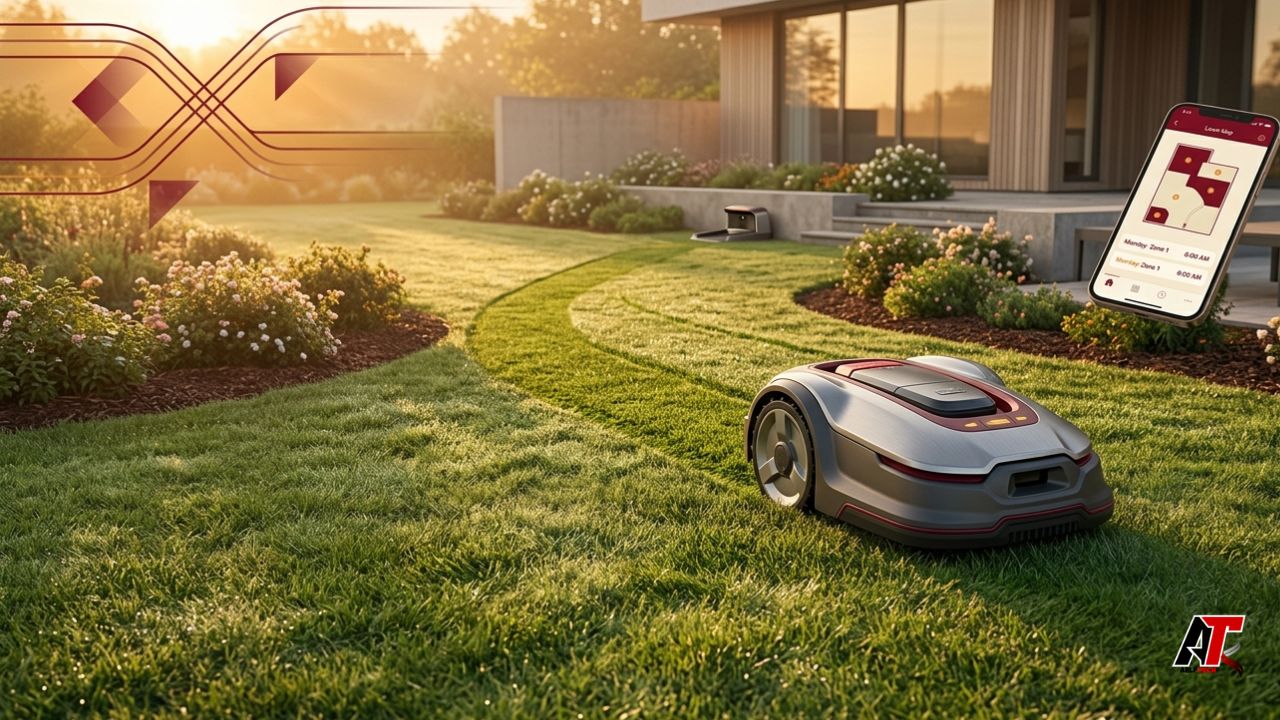
Routine mowing traditionally demands time, physical effort, equipment preparation, and constant attention. Robotic mowers change that pattern by turning grass cutting into a scheduled background task. Once installed and configured, a suitable system can leave its charging station, maintain a defined area, return to recharge, and repeat the cycle with limited daily supervision.
Lawn care does not become completely hands-free. Homeowners still need to choose the right machine, prepare the yard, set the cutting height, remove hazards, inspect blades, manage edges, and respond to seasonal growth. Automation mainly removes the repetitive job of pushing or riding a mower across the same ground each week.
What Is a Robotic Lawn Mower?
A robotic lawn mower is a compact, battery-powered machine designed to cut grass autonomously inside an approved mowing area. It uses a combination of mapping, positioning, boundary detection, cameras, collision sensors, lift sensors, software, and programmed schedules. The exact navigation method depends on the model. Traditional units may follow a buried or surface-mounted boundary wire, while newer wire-free systems can use real-time kinematic positioning, satellite signals, vision, or multiple sensor types.
The mower normally cuts small amounts of grass during frequent sessions instead of removing a large volume in one weekly pass. Fine clippings fall back into the turf, where they can decompose rather than filling a collection bag. When battery power falls, the machine returns to its dock and resumes work later according to its programming.
How Robotic Mowers Automate the Mowing Cycle
1. Lawn Mapping and Boundary Control
Automation begins by defining where the mower may travel. A wired model uses a low-voltage cable around the perimeter, beds, and restricted spaces. A wire-free model may let the user map virtual zones, pathways, and no-go areas in an app. Wireless layouts are easier to change, but performance may depend on sky visibility, reference-station placement, or clear camera views.
2. Scheduled, Frequent Cutting
Instead of waiting for the lawn to become noticeably tall, robotic mowers can operate several times per week. Frequent trimming helps them process only the tips of grass blades, which reduces the volume of clippings and makes each pass less demanding. A homeowner can normally adjust days, times, zone priorities, and cutting height through onboard controls or an app. Scheduling should still reflect grass growth, weather, local watering restrictions, and the need to keep people and pets away from the active mowing area.
3. Obstacle Detection and Route Adjustment
Sensors help the mower recognize contact, lifting, tilting, and nearby objects. Advanced products may combine cameras with artificial intelligence to identify toys, trees, outdoor furniture, landscaping features, and other obstacles. These systems reduce routine intervention, but they are not a substitute for yard preparation. Small cords, low toys, fallen branches, shallow holes, exposed roots, and wildlife can still create problems, so the lawn should be inspected regularly.
4. Automatic Charging and Resumption
A major advantage is automatic energy management. The mower monitors its battery, navigates to the dock when necessary, charges, and later continues the schedule. The charging station needs a stable, level, well-drained position with suitable electrical access. Keeping the approach clear is essential because blocked docking routes can interrupt the entire maintenance cycle.
5. App-Based Monitoring and Adjustments
Connected models let owners review status, change schedules, create zones, receive alerts, and sometimes track location. These controls help with large properties or irregular routines. Buyers should confirm whether features rely on Bluetooth, Wi-Fi, cellular service, subscriptions, or several technologies.
Why Frequent Robotic Mowing Can Support Lawn Quality
Good mowing is not simply about making grass shorter. Cutting frequency, height, blade condition, and the amount removed at one time influence turf health. University turf guidance commonly recommends avoiding the removal of more than roughly one-third of existing grass growth in a single mowing. Frequent robotic cutting can make that principle easier to follow because the machine removes a small amount during each session rather than taking off several inches after delayed maintenance.
Fine clippings can also return nutrients to the lawn. They normally break down quickly when mowing is frequent and the turf is dry enough to prevent clumping. Robotic mowing does not eliminate fertilization, irrigation, aeration, overseeding, disease management, or soil testing, but it can create a more consistent mowing routine that supports the wider lawn-care plan.
Benefits Beyond Saving Time
- More predictable maintenance: A schedule reduces the risk that mowing will be postponed during busy weeks.
- Less physical labor: Owners do not have to push, steer, or repeatedly transport a conventional mower for routine cutting.
- Quiet operation: Battery-powered robotic models generally operate more quietly than many gasoline mowers, although sound levels differ by product.
- No routine clipping collection: Frequent micro-cutting can leave fine material in the turf instead of producing bags of clippings.
- Flexible zone control: Suitable systems can prioritize front lawns, side yards, pathways, and separate mowing areas.
- Data and alerts: Apps can provide operating status, error notifications, location features, and schedule control.
- Reduced direct mowing emissions: Electric robotic mowers do not produce tailpipe exhaust while cutting, though their overall environmental impact still depends on electricity generation, battery production, durability, and disposal.
Where Robotic Mowers Still Need Human Help
Automation works best when expectations are realistic. Most robotic units maintain open turf; they do not complete every landscaping task. Narrow strips, steep banks, deeply rutted ground, steps, gravel crossings, low branches, decorative borders, and disconnected lawn sections may need special planning. Grass beside walls, fences, raised edging, and garden beds may still require a string trimmer or manual edging tool.
Owners also need to clean the deck, inspect wheels, replace or rotate small blades, confirm that safety functions work, update software, repair damaged boundary wire where applicable, and store or protect equipment during unsuitable seasons. Wet, muddy, frozen, drought-stressed, or exceptionally overgrown turf may require the schedule to be paused.
Safety Practices That Should Not Be Automated Away
A robotic mower is still a cutting machine. Sensors and protected blade designs improve control, but responsible operation remains essential. Children and pets should be kept out of the mowing area while the machine is running. The lawn should be cleared of stones, wire, tools, hoses, toys, and other objects that could damage the mower or be struck by its blades. Users should stop the machine, activate its safety or lockout control, and follow the manufacturer’s instructions before lifting, cleaning, inspecting, or replacing blades.
Night operation deserves particular caution because small wildlife may be harder for any system to detect. Scheduling during daylight, visually checking the yard, and using appropriate no-go zones can reduce risk. Owners should also register the product, monitor safety notices or recalls, and use only compatible batteries, chargers, blades, and replacement parts.
How to Choose the Right System for Your Lawn
The best machine is not necessarily the one with the longest feature list. It is the one whose capacity, navigation method, cutting range, slope rating, and support network match the property. Before comparing models, measure the actual mowable area rather than the total lot size. Then document slopes, narrow passages, trees, walls, water features, separate lawn sections, heavy shade, and weak connectivity.
- Area capacity: Leave a reasonable performance margin instead of choosing a model at the absolute limit of its advertised coverage.
- Navigation type: Decide whether a boundary wire, virtual boundary, RTK reference station, camera-based system, or hybrid approach fits the yard.
- Cutting-height range: Match the mower to the turf species and recommended seasonal height in your region.
- Slope capability: Check the maximum operating slope and the lower limits that may apply near boundaries or the charging dock.
- Passage width: Confirm the mower can enter side yards and move between zones without repeated trapping.
- Weather protection: Review water-resistance ratings, rain behavior, frost settings, cleaning instructions, and storage requirements.
- Safety and security: Look for lift and tilt shutoff, obstacle sensing, a visible stop control, PIN protection, alarms, and location tracking where needed.
- Ongoing costs: Consider blades, boundary-wire repairs, accessories, battery replacement, cellular subscriptions, installation, and professional service.
- Parts and support: Confirm that manuals, replacement parts, warranty service, and technical support are realistically accessible.
Homeowners comparing a robotic mower should read the specifications for each individual model instead of assuming that every unit uses the same navigation, coverage, connectivity, or obstacle-detection technology. Current Greenworks options, for example, include wire-free RTKVision models as well as earlier boundary-wire designs, illustrating how quickly the category is evolving.
A Practical Setup Plan
- Survey the lawn. Measure turf area and record slopes, obstacles, passages, drainage problems, and disconnected zones.
- Improve the surface. Fill dangerous holes, stabilize loose edging, prune very low branches, and remove recurring debris.
- Choose the dock location. Provide level ground, drainage, power, the required clear approach, and the connectivity specified by the manufacturer.
- Create boundaries and zones. Install wire carefully or map virtual boundaries, pathways, and no-go areas according to the manual.
- Start with conservative settings. Use a higher cutting position and shorter trial sessions while observing navigation and docking.
- Inspect results. Look for missed areas, wheel ruts, scalping, repeated collisions, weak signal zones, and places requiring manual edging.
- Refine the schedule. Adjust frequency and zone priority as grass growth changes through the season.
Do Robotic Mowers Reduce the Total Cost of Lawn Care?
The financial answer depends on what the machine replaces. A homeowner who currently pays for frequent mowing may value reduced service visits. Someone who already owns a reliable mower and enjoys doing the work may face a longer payback period. Initial costs can include the mower, installation, dock preparation, connectivity, accessories, and landscaping changes. Ongoing costs may include electricity, blades, repairs, subscriptions, and eventual battery replacement.
The strongest value often comes from time savings, consistency, and convenience rather than a guaranteed cash return. Buyers should compare the full ownership cost with their existing approach over several seasons. They should also consider whether the lawn is suitable enough to benefit from automation without extensive modifications.
The Future of Automated Lawn Maintenance
Robotic mowing is moving from random navigation toward deliberate mapping, camera-assisted obstacle recognition, virtual boundaries, precise positioning, and smarter zone management. These advances can improve coverage, but they also increase reliance on software, sensors, apps, signals, and data services.
Future lawn-care systems may coordinate mowing with irrigation, weather data, turf monitoring, and property-management platforms. Even then, the healthiest results will still depend on basic horticultural judgment: mowing at the correct height, protecting stressed grass, maintaining sharp blades, correcting drainage and soil problems, and adapting care to the local climate.
Frequently Asked Questions
Can a robotic mower replace a conventional mower completely?
For a compatible, established lawn, it can handle most routine cutting. A conventional mower or trimmer may still be needed for seasonal renovation, heavily overgrown grass, awkward edges, inaccessible strips, or cleanup after unusual weather.
Do robotic mowers collect grass clippings?
Most models are designed to cut frequently and leave very fine clippings in the lawn. They are not normally bagging mowers.
Can they work without a boundary wire?
Yes. Some newer machines use virtual mapping with RTK positioning, satellite navigation, cameras, or hybrid sensors. Other models still use boundary and guide wires, which can remain reliable when installed correctly.
Are robotic mowers safe around pets?
They include safety features, but pets should not share the active mowing area. Remove pets, children, toys, and feeding items before operation, and follow the specific manual.
Will a robotic mower handle leaves and branches?
It may pass over light material, but leaves can interfere with cutting and larger branches can damage blades or stop the unit. Clear the lawn before scheduled operation.
Conclusion
Robotic mowers automate the most repetitive part of lawn maintenance by combining scheduled cutting, navigation, obstacle response, self-charging, and remote controls. Their real benefit is not that they remove every lawn-care responsibility, but that they convert mowing from a recurring manual project into a supervised system.
A successful purchase begins with an honest property assessment. Homeowners should match capacity and navigation to the lawn, prepare boundaries, protect children and animals, maintain the machine, and continue proper turf care. When those conditions are met, robotic mowing can keep grass consistently trimmed while returning time to the household. For more practical technology and home-improvement content, readers can explore resources from aelftech.com.
Leave a Reply