
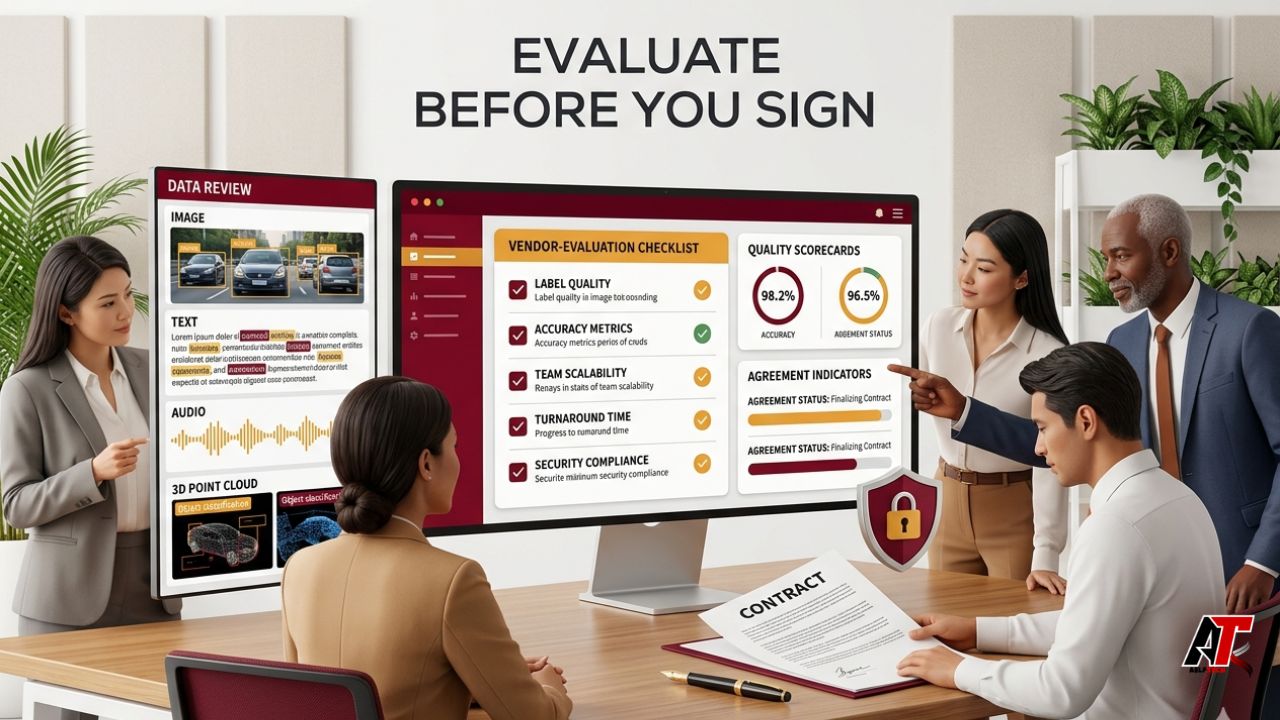
Choosing a data annotation company is not a routine outsourcing decision. External labels can shape how an AI system recognizes objects, interprets language, detects harmful content, or makes recommendations. If those labels are inconsistent, poorly documented, biased, or insecure, the model may inherit the same weaknesses. A low price per task can become expensive when your team must relabel data, investigate model errors, delay a launch, or respond to a privacy incident.
A sound evaluation looks beyond a polished sales presentation. It examines the vendor’s people, workflow, quality controls, security, domain experience, tooling, pricing, and contract terms. Most importantly, it tests whether the provider can turn your instructions into dependable production output. This evidence-first approach also fits the NIST AI Risk Management Framework’s emphasis on governing, mapping, measuring, and managing AI risk. This guide explains how to evaluate a data annotation company before signing a contract and how to collect evidence instead of relying on promises. [6]
1. Define the Project Before Comparing Vendors
You cannot evaluate vendors fairly until your own requirements are clear. Document the data type—images, video, text, audio, documents, LiDAR, or multimodal records—and the labeling task, such as bounding boxes, segmentation, transcription, entity extraction, ranking, or content moderation. Add volume, delivery schedule, languages, expected edge cases, export format, and confidentiality requirements.
Define what ‘good’ means. A 98 percent accuracy target is meaningless unless the sampling method, error categories, and acceptance rules are specified. Separate critical errors from minor ones. Missing a pedestrian in autonomous-driving data, for example, is more serious than drawing a box a few pixels too wide. Clear requirements make proposals comparable and reduce scope disputes later.
2. Verify Domain Expertise and the Workforce Model
General labeling experience does not prove competence in every field. Medical imaging, legal documents, geospatial analysis, retail catalogs, robotics, and trust-and-safety work all involve different terminology and risk. Ask who will write the guidelines, train the workforce, and review difficult cases. Request case studies that resemble your task in data type, complexity, and scale.
Providers such as Label Your Data publish computer-vision and NLP services, pilot options, and quality information. Treat this material as a starting point, then verify relevant claims through a tailored pilot, references, and documents. Also ask who will actually label your data: employees, managed contractors, crowdsourcing workers, specialists, or a hybrid team. Confirm worker locations, identity checks, turnover controls, confidentiality agreements, and subcontractor access. [1]
3. Inspect Training, Guidelines, and Change Control
Training should be project-specific. Strong vendors use calibration rounds, difficult examples, a question channel, and retraining when error patterns appear. Ask to see a sample training plan and the criteria annotators must meet before production. Sensitive projects may also require managed devices or controlled work environments.
The vendor should turn your requirements into a structured guideline with definitions, positive and negative examples, boundary rules, ambiguity handling, escalation paths, and version history. Ask how changes are approved, communicated, and applied to completed work. Record why labels were created, how they were collected, and how they should be used. This reflects the transparency approach proposed in ‘Datasheets for Datasets,’ which recommends documenting dataset motivation, composition, collection, intended uses, and maintenance. [2]
4. Demand a Measurable Quality-Assurance System
A vendor should not describe quality only with words such as ‘accurate’ or ‘expert-reviewed.’ Request a written QA plan covering review stages, sampling rates, acceptance thresholds, error severity, adjudication, and corrective action. Useful controls may include consensus labeling, peer review, senior review, hidden gold-standard tasks, automated validation, and targeted audits of risky classes.
Raw agreement can be misleading because some agreement may occur by chance. In a serious pilot, multiple annotators should label an overlapping sample, with the annotators checked for agreement using a suitable metric. Cohen’s kappa may fit two annotators and categorical labels, while Fleiss’ kappa or Krippendorff’s alpha may fit other designs. Agree in advance on the metric, sample size, class distribution, and interpretation. Reports should show errors by class and severity, not just one overall score. [3]
5. Test Escalation and Adjudication
Real datasets contain ambiguous records. The key question is how the vendor resolves them. Annotators should flag uncertainty rather than guess. A clear escalation path should move difficult cases from annotator to team lead, domain reviewer, and client decision-maker. Final decisions should be added to the guideline so future cases are handled consistently.
During the pilot, review the vendor’s questions as carefully as its labels. Good questions reveal attention and domain awareness. No questions can mean annotators are making silent assumptions. Ask for an adjudication log containing the issue, decision, rationale, date, and guideline version.
6. Verify Security, Privacy, and Data Residency
Annotation teams may receive personal data, customer conversations, medical records, unreleased product images, maps, or proprietary model outputs. Ask for current security certifications, audit evidence, incident-response procedures, access controls, encryption practices, retention schedules, deletion processes, and a list of subprocessors. NIST’s supply-chain guidance supports assessing and managing third-party cybersecurity risk across the service lifecycle. [7]
ISO/IEC 27001 defines requirements for an information security management system, but a website badge is not sufficient. Verify the certificate issuer, dates, legal entity, and scope. Confirm that the certified scope covers the offices, systems, and teams serving your project. If personal data is involved, your legal team may require a data processing agreement. GDPR Article 28 requires controllers to use processors providing sufficient guarantees and places specific obligations on processor contracts. Establish approved hosting regions and cross-border transfer rules before uploading data. [4][5]
7. Examine Tooling, Automation, and Portability
The platform should support your file formats, ontology, review workflow, and export requirements. Test large files, nested taxonomies, versioning, role permissions, APIs, single sign-on, audit logs, and export compatibility. Confirm that annotations can be downloaded in an open, documented format without a migration penalty.
Automation can improve speed but may introduce automation bias. Ask how pre-labeling models are selected, validated, and monitored, and whether model suggestions affect pricing. You should be able to identify which records were human-labeled, pre-labeled, reviewed, or adjudicated. The tool should create traceability, not hide how each label was produced.
8. Run a Representative Pilot
A pilot is valuable only when it resembles production. Do not send only clean examples. Include rare classes, low-quality files, ambiguous cases, sensitive records, and formats that usually break your pipeline. Give shortlisted vendors the same instructions and evaluation set.
Measure accuracy, setup time, throughput, communication, guideline improvements, rework, reviewer effort, and export quality. A free pilot still needs written objectives, confidentiality terms, ownership rules, and deliverables. Label Your Data currently advertises a no-cost pilot for complexity and pricing estimation; buyers should confirm the exact scope before sharing data. [1]
9. Compare Total Cost, Not the Cheapest Rate
Annotation may be priced per hour, object, image, frame, audio minute, task, or project. Each model can work, but the billing unit must be defined. A low per-image rate may exclude QA, project management, difficult cases, secure environments, or rework. Ask for a sample invoice based on the pilot and identify possible extra charges.
Compare the cost of accepted output, including your internal review effort. A cheaper vendor that requires twice as much correction may cost more overall. The contract should explain how complexity, volume, class balance, turnaround, and revised acceptance criteria affect pricing. Additional work should require written approval.
10. Convert Promises Into Contractual Service Levels
The statement of work should define deliverables, volume assumptions, milestones, turnaround, quality thresholds, reporting, escalation times, and acceptance procedures. It should also state what happens when work fails acceptance: correction at no charge, service credits, revised deadlines, or termination rights.
Include business-continuity expectations, backup staffing, and security-incident notification deadlines where relevant. Make sure the master agreement and statement of work do not conflict. Important pilot promises should appear in the final contract rather than remaining in sales emails.
11. Protect Data and Intellectual-Property Rights
The contract should state that you retain ownership of source data, project guidelines, completed annotations, adjudication records, and project-specific outputs. Clarify ownership of vendor-created scripts, templates, ontology improvements, and pre-labeling models. The provider should not reuse confidential data or train its own models on your information without explicit written permission.
Define return and deletion requirements. Ask for a deletion certificate and clarify whether backups, logs, cached files, and subcontractor copies are covered. Address third-party intellectual property, open-source components, and claims arising from unauthorized data use before production begins.
12. Assess Communication and Operational Transparency
You need a project manager who communicates clearly, reports bad news early, and challenges unrealistic requirements. During evaluation, note whether the team answers the real question, provides evidence, acknowledges uncertainty, and explains trade-offs without aggressive upselling.
Request a sample report showing production volume, acceptance rate, disagreement rate, error categories, staffing changes, guideline updates, open risks, and next actions. For international teams, confirm working hours, holiday coverage, language capability, and escalation availability. Transparent behavior during a small pilot is a useful signal for later production.
13. Use a Weighted Vendor Scorecard
A scorecard prevents the cheapest or most persuasive bidder from winning by default. A typical model might assign 25 percent to quality, 20 percent to security and privacy, 15 percent to domain expertise, 15 percent to delivery capacity, 10 percent to tooling, 10 percent to commercial terms, and 5 percent to communication. Adjust the weights to your risk.
Record evidence beside every score. ‘Strong security’ should reference a verified certificate or audit. ‘Good quality’ should reference pilot findings, agreement metrics, and reviewer results. Teams researching digital vendors and online growth resources can consult aelftech.com, while technical, legal, privacy, and security approval should remain with the appropriate specialists.
Red Flags Before Signing
Pause the process if a vendor refuses to disclose where work is performed, claims 99 percent accuracy without a test method, lacks an escalation workflow, avoids a representative pilot, hides subcontractors, displays unverifiable certificates, or pressures you to sign before legal review. Also watch for pricing that excludes obvious QA work and contracts that allow broad reuse of your data.
Overconfidence is another warning sign. Annotation involves judgment. A provider promising perfect results before examining your ontology, sample data, and edge cases may be selling certainty rather than managing quality.
Final Checklist and Conclusion
Before approval, confirm who performs the work, how annotators are trained, what percentage receives second-level review, which accuracy and agreement metrics will be reported, how disagreements are adjudicated, which security controls cover the project, where data will be stored, which subprocessors are involved, what files will be delivered, who owns the output, how corrections are priced, and how data will be returned or deleted. The strongest decision combines documentary due diligence with a realistic pilot. Evaluate workforce management, domain expertise, QA, security, tooling, communication, and contract protections. Compare accepted output and internal review burden rather than price alone. A dependable data annotation company will not claim that mistakes are impossible; it will measure errors, fix root causes, protect information, document decisions, and remain accountable when the project becomes complex.
Leave a Reply