
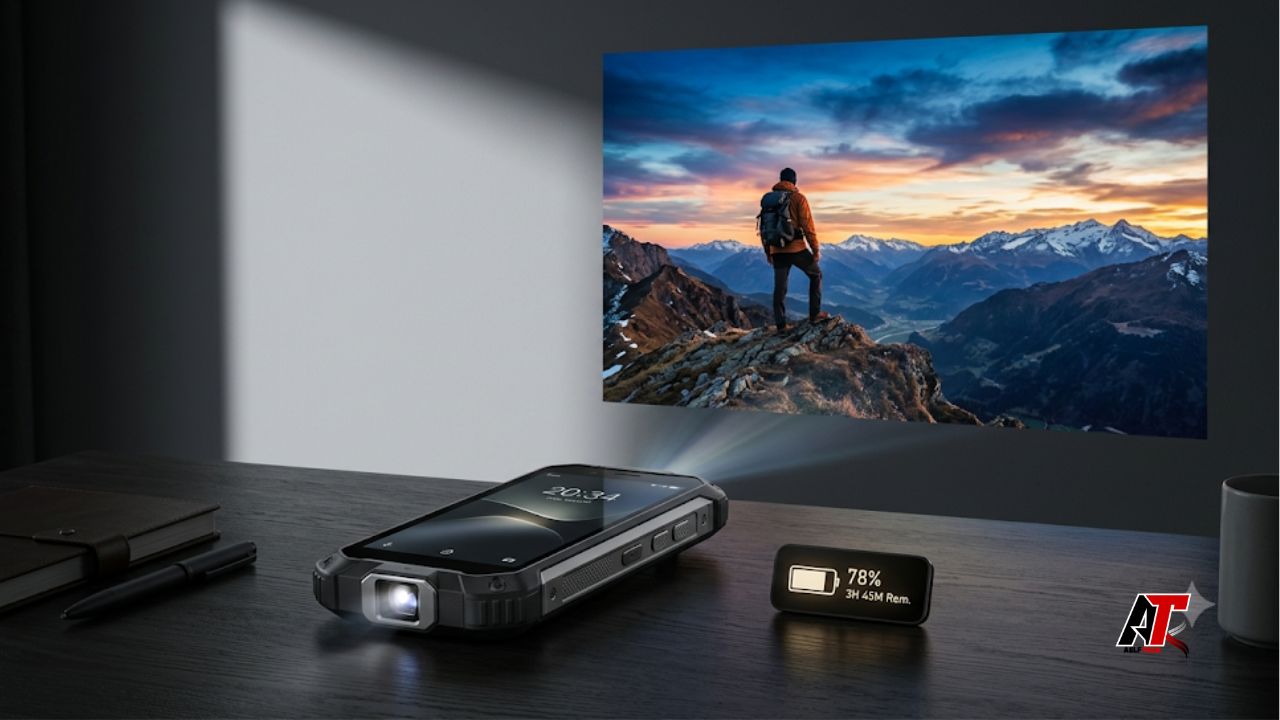
Yes, projector phones usually drain battery faster while the projector is running. That is expected because the phone is powering a light source, image-processing hardware, cooling controls, speakers, wireless connections, and sometimes the display at the same time. However, the word “fast” depends on the phone. A regular smartphone with a small battery may lose power quickly during projection, while a purpose-built projector phone with a very large battery can continue for several hours.
The practical answer is simple: projection is one of the most demanding things a phone can do, but it does not automatically make projector phones inconvenient. Battery capacity, projector brightness, content quality, network use, heat, and charging speed all affect the experience. Modern Rugged phones with built-in projectors are often designed with larger batteries specifically to handle this extra load.
Why Does a Phone Projector Use More Battery?
A normal phone screen only needs to light a surface a few inches wide. A projector must create an image that remains visible after traveling across a room and spreading over a wall or screen. That requires more light and more continuous processing. The phone also has to decode the video, scale the image, correct focus, manage keystone adjustment, and send sound through its speakers or a Bluetooth device.
When all these jobs happen together, battery demand rises. This is similar to running a demanding mobile game while using maximum screen brightness and streaming over 5G. The phone is not only displaying content; it is acting as a compact cinema, presentation device, and media player.
The Main Factors That Control Battery Drain
1. Projector Brightness
Brightness is usually the biggest factor. A brighter projected image needs more power. High-brightness mode may be useful in a meeting room or a shaded outdoor area, but it can reduce runtime compared with an eco or night mode. In a dark room, lowering brightness often gives a clear image while preserving much more battery.
2. Battery Capacity
Battery size changes the entire calculation. Many mainstream smartphones use batteries around the typical all-day range, while specialist projector phones may carry batteries several times larger. A larger battery does not make the projector more efficient by itself, but it gives the device more stored energy to support long projection sessions.
3. Video Resolution and Processing
Higher-resolution content requires more decoding and image processing. A locally stored standard-definition clip usually places less demand on the phone than a high-resolution stream with constant network activity. The projector’s supported output, the original video quality, frame rate, and software optimization can all influence consumption.
4. Wi-Fi, 5G and Bluetooth
Streaming a movie adds network use to the projector load. A weak 5G signal can be especially demanding because the phone works harder to maintain the connection. Bluetooth speakers or headphones also use some power, although the effect is normally smaller than the projector itself. Downloading content before a long session can reduce network-related drain and prevent buffering.
5. Speaker Volume
Built-in speakers must run continuously during a film or presentation. High volume increases power use and may add heat. For private viewing, wired headphones can be efficient. For a group, a separate powered speaker prevents the phone from supplying all the audio energy, although Bluetooth still creates a small wireless load.
6. Heat and Cooling
Projection creates heat, and heat affects both immediate performance and long-term battery health. If the phone becomes too warm, its software may lower brightness or performance to protect internal components. Using the device on a hard, open surface is better than placing it on a bed, sofa, or inside a tight case that traps heat.
How Long Can a Projector Phone Last?
There is no universal runtime because projector phones differ widely. On a standard-size phone battery, continuous projection may use power much faster than ordinary browsing or video playback on the phone’s display. Purpose-built devices can last longer because they combine large batteries with projection modes designed for different lighting conditions.
A useful real-world example is the Tank X. Its manufacturer lists a 17,600mAh battery, 120W charging, and up to six hours of projector use in night mode. That does not mean every user will get exactly six hours. Brightness, temperature, signal strength, audio volume, installed apps, battery age, and content source can change the result. Still, it shows why large-battery projector phones can remain practical even though projection itself is power-hungry.
How to Measure Your Own Projector Battery Life
The best estimate comes from a controlled test on your own device. Charge the phone to 100%, close unnecessary apps, choose the brightness mode you normally use, and play the same type of content for 30 minutes. Record the battery percentage before and after the test.
For a rough estimate, divide 100 by the percentage used during the test and multiply by 30 minutes. For example, if projection uses 10% in 30 minutes, the simple theoretical estimate is about five hours. Real runtime will normally be a little lower because batteries do not discharge at a perfectly fixed rate and the phone may change performance as it heats up.
Ways to Make a Projector Phone Battery Last Longer
- Use the lowest projector brightness that still produces a comfortable image.
- Project in a dark room so the phone does not need maximum brightness.
- Download movies, slides, or training videos before the session instead of streaming them.
- Turn off 5G, GPS, hotspot, NFC, and background syncing when they are not needed.
- Lower the phone screen brightness or switch off the screen if the device allows projection to continue.
- Close games, camera apps, navigation tools, and other background processes.
- Keep the phone uncovered and well ventilated to reduce heat-related throttling.
- Use the original charger and cable, especially when the phone supports high-wattage charging.
- Avoid starting a long presentation with a partially charged battery.
- Carry a compatible power bank for travel, camping, exhibitions, or fieldwork.
Can You Use a Projector Phone While Charging?
Many projector phones can project while connected to a charger, but this should be done carefully. Projection and fast charging both create heat. If the phone becomes unusually hot, reduce projector brightness, remove a thick case, improve airflow, or pause the session. Avoid charging on soft surfaces, inside direct sunlight, or in a hot vehicle.
Using an original or certified charger is important because an underpowered adapter may only slow the rate of battery loss rather than increase the charge. A suitable charger can help maintain power during a presentation, but the exact behavior depends on the device’s thermal controls and charging system.
Does Frequent Projection Damage the Battery?
Projection does not automatically damage a phone battery. The bigger concern is repeated heat exposure. Lithium-ion batteries naturally lose capacity over time, and high temperatures can speed up that aging. Long projection sessions at maximum brightness, especially while fast charging in a warm environment, may place more stress on the battery than light everyday use.
You can reduce that stress by keeping the device cool, avoiding unnecessary maximum brightness, using proper charging accessories, and allowing the phone to cool after an extended session. If projection is part of your daily work, a model designed around a large battery and strong thermal management is a better choice than relying on a small mainstream phone with an add-on projector.
Projector Phone vs Portable Projector: Which Uses Power Better?
A projector phone is convenient because one device handles communication, files, apps, streaming, and projection. It reduces cables and makes spontaneous presentations easy. A separate portable projector may offer higher brightness or a larger image, but it introduces another battery, charger, and device to carry.
The better option depends on your use. For occasional movies, small meetings, camping, training, or field demonstrations, a projector phone can be efficient because everything is integrated. For all-day events, bright rooms, or very large audiences, a dedicated projector connected to mains power may be more suitable. Readers looking for more practical technology guidance can explore aelftech.com for additional digital and technology-focused content.
Who Should Consider a Projector Phone?
Projector phones are especially useful for people who value portability more than a slim design. Sales teams can show a deck without searching for a screen. Teachers and trainers can display material in small rooms. Field workers can project plans or instructions. Campers can watch downloaded films on a tent wall. Families can create a quick viewing setup while traveling.
The trade-off is usually size and weight. A large battery, durable body, cooling system, and projector module make the phone thicker than a standard flagship. Buyers should compare projector brightness, battery capacity, charging speed, focus controls, supported resolution, speaker quality, and real-world runtime rather than judging the phone by battery size alone.
Frequently Asked Questions
Do projector phones drain battery faster than normal phones?
Yes. When projection is active, the phone powers additional light and processing hardware, so consumption is higher than normal browsing, messaging, or screen-only video playback.
Can a projector phone last through a full movie?
Many can, especially models with large batteries. Runtime depends on projector brightness, movie length, network use, volume, temperature, and battery condition.
Does lowering projector brightness save battery?
Yes. Lower brightness is one of the most effective ways to extend projection time. A darker room lets you reduce brightness without making the image difficult to see.
Is streaming worse for battery than playing downloaded video?
Usually, yes. Streaming adds Wi-Fi or mobile-data activity to the projector and video-processing load. Downloaded content removes that continuous network demand.
Should I keep the phone plugged in during a presentation?
You can when the manufacturer supports it, but monitor heat and use the correct charger. Good airflow and moderate brightness help keep temperatures under control.
Will a power bank run the projector?
A compatible power bank can extend runtime, but it must support the phone’s required charging standard and output. A weak power bank may only slow the battery drain.
Are projector phones worth buying?
They are worth considering for users who regularly present, travel, camp, train teams, or work in the field. Buyers who rarely project may prefer a slimmer phone and a separate projector when needed.
Final Verdict
So, do projector phones drain battery fast? The projector does use power quickly compared with ordinary phone tasks, but the complete answer depends on the device. A small battery, high brightness, 5G streaming, loud audio, and poor ventilation can shorten runtime. A large battery, efficient projector modes, downloaded content, moderate brightness, and fast charging can make the experience far more practical.
Before buying, look beyond the headline battery capacity. Check the manufacturer’s projected runtime, brightness modes, charging speed, heat management, and independent user feedback. For current owners, a simple 30-minute test will provide a much more realistic estimate than a generic battery claim. Used with sensible settings, a projector phone can deliver hours of useful viewing without turning every session into a race for the charger.
Leave a Reply