
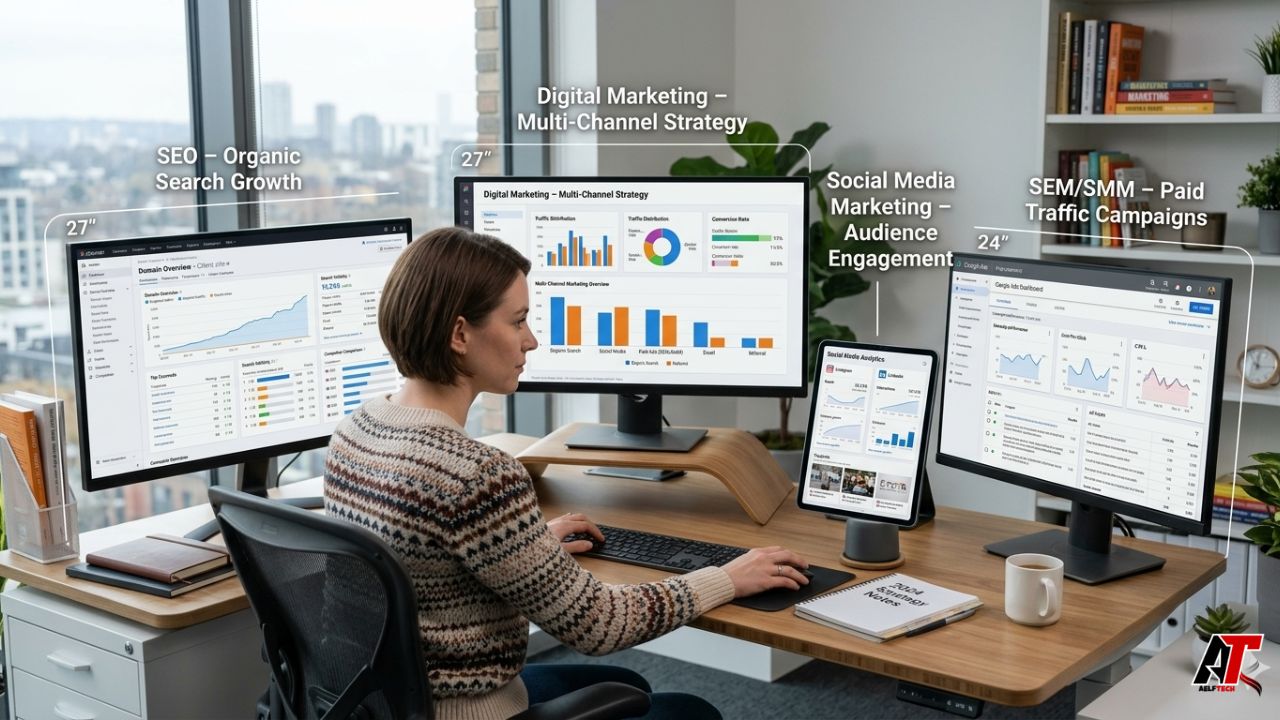
Navigating the complex world of online visibility can feel like learning a new language. Business owners and marketing managers are constantly bombarded with acronyms—SEO, SEM, SEA, PPC, SMM, and CRO. Understanding how these distinct channels interact is the foundational step toward building a profitable, scalable online presence. Rather than viewing these tactics in isolation, the most successful brands recognize that true digital growth comes from integrating them into a cohesive ecosystem. Whether you are trying to capture high-intent search traffic or build an engaged community, knowing when to deploy each strategy is critical.
SEO vs Digital Marketing: What Is the Difference?
A common point of confusion for many business leaders is deciding between seo or digital marketing. The reality is that this is not an either/or choice. Digital marketing is the broad umbrella term that encompasses all online promotional efforts, including email marketing, social media, paid advertising, and content creation. Search Engine Optimization (SEO), on the other hand, is a highly specific pillar operating beneath that umbrella.
While comprehensive digital marketing services cast a wide net across multiple platforms, SEO focuses strictly on improving your website’s organic visibility on search engines like Google and Bing. If digital marketing is the entire engine of your online business, SEO is one of its most vital, sustainable cylinders.
Digital Marketing, Online Marketing or SEO: What Covers More?
When searching for the right growth partner, you might wonder whether to look for digital marketing online marketing or seo expertise. “Digital marketing” and “online marketing” are essentially synonymous, covering everything from podcast sponsorships to banner ads. SEO is specifically focused on capturing users who are actively searching for solutions. While an online marketing campaign might interrupt a user’s scroll to show them a product, SEO ensures your brand is waiting for them the exact moment they ask a search engine for help.
SEO and Social Media Sinergy: How They Support Each Other
One of the most powerful, yet underutilized, strategies is creating an effective seo and social media sinergy. While Google has repeatedly stated that social signals (like likes and shares) are not direct ranking factors, the indirect benefits are massive. High-quality content optimized for search engines provides excellent material to share across social networks.For example, before sharing visuals across platforms, marketers often crop an image to fit different social media dimensions, ensuring the content looks polished, maintains engagement, and performs better in both search and social channels.
For example, before sharing visuals across platforms, marketers often crop an image to fit different social media dimensions, ensuring the content looks polished, maintains engagement, and performs better in both search and social channels.Conversely, viral social campaigns generate brand awareness, which leads to increased branded search volume and natural backlink acquisition.
When these two channels work in harmony, you amplify your reach. Engaging social content can drive initial traffic bursts, while your search optimizations ensure long-term, evergreen visibility. Tracking your social media rankings alongside your search metrics provides a complete picture of your brand’s digital footprint.
SEO and SMM: Are They the Same?
To put it simply, seo and smm (Social Media Marketing) are fundamentally different disciplines. SEO is intent-driven; it targets users actively looking for an answer, product, or service. SMM is interruption-driven and community-focused; it relies on demographic targeting, visual storytelling, and engagement to build brand loyalty before the user even realizes they need your product.
To succeed in SMM, you need a deep understanding of platform algorithms (like TikTok or LinkedIn), whereas SEO requires deep technical knowledge of website architecture, content relevance, and link equity. Both are necessary, but they require entirely different skill sets and execution strategies.
SEO or Social Media Marketing: Which One Should You Choose?
Startups with limited budgets often ask whether they should invest in seo or social media marketing first. The answer depends on your immediate business goals. If your product is highly visual, requires consumer education, or thrives on impulse purchases, Social Media Marketing might yield faster initial traction. However, if your customers search for specific solutions, B2B services, or local providers, SEO is non-negotiable.
Ideally, you shouldn’t choose just one. A mature Digital Strategy dictates that social media is used to build the brand and distribute content, while SEO is used to capture bottom-of-the-funnel, high-converting search traffic.
SEO, SEA, and SEM Explained
As we move deeper into search engine visibility, the acronyms become more granular. Understanding seo sea sem is vital for budget allocation:
- SEO (Search Engine Optimization): The practice of earning organic, unpaid traffic through content quality and technical site health.
- SEA (Search Engine Advertising): The practice of buying ad space at the top of search engine results (like Google Ads).
- SEM (Search Engine Marketing): Historically, this term encompassed both SEO and SEA. Today, industry professionals primarily use SEM to refer specifically to paid search advertising.
SEO vs SEA: Organic vs Paid Visibility
The debate of seo vs sea comes down to time versus money. SEA provides immediate visibility. The minute your campaign goes live and you pay for clicks, you appear at the top of the search results. However, the moment you stop paying, your traffic drops to zero.
In contrast, Advanced SEO Services require a longer runway—often three to six months—to see significant movement. But once you secure organic rankings, the traffic is essentially “free” and compounds over time, dramatically lowering your overall cost-per-acquisition (CPA).
SEO, SEM, and PPC Marketing: How They Work Together
When you combine seo sem ppc marketing (Pay-Per-Click), you dominate the search engine results page (SERP). PPC is the broader pricing model where you pay each time someone clicks your ad, and SEM is the application of PPC within search engines. By running PPC campaigns for high-value, competitive keywords while simultaneously building organic SEO for those same terms, you ensure that your competitors cannot steal your market share.
Furthermore, PPC Management USA teams can use immediate ad data to determine which keywords convert best, and pass that valuable data to the SEO team to guide their long-term content strategy.
Digital Visibility Comparison Table
| Channel | Primary Focus | Time to Results | Cost Structure |
|---|---|---|---|
| SEO | Organic Search Visibility | 3 to 6+ Months | Investment in content/tech; clicks are free |
| SEM / SEA / PPC | Paid Search Visibility | Immediate | Pay per click/impression |
| SMM | Community & Brand Awareness | Immediate to Medium | Paid ads or organic resource investment |
Ecommerce SEO SEM Strategies for Growth
Online retailers face a uniquely competitive environment. Combining ecommerce seo sem tactics is the only way to scale effectively. SEM allows an ecommerce store to push seasonal products, run Google Shopping campaigns, and capture immediate sales during holidays. Meanwhile, robust ecommerce SEO strategies ensure that category pages and individual product listings rank naturally year-round, protecting profit margins from rising ad costs.
CRO and SEO: Why Rankings Alone Are Not Enough
Generating thousands of visitors through search is useless if those visitors do not buy your product or fill out your contact form. This is where the critical relationship between cro and seo (Conversion Rate Optimization) comes into play. SEO brings the horse to water; CRO makes it drink.
While modern semantic SEO ensures you are bringing highly relevant, intent-driven traffic to your site, CRO involves testing button colors, simplifying checkout processes, and improving page speed to maximize the percentage of visitors who convert. An effective digital campaign must balance both traffic generation and user experience to drive actual revenue.
Conclusion: Building a Unified Growth Engine
Succeeding in today’s digital landscape requires moving past isolated tactics. Whether you are balancing paid search with organic growth, or aligning your social media messaging with your website’s technical architecture, every channel must support the others. If you are ready to stop guessing and start implementing a data-driven, cohesive marketing system, Aelftech is here to help. Reach out to our team today to discover how we can elevate your brand across every digital touchpoint.
Frequently Asked Questions
1. What is the difference between SEO and digital marketing?
Digital marketing is the broad term for all online marketing efforts (email, social media, paid ads, etc.), while SEO is a specific sub-discipline focused solely on improving a website’s unpaid, organic rankings on search engines.
2. Is SEO better than social media marketing?
Neither is objectively “better”; they serve different purposes. SEO is best for capturing users actively searching for a specific solution, while social media marketing is better for building brand awareness, community engagement, and visual storytelling.
3. What is SEO and social media synergy?
This synergy occurs when both channels support each other. For example, high-quality SEO content can be shared on social media to drive traffic, and viral social media campaigns can generate brand awareness that leads to higher search volumes and natural backlinks.
4. What is the difference between SEO, SEM, SEA, and PPC?
SEO drives organic (unpaid) search traffic. SEA refers to paid search ads. SEM is the umbrella term for marketing on search engines (usually referring to paid search today). PPC is the billing model where you pay per click, often used interchangeably with SEM and SEA.
5. Should ecommerce brands invest in SEO or SEM?
Ecommerce brands must invest in both. SEM provides immediate visibility and sales for seasonal promotions, while SEO builds sustainable, long-term traffic to product and category pages that protects profit margins over time.
6. How do CRO and SEO work together?
SEO drives targeted, high-intent traffic to your website, while CRO (Conversion Rate Optimization) ensures that the website’s layout, speed, and user experience are optimized to turn that traffic into paying customers or leads.
7. Can SEO support SMM campaigns?
Yes. By using SEO keyword research, you can discover exactly what questions your audience is asking online, and then use those insights to create highly relevant, engaging content for your Social Media Marketing (SMM) campaigns.
8. Is digital marketing the same as online marketing?
Yes, the terms are generally used interchangeably in the industry to describe any marketing efforts that take place on the internet, encompassing everything from search optimization to social media and email outreach.
Leave a Reply