
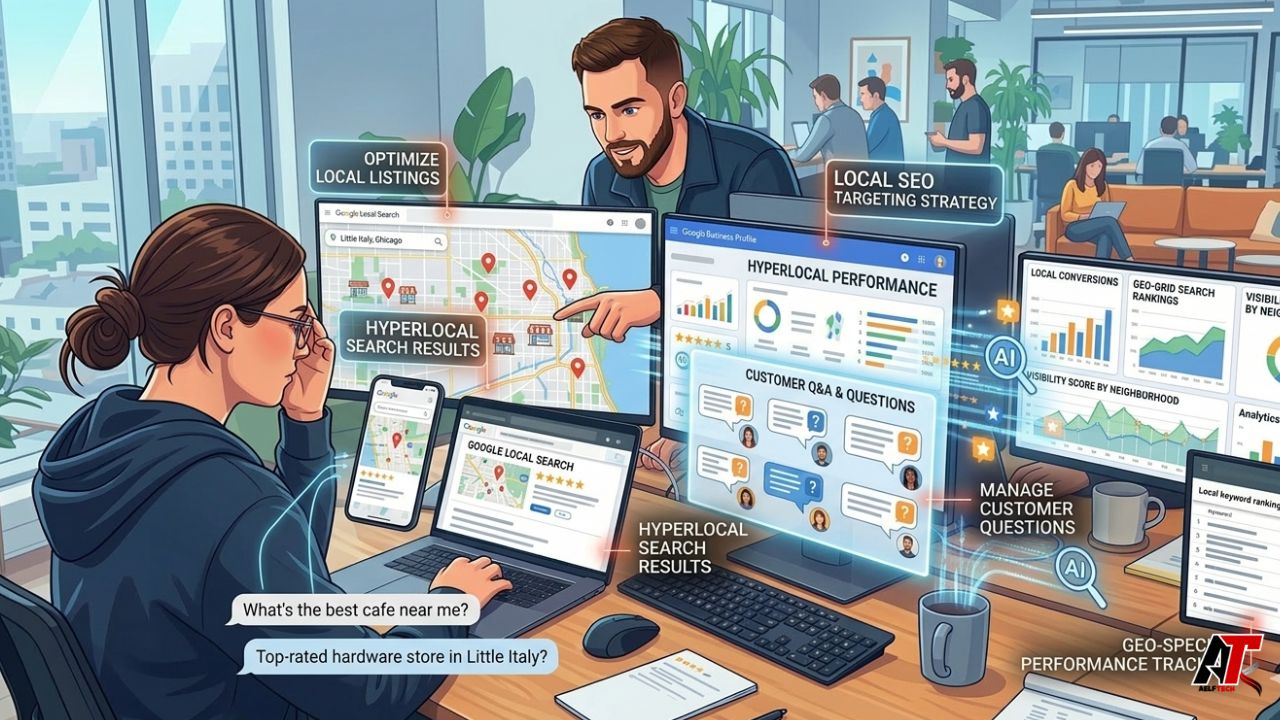
In today’s mobile-first world, consumers rarely search broadly when they need an immediate solution; they search for what is closest to them right now. Capturing these high-intent, bottom-of-the-funnel customers requires a targeted Digital Strategy that goes beyond basic city-level optimization. Whether you operate a single cafe, manage a massive residential complex, or oversee a nationwide chain, tailoring your online presence to exact neighborhoods and street corners is the key to driving real-world foot traffic and localized leads.
Hyperlocal SEO Near Me: Why Intent Matters
Search engines have evolved to prioritize the physical proximity of the user. When someone executes a hyperlocal seo near me search, Google’s algorithm bypasses general, national results and immediately serves up the “Local Pack”—the top three map listings closest to the searcher’s GPS coordinates.
This intent is highly transactional. A user searching for “coffee near me” or “emergency plumber near me” is usually looking to make a purchase within the hour. Winning these micro-moments requires perfectly optimized Google Business Profiles (GBP), precise geolocation signals on your website, and a high volume of positive local reviews to prove immediate relevance.
Local SEO Questions Every Business Should Ask
Before launching a localized marketing campaign, diagnosing your current visibility is critical. There are specific local seo questions every business owner and marketing director should ask to establish a clear baseline:
- Is our Name, Address, and Phone number (NAP) 100% consistent across every online directory?
- Does our website have dedicated, unique landing pages for every physical location we operate?
- Are we actively generating, monitoring, and responding to Google reviews at the local level?
- Is our Google Business Profile fully filled out with accurate categories, operating hours, and localized photos?
Local SEO for Restaurants: Visibility Where It Counts
The food and beverage industry moves incredibly fast, making local seo for restaurants a unique challenge. Hungry searchers are heavily influenced by visual appeal, convenience, and peer validation. For a restaurant, ranking in the map pack is often the difference between a fully booked weekend and an empty dining room.
To succeed, restaurants must go beyond basic website optimization. This means linking directly to your menu, integrating reservation or delivery platform links directly into your GBP, and constantly uploading high-quality photos of your most popular dishes. Because diners rely heavily on star ratings, having a proactive system to generate reviews is essential for ongoing local SEO success.
Local SEO for Franchises: Scaling Without Losing Local Relevance
Managing the online presence of a brand with 50 or 500 locations introduces massive logistical hurdles. Local seo for franchises requires striking a delicate balance: maintaining strict corporate brand consistency while allowing enough flexibility to appeal to distinct local neighborhoods.
If corporate simply duplicates the same landing page content 50 times and only changes the city name, search engines will filter those pages out as duplicate content. Partnering with a team that provides Advanced SEO Services ensures that each location page features hyper-local content, unique local staff bios, specific neighborhood directions, and distinct local schema markup.
Franchise SEO Strategy for Multi-Location Growth
A successful franchise seo strategy hinges on centralized governance combined with localized execution. Managing dozens of GBP listings requires structured workflows to ensure holiday hours are updated simultaneously, duplicate rogue listings are merged, and local citations are built accurately.
Poor Franchise Strategy
One global website page listing all 50 addresses. Unclaimed or unverified Google Business Profiles. Reviews go unanswered, and localized content is identical across regions.
Strong Franchise Strategy
A robust location finder leading to dedicated URL subfolders (e.g., /locations/dallas-tx/). Centralized GBP management software, localized URL backlinks, and active review management workflows.
By implementing a unified business marketing strategy, franchise owners can empower local managers to capture neighborhood traffic without sacrificing the integrity of the national brand.
Multifamily SEO: Local Search for Property Visibility
The real estate and property management sectors rely heavily on location-based queries. Multifamily seo focuses on driving highly qualified leads (prospective renters) to specific apartment complexes or residential communities. Renters do not just search for an apartment; they search for “apartments in [Specific Neighborhood]” or “pet-friendly apartments near [Landmark].”
Property managers must optimize their local pages with specific floor plan schema, detailed amenity lists, neighborhood guides, and virtual tours. Because the customer journey for signing a lease is longer than buying a cup of coffee, local content must deeply answer questions about the surrounding community, schools, and transit options to establish trust.
Common Local SEO Mistakes to Avoid
Even established businesses stumble when dealing with the nuances of local search. To protect your rankings, avoid these common pitfalls:
- Keyword Stuffing Business Names: Adding terms like “Best Plumber” to your official GBP name violates Google’s guidelines and can trigger an account suspension.
- Ignoring Directory Inconsistencies: If Yelp lists your old address and Google lists your new one, search engines lose trust in your entity.
- Using P.O. Boxes: Google requires a physical address for map listings; P.O. boxes or virtual offices are generally prohibited.
For a complete breakdown of avoiding these errors and dominating your region, refer to our comprehensive local SEO guide. Exploring past SEO case studies can also show how correcting these simple mistakes yields massive traffic gains.
How to Build a Stronger Local Presence Over Time
Local SEO is not a one-time setup; it requires continuous nurturing. By consistently publishing localized content, keeping your business data accurate, and actively engaging with customer reviews, you build an impenetrable local moat around your business. Staying informed with the latest digital marketing insights ensures you adapt whenever Google updates its local algorithm. If you are ready to stop losing local customers to the competition, request a free SEO audit today, and let us build a localized roadmap for your success.
Frequently Asked Questions (FAQs)
1. What is hyperlocal SEO near me?
Hyperlocal SEO “near me” refers to optimizing a business’s online presence to capture search traffic from highly specific, immediate geographic areas—often down to the neighborhood, street, or exact GPS radius of the mobile user performing the search.
2. What local SEO questions should a business ask first?
A business should first ask: Are our Name, Address, and Phone number (NAP) consistent everywhere online? Do we have a claimed, optimized Google Business Profile? Do we have a dedicated page on our website for every physical location? How are we actively generating local reviews?
3. How is local SEO for restaurants different from other industries?
Local SEO for restaurants relies heavily on immediate, bottom-of-the-funnel intent. It requires highly visual profiles, integrated menus, direct links for reservations or delivery, and constant review management, as diners make rapid decisions based on star ratings and proximity.
4. What makes local SEO for franchises more complex?
Franchises must scale local SEO across dozens or hundreds of locations without creating duplicate content or conflicting directory listings. It requires balancing strict corporate branding guidelines with the need for hyper-local, unique content for each individual neighborhood they serve.
5. What should a franchise SEO strategy include?
A franchise SEO strategy should include centralized management of all Google Business Profiles, unique local landing pages with localized content for every branch, a systematic approach to local citation building (NAP consistency), and automated workflows for generating and responding to local reviews.
6. What is multifamily SEO?
Multifamily SEO focuses on optimizing online visibility for apartment complexes, condos, and property management companies. It involves targeting neighborhood-specific keywords, highlighting property amenities, using floor plan schema markup, and creating content about the surrounding local community to attract renters.
7. Do near me searches still matter in local SEO?
Yes, “near me” searches are more important than ever. As mobile search dominates, users expect search engines to automatically factor in their location. Optimizing for proximity and intent ensures you appear when a user is physically nearby and ready to buy.
8. How many local landing pages should a multi-location business create?
A multi-location business should create exactly one unique, highly detailed local landing page for every physical storefront or office they operate. Do not create fake location pages for cities where you do not have a physical presence or a legitimate service area.
Leave a Reply