
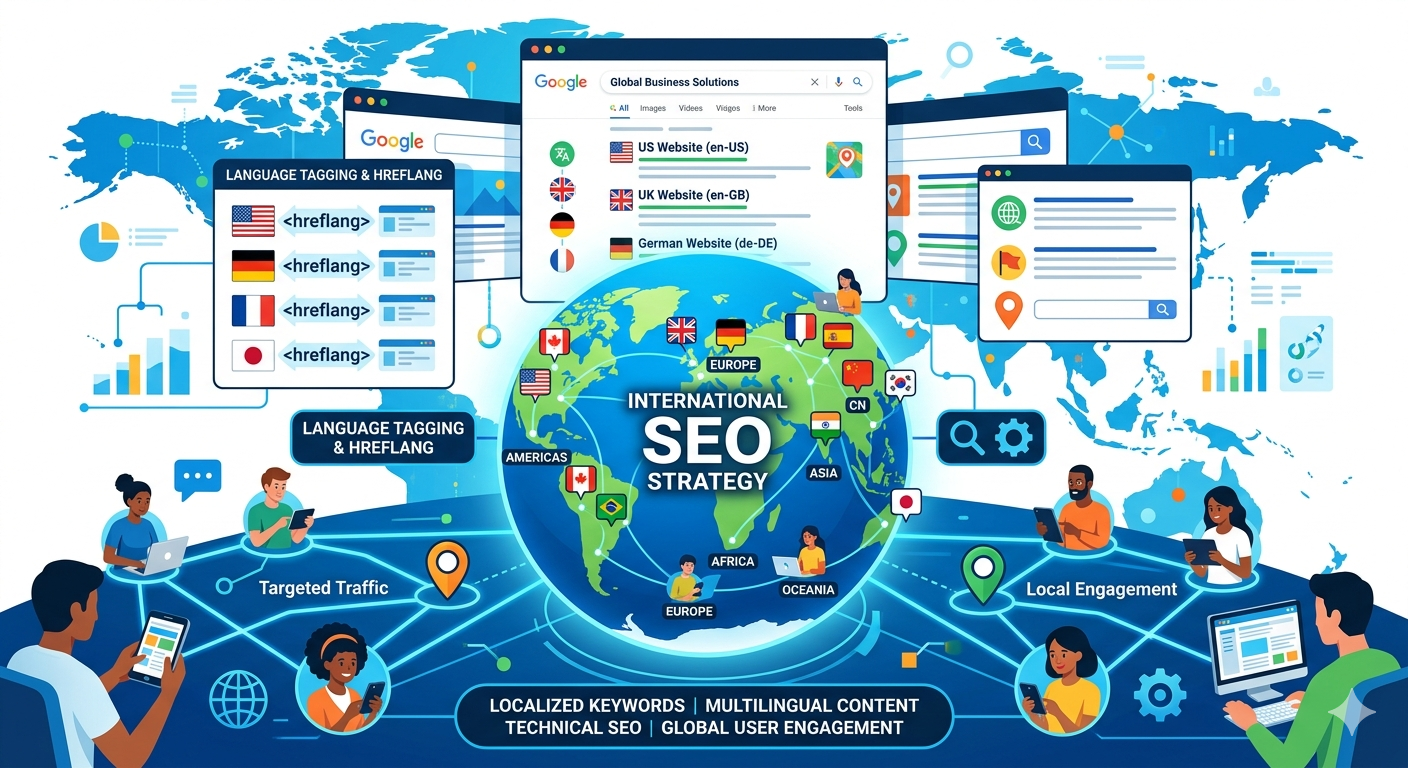
Expanding your business across borders is an exciting milestone, but capturing international market share requires far more than simply translating your website into a few different languages. A robust Digital Strategy for international growth must account for regional search habits, distinct algorithmic preferences, and deep cultural nuances. Without a carefully planned technical foundation, businesses risk confusing search engines, frustrating users, and missing out on lucrative global revenue.
What Is Global SEO?
For brands looking to scale beyond their domestic borders, the first question is often: what is global seo? Global SEO is the systematic process of optimizing your website so that search engines can easily identify which countries you want to target and which languages you use for business. It involves a combination of URL structuring (like ccTLDs or subdirectories), implementing correct hreflang tags, and culturally localizing content so that users around the world receive a native, frictionless search experience.
International SEO Mistakes That Limit Growth
Unfortunately, many companies stumble during their global rollouts. The most common international seo mistakes stem from treating global expansion as a mere translation exercise. Relying strictly on automated translation plugins without human proofreading often results in awkward phrasing that damages brand trust. Additionally, misconfiguring hreflang tags can lead to severe keyword cannibalization, where your US English page competes directly against your UK English page in the search results.
Another major mistake is ignoring local search volume. A keyword that drives massive traffic in the United States might not have a direct, high-volume equivalent in Germany or Japan. Proper international SEO requires fresh keyword research for every target market.
International SEO Without VPN: What You Can Still Validate
Marketers often wonder how to accurately test their global rankings and SERP (Search Engine Results Page) layouts from their home office. While Virtual Private Networks are popular, checking international seo without vpn access is entirely possible and sometimes more reliable for raw data gathering.
You can leverage Google Search Console’s country performance filters to see exactly how specific regions interact with your site. Additionally, appending location parameters (like &gl=uk for the United Kingdom) to your Google search URL, or using Chrome Developer Tools to override your browser’s geolocation sensors, allows you to simulate international search environments seamlessly without third-party software.
Recherche Vocale SEO and Multilingual Search Behavior
As smart speakers and mobile assistants proliferate globally, optimizing for voice search has become a universal necessity. However, voice search behavior changes drastically across languages. For instance, in French-speaking markets, prioritizing recherche vocale seo means optimizing for longer, more conversational, and naturally spoken question phrases rather than disjointed keywords.
Adapting to voice search requires a strong foundation in semantic SEO. Search engines must understand the context and entities within your content to answer spoken queries accurately. Integrating insights from AI in digital marketing can help your team analyze and predict natural language patterns across different regional dialects.
Multilingual SEO Company: What to Look For
Because the complexities of international search are so vast, partnering with a specialized multilingual seo company is often the most cost-effective way to scale. When evaluating an agency, look beyond their ability to translate. You need a partner who understands technical international architecture, local link-building nuances, and regional search intent.
A reputable agency offering Advanced SEO Services will employ native speakers for content localization and possess a deep understanding of how different search engines process global signals. This holistic approach is a hallmark of top digital services tailored for enterprise growth.
SEO Russian and Russian SEO: Localizing Beyond Translation
When entering the Eastern European or Eurasian markets, understanding seo russian practices is vital. Google is not the only player in town; Yandex holds a massive share of the Russian-speaking search market. Effective russian seo requires optimizing for Yandex’s specific algorithms, which place a heavy emphasis on user behavioral factors, regionality, and strict grammatical correctness.
Localization in Russian must account for Cyrillic search behaviors, complex noun declensions, and cultural purchasing habits. A direct translation of an English marketing slogan will rarely carry the same commercial weight or search volume in a Russian-speaking market.
SEO Baidu vs Google: Key Differences in Search Strategy
Expanding into China introduces an entirely different ecosystem. The landscape of seo baidu vs google features stark contrasts that require dedicated strategies. Baidu is the undisputed leader in China, and treating it like a localized version of Google will guarantee failure.
Google SEO
Prioritizes high-quality backlinks, semantic understanding, and Core Web Vitals. Meta keywords are entirely ignored. Indexing is relatively fast, and businesses do not need a government license to appear in organic results.
Baidu SEO
Heavily favors websites hosted in China with an ICP (Internet Content Provider) license. Meta keywords still hold some weight. Baidu prioritizes its own properties (like Baidu Baike) and relies heavily on fresh, constant content updates.
Technical and Content Best Practices for International SEO
Whether you are optimizing for Baidu, Yandex, or localized Google SERPs, technical precision is your greatest asset. Ensure your hreflang tags map perfectly to their respective URLs, host your site on a fast global CDN, and always use dedicated URLs (not cookie-based dynamic translations) for different languages. Staying current with global digital marketing insights will help you navigate regional algorithm updates as they happen.
Conclusion
Global SEO is a multifaceted discipline that demands cultural empathy, technical rigor, and an understanding of diverse search ecosystems. By avoiding common translation pitfalls, optimizing for regional engines like Baidu and Yandex, and tailoring your content to local search intents, you can build a truly borderless digital presence. Exploring global SEO case studies can provide a roadmap for your own international success. If you are ready to expand your market share globally, request a free SEO audit from Aelftech today, and let us help you map your international growth strategy.
Frequently Asked Questions (FAQs)
1. What is global SEO?
Global SEO is the process of optimizing your website and content to rank in search engines across multiple countries and languages. It ensures that search engines serve the correct localized version of your website to the right users based on their geographic location and language preferences.
2. What are the most common international SEO mistakes?
The most common mistakes include relying on auto-translate tools instead of human localization, incorrectly implementing or entirely missing hreflang tags, using a single URL to serve multiple languages via cookies, and failing to conduct localized keyword research for each target market.
3. Can you do international SEO without a VPN?
Yes. While VPNs are helpful, you can validate international SEO by using Google Search Console’s country filters, appending location-specific parameters to search URLs, or using Chrome Developer Tools to temporarily override your browser’s geolocation settings to view localized SERPs.
4. What does recherche vocale SEO mean?
Recherche vocale SEO translates to “voice search SEO” in French. It refers to the strategy of optimizing content for voice-activated assistants (like Siri or Google Assistant) in French-speaking markets, focusing on natural, conversational language and long-tail question queries.
5. What should I expect from a multilingual SEO company?
A capable multilingual SEO company should provide technical international architecture setup (URL structures, hreflang), native-speaker content localization, regional keyword research, and an understanding of non-Google search engines if applicable to your target markets.
6. Is Russian SEO different from English SEO?
Yes, significantly. Russian SEO requires optimizing for Yandex, the region’s dominant search engine, alongside Google. Yandex has different ranking factors, placing heavier emphasis on user behavior metrics, regionality, and strict adherence to the grammatical nuances of the Russian language.
7. What is the biggest difference between SEO for Baidu vs Google?
The biggest difference is regulatory and structural. To rank well on Baidu in China, a website almost always requires a Chinese ICP license and local hosting. Furthermore, Baidu still considers meta keywords, favors its own digital properties, and has a slower, more complex indexation process than Google.
8. Do multilingual websites need separate SEO strategies for each market?
Yes. Search intent, cultural context, and competitor landscapes change drastically from country to country. A keyword that works well in the US may not have a direct translation or search demand in Spain, making unique, localized strategies essential for each targeted market.
Leave a Reply