
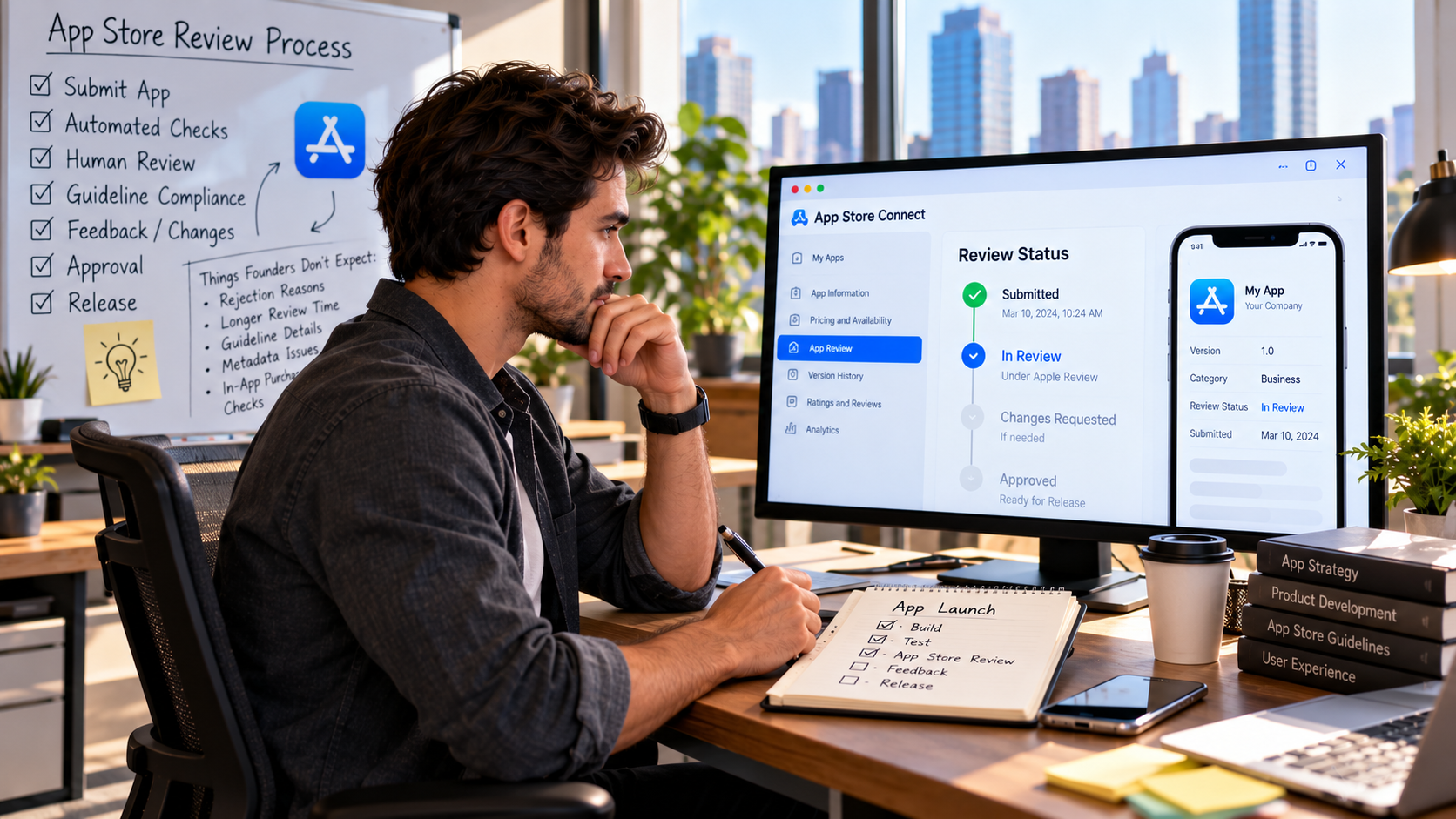
Most founders building their first mobile app treat submission as the final step, a formality after months of real work. The teams that have been through it before know submission is where a surprising amount of friction actually lives. App Store and Google Play review exist to protect users, and that protection comes with specific, detailed requirements that catch first-time founders off guard more often than any part of actual development.
Understanding what the review process actually checks for, and building toward those requirements from the start, saves founders the specific pain of a rejection landing the week they planned to launch.
Apple’s Review Is More Subjective Than Founders Expect
Apple’s App Store review combines automated checks with human reviewers actually using the app, and that human element introduces real subjectivity. An app can pass every automated check and still get rejected because a reviewer found the user experience confusing, felt a feature didn’t provide enough value to justify existing, or interpreted a guideline differently than the founder expected.
Common first-time rejection reasons include incomplete app metadata, placeholder content left in from testing, crashes a reviewer encountered that internal testing missed, and privacy policy language that doesn’t precisely match what the app actually does with user data. Apps requesting permissions like location, camera, or contacts access without a crystal-clear, contextual explanation of why the app needs that access get flagged consistently.
Teams working with a dedicated iOS app development services partner who has been through this review process repeatedly catch these issues before submission, since recognizing what a reviewer will flag comes from direct pattern recognition built over many past submissions, well beyond what reading Apple’s guidelines once can teach.
Google Play’s Automated Checks Catch Different Problems
Google Play review relies more heavily on automated scanning, which means it catches a different category of issues than Apple’s human-reviewed process. Automated scanning flags security vulnerabilities, policy violations around sensitive permissions, and technical issues like broken links or crashes on specific Android configurations the scanning tools test against.
Google’s policy around sensitive permissions has tightened considerably over recent years, and apps requesting access to call logs, SMS, or accessibility services without an extremely narrow, well-justified use case get rejected or suspended even after initial approval. A team genuinely fluent in current Google Play policy, the kind a dedicated android app development services team stays current on by submitting apps regularly, catches these policy mismatches before they become a rejection or, worse, a suspension after the app already has live users.
The Timeline Founders Should Actually Plan For
Apple’s review typically takes one to three days for a first submission, though that window can extend if a reviewer flags an issue requiring resubmission. Each resubmission restarts the review clock, so a rejection on day two of review, followed by a fix and resubmission, can easily push total review time to a week or more.
Google Play’s initial review tends to move faster, often within hours to a day for straightforward apps, though apps requesting sensitive permissions or operating in regulated categories like finance or health face additional scrutiny that extends that timeline meaningfully. Founders planning a specific launch date should build in buffer for at least one rejection-and-resubmission cycle on each platform, since treating the stated review window as a guarantee leads directly to missed launch dates.
What Actually Prevents Most Rejections
The founders who sail through review on the first attempt share a few consistent habits. They test the actual submission build, the real one, on real devices before submitting, since issues that don’t appear in a simulator or development environment show up constantly in the exact build a reviewer sees. They write privacy policy language built specifically around what the app actually does, matching its real data handling precisely without leaning on a generic template.
They also request only the permissions the app genuinely needs for its core functionality, since every requested permission the app doesn’t clearly use invites reviewer scrutiny. And they prepare clear, specific reviewer notes explaining anything unusual about the app, test account credentials if login is required, and context for any feature that might look unusual without explanation.
When a Rejection Happens Anyway
A rejection isn’t a crisis, even though it feels like one during a planned launch week. Both platforms provide specific rejection reasons, and the fastest path forward is addressing exactly what was flagged, without guessing at a broader rewrite that wasn’t actually required. Apple’s resolution center allows direct communication with the review team for genuine clarification, which first-time founders often don’t realize exists and skip in favor of simply resubmitting and hoping.
Teams that have been through this cycle before know which rejections warrant a quick clarifying message to the review team and which require an actual fix, and that judgment alone often saves days compared to a founder guessing at the right response on their first try.
A Real Rejection, Worked Through
A team building a budgeting app submitted their first version to Apple with a straightforward feature set: link a bank account, categorize spending, set savings goals. The rejection cited “insufficient app functionality,” a notoriously vague reason that first-time founders often misread as a demand for more features. The actual issue, confirmed through a message to Apple’s resolution center, was that the app’s core value wasn’t clear within the first thirty seconds of use, the reviewer couldn’t tell what the app actually did without digging through several screens first.
The fix wasn’t new features. It was a clearer onboarding flow that stated the app’s purpose immediately and got a user to their first meaningful action, connecting an account, within two screens, down from five. Resubmission cleared review in under 24 hours. The team that assumes “insufficient functionality” always means “build more” often ends up adding complexity that makes the actual problem, an unclear first impression, even harder for the next reviewer to parse.
The Takeaway
App store review isn’t the formality it looks like from the outside. It’s a detailed evaluation with specific, evolving requirements that catch first-time founders off guard in ways that have nothing to do with whether the underlying app actually works well. Building toward both platforms’ real requirements from the start, with a team that has been through the process enough times to recognize what gets flagged before a reviewer ever sees it, is what separates a smooth launch from a stressful week of rejections and resubmissions right when a founder expected to be celebrating.
Leave a Reply