
Losing a life partner is emotionally devastating, and the legal challenges that follow can make an already difficult situation more complicated. In Texas, surviving partners who never participated in a formal wedding ceremony may wonder whether they have the same legal rights as traditionally married spouses. Understanding common-law marriage is particularly important when determining who can file a wrongful death lawsuit and pursue compensation after a partner’s death.
Texas recognizes certain informal marriages as legally valid, meaning a surviving partner may qualify as a spouse even without a marriage certificate or wedding ceremony. However, common-law marriage must satisfy specific legal requirements, and proving the relationship after a death can present challenges. Knowing how Texas wrongful death laws interact with informal marriage can help surviving partners understand their eligibility, important deadlines, and the evidence needed to establish their rights.
Can a Common-Law Spouse File a Wrongful Death Claim in Texas?
Yes. A surviving partner in a legally valid common-law marriage can generally file a wrongful death claim in Texas because state law recognizes informal marriages that satisfy the legal requirements.
Under Texas Civil Practice and Remedies Code Section 71.004, a wrongful death action may be brought for the benefit of the surviving spouse, children, and parents of the deceased.
The law does not limit surviving-spouse eligibility to couples who obtained a formal marriage license or participated in a wedding ceremony.
Instead, the central question is whether a legally recognized marriage existed.
If a surviving partner can establish a valid common-law marriage, that person generally has the same standing as a formally married spouse to pursue a wrongful death action.
However, simply living together or describing someone as a long-term partner does not automatically establish marriage.
The relationship must satisfy Texas legal requirements.
Why Marital Status Matters in Wrongful Death Cases
Texas limits wrongful death claims to specific family members.
Unlike some jurisdictions, Texas generally does not allow an unmarried romantic partner to bring a wrongful death claim solely because the relationship was long-lasting or financially interdependent.
This makes common-law marriage particularly important for couples who never formally registered their relationship.
A surviving partner may need to establish marital status before the court can determine whether that person qualifies as a statutory beneficiary.
The issue can become especially significant when other family members dispute the relationship.
What Is Common-Law Marriage in Texas?
Common-law marriage is a legally recognized marital relationship established without the traditional formalities of obtaining a marriage license and participating in a marriage ceremony.
Texas law generally refers to this arrangement as an informal marriage.
Under Texas Family Code Section 2.401, an informal marriage may be proved through a properly executed and registered declaration of informal marriage.
Alternatively, it may be established by evidence showing that the couple satisfied three statutory requirements.
The Three Requirements for Common-Law Marriage
Texas Family Code Section 2.401(a)(2) identifies three essential elements.
- The couple agreed to be married.
- After the agreement, they lived together in Texas as spouses.
- They represented to others in Texas that they were married.
All three requirements must be established.
A relationship that satisfies only one or two elements does not qualify under this statutory method.
Agreement to Be Married
Both partners must have agreed to enter a present marital relationship.
This requirement involves more than an intention to marry at some future date.
For example, discussing wedding plans does not necessarily establish an existing marriage.
Evidence may include communications, statements, or conduct demonstrating that both individuals considered themselves currently married.
Living Together in Texas
The couple must have cohabited in Texas as spouses after agreeing to be married.
There is no statutory requirement that they live together for a particular number of years.
A relationship does not automatically become a common-law marriage after six months, two years, or any other fixed period.
The relevant issue is whether the legal requirements were satisfied.
Representing the Relationship as a Marriage
The couple must have represented to others in Texas that they were married.
This requirement is sometimes called holding out.
Examples may include introducing each other as spouses, identifying the relationship as a marriage on documents, or consistently communicating marital status to other people.
Private affection or shared living arrangements alone are insufficient.
The evidence must support the conclusion that the couple represented themselves as married.
7 Essential Legal Facts About Common-Law Marriage and Wrongful Death Claims
Understanding the relationship between common-law marriage and wrongful death law can help surviving partners avoid common misconceptions.
1. Texas Recognizes Valid Informal Marriages
Texas does not require every legally married couple to complete a traditional wedding ceremony.
A valid informal marriage can create the same marital status as a ceremonial marriage.
This recognition is important because surviving spouses are among the individuals authorized to bring wrongful death claims.
The absence of a conventional marriage certificate does not automatically defeat eligibility.
2. Living Together Does Not Automatically Create Marriage
Cohabitation is only one element of the statutory test.
A couple may live together for many years without establishing a legally recognized marriage.
For example, two partners who share a home but consistently describe themselves as unmarried may have difficulty establishing common-law marriage.
The specific facts and available evidence determine the legal outcome.
3. There Is No Automatic Seven-Year Rule
A widespread misconception suggests that couples become married after living together for seven years.
Texas law contains no such rule.
The duration of cohabitation may provide background evidence, but time alone does not establish marital status.
A couple must satisfy the statutory requirements regardless of how long the relationship lasted.
4. A Declaration of Informal Marriage Can Provide Important Evidence
Texas allows qualifying couples to execute a declaration of informal marriage.
This document is filed with the county clerk and serves as formal evidence of the marriage.
However, a declaration is not the only way to establish common-law marriage.
A couple may have a valid informal marriage without filing one.
For wrongful death litigation, a registered declaration can simplify proof of marital status.
5. Marriage May Be Disputed After Death
A surviving partner’s claim may become complicated if relatives or other interested parties challenge the alleged marriage.
For example, family members may dispute whether the deceased ever agreed to be married.
Courts may need to examine documents, witness testimony, and the couple’s conduct.
Because one partner can no longer testify, evidence collected during the relationship may become especially important.
6. Common-Law Spouses Have the Same Wrongful Death Standing
When a common-law marriage is legally established, the surviving spouse generally qualifies under the same wrongful death statute as someone married through a formal ceremony.
The law focuses on valid marital status rather than the method used to establish the marriage.
However, standing does not guarantee compensation.
The claimant must still establish the underlying elements of the wrongful death case.
7. Filing Deadlines Can Affect Legal Rights
Texas wrongful death claims are generally subject to a two-year limitations period.
Under Texas Civil Practice and Remedies Code Section 16.003(b), the deadline ordinarily runs from the date of death.
Certain exceptions or tolling rules may apply in particular circumstances.
Because determining marital status can take time, surviving partners should seek legal guidance promptly.
How to Prove Common-Law Marriage After a Partner’s Death
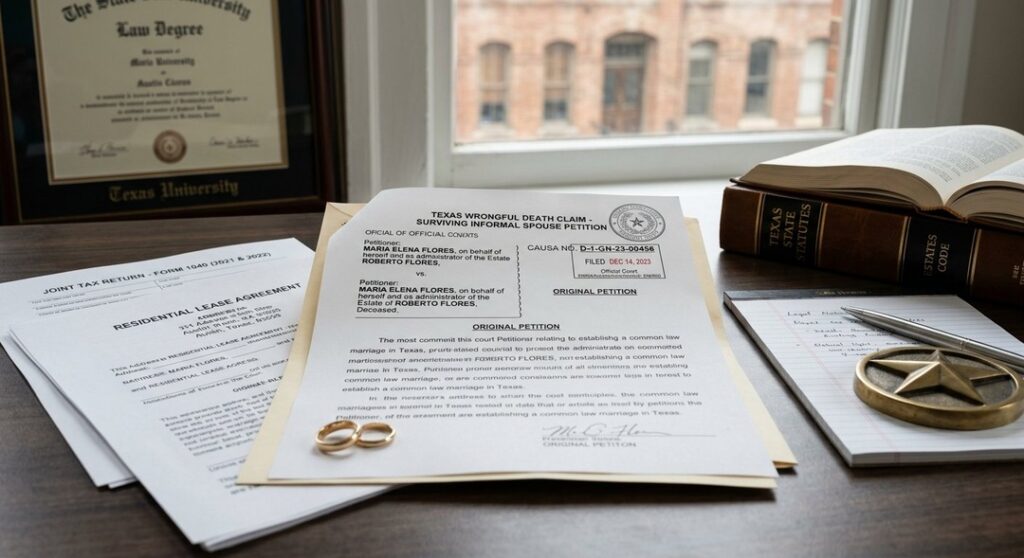
Proving an informal marriage after death may require substantial evidence.
The surviving partner must establish that the relationship satisfied the applicable legal requirements.
A court evaluates the evidence as a whole rather than relying exclusively on one document.
Evidence of an Agreement to Be Married
The first element involves showing that both individuals agreed to be married.
Possible evidence includes:
- Written communications referring to an existing marriage.
- Statements made to relatives or friends.
- Documents identifying the partners as spouses.
- Consistent conduct reflecting a present marital relationship.
- Testimony from people familiar with the couple.
- A registered declaration of informal marriage, if one exists.
No single category of evidence automatically proves the entire case.
The strength of the evidence depends on its credibility and relevance.
Evidence of Cohabitation
The second element requires proof that the couple lived together in Texas as spouses.
Relevant materials may include residential leases, property documents, utility records, and correspondence showing a shared address.
However, shared residence alone does not establish common-law marriage.
These records must be considered alongside evidence of agreement and public representation.
Evidence of Holding Out as Married
The third element concerns how the couple represented their relationship to others.
Potential evidence includes:
- Tax documents identifying marital status.
- Insurance records listing a spouse.
- Employment benefit forms.
- Statements to friends and relatives.
- Medical records identifying a spouse.
- Social communications referring to the relationship as a marriage.
- Other records reflecting consistent public representations.
The legal significance of each document depends on the surrounding circumstances.
Can Social Media Posts Help Prove Marriage?
Social media content may provide supporting evidence when it shows how partners publicly described their relationship.
For example, repeated public references to a spouse may be relevant.
However, a single anniversary photograph or affectionate caption does not automatically establish marriage.
Courts consider authenticity, context, and consistency with other evidence.
What Happens When Common-Law Marriage Is Disputed?
Disputes can arise when a surviving partner claims marital status that other family members do not recognize.
Such disagreements may affect wrongful death litigation, inheritance questions, or other legal proceedings.
Challenges From Family Members
Parents, children, or other interested individuals may question whether the deceased agreed to be married.
A disagreement between relatives does not automatically invalidate a common-law marriage.
However, it can create factual issues requiring judicial resolution.
Conflicting Documents
Marriage claims may become more difficult when documents contain inconsistent information.
For example, some records may describe the deceased as single while others identify a spouse.
The court must evaluate the evidence and determine its significance.
The Importance of Credible Witnesses
Witnesses who personally observed the relationship may provide relevant testimony.
They may describe how the couple introduced themselves or represented their marital status.
However, witness statements should reflect actual knowledge rather than assumptions.
The Two-Year Separation Presumption
Texas Family Code Section 2.401(b) contains an important evidentiary rule.
When a proceeding to prove a marriage under Section 2.401(a)(2) is not commenced before the second anniversary of the date the parties separated and ceased living together, the law establishes a rebuttable presumption that they did not agree to be married.
This provision concerns separation and cohabitation, not simply the passage of time after a partner’s death.
Its application can be fact-sensitive.
It also should not be confused with the separate limitations period governing wrongful death claims.
Who Can File a Wrongful Death Claim in Texas?
Texas Civil Practice and Remedies Code Section 71.004 identifies the primary statutory beneficiaries.
These include the deceased person’s surviving spouse, children, and parents.
A legally established common-law spouse falls within the surviving-spouse category.
Surviving Spouses
A spouse may pursue a wrongful death claim when the death results from conduct that satisfies the requirements of Texas wrongful death law.
A valid informal marriage can establish the necessary marital relationship.
Children of the Deceased
Children may also qualify as wrongful death beneficiaries.
Texas law recognizes eligible children regardless of whether their parents participated in a formal marriage ceremony.
Eligibility depends on the legally recognized parent-child relationship and applicable law.
Parents of the Deceased
Parents may pursue wrongful death claims involving the death of their child.
Their eligibility is separate from whether the deceased had a surviving spouse.
Can Siblings File Wrongful Death Claims?
Siblings generally are not included among the statutory wrongful death beneficiaries under Texas Civil Practice and Remedies Code Section 71.004.
Other legal proceedings, such as certain estate-related claims, involve different rules.
The distinction between wrongful death and estate claims is important.
Common-Law Marriage vs Unmarried Cohabitation in Texas
The legal difference between marriage and cohabitation can determine whether a surviving partner qualifies to sue.
| Legal Consideration | Valid Common-Law Marriage | Unmarried Cohabitation |
|---|---|---|
| Legally recognized marriage | Yes | No |
| Formal wedding required | No | No |
| Agreement to be married | Required under statutory proof method | Not necessarily present |
| Cohabitation | Required under statutory proof method | May exist |
| Holding out as married | Required under statutory proof method | Not necessarily present |
| Wrongful death spouse standing | Generally available | Generally unavailable solely as a partner |
| Spousal inheritance rights | May apply | Generally not available based solely on cohabitation |
| Need to prove marital status | Sometimes | Partnership alone is insufficient |
These differences explain why establishing common-law marriage can be central to a surviving partner’s wrongful death case.
What Is a Wrongful Death Claim Under Texas Law?
A wrongful death claim is a civil legal action seeking damages when a person’s death results from legally actionable conduct.
Texas Civil Practice and Remedies Code Chapter 71 governs wrongful death actions.
Under Section 71.002, liability may arise when an injury causes death through another person’s wrongful act, neglect, carelessness, unskillfulness, or default, subject to the statute’s requirements.
A wrongful death lawsuit is separate from a criminal prosecution.
It focuses on civil liability and available compensation.
Common Situations Leading to Wrongful Death Claims
Wrongful death cases may arise from several circumstances.
- Motor vehicle collisions.
- Commercial truck accidents.
- Workplace incidents involving potentially liable third parties.
- Medical negligence.
- Defective products.
- Unsafe property conditions.
- Other incidents involving legally actionable conduct.
Not every accidental death supports a wrongful death claim.
The claimant must establish a valid legal basis for liability.
What Must Be Proven?
The precise legal elements depend on the underlying theory.
In a negligence-based case, the claimant generally must establish duty, breach, causation, and legally recoverable damages.
Other claims may involve different legal standards.
For a common-law spouse, proving marital status establishes potential eligibility but does not eliminate the need to prove liability.
What Compensation Can a Common-Law Spouse Recover?
A surviving spouse in a valid common-law marriage may pursue damages recognized under Texas wrongful death law.
The available compensation depends on the facts and applicable legal principles.
Loss of Financial Support
A surviving spouse may seek compensation for financial contributions the deceased would reasonably have provided.
Relevant evidence may include earnings, work history, and household financial circumstances.
Future losses may require expert analysis.
Loss of Companionship
Texas wrongful death law may allow recovery for the loss of companionship and society.
This category concerns the relational benefits the deceased would have provided.
The amount depends on the evidence and circumstances.
Mental Anguish
A surviving spouse may pursue legally recoverable mental anguish damages.
These damages concern emotional suffering associated with the death.
Courts evaluate evidence according to applicable legal standards.
Loss of Household Services
The death of a spouse may result in the loss of household contributions.
These may include tasks or services the deceased regularly performed.
The legal value of such losses depends on the evidence.
Exemplary Damages
Texas Civil Practice and Remedies Code Section 71.009 addresses exemplary damages in certain wrongful death cases involving qualifying conduct.
Such damages are not available in every case.
They are subject to applicable legal requirements and limitations.
Wrongful Death Claims vs Survival Actions
Wrongful death claims and survival actions are related but legally distinct.
A wrongful death action generally addresses losses suffered by eligible surviving family members.
A survival action preserves certain claims belonging to the deceased person that survive death.
Texas Civil Practice and Remedies Code Section 71.021 governs survival actions.
| Feature | Wrongful Death Claim | Survival Action |
|---|---|---|
| Primary purpose | Compensate eligible survivors | Preserve the deceased person’s legal claim |
| Relevant statute | Texas Civil Practice and Remedies Code Chapter 71 | Section 71.021 |
| Beneficiaries | Statutory family beneficiaries | Estate-related interests |
| Types of losses | Survivors’ legally recoverable losses | Certain damages the deceased could have pursued |
| Common-law marriage relevance | May establish surviving-spouse standing | May affect estate-related rights |
| Legal requirements | Wrongful death liability and eligibility | Valid surviving underlying claim |
A common-law spouse may have interests involving both types of proceedings, depending on the circumstances.
However, estate administration and beneficiary rights involve additional legal rules.
How Long Does a Common-Law Spouse Have to File?
The general Texas wrongful death limitations period is two years from the date of death.
This rule appears in Texas Civil Practice and Remedies Code Section 16.003(b).
However, the calculation can become complicated.
Why Filing Deadlines Matter
Missing the applicable deadline may prevent a claim from proceeding.
A surviving partner should not assume that disputes over common-law marriage automatically extend the filing period.
Prompt action is especially important when evidence of the relationship must be gathered.
Are There Exceptions?
Certain legal doctrines and statutory provisions may affect limitations in specific situations.
For example, rules involving minors or other legally recognized circumstances may require separate analysis.
The availability of an exception should never be assumed.
Does Proving Marriage Extend the Deadline?
Establishing common-law marriage and filing a wrongful death claim are separate legal issues.
The need to prove marital status does not automatically suspend the wrongful death limitations period.
A Texas attorney can evaluate how the relevant deadlines apply to the particular facts.
What Happens if No Wrongful Death Beneficiary Files?
Texas Civil Practice and Remedies Code Section 71.004(c) provides a procedure involving the personal representative or administrator of the deceased person’s estate.
If none of the statutory beneficiaries begins an action within three calendar months after the death, the personal representative or administrator generally must bring and prosecute the action unless requested not to do so by all statutory beneficiaries.
This three-month provision is not the same as the general two-year limitations period.
It also does not mean that beneficiaries automatically lose their rights after three months.
The interaction between these provisions can be important in cases involving disputed marital status.
A surviving partner claiming common-law marriage should obtain legal advice about the appropriate filing procedure.
Can a Common-Law Spouse Claim Inheritance in Texas?
A valid common-law marriage can affect inheritance rights.
When an individual dies without a will, Texas intestacy laws determine how property passes to qualifying heirs.
A surviving spouse may have rights involving community property and separate property, depending on the family circumstances.
Community Property Considerations
Texas generally follows a community property system.
Certain property acquired during marriage may be classified as community property.
However, classification depends on the source, timing, and legal character of the property.
Separate Property Considerations
Separate property may include assets owned before marriage or acquired through certain gifts or inheritances.
Inheritance rights concerning separate property differ from community property rules.
Why Marriage Proof Matters
A surviving partner who cannot establish a legally valid marriage may be unable to claim rights reserved for spouses.
This can affect both inheritance and wrongful death proceedings.
However, wrongful death compensation and inheritance distributions are governed by different legal frameworks.
What if the Deceased Was Legally Married to Someone Else?
A valid common-law marriage generally cannot arise when one partner remains legally married to another person and the prior marriage has not been dissolved.
Texas Family Code Section 2.401 contains requirements concerning eligibility for informal marriage.
Other provisions of Texas marriage law also address prohibited or void marriages.
Prior Marriage Issues
If a person was already legally married when the alleged informal marriage began, the later relationship may not qualify as a valid marriage.
However, legal complications can arise when a prior marriage ends and the couple continues living together.
The timing of events and applicable legal rules may become significant.
Conflicting Spousal Claims
Disputes can occur when more than one person claims to be the deceased’s surviving spouse.
Courts may need to determine which marriage, if any, was legally valid at the relevant time.
These disputes require careful examination of marriage records, divorce documents, and relationship evidence.
Can Same-Sex Couples Establish Common-Law Marriage in Texas?
Yes. Same-sex couples may establish legally recognized informal marriages in Texas when the applicable requirements are satisfied.
Following the United States Supreme Court’s decision in Obergefell v. Hodges in 2015, same-sex couples have the constitutional right to marry.
Texas informal marriage principles apply without excluding couples based on sex.
Recognition of Informal Marriage
A same-sex couple may establish common-law marriage through a qualifying declaration or by proving the statutory elements.
The relevant evidence must establish the required marital relationship.
Wrongful Death Rights
A surviving spouse in a valid same-sex common-law marriage generally has the same statutory standing to pursue a Texas wrongful death claim.
The central issue remains whether a legally recognized marriage existed.
Historical Relationship Evidence
Some cases involving relationships that began before nationwide marriage equality may present additional questions about when a legally recognized marriage arose.
These matters can be fact-sensitive and may require analysis of relevant judicial decisions.
Steps to Take After the Wrongful Death of a Common-Law Spouse

After a partner’s death, legal and administrative responsibilities can feel overwhelming.
A structured approach can help preserve important information.
Gather Evidence of the Relationship
Collect documents that may establish common-law marriage.
These could include shared residential records, financial documents, correspondence, and evidence of public representations.
Preserve original files when possible.
Obtain Relevant Death Records
A death certificate and related records may be necessary for legal proceedings.
Additional documents may include accident reports or other materials concerning the circumstances of death.
Identify Potential Witnesses
Friends, relatives, coworkers, and other individuals may have relevant knowledge of the relationship.
Their observations may help establish how the couple represented their marital status.
Preserve Evidence of the Incident
A wrongful death claim requires evidence concerning the underlying event.
Relevant records may include photographs, medical documentation, employment information, or official reports.
Review Applicable Deadlines
Do not delay legal evaluation while trying to resolve every question independently.
The general two-year limitations period makes timing important.
Consult a Qualified Texas Attorney
A lawyer experienced in wrongful death litigation and informal marriage disputes can assess the legal issues.
Complex cases may require coordination with family law or probate counsel.
Common Mistakes That Can Weaken a Wrongful Death Claim
Certain misunderstandings can create unnecessary legal difficulties.
Assuming Cohabitation Is Enough
Living together does not automatically establish common-law marriage.
The statutory requirements must be satisfied.
Relying Entirely on Verbal Statements
Verbal evidence may be relevant, but supporting documents can strengthen the overall presentation.
The available evidence should be preserved carefully.
Waiting Too Long to Seek Advice
Delay can create problems involving limitations periods and evidence preservation.
Early legal assessment can help identify necessary steps.
Confusing Estate Claims With Wrongful Death Claims
The two proceedings address different legal interests.
Eligibility for one does not automatically establish entitlement under the other.
Assuming Compensation Is Guaranteed
Establishing common-law marriage does not guarantee a successful wrongful death lawsuit.
The claimant must still prove liability and legally recoverable damages.
How Texas Courts Evaluate Common-Law Marriage Evidence
Texas courts examine whether the evidence establishes the required elements of informal marriage.
The analysis is fact-specific.
Consistency of Representations
Courts may consider whether the couple consistently represented themselves as married.
Occasional or isolated references may carry different weight from repeated public representations.
Documentary Evidence
Written records may support or contradict a marriage claim.
Their relevance depends on authenticity, timing, and context.
Witness Credibility
Testimony may help establish the couple’s agreement and conduct.
Courts evaluate credibility and the witness’s personal knowledge.
Totality of the Evidence
No universal checklist guarantees proof of informal marriage.
The court considers the legally relevant evidence and determines whether the required standard has been met.
For surviving partners, careful documentation can be especially important because the deceased cannot personally explain the relationship.
Why Legal Representation May Be Important
A wrongful death claim involving common-law marriage can raise multiple legal questions.
The claimant may need to establish marital status while simultaneously proving negligence or another basis for liability.
Insurance companies and defendants may contest either issue.
Establishing Standing
A lawyer may help identify evidence showing that the claimant qualifies as a surviving spouse.
Investigating the Death
Legal representation may involve obtaining records, identifying witnesses, and evaluating potentially responsible parties.
Calculating Damages
Financial and nonfinancial losses may require supporting evidence.
Certain cases may involve professional economic analysis.
Managing Filing Requirements
Texas civil litigation involves procedural deadlines and court rules.
A qualified attorney can evaluate the appropriate filing strategy.
Addressing Disputed Relationships
When family members challenge marital status, additional proceedings or evidence may be required.
Legal guidance can help clarify how these issues interact.
FAQ’s
1. Can a Common-Law Spouse Sue for Wrongful Death in Texas?
Yes. A surviving partner in a legally valid common-law marriage generally qualifies as a spouse under Texas wrongful death law and may pursue a claim.
2. How Do You Prove Common-Law Marriage After Death?
Proof may include evidence of an agreement to be married, cohabitation in Texas, and public representation as spouses. A registered declaration can also establish an informal marriage.
3. How Many Years Must You Live Together for Common-Law Marriage in Texas?
Texas has no minimum cohabitation period. Common-law marriage requires satisfaction of the statutory elements, not living together for a specific number of years.
4. Can an Unmarried Partner File a Wrongful Death Claim in Texas?
An unmarried romantic partner generally cannot file solely based on cohabitation. However, a partner who establishes a valid informal marriage may qualify as a surviving spouse.
5. What Is the Deadline for a Texas Wrongful Death Lawsuit?
The general deadline is two years from the date of death under Texas Civil Practice and Remedies Code Section 16.003(b), although certain exceptions may apply.
6. Does Common-Law Marriage Give the Same Legal Rights as Formal Marriage?
A legally valid common-law marriage generally creates the same marital status as a ceremonial marriage, including relevant surviving-spouse rights under Texas law.
Conclusion
Common-law marriage can play a decisive role in determining whether a surviving partner has the legal right to pursue a wrongful death claim in Texas. Although the state recognizes informal marriages, simply living together or maintaining a long-term romantic relationship does not automatically establish marital status. Surviving partners must demonstrate that the relationship satisfied the applicable legal requirements, including an agreement to be married, cohabitation in Texas, and representation to others as spouses, unless the marriage is established through a qualifying declaration. When these requirements are met, a common-law spouse generally has the same wrongful death standing as a formally married spouse.
Understanding the relationship between common-law marriage and Texas wrongful death law is particularly important when relatives dispute marital status or evidence is difficult to obtain after a partner’s death. Preserving documents, identifying knowledgeable witnesses, understanding statutory deadlines, and obtaining appropriate legal guidance can help protect potential claims. Because wrongful death litigation involves separate questions of eligibility, liability, and damages, each situation requires careful evaluation. A qualified Texas attorney can help determine whether an informal marriage existed and what legal remedies may be available under the specific circumstances.
Leave a Reply