
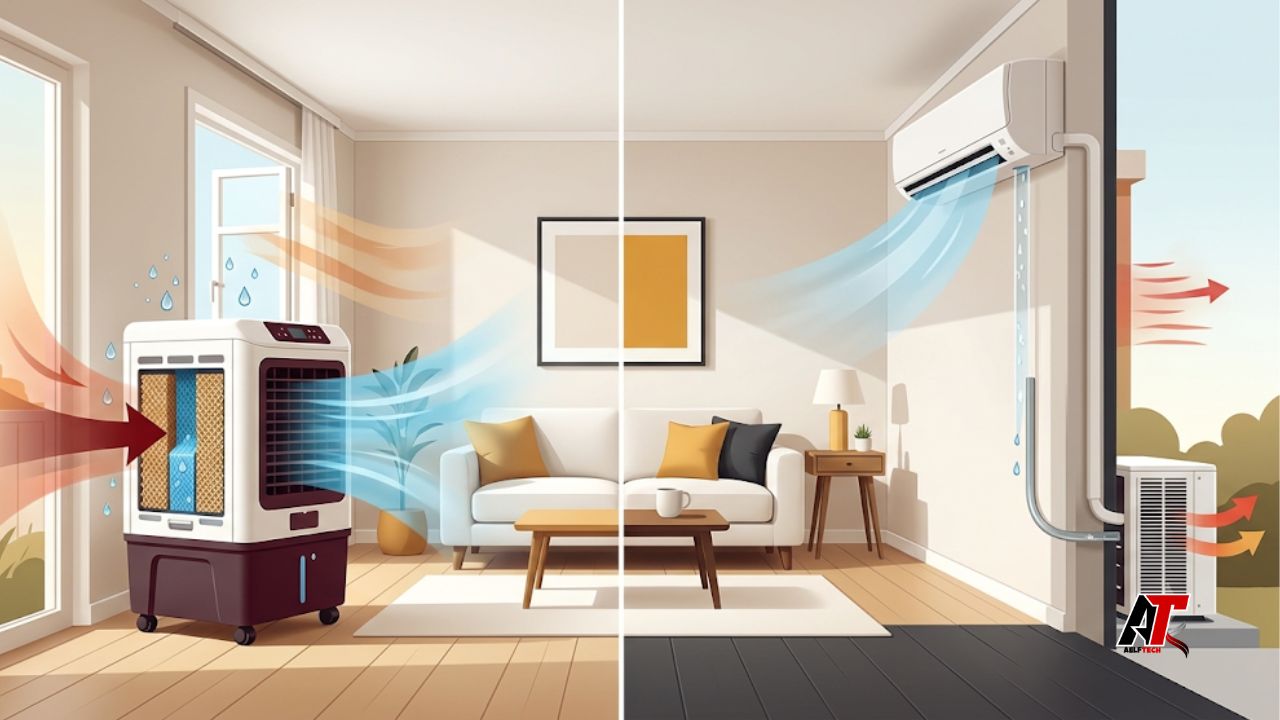
Choosing a home cooling system is not only about finding the coldest option. The best choice must also fit your climate, budget, floor plan, comfort goals, and maintenance routine. That is why the debate around swamp coolers vs AC deserves a practical answer rather than a simple winner.
Evaporative coolers and air conditioners remove heat in very different ways. One uses water evaporation and a steady supply of outside air. The other uses refrigerant, coils, and a compressor to move heat outdoors. Each system can be excellent in the right setting. However, each can also disappoint when the local weather or building design works against it.
This guide compares both options in clear terms. It covers cooling performance, humidity, energy use, installation, upkeep, air quality, water use, and long-term value. By the end, you will know which system is more suitable for your home or workspace.
The Quick Answer: Which Cooling System Is Better?
Air conditioning is usually the better all-around choice for hot, humid, or changing climates. It delivers predictable temperatures, reduces indoor humidity, and works with closed windows and doors. It is also easier to use in multi-room homes where consistent comfort matters.
Evaporative cooling is often the better value in hot and very dry regions. It can provide fresh airflow while using less electricity than compressor-based cooling. In addition, the equipment may cost less to buy and install. However, its performance drops as outdoor humidity rises.
Therefore, the real answer depends on climate first. After that, compare comfort expectations, utility costs, water availability, and maintenance needs.
How Swamp Coolers Work
Evaporative coolers pull warm outdoor air through wet cooling pads. As the water evaporates, it absorbs heat from the air. A fan then sends the cooler, more humid air into the building. Warm indoor air must escape through open windows, doors, or dedicated exhaust vents.
Modern swamp coolers are available as roof-mounted, window-mounted, ducted, and portable units. Larger systems can cool an entire home when they are sized and installed correctly. Smaller models usually provide spot cooling for one room, garage, patio, workshop, or similar area.
The process is simple, but it relies on dry air. Dry air can absorb more moisture, so evaporation happens quickly and creates a stronger temperature drop. When the air is already humid, evaporation slows and the cooling effect becomes weaker.
How Air Conditioning Works
An air conditioner does not create cold air from nothing. Instead, it transfers heat from inside the building to the outdoors. Refrigerant moves through an indoor evaporator coil and an outdoor condenser coil. The indoor coil absorbs heat, while the outdoor coil releases it.
At the same time, moisture condenses on the cold indoor coil. The system drains that water away. As a result, AC cools and dehumidifies the room at the same time. This is a major advantage in muggy weather.
Common options include central air, ducted heat pumps, ductless mini-splits, window units, and portable air conditioners. Their capacity, efficiency, and installation needs vary. Still, they all use the same basic refrigeration cycle.
1. Climate and Humidity
Climate is the most important factor in the swamp coolers vs AC comparison. Evaporative cooling works best during hot, dry weather. Desert and semi-arid regions often provide the ideal conditions because the outdoor air has room to absorb extra moisture.
By contrast, high humidity limits evaporation. A cooler may still move air, but the temperature reduction can become small. Indoor air may also feel damp or sticky. For coastal, tropical, and humid subtropical regions, conventional AC is usually the safer choice.
Weather can also change during the season. Some dry areas experience humid storm periods. During those days, an evaporative cooler may lose much of its advantage. AC remains more consistent because it does not depend on evaporation to remove heat.
2. Temperature Control and Everyday Comfort
Air conditioning offers precise temperature control. A thermostat measures indoor conditions and cycles the system to maintain the chosen setting. Zoned and variable-speed systems can provide even better control across different rooms.
Evaporative cooling feels more natural and breezy. It continually replaces indoor air with fresh outside air. However, it normally cannot hold an exact low temperature in the same way as AC. Its results change with outdoor heat, humidity, airflow, pad condition, and window position.
Personal preference matters too. Some people enjoy the fresh airflow and added moisture from an evaporative system. Others prefer the dry, controlled environment produced by AC. People who need stable temperatures for sleep, remote work, equipment, medication, or health reasons may find AC more dependable.
3. Energy Use and Operating Cost
Evaporative coolers usually need electricity for a fan and a small water pump. They do not rely on an energy-intensive compressor. Therefore, they can use much less electricity in suitable climates. This can reduce summer power bills, especially when the system runs for many hours each day.
Air conditioners generally consume more electricity. However, modern inverter compressors, efficient motors, smart thermostats, better insulation, and correct sizing can lower operating costs. A high-efficiency mini-split may also be economical when it cools only occupied rooms.
Do not compare electricity alone. Evaporative systems also use water, and local water prices vary. In addition, poor maintenance can waste both water and energy. The best cost estimate should include electricity, water, replacement pads, filter care, service visits, and expected equipment life.
4. Purchase Price and Installation
A basic evaporative cooler often costs less than a full central AC system. Installation may also be simpler when the home already has suitable ducts or when a window or side-mounted unit can serve the space. Even so, roof work, duct changes, drainage, electrical connections, and water lines can raise the total price.
Central air usually requires a larger investment. The project may include an outdoor condenser, indoor coil, air handler or furnace connection, refrigerant lines, electrical work, drainage, and duct repairs. Ductless mini-splits avoid major ductwork, but each indoor head adds cost.
5. Indoor Air Quality and Ventilation
Evaporative cooling brings in a continuous stream of outside air. This can reduce stale indoor conditions and may help remove indoor odors. However, outside dust, smoke, pollen, and pollution can also enter. Quality filters and clean pads are important, especially during wildfire, dust, or high-pollen periods.
AC usually recirculates indoor air through a filter. Better filters can capture many airborne particles, provided the system can handle the added airflow resistance. However, standard AC does not automatically provide fresh ventilation. A separate ventilation strategy may be needed in a tightly sealed building.
6. Maintenance and Reliability
Evaporative coolers need regular hands-on care. Owners should inspect the pads, pump, float valve, water distribution lines, reservoir, fan belt, and cabinet. Mineral deposits can build up quickly in areas with hard water. Pads may also develop odors if the unit stays wet and dirty.
Seasonal shutdown is important in freezing climates. The water supply should be disconnected, the reservoir drained, and the unit protected. In spring, the system needs cleaning and inspection before use.
AC systems also need maintenance, but the tasks are different. Filters require routine cleaning or replacement. Outdoor coils need clear airflow. Condensate drains should remain open, and refrigerant components should be checked by a qualified technician when performance drops.
In either case, neglected equipment becomes less efficient and less reliable. The best system is one the owner is willing and able to maintain properly.
7. Water Use and Environmental Factors
Evaporative cooling saves electricity but consumes water. The amount depends on unit size, weather, operating time, bleed-off settings, and water quality. In drought-prone areas, water use may be a serious concern even when the energy savings look attractive.
Air conditioning uses little or no operating water in a typical residential setup. However, it consumes more electricity and relies on refrigerant. Refrigerant leaks can affect the environment, so correct installation, servicing, and end-of-life recovery matter.
The greener option depends on local resources. In a dry region with cleaner electricity constraints but adequate water, evaporative cooling may make sense. In a water-stressed area with efficient electric power, a high-efficiency heat pump or AC system may be the better environmental choice.
Side-by-Side Comparison
The table below highlights the practical differences that matter most during a purchase decision.
| Factor | Evaporative Cooler | Air Conditioner |
| Best climate | Hot and dry | Hot, humid, or mixed |
| Cooling method | Water evaporation | Refrigerant heat transfer |
| Humidity effect | Adds moisture | Removes moisture |
| Windows | Usually partly open | Usually closed |
| Electricity use | Generally lower | Generally higher |
| Water use | Continuous during operation | Minimal in standard homes |
| Temperature control | Weather-dependent | Precise and consistent |
| Maintenance | Pads, pump, reservoir, minerals | Filters, coils, drains, service |
| Fresh-air supply | Continuous outside air | Mostly recirculated air |
| Typical fit | Dry regions and open spaces | Most climates and room layouts |
Which System Is Better for Different Situations?
Choose evaporative cooling when the climate is consistently hot and dry, you value fresh airflow, and you want lower electricity use. It is also a strong option for garages, workshops, warehouses, patios, and other spaces where doors open often and perfect thermostat control is not essential.
Choose AC when summers are humid, temperatures must remain stable, or the building needs closed windows. AC is also better for allergy control during polluted outdoor conditions, provided the filtration and ventilation design are appropriate. It usually suits bedrooms, offices, multi-story homes, server areas, and homes with many enclosed rooms.
How to Choose the Right Cooling System
Start with local summer humidity, not just the highest temperature. Ask a contractor to explain expected indoor results during typical and worst-case weather. A responsible estimate should consider wet-bulb temperature, building size, insulation, window area, orientation, occupancy, and heat-producing appliances.
Next, define your comfort target. Do you need a steady set temperature, or is a cooler breeze enough? Are there rooms that must stay closed? Does anyone in the home react strongly to humidity, smoke, dust, or pollen? These answers can be more important than the purchase price.
Then compare full ownership costs. Request written estimates for equipment, installation, electricity, water, filters, pads, service, repairs, and warranty coverage. Finally, confirm that the installer will size the system instead of relying on a simple rule of thumb.
See aelftech.com usa for more practical home and technology guides.
Frequently Asked Questions
Can a swamp cooler cool an entire house? Yes, a correctly sized and installed whole-house model can cool an entire home in a dry climate. It needs a clear exhaust path and balanced airflow. Results will still depend on outdoor humidity and the home’s layout.
Do swamp coolers work with windows closed? Usually, no. The incoming air needs a way to push warm indoor air out. Closed windows can cause humidity buildup and weak airflow unless the home has dedicated exhaust vents or up-ducts.
Is a portable evaporative cooler the same as portable AC? No. A portable evaporative cooler adds moisture and works best with fresh airflow in dry conditions. Portable AC uses refrigerant, removes heat through an exhaust hose, and also dehumidifies the room.
Which option is cheaper to run? Evaporative cooling is often cheaper to run in a suitable dry climate because it uses no compressor. Still, water costs, maintenance, equipment efficiency, and operating hours affect the final bill.
Final Verdict
There is no universal winner in the swamp coolers vs AC debate. Evaporative cooling can be efficient, affordable, and refreshing in dry heat. It provides constant outdoor air and may reduce electricity use. Yet it needs water, frequent maintenance, and low humidity to perform well.
Air conditioning costs more to operate in many cases, but it delivers stronger and more consistent cooling. It also removes humidity and works across a wider range of climates. For humid regions and homes that need precise comfort, AC is usually the better choice.
Before buying, study your climate, building design, comfort needs, and total ownership cost. The right system is not simply the most powerful one. It is the system that performs reliably in your conditions without creating new problems for your budget, air quality, or daily routine.
Leave a Reply