
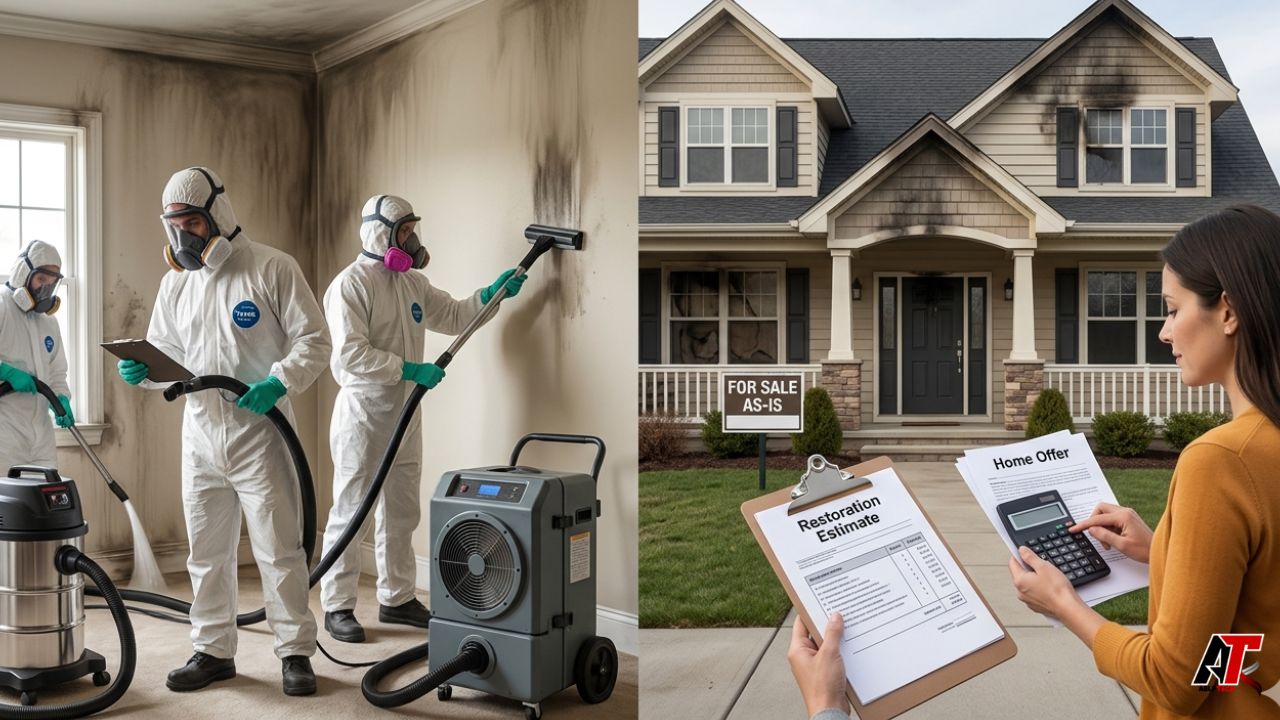
A house fire may end within minutes, yet smoke can keep creating problems long afterward. Fine soot settles behind cabinets, inside ductwork, across insulation, and deep within porous materials. Even when the flames affected only one room, odors and residue may travel throughout the property. That leaves many homeowners facing a difficult financial choice: pay for professional restoration and then sell, or avoid a lengthy cleanup by selling the home in its current condition.
The right answer rarely comes from comparing one contractor quote with one buyer offer. A sound decision requires a broader calculation that includes smoke damage restoration costs, insurance proceeds, temporary housing, mortgage payments, code upgrades, possible delays, and the price discount attached to an as-is sale. This guide explains each side of the equation so you can judge which route protects your time, cash flow, and home equity.
What Smoke Damage Restoration Actually Includes
Smoke restoration is more than repainting stained walls or opening windows. Professionals first assess the source of the fire, the type of residue, and the materials affected. Wet smoke from low-heat fires behaves differently from dry smoke produced by hotter fires. Protein residue from a kitchen fire can be nearly invisible while still leaving a powerful odor. Because the cleaning method must match the residue, a complete inspection is essential before anyone promises a final price.
A typical project may include emergency board-up, debris removal, HEPA vacuuming, surface cleaning, content packing, fabric treatment, thermal fogging, hydroxyl treatment, odor sealing, duct inspection, repainting, and replacement of materials that cannot be safely cleaned. Water used to extinguish the fire can also create a second restoration problem. If drywall, flooring, or insulation remains wet, drying and mold prevention may become part of the scope.
How Much Does Smoke Damage Restoration Cost?
National cost guides provide useful starting points, but they should not replace a site-specific estimate. Angi and HomeAdvisor report that smoke damage restoration commonly costs about $200 to $1,200 per affected room. Their figures include services such as deep cleaning, deodorization, and specialized odor treatments. HomeAdvisor’s broader 2026 disaster-recovery guide places combined fire-and-smoke restoration at roughly $3,300 to $22,400 for many residential projects. Severe structural damage, extensive contents loss, or whole-house contamination can push the final bill far beyond those ranges.
| Damage Level | Typical Conditions | Possible Scope | Budget Direction |
| Light | Localized odor or surface soot | Cleaning, deodorizing, limited repainting | $200–$1,200 per affected room may be a useful starting point |
| Moderate | Several rooms, porous materials affected | Contents cleaning, sealing, flooring or drywall replacement | Often several thousand to tens of thousands of dollars |
| Severe | Whole-house smoke, fire, water, or structural damage | Demolition, reconstruction, systems work, code upgrades | Can exceed standard national ranges substantially |
The largest price drivers are the size of the contaminated area, the material burned, the time residue remained untreated, and whether HVAC or structural components were involved. Labor rates and disposal rules vary by location. Older homes may also require lead-safe practices, asbestos testing, or upgrades to electrical and building systems before reconstruction can pass inspection.
Hidden Expenses That Can Change the Repair Decision
The restoration proposal is only one line in the real cost of repairing before a sale. A damaged house may continue generating expenses while work is underway. Those carrying costs can turn an apparently profitable repair into a weak financial outcome, especially when contractors uncover additional damage after demolition begins.
- Mortgage, property tax, insurance, security, utilities, and lawn or snow maintenance during the restoration period.
- Temporary housing, storage, pet boarding, extra travel, and meals when the property is uninhabitable.
- Insurance deductibles, uncovered upgrades, depreciation disputes, and work that exceeds policy limits.
- Permit fees, engineer reports, environmental testing, demolition, disposal, and final inspections.
- Real estate commissions, staging, cleaning, photography, seller concessions, and normal closing costs after repairs.
Standard homeowners policies commonly cover direct fire and smoke damage when the loss is caused by a covered event, and many policies include additional living expense coverage when the home cannot be occupied. Coverage limits, exclusions, deductibles, and reimbursement rules still differ. Before signing a restoration contract, request the insurer’s written scope, ask how replacement-cost payments will be released, and confirm which improvements are considered code-required rather than elective upgrades.
What Selling a Smoke-Damaged Home As-Is Means
An as-is listing generally tells buyers that the seller does not plan to make repairs or guarantee the property’s condition. It does not automatically erase the buyer’s right to inspect the property, and it does not remove the seller’s disclosure duties. The National Association of Realtors explains that disclosure requirements depend on state and local law, but known material defects commonly must be reported. Smoke, fire, water intrusion, structural concerns, and completed repair work should be discussed with a qualified local agent or attorney.
The advantage is speed and predictability. You avoid managing demolition, cleaning, contractors, inspections, and a second marketing cycle. The disadvantage is a lower price. Investors usually calculate an offer by estimating the home’s repaired value, subtracting renovation costs, adding a contingency for surprises, and reserving room for holding costs and profit. Buyers may also face financing or insurance obstacles when a property needs major work, which can shrink the conventional buyer pool.
Homeowners who want to compare a direct-sale route can review an informational option such as We Buy Fire Damaged Houses. Obtain more than one offer, verify proof of funds, read all assignment or cancellation clauses, and compare the net amount after fees rather than relying only on the headline price.
Restoration Versus As-Is Sale: Compare the Net, Not the Price
A repaired home may sell for more, but the higher sale price is not the same as higher profit. Build two net sheets before deciding. The repair scenario should subtract every expected project and carrying cost from the likely post-restoration sale proceeds. The as-is scenario should subtract only the costs that remain under the proposed sale, such as unpaid liens, agreed closing charges, or moving expenses.
| Illustrative Comparison | Repair Then Sell | Sell As-Is |
| Expected sale price / offer | $340,000 | $245,000 |
| Restoration and repairs | -$52,000 | $0 |
| Holding and temporary costs | -$14,000 | -$2,000 |
| Selling and closing costs | -$24,000 | -$8,000 |
| Illustrative net before debt payoff | $250,000 | $235,000 |
This example is not a market estimate; it simply shows why the decision can be closer than the two sale prices suggest. A $95,000 difference in gross price becomes only a $15,000 difference after hypothetical repair, carrying, and selling expenses. If the project runs over budget or takes longer than planned, the as-is option could produce the stronger practical result. If insurance pays most of the restoration and the local market rewards move-in-ready homes, repairing could create substantially more equity.
When Repairing Before You Sell Often Makes Sense
Restoration deserves serious consideration when the smoke damage is limited, the structure and major systems remain sound, and the expected increase in market value clearly exceeds the owner’s out-of-pocket cost. It is also more attractive when the insurer has approved a detailed scope, reputable contractors are available, and the homeowner can tolerate the timeline without financial strain.
A repaired property can appeal to a larger group of owner-occupants, including buyers using conventional financing. Professional cleaning records, permits, invoices, photographs, and post-remediation testing can also reduce uncertainty. However, cosmetic improvements should not hide unresolved contamination. The goal is documented restoration, not merely making the house look clean for showings.
When Selling As-Is May Be the Smarter Choice
An as-is sale may be sensible when damage is extensive, insurance coverage is inadequate, or the owner cannot fund work while waiting for reimbursement. It can also fit estates, inherited properties, landlords, relocating owners, or families who need closure more than the final incremental dollar. A long reconstruction can be emotionally exhausting, particularly after a traumatic fire.
Selling without full restoration is also worth considering when multiple specialists identify major uncertainty inside walls, roof assemblies, ducts, wiring, or foundations. The more unknown conditions a project contains, the larger the contingency fund should be. Investors accept that uncertainty because their offers price in risk; an individual homeowner may prefer to transfer that risk rather than manage it.
Insurance, Inspections, and Disclosure Still Matter
Do not begin broad cleanup or dispose of damaged contents before documenting the loss and following the insurer’s instructions. Photograph every affected area, preserve receipts, keep a communication log, and request itemized estimates. The U.S. Fire Administration directs homeowners to recovery guidance covering insurance, property valuation, salvage, and the first steps after a fire. EPA guidance also warns that ash and fine particles can become airborne during cleanup and recommends protective clothing, an N95 respirator, damp cleaning methods, and HEPA-type vacuuming where appropriate.
Buyers should still arrange independent inspections. The Consumer Financial Protection Bureau notes that major defects can complicate closing because some loan programs require repairs before financing is completed. Sellers should therefore identify the realistic buyer pool before choosing a listing strategy. A property that cannot qualify for ordinary financing may need investor-focused marketing, renovation financing, or a cash transaction.
A Five-Step Decision Framework
Use the following sequence to replace guesswork with evidence:
- Get at least two itemized restoration estimates and ask what is excluded, provisional, or subject to demolition findings.
- Request the insurer’s written coverage position, deductible, depreciation details, payment schedule, and additional living expense limits.
- Ask an experienced local agent for a realistic repaired-value range, likely days on market, and expected selling costs.
- Collect two or more as-is offers and compare proof of funds, inspection periods, closing dates, fees, and cancellation rights.
- Calculate best-case, expected, and worst-case net proceeds for both routes, then include the personal value of time and certainty.
A decision spreadsheet does not need to be complicated. Use conservative numbers, include a repair contingency, and avoid counting insurance money until coverage is confirmed in writing. If the difference between the two options is small, speed, housing stability, health concerns, and emotional capacity may reasonably become the deciding factors.
Final Verdict
There is no universal winner in the restoration-versus-as-is debate. Repairing can protect equity when damage is manageable, insurance is responsive, and the post-restoration market value comfortably covers every cost. Selling as-is can protect liquidity and reduce risk when contamination is widespread, the timeline is uncertain, or the homeowner needs a clean exit. The most reliable answer comes from comparing verified net proceeds rather than reacting to the highest sale price or the lowest repair quote. For more practical property, technology, and consumer-focused guides, visit aelftech.com.
Leave a Reply