
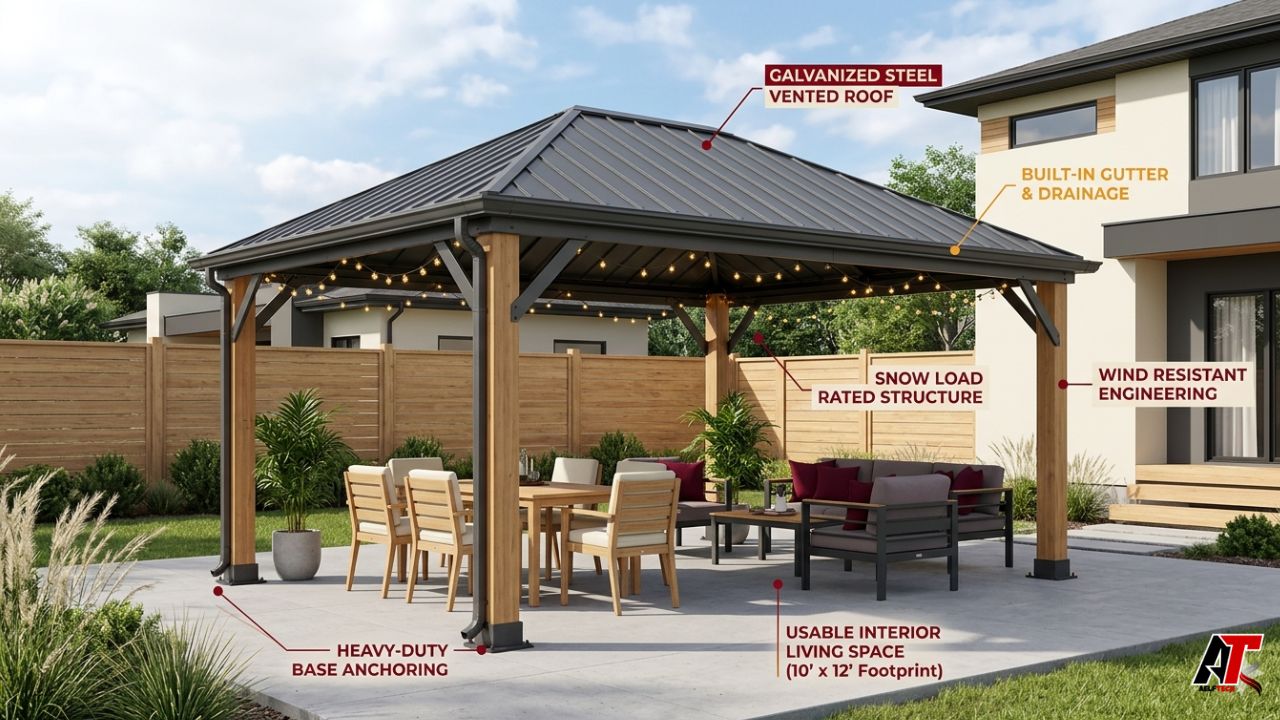
A hardtop gazebo can turn an exposed patio into a shaded dining room, lounge, hot-tub shelter, or outdoor entertaining zone. It can also become an expensive disappointment if the size is wrong, the roof is unsuitable for the climate, the posts are poorly anchored, or local rules are checked only after delivery. Unlike a fabric canopy that may be packed away seasonally, a hardtop model behaves much more like a permanent accessory structure.
That difference should change how you shop. Appearance matters, but the more important questions concern loads, foundations, drainage, corrosion, installation access, spare parts, and long-term maintenance. The best purchase is not necessarily the largest model or the one with the highest advertised discount. It is the gazebo that fits the site, supports the intended use, and can be installed in accordance with the manufacturer’s instructions and local requirements.
Before comparing products, sketch your patio and list how the gazebo will be used. For inspiration, browsing practical gazebo ideas can help you decide whether the space should prioritize dining, conversation seating, a spa, privacy, or flexible entertaining. The idea should come first; the product dimensions should follow.
1. Understand What “Hardtop” Actually Means
Hardtop gazebos are sold with several roof and frame combinations. Common roof materials include galvanized steel, aluminum panels, and polycarbonate. Frames are often powder-coated steel or aluminum. Erommy’s current collection describes reinforced aluminum, steel, and polycarbonate options, so buyers should read the specification for the exact model rather than assuming every gazebo in a collection is built the same way.
A steel roof is opaque, durable, and generally feels substantial, but it can transmit rain noise and add considerable weight. Aluminum resists corrosion well and is lighter, although panel thickness and connection design still matter. Polycarbonate lets in filtered daylight and reduces roof weight, but buyers should examine UV protection, panel structure, heat transmission, scratch resistance, and replacement availability. A double-roof or vented roof can improve hot-air escape, yet it also adds joints that must be assembled and sealed correctly.
The frame deserves equal attention. Aluminum is naturally corrosion-resistant and easier to move during assembly. Steel can provide a strong, rigid feel but depends heavily on coatings, drainage, and fastener quality. In coastal or poolside settings, ask what hardware is supplied and whether upgraded corrosion-resistant fasteners are recommended.
2. Choose the Usable Size, Not the Label Size
A 10-by-12-foot gazebo does not necessarily provide a full 120 square feet of comfortable furniture space. Posts, roof overhangs, braces, curtains, and mosquito-net tracks affect usable dimensions. Measure the clear distance between posts and compare it with the actual footprint of the dining table, sofa, hot tub, or sectional you plan to place inside.
Allow circulation space. Dining chairs need room to slide back, and a grill or heater may require clearances that make it unsuitable for the gazebo altogether. Doors, steps, pool gates, windows, downspouts, and landscape beds should remain accessible. On a deck, confirm that the post locations align with structure capable of carrying the loads; deck boards alone are not a foundation.
Also look above the gazebo. Roof peaks, gutters, branches, overhead utilities, and the eaves of the house can conflict with assembly or future maintenance. A scale plan showing the full roof footprint—not just the post rectangle—can prevent an expensive placement error.
3. Treat Wind and Snow Ratings Carefully
Wind and snow claims can be useful, but only when the test basis, installation conditions, and exact model are clear. A rating may assume complete assembly, specific anchors, closed or removed curtains, a concrete foundation, or maintenance such as clearing accumulated snow. Do not transfer a rating from one gazebo, carport, or product page to another model.
Ask for the installation manual, engineering documentation, and stated wind and snow loads before purchase. Compare those values with local design conditions and building-department requirements. In high-wind or high-snow regions, a local engineer or qualified contractor may need to review the proposed foundation and connections.
The U.S. Department of Energy’s Building America guidance for covered exterior structures emphasizes a continuous load path: roof members connect to beams, beams to columns, and columns to the foundation. The connections are often the weakest part of the system. A heavy roof does not make a gazebo wind-safe if the posts can lift from the patio.
4. Plan the Foundation and Anchoring Before Delivery
A hardtop gazebo should normally be installed on a level, stable base that can support the structure and accept the approved anchors. Concrete slabs and properly designed footings are common solutions. Pavers may look solid but can lift individually unless the anchoring system reaches suitable concrete or engineered footings beneath them. Soil installations require foundations designed for the ground conditions, frost depth, loads, and local code.
If the gazebo will sit on an existing deck, have the framing assessed. Post bases may need to connect through the decking to beams, blocking, or added structural members. Waterproofing around fasteners also matters. Never assume that adding more screws to the deck surface creates a safe connection.
Follow the model-specific anchor schedule, bolt diameter, edge distances, and concrete requirements. Substituting generic stakes or patio weights for permanent anchors may invalidate ratings or warranties. In severe-wind regions, professional review is a small cost compared with a roof structure becoming airborne.
5. Check Permits, Setbacks, Utilities, and HOA Rules
Permit and zoning rules vary widely. Some jurisdictions treat a roofed gazebo as a permanent accessory structure and require a building permit; others create exemptions based on size or attachment, while still enforcing setbacks, easements, height limits, lot coverage, and electrical rules. The City of Sun Prairie, Wisconsin, for example, identifies a gazebo as a permanent roofed structure and requires a building permit. That does not make the same rule universal—it shows why local confirmation is essential.
Contact the local building and zoning offices before ordering. Provide the dimensions, height, roof material, foundation type, distance from property lines, and whether electricity, gas, plumbing, a hot tub, or attachment to the home is planned. Check underground utilities before excavation, and review HOA or community-design restrictions separately from government permits.
Save product drawings and manuals because the permit office or installer may need them. If the seller cannot provide clear dimensions, anchoring instructions, and load information, that is a warning sign for a structure intended to remain outdoors year-round.
6. Think About Water, Heat, and Everyday Comfort
A solid roof creates shade, but it also concentrates rainwater. Check the roof slope, drainage channels, gutter availability, and where runoff will land. Water should not discharge onto steps, doors, the house foundation, pool equipment, or a neighbor’s property. In snowy climates, consider where sliding snow or ice could fall.
Metal roofs can become hot in direct sun and may amplify rainfall. Polycarbonate can brighten the interior but may produce more solar heat than expected. Roof vents, ceiling height, fans, shade orientation, and open sides all affect comfort. If electrical fans, lights, or outlets are planned, use permits, wet-location-rated equipment, and qualified electrical installation where required.
Curtains and mosquito netting improve flexibility, but they also catch wind and collect moisture. Verify that tracks are included, replacement panels are available, and curtains can be secured or removed before storms. Light-coloured roof panels may reduce the visual heaviness of a large structure, while darker panels can coordinate with a home but show dust, pollen, and water marks more readily.
7. Do Not Assume a Gazebo Is a Safe Outdoor Kitchen
A spacious roof can make a gazebo look like the ideal place for a grill, fire pit, or patio heater, but combustion appliances introduce heat, flame, grease, and carbon-monoxide risks. The U.S. Consumer Product Safety Commission advises using grills outdoors in well-ventilated areas and not in a garage, carport, porch, or under a surface that can burn. Follow the appliance manual, gazebo manual, local fire rules, and required clearances.
Do not rely on the word “metal” as proof that the entire assembly is noncombustible. Curtains, screens, furniture, roof coatings, polycarbonate panels, wiring, and nearby walls may still be vulnerable. A safer layout may keep cooking equipment outside the roofed footprint while using the gazebo for dining and seating.
8. Budget for Assembly, Access, and Hidden Costs
Hardtop gazebos often arrive in multiple long, heavy cartons. Before purchase, confirm delivery method, curbside limitations, carton sizes, total weight, storage needs, and the number of people recommended for assembly. Narrow side yards, stairs, soft lawns, and gated communities can complicate moving the components to the installation site.
Installation may require several people, ladders, temporary bracing, drills, sockets, sealant, concrete anchors, and a lift for large roof panels. Add the cost of the slab or footings, permit fees, engineering, electrical work, guttering, professional assembly, furniture, screens, and seasonal maintenance. Comparing only the product price can make a budget look artificially low.
Review the manual before the return period expires. Confirm all cartons and hardware, inspect coated parts for damage, and organize components by step. Do not attempt roof assembly in wind. Fasteners should be tightened in the sequence stated by the manufacturer so the frame remains square.
9. Compare Warranty, Parts, and Seller Support
A gazebo may remain in the yard far longer than the retailer’s standard return window. Read what the warranty covers, what it excludes, and whether labour, shipping, weather damage, corrosion, finish fading, or improper anchoring are excluded. Keep receipts, model numbers, photos, and the final manual.
Replacement roof panels, curtains, nets, connectors, and fasteners can determine whether a minor incident becomes a repair or a full replacement. Ask how long parts are stocked and whether components are model-specific. Product reviews are useful for identifying assembly issues, but prioritize documented specifications and responsive support over star ratings alone.
When comparing hardtop gazebos, examine each product page for the exact roof material, dimensions, package details, accessories, and installation requirements. Collection-level descriptions are a starting point, not a substitute for model-specific documentation.
10. Use a Pre-Purchase Checklist
- Purpose: dining, lounge, spa, shade, entertaining, or mixed use.
- Clear interior dimensions, full roof footprint, peak height, and post locations.
- Roof and frame materials, coatings, panel thickness, and replacement availability.
- Model-specific wind and snow documentation and required anchoring conditions.
- Foundation design, deck capacity, drainage, frost depth, and utility locations.
- Local permits, zoning setbacks, HOA approval, and electrical or gas requirements.
- Delivery access, carton weights, assembly labour, tools, and professional-installation cost.
- Water runoff, sun direction, ventilation, curtains, screens, and furniture clearance.
- Warranty exclusions, spare parts, seller support, and maintenance instructions.
Maintenance After Installation
Inspect the gazebo at least seasonally and after major storms. Look for loose fasteners, movement at post bases, blocked drainage, coating damage, rust, cracked panels, failed seals, and tears in curtains or screens. Clean the roof using the method approved for its material; abrasive tools and harsh chemicals can damage coatings or polycarbonate surfaces.
Remove leaves and standing debris, control vegetation around the posts, and address scratches before corrosion spreads. Follow the manual for snow removal and do not climb onto a roof that is not designed for foot traffic. If the structure shifts, anchors loosen, or roof panels deform, stop using the area until it has been assessed.
Final Verdict: Buy the Site-Appropriate Gazebo
A hardtop gazebo can be an excellent long-term outdoor upgrade, but it should be purchased like a small building rather than a decorative accessory. The right decision connects the product specification to the real site: climate, foundation, wind exposure, drainage, local rules, available assembly labour, and how the space will actually be used.
Do not let a beautiful lifestyle photo answer structural questions. Obtain the manual, verify ratings, measure the furniture, confirm permits, plan the anchors, and calculate the complete installed cost. That process may lead you to a different size or material than you first imagined, but it greatly improves the chance that the finished gazebo will be safe, comfortable, and useful for years.
Leave a Reply