
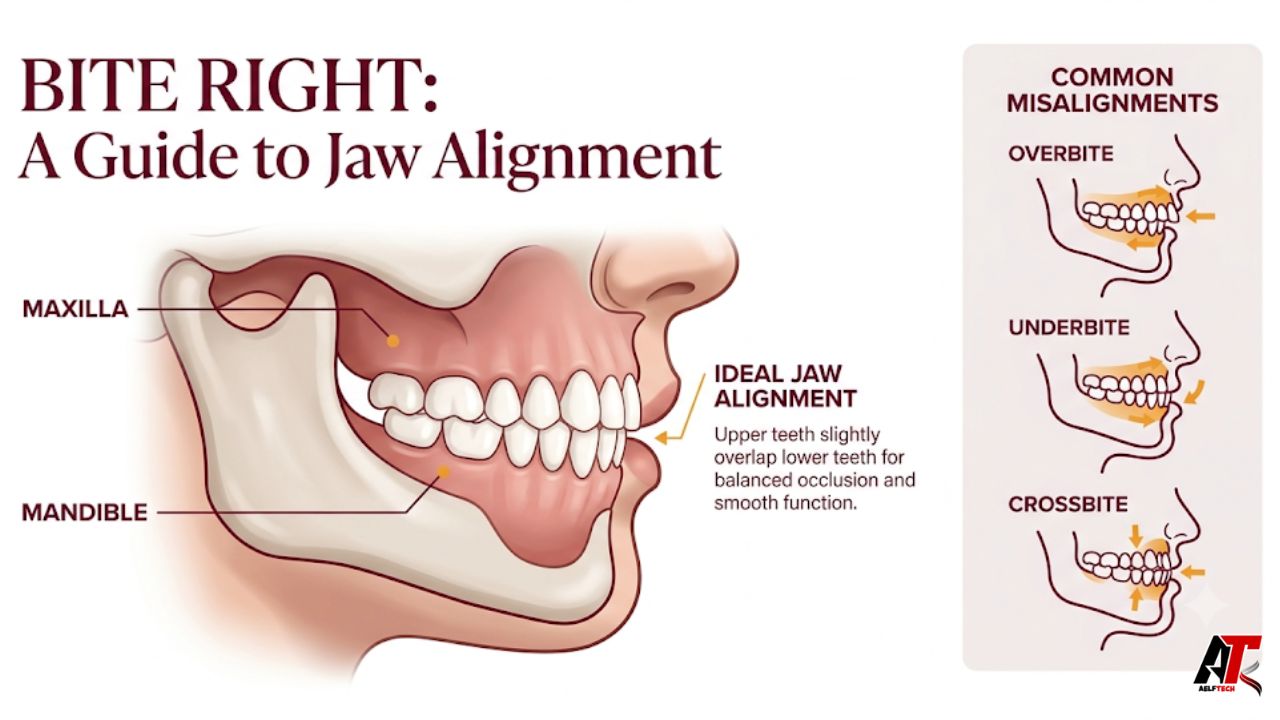
A comfortable bite is easy to overlook until chewing feels awkward, teeth begin to wear unevenly, or the jaw feels strained. Jaw alignment describes the relationship between the upper jaw, lower jaw, and teeth when the mouth closes. When these structures meet in a balanced way, biting and chewing are more efficient, speech is supported, and pressure is shared across the teeth.
Jaw alignment is not only about straight-looking teeth. A person can have an attractive smile but still have a bite problem, while slightly crooked teeth may function well. The clinical term for an improper bite is malocclusion. It may involve tooth position, jaw size or shape, or both.
This guide covers common bite patterns, causes, warning signs, diagnosis, and treatment. It is educational and cannot replace an examination by a dentist or orthodontist.
What Does Healthy Jaw Alignment Look Like?
In a generally healthy bite, the upper teeth sit slightly in front of and over the lower teeth. The molars fit into the grooves of the opposing molars, helping spread pressure during chewing. The jaw should open and close without a major sideways shift.
Perfect symmetry is not required. Faces and jaws naturally vary, and many minor differences do not need correction. Treatment becomes more relevant when alignment affects function, oral health, comfort, tooth stability, or quality of life.
Why a Balanced Bite Matters
A balanced bite helps you bite food, chew efficiently, and speak clearly. When only a few teeth carry most of the pressure, enamel may wear faster and teeth may chip or become sensitive. Crowded or overlapping teeth can also be harder to brush and floss, increasing the risk of decay and gum disease.
Misalignment may contribute to repeated cheek or tongue biting, gum irritation, or difficulty biting into foods. However, jaw pain, headaches, and clicking have many possible causes. A bite problem should not be assumed to be the cause without a proper assessment.
Common Types of Jaw and Bite Misalignment
Overbite and Deep Bite
A small vertical overlap of the upper front teeth is normal. A deep bite occurs when the upper front teeth cover too much of the lower front teeth. In severe cases, the teeth may irritate the gums or roof of the mouth and experience excessive wear.
Overjet
Overjet is the horizontal distance between the upper and lower front teeth. A pronounced overjet can make the upper teeth more vulnerable to injury and may make relaxed lip closure difficult.
Underbite
An underbite occurs when the lower front teeth sit in front of the upper front teeth. It may be caused by jaw growth, tooth position, or both. Depending on severity, it can affect chewing, speech, tooth wear, and facial balance.
Crossbite
In a crossbite, one or more upper teeth bite inside the lower teeth. It may affect the front or back teeth and can occur on one or both sides. Some crossbites cause the lower jaw to shift during closure, especially in growing children.
Open Bite
An open bite means certain upper and lower teeth do not touch when the mouth closes. A front open bite may interfere with biting thin foods, speech, and tongue position. A back open bite can reduce chewing efficiency.
Crowding and Spacing
Crowding develops when there is not enough room for all teeth to align normally, causing overlap, rotation, or abnormal eruption. Spacing may result from small or missing teeth, a larger dental arch, or habits that move teeth apart. Both patterns can change how the bite meets.
What Causes Jaw Misalignment?
Genetics strongly influences jaw size, facial growth, and tooth size. A child may inherit a small jaw and relatively large teeth, creating crowding. Uneven growth of the upper and lower jaws can also produce an overbite, underbite, or crossbite.
Long-lasting childhood habits may influence development. Thumb sucking, prolonged pacifier use, tongue thrusting, and certain swallowing patterns can place repeated pressure on teeth and supporting bone. Early loss of baby teeth may allow nearby teeth to drift, while retained baby teeth may block permanent teeth.
Other contributors include missing or extra teeth, unusually shaped teeth, poorly fitting restorations, jaw injuries, cleft lip or palate, and growth disorders. Teeth that cannot erupt normally may also affect space and alignment. Readers can learn more about (impacted teeth), which are sometimes discovered only during a routine X-ray.
Signs That Your Bite May Need Evaluation
You may benefit from an assessment if you notice difficulty biting or chewing, repeated cheek or tongue biting, excessive wear on certain teeth, front teeth that do not meet, or a jaw that shifts to one side when closing.
Other signs include speech changes, lips that do not close comfortably, food repeatedly trapping around crowded teeth, or a noticeable change in how the upper and lower teeth fit. Painful locking, persistent swelling, sudden bite changes, or difficulty opening the mouth require prompt professional attention.
How Jaw Alignment Is Diagnosed
Diagnosis begins with a dental and health history. The clinician may ask about pain, injury, grinding, missing teeth, previous orthodontic care, and when the problem began. The examination usually covers the teeth, gums, facial proportions, jaw movement, muscle tenderness, and tooth contact.
Photographs, digital scans, or impressions may be used to model the bite. Dental X-rays reveal roots, unerupted teeth, bone levels, and jaw structures. Panoramic imaging shows the jaws and teeth broadly, while cephalometric imaging helps evaluate the relationship between the jaws and skull.
A complete diagnosis separates dental misalignment, which mainly involves tooth position, from skeletal misalignment, which involves jaw size or position. This distinction determines which treatment is likely to work.
Treatment Options for Jaw Alignment
Monitoring
Not every irregular bite needs immediate treatment. Mild problems that do not affect health or function may be monitored during routine visits. In children, a dentist or orthodontist may watch how permanent teeth erupt and how the jaws grow.
Braces and Clear Aligners
Braces use brackets and wires to move teeth gradually and can treat many types of crowding, spacing, rotation, and bite problems. Clear aligners use a planned series of removable trays and can be effective for many mild to moderate cases and selected complex problems. They must be worn as prescribed and are not ideal for every skeletal or dental condition.
Growth-Guidance Appliances
For some children and adolescents, expanders or other appliances may be used while the jaws are developing. A palatal expander can widen a narrow upper arch and help correct certain crossbites. Timing is important because growth-based treatment has different possibilities before and after skeletal maturity.
Impacted or Missing Teeth
An impacted tooth may be monitored, surgically exposed and guided into position, or removed. The choice depends on its location, health, and effect on nearby teeth. Missing teeth may be managed by closing the space orthodontically or replacing the tooth with a bridge, implant, or denture.
When several teeth are missing, restoring stable contact between the upper and lower arches becomes part of bite planning. People researching permanent dentures, like those in Scott, LA should ask how tooth position, bone support, chewing forces, and maintenance will be evaluated before choosing a fixed or implant-supported option.
Jaw Surgery
A severe skeletal difference may not be correctable through tooth movement alone. In these cases, an orthodontist may work with an oral and maxillofacial surgeon. Orthognathic surgery repositions one or both jaws, while orthodontics aligns the teeth before and after surgery. It is reserved for significant functional or structural problems.
Retainers
Teeth can shift after active treatment, so retainers are essential. They may be removable or bonded behind the teeth. Wearing a retainer as directed and attending regular dental visits helps protect the result.
Jaw Alignment and TMJ Disorders
The temporomandibular joints connect the lower jaw to the skull. Temporomandibular disorders, or TMDs, may affect the joints, chewing muscles, or associated headaches. Symptoms can include pain, stiffness, limited movement, locking, or painful clicking.
It is tempting to assume that every case of jaw pain comes from a bad bite, but current evidence does not support a simple cause-and-effect relationship between malocclusion and TMD. Painless clicking is also common and may not need treatment. Persistent pain deserves a careful diagnosis rather than irreversible bite changes based on guesswork.
Jaw Alignment in Children and Adults
Regular dental visits allow a child’s eruption pattern and jaw growth to be observed. An early orthodontic assessment does not always lead to immediate braces. Monitoring may be enough, while early treatment may help a developing crossbite, guide growth, or protect protruding teeth.
Adults can also benefit from orthodontic care. Age alone does not prevent tooth movement, but healthy gums and bone support are important. Adult cases may require coordination among a dentist, orthodontist, periodontist, prosthodontist, or oral surgeon, especially when teeth are missing or heavily restored.
Protecting Your Bite and Treatment Results
Brush twice daily with fluoride toothpaste, clean between the teeth, and attend routine dental examinations. Wear a sports mouthguard during contact activities and avoid using teeth to open packages or bite very hard objects. If you grind or clench, discuss it with a dentist instead of relying on a poorly fitting over-the-counter device.
Follow orthodontic instructions, keep braces or aligners clean, and wear retainers on the recommended schedule. Seek care if a retainer breaks, teeth suddenly shift, a filling or crown feels too high, or the bite changes after an injury.
When to See a Professional
Book a dental assessment when a bite problem interferes with eating, cleaning, speaking, comfort, or confidence. Seek prompt care for sudden bite changes, facial trauma, severe pain, swelling, fever, pus, numbness, or a jaw that locks open or closed. Children with a noticeable crossbite, significant protrusion, delayed eruption, or continuing oral habits should also be evaluated.
A dentist can identify disease and refer you to an orthodontist when specialist correction is appropriate. For more accessible health and technology explainers, readers can visit aelftech.com.
Frequently Asked Questions
Can jaw alignment improve naturally?
Minor changes occur as children grow and permanent teeth erupt, but established bite problems do not reliably correct themselves. A professional can determine whether monitoring or treatment is appropriate.
Can braces change the jawline?
Braces mainly move teeth. Correcting tooth position may improve facial balance, while selected appliances can influence growth in younger patients. Major skeletal changes in adults may require jaw surgery.
Is a clicking jaw a sign of misalignment?
Not necessarily. Clicking without pain is common. Painful clicking, locking, limited movement, or a sudden bite change should be assessed.
How long does treatment take?
Treatment length varies. Mild tooth movement may take months, while complex orthodontic or surgical care may take several years from planning through retention.
Conclusion
Healthy jaw alignment is a functional relationship among the teeth, jaws, muscles, and supporting tissues. It can make chewing, speaking, cleaning, and protecting teeth easier, but not every imperfect bite needs treatment. The right decision depends on symptoms, severity, growth, oral health, and personal goals.
A thorough examination is more reliable than comparing your smile with online photos or attempting unmonitored treatment. With an accurate diagnosis and a coordinated plan, children and adults can improve bite function while protecting long-term oral health.
Leave a Reply