
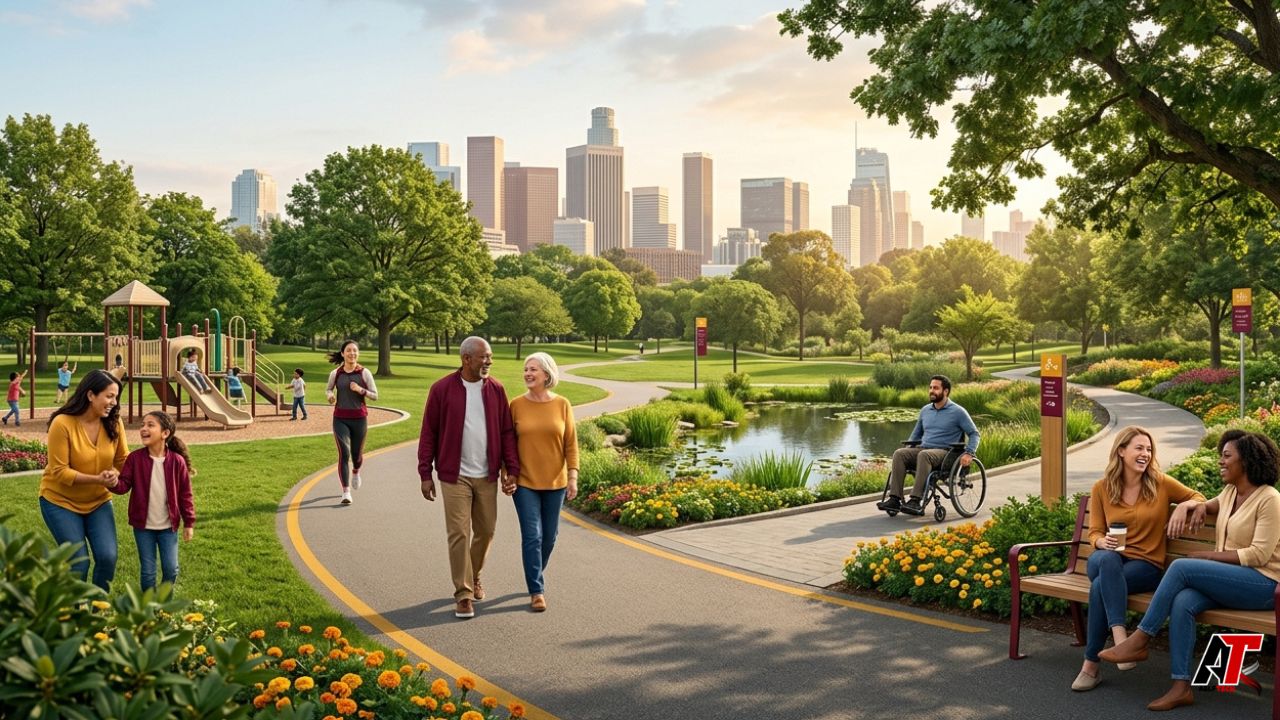
In a dense city, a park can look like a pleasant break between buildings. In reality, it can function as part of the public-health infrastructure. A nearby green space gives residents somewhere to walk, exercise, play, rest, meet neighbors, and escape traffic noise. Trees and vegetation can also provide shade, reduce local heat, and soften some environmental pressures created by paved urban areas.
The health value of a park does not come from greenery alone. It comes from the opportunities the space creates. A safe walking loop can make daily movement easier. A shaded bench can help an older adult remain active without becoming exhausted. A playground can support children’s physical and social development. A quiet lawn or tree-lined path can offer a short period of recovery from stress.
Research and public-health guidance increasingly describe several connected pathways through which urban green spaces support health: physical activity, psychological restoration, social connection, and reduced exposure to heat, noise, and some forms of pollution. The strongest benefits appear when parks are close, welcoming, safe, accessible, and designed for the people who actually use them.
1. Parks Make Everyday Physical Activity Easier
One of the clearest benefits is convenience. People are more likely to walk, cycle, play, or exercise when a suitable place is nearby and easy to reach. The Centers for Disease Control and Prevention notes that people with better access to parks and trails tend to be more physically active, especially when they live close enough to walk or bike and feel safe while doing so.
This matters because exercise does not have to happen in a gym. Brisk walking, jogging, informal sports, active play, wheelchair rolling, outdoor fitness classes, and cycling can all contribute to weekly activity. Regular physical activity supports heart health, blood-pressure control, stronger bones and muscles, weight management, sleep, balance, and a lower risk of several chronic diseases.
Parks also reduce friction. There is no membership fee for a public path, and people can often fit a short walk into lunch, school pickup, or an evening routine. That flexibility can make activity more sustainable than a plan that requires travel, equipment, or a fixed appointment.
2. Green Space Can Help the Mind Recover From Stress
Urban life requires continuous attention. Traffic, screens, deadlines, noise, crowds, and visual clutter compete for mental energy. Natural settings offer a different pattern of stimulation. Leaves moving, birdsong, open sky, water, and changing light can hold attention gently rather than demanding constant decisions.
WHO reviews identify psychological relaxation and stress alleviation as important ways urban green spaces may support health. Research also links green-space exposure with better mental well-being and lower levels of stress, anxiety, or depressive symptoms, although outcomes vary by study design, population, park quality, and how exposure is measured.
A park visit is not a substitute for professional mental-health treatment. It can, however, become a practical part of a broader routine. A quiet walk before work, ten minutes on a bench, or an outdoor conversation may create enough distance from a stressful environment to improve mood and perspective.
3. Outdoor Movement Combines Two Helpful Experiences
Exercise and contact with nature can reinforce each other. Movement supports mood, sleep, cardiovascular health, and brain function. A pleasant green setting can make the activity feel less repetitive and encourage people to continue for longer or return more often.
Recent research on urban green exercise suggests positive mental-health outcomes when physical activity takes place in green urban settings. The practical lesson is simple: the best park routine does not need to be intense. Walking at a comfortable pace, stretching under shade, playing with children, or joining a community class can still be worthwhile.
4. Parks Support Social Connection and Belonging
Loneliness can exist even in a crowded city. Parks create shared spaces where interaction can happen without a formal invitation or commercial purchase. Neighbors greet each other on a path, parents talk near a playground, older adults meet on benches, and community groups gather for events, gardening, sports, or cultural activities.
These repeated low-pressure encounters can strengthen familiarity, trust, and attachment to place. Research on urban green space and social cohesion describes pathways involving social support, belonging, participation, and community empowerment. The benefit is not limited to close friendship; simply recognizing familiar faces can make a neighborhood feel less anonymous.
Design strongly affects this outcome. Seating arranged for conversation, tables, playgrounds, dog areas, sports courts, community gardens, and flexible lawns invite different kinds of contact. Empty space without shade, lighting, maintenance, or useful facilities may remain underused.
5. Trees and Vegetation Help Cities Manage Heat
Cities can become hotter than surrounding areas because roads, roofs, and buildings absorb and retain heat. Trees and other vegetation cool local environments through shade and evapotranspiration. The U.S. Environmental Protection Agency reports that a review of more than 300 studies found urban forests were cooler on average than urban non-green areas.
Cooling is a direct health issue. High temperatures can worsen cardiovascular and respiratory strain and increase the risk of heat illness, especially for older adults, young children, outdoor workers, and people with certain medical conditions. Shaded parks give residents places to move or rest with less direct sun exposure, though hydration, weather awareness, and heat-safety guidance still matter.
6. Parks Can Improve the Everyday Environmental Experience
Vegetation can capture some airborne pollutants, reduce glare, absorb rainfall, and soften noise. Parks may also provide safer places to exercise away from heavy traffic. WHO identifies green and blue spaces as refuges from noise and as locations that support relaxation, active travel, recreation, and social interaction.
These benefits should be described carefully. A park near a busy road is not automatically free from air pollution, pollen can affect people with allergies, and poorly maintained water or vegetation can create hazards. Good planning considers tree species, traffic exposure, drainage, lighting, visibility, and maintenance rather than assuming that every form of greenery produces the same result.
7. Children Gain Space to Move, Explore, and Learn
Children need frequent opportunities for active play, but many urban homes have limited outdoor space. Parks can provide climbing, running, balancing, imaginative play, and contact with natural materials. These activities support motor skills, confidence, social learning, and physical fitness.
Natural features can expand the experience beyond fixed equipment. Logs, gardens, slopes, sand, water, and open-ended play areas encourage creativity and problem-solving. Safe routes, age-appropriate equipment, shade, toilets, seating for caregivers, and inclusive play features determine whether families can use the park comfortably.
8. Older Adults Benefit From Movement and Routine
For older adults, regular activity helps preserve mobility, balance, strength, and independence. A nearby park can make walking feel purposeful and socially connected rather than clinical. Familiar routes also support routine, which may improve consistency.
Small design details become especially important: smooth paths, handrails, frequent benches, clear signs, accessible toilets, shade, safe crossings, and entrances that accommodate mobility devices. A park may technically exist within walking distance but remain functionally inaccessible if the route is steep, broken, poorly lit, or difficult to cross.
9. Quality and Safety Matter as Much as Proximity
Distance is only one measure of access. Residents may avoid a nearby park if it feels unsafe, lacks maintenance, has no shade, contains inaccessible paths, or does not reflect community needs. CDC guidance emphasizes safe, equitable, and inclusive access, along with community involvement in design and programming.
A high-quality park usually combines several elements: visible entrances, connected walking routes, lighting suited to the setting, clean facilities, seating, shade, active areas, quiet areas, accessible surfaces, and regular maintenance. Programming can extend the value through walking groups, sports, arts, markets, nature activities, and inclusive recreation.
How Different Park Features Support Well-Being
| Park feature | Possible health pathway | Practical benefit |
| Walking loops | Physical activity and routine | Supports walking, jogging, rolling, and rehabilitation-friendly movement |
| Trees and shade | Cooling and comfort | Makes longer visits and summer activity more manageable |
| Benches and tables | Rest and social contact | Supports older adults, caregivers, conversation, and informal gatherings |
| Playgrounds and courts | Active play and fitness | Encourages children, teens, families, and teams to move |
| Gardens and natural areas | Restoration and attention | Offers quieter sensory experiences and nature contact |
| Accessible entrances and paths | Equitable participation | Allows more people with mobility limitations to use the space |
Simple Ways to Use a City Park for Better Health
- Start small. A ten-minute walk is easier to repeat than an ambitious routine that quickly becomes exhausting.
- Choose a regular time. Link the park visit to lunch, school pickup, commuting, or an evening habit.
- Use more than one zone. Combine a walking path, bench, garden, play area, or open lawn according to your needs.
- Invite someone. A walking partner can add safety, motivation, and social connection.
- Adjust for weather. Use shade, water, suitable clothing, sun protection, and local heat or air-quality guidance.
- Respect your limits. People with health conditions should follow appropriate medical advice and choose suitable intensity.
Equitable Access Is a Public-Health Issue
The benefits of parks cannot be separated from who can reach and use them. Some neighborhoods have large, well-maintained green spaces, while others have small sites, unsafe routes, limited facilities, or few trees. Unequal access can reinforce existing differences in physical activity, heat exposure, social opportunity, and well-being.
Cities can respond by prioritizing underserved areas, connecting parks to sidewalks and public transport, involving residents in decisions, and measuring quality as well as acreage. Improvements should also consider unintended consequences such as displacement or rising costs around newly upgraded green spaces.
A Note on Visual Inspiration
A useful visual example of a contemporary urban park can be viewed on Pixabay. The image was shared by MichelleMaria_Pitzel and shows how trees, pathways, buildings, and open space can coexist within a city setting.
Final Thoughts
City parks improve well-being because they make healthy choices easier and urban life more humane. They create room for movement, mental recovery, play, social contact, cooling, and contact with nature. These benefits are connected: a cooler, safer, more attractive park invites longer visits, and longer visits create more opportunities for activity and connection.
The most effective parks are not simply green patches on a map. They are maintained, accessible, inclusive places shaped around real community needs. When cities invest in quality and residents build parks into ordinary routines, a public space can become a practical resource for both mental and physical health. For more informative lifestyle and community guides, visit aelftech.com.
Leave a Reply