
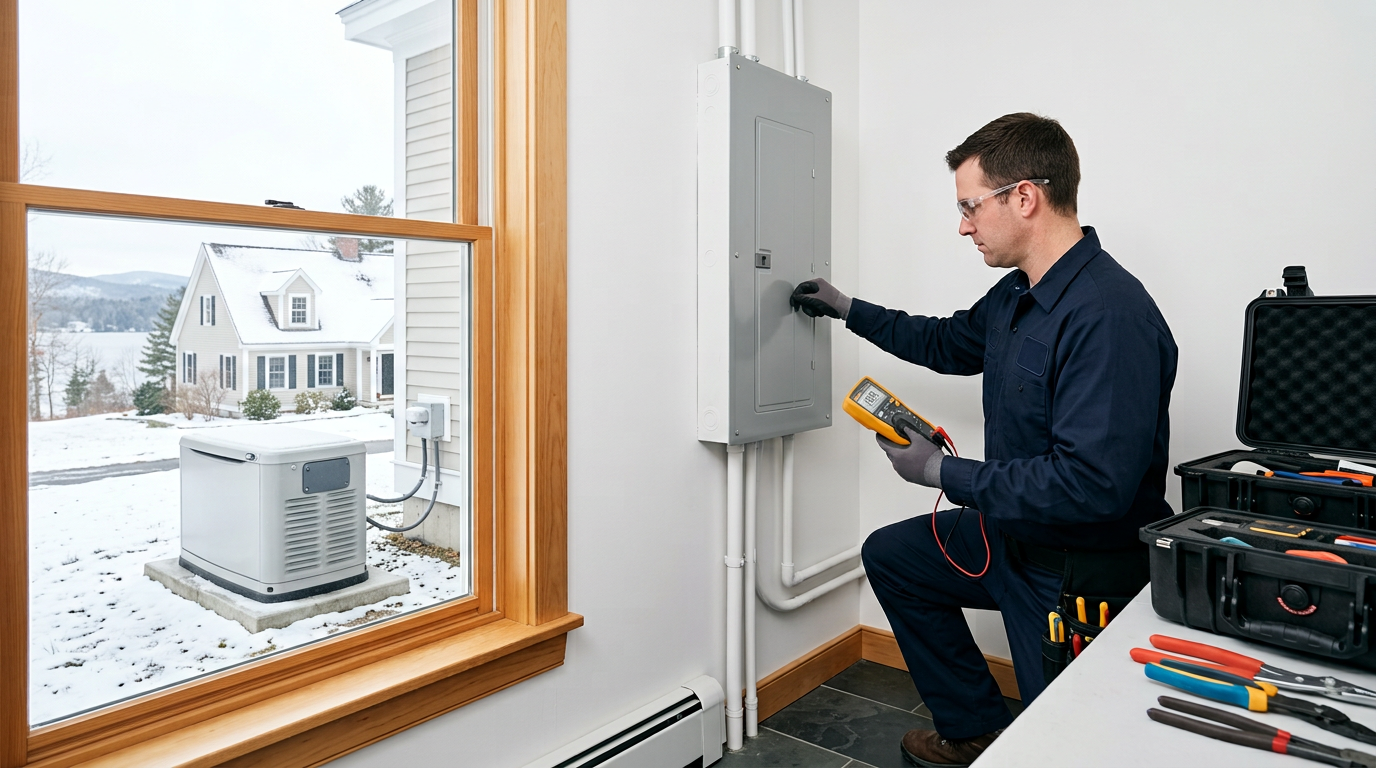
Choosing Whiting Electrical Services gives Laconia and Lakes Region property owners access to professional electrical repairs, inspections, panel upgrades, standby generators, EV chargers, wiring, lighting and surge protection. Electrical reliability is especially important in New Hampshire, where winter storms, ice, heavy snow and extended outages can place unusual demands on homes and businesses. A qualified electrician can identify unsafe conditions, calculate new loads and install equipment as one coordinated system. This guide explains key services, urgent warning signs, project-planning questions and common mistakes that property owners should avoid.
What Is Whiting Electrical Services?
Whiting Electrical Services is a veteran-owned electrical contractor serving Laconia, New Hampshire, and surrounding Lakes Region communities. According to its company information, the team provides residential and commercial electrical work, including panels, service upgrades, generators, EV charging, grounding, circuits, wiring, lighting, hot-tub wiring and whole-house surge protection.
The company also identifies itself as a generator dealer and service provider. Customers should confirm the exact equipment brands, certification, maintenance coverage and warranty terms relevant to their proposed system.
A professional electrical recommendation should be based on inspection and testing. A larger panel, generator or EV charger cannot be selected correctly without understanding existing service capacity, wiring condition, calculated demand and equipment requirements. Whiting Electrical Services should explain the evidence, options and project limitations in clear language.
Why Electrical Planning Matters in the Lakes Region
Homes around Laconia range from older properties to new construction, seasonal residences, lake houses and renovated buildings. Each can present different electrical needs.
Older systems may have limited circuits, outdated equipment or modifications completed over many years. Seasonal homes may need freeze protection, remote monitoring or backup power. Lake properties often include docks, pumps, hot tubs and outdoor lighting, where water exposure makes protective devices and bonding especially important.
New electrical loads can include:
- Heat pumps and air-conditioning equipment
- Electric water heating
- EV charging
- Workshops and garages
- Hot tubs and pools
- Home offices
- Standby generators
- Smart controls
- Outdoor living areas
- Additions and finished basements
Whiting Electrical Services can evaluate these loads as part of the complete service rather than treating each new device in isolation.
9 Essential Services From Whiting Electrical Services
Electrical projects should begin with safety, capacity and long-term use. The following services address common residential and commercial concerns throughout central New Hampshire.
1. Comprehensive Electrical Inspections
An electrical inspection evaluates accessible components for condition, safety and suitability. It may be appropriate before a property purchase, renovation, generator installation, EV charger project or major appliance change.
The electrician may review service equipment, panels, breakers, grounding, bonding, accessible wiring, outlets, GFCI protection, lighting and signs of overheating or unapproved modifications. The scope should be defined because a service inspection does not expose every concealed cable.
Whiting Electrical Services should separate immediate hazards from recommended improvements. A scorched connection or damaged service equipment requires different priority from adding convenience outlets.
A written report helps property owners plan. It should describe the observed concern, suggested response and any areas that could not be inspected. Older wiring is not automatically unsafe solely because of age, but its condition and use need appropriate evaluation.
2. Electrical Panel Repair and Upgrade
The main panel distributes power through breakers that protect branch circuits. Heat damage, corrosion, loose connections, unsuitable components, inadequate space and planned loads can justify professional work.
Panel replacement should be based on condition and project requirements, not a generic age threshold. Conversely, visible melting, burning, water intrusion, buzzing or repeated breaker problems should not be ignored.
Whiting Electrical Services offers panel installation, repair and upgrade. The proposal should identify panel rating, breaker type, main disconnect, grounding changes, surge protection, permits, utility coordination and expected outage.
A larger enclosure does not automatically increase electrical service capacity. If capacity changes, meter equipment, service conductors and utility work may also be involved.
3. Whole-Home Generator Installation
Winter outages can interrupt heating controls, well pumps, refrigeration, lighting, communications and medical equipment. A standby generator can support selected or broader loads when designed correctly.
Sizing begins with priorities, not square footage. Electric heat, central air conditioning, pumps and water heaters can add substantial demand. Load management may allow a smaller generator to serve essential needs without operating every appliance simultaneously.
Whiting Electrical Services provides generator installation and related service. A complete proposal should define generator output, transfer equipment, fuel responsibility, placement, protected circuits, permits, startup and owner training.
Generators produce carbon monoxide. They must operate outdoors with clearances specified by the manufacturer and applicable requirements. Portable generators must never be used inside a home, garage or enclosed porch, even with doors open.
4. EV Charger Installation
EV chargers can draw power for hours, making circuit design and connection quality important. Installation requires evaluation of service capacity, panel space, conductor route, equipment rating and environmental exposure.
The fastest available charger is not always necessary. Daily mileage, parking time, vehicle acceptance rate and utility pricing should influence the design. In some homes, load-management equipment may help avoid or postpone a service upgrade.
Whiting Electrical Services can assess hardwired and receptacle-based options. The charger should be compatible with the vehicle and mounted where the cable reaches safely without creating a trip or snow-removal hazard.
Do not use ordinary extension cords or improvised adapters for vehicle charging. Warm plugs, discolouration, charging interruptions and repeated tripping need professional evaluation.
5. Grounding, Bonding and Surge Protection
Grounding and bonding support electrical safety, but they perform different functions. Bonding connects conductive components to provide an effective path for fault current. Grounding connects the electrical system to earth according to the design.
Improper neutral and ground connections can energise metal components or create current on paths not intended to carry it. Property owners should not install improvised grounding conductors.
Whiting Electrical Services provides grounding and whole-house surge protection. Service-level surge devices can reduce certain transient voltages from utility events or nearby lightning, but they cannot guarantee protection from every surge.
A layered approach may include service protection, correct grounding and suitable point-of-use devices. Customers should ask how to check the surge protector’s status and when replacement is needed.
6. Hot-Tub, Pool and Outdoor Wiring
Water and electricity require careful separation and protective design. Hot tubs, pools, docks, exterior outlets and landscape lighting can involve GFCI protection, bonding, weather-resistant equipment, disconnects and specific clearances.
Whiting Electrical Services lists hot-tub and pool wiring. The electrician should review exact equipment specifications before rough-in. Pump, heater, control and lighting loads can vary substantially between models.
A hot tub should not be installed on the assumption that an existing outdoor circuit is sufficient. Service capacity, conductor size, disconnect location and bonding must be evaluated.
Outdoor equipment also faces moisture, snow, ice and temperature changes. Covers, enclosures, boxes and fittings must be suitable for the location, and damaged weatherproofing should be repaired promptly.
7. Wiring for Additions, Garages and New Construction
New spaces should be wired around actual use. A garage with lights and receptacles differs from one supporting EV charging, welding, compressors, heating and a workshop.
Planning should address circuits, lighting, communications, smoke alarms, HVAC, future loads and panel distribution. Running spare conduit or providing expansion space may be economical before walls are closed.
Whiting Electrical Services provides addition, garage and new-construction electrical work. Customers should confirm who coordinates plans, permits, utility service, trenching, drywall and final fixture installation.
Photographs of concealed wiring before insulation and wallboard can be useful for future reference. Panel directories should be accurate and legible at completion.
8. Lighting and Smart-Home Installation
Lighting influences visibility, security and room comfort. Good design considers fixture placement, brightness, colour temperature, glare, controls and energy use.
Smart devices add remote access, schedules and automation but depend on compatibility, network reliability and secure accounts. Smart switches may require wiring that is not present in every older electrical box.
Whiting Electrical Services lists interior, outdoor, holiday and smart-home installation. Customers should clarify whether fixtures are supplied by the contractor, who supports product setup and what happens if an owner-supplied device is defective.
Outdoor and holiday lighting should use equipment rated for the environment. Extension cords should not serve as permanent wiring, and snow or water should not cover connections.
9. Commercial Electrical Service
Businesses need dependable power for lighting, computers, heating, refrigeration, tools, security and customer areas. Even a limited outage can interrupt operations.
Commercial service should account for working hours, public access, equipment shutdown and documentation. The project may involve panels, circuits, lighting, repairs, surge protection or tenant improvements.
Whiting Electrical Services serves businesses according to its company information. Commercial customers should confirm the contractor’s experience with the property type, required insurance, permit process and specialised equipment.
A planned outage should include protection for servers, refrigeration, alarms and point-of-sale systems. The business should designate who can approve changes and authorise restoration.
Warning Signs to Call Whiting Electrical Services
Arrange prompt electrical service when you notice:
- Repeated breaker trips
- Flickering across several rooms
- Outlets, switches or panels that feel warm
- Burning or fish-like odours
- Buzzing, sizzling or crackling
- Scorch marks or melted plastic
- Shocks from appliances or fixtures
- Loose or damaged receptacles
- Sudden partial power
- Lights becoming unusually bright and dim
- Water entering electrical equipment
- Damaged exterior service components
- Generator alarms or failed transfer
- EV charging plugs that overheat
- GFCI devices that will not reset
For active fire, smoke, arcing or downed lines, move away and contact emergency services or the utility as appropriate. Never approach a fallen conductor, even if it appears inactive.
Whiting Electrical Services should be called after the immediate danger is controlled. Property owners should not remove panel covers or touch wet electrical equipment.
Whiting Electrical Services Generator Planning
A generator project should begin with an outage plan.
Identify essential loads
List heating controls, well pumps, refrigeration, communications, medical devices, sump pumps and necessary lighting. Separate essential loads from conveniences.
Calculate demand
Motor starting current and simultaneous appliance use affect size. Electric heating can dominate the calculation.
Select transfer equipment
Approved transfer equipment isolates the building from utility power and prevents dangerous backfeeding. Manual and automatic systems differ in operation.
Plan fuel and placement
Fuel capacity, exhaust clearances, snow accumulation, windows, doors, property lines and service access influence location.
Commission and train
Whiting Electrical Services should test transfer operation, demonstrate controls, provide manuals and explain maintenance. Owners should know how to respond to alarms and failed starts.
Generator Maintenance for New Hampshire Winters
A generator that sits unused can fail during the outage it was meant to handle. Maintenance requirements vary by model and may include battery, oil, filter, fuel, coolant and exercise checks.
Snow and ice should not block cooling, combustion air or exhaust. Clearances must be maintained without placing the user near moving or hot components.
Propane or natural-gas supply needs professional coordination. Fuel availability and regulator capacity can affect generator performance.
Whiting Electrical Services should explain which maintenance it provides and which work belongs to the engine or fuel-system provider. Keep service records with the equipment manuals.
A generator should be tested through its transfer sequence on the recommended schedule. A weekly exercise that starts the engine does not always prove the building will transfer and carry load correctly.
Whiting Electrical Services Panel Upgrade Process
Panel and service work often requires coordination with the utility and local inspector.
Assessment
The electrician reviews equipment condition, calculated demand, service rating, grounding and future plans.
Proposal
The scope identifies panel rating, main disconnect, breakers, grounding, surge protection, permits and restoration exclusions.
Scheduling
Whiting Electrical Services coordinates outage, utility disconnect and inspection as assigned. Customers should prepare for heating, refrigeration and home-office needs.
Installation
Approved equipment is installed and circuits are reconnected and labelled. Unexpected wiring defects may require a written change.
Closeout
Power is restored after required approvals. The customer receives panel schedules, permits, warranty and operating information.
Whiting Electrical Services EV Charger Planning
Cold weather can affect vehicle range and charging needs, making reliable home charging valuable in New Hampshire. Charger design should account for snow, ice and cable management.
Consider:
- Daily driving distance
- Parking position
- Indoor or outdoor installation
- Charger and vehicle output
- Cable reach
- Service capacity
- Utility rates
- Load management
- Future vehicles
- Network connectivity
Whiting Electrical Services should install equipment where the connector remains accessible without becoming a trip hazard or interfering with snow removal. Outdoor devices must have appropriate ratings.
The circuit should be tested under load, and customers should retain permit and equipment records.
Electrical Safety for Lake Homes and Seasonal Properties
Seasonal homes may remain unattended for extended periods. Electrical faults, frozen pipes and failed heating can cause serious damage before anyone notices.
Remote monitoring can provide alerts for temperature, power loss, water leaks and generator status, but connectivity and backup power must be reliable. Alerts do not help if no one is available to respond.
Lake homes may include docks, pumps and outdoor power near water. These systems require correct GFCI protection, bonding and regular inspection. Movement, ice and water exposure can damage cables and fittings.
Whiting Electrical Services can evaluate electrical components, while dock structure and marine equipment may require specialised contractors. Never use damaged cords or household extension cables near water.
Whole-House Surge Protection
A surge protective device can limit some transient voltage events before they spread through branch circuits. It is especially useful for modern homes with electronic HVAC controls, appliances, smart devices and entertainment equipment.
Whiting Electrical Services should select a device compatible with the panel and service. Customers should ask about protection rating, status indicators, replacement and warranty.
Surge protection does not correct sustained overvoltage, undervoltage, open neutrals or wiring defects. It also cannot guarantee survival during direct lightning events.
Sensitive equipment may still benefit from point-of-use protection or an uninterruptible power supply. Backup power and surge protection serve different purposes.
Repair, Upgrade or Monitor?
Not every finding requires immediate replacement. A qualified electrician should help owners prioritise.
Repair is appropriate when a defect is local and the surrounding system remains sound. Upgrade may be appropriate when capacity is insufficient, equipment is damaged, parts are unsuitable or planned loads justify modernisation. Monitoring may be reasonable for non-hazardous conditions that do not currently impair use.
Ask Whiting Electrical Services to categorise findings:
Urgent safety correction
Conditions involving shock, fire, heat, damaged service equipment or active fault.
Reliability repair
Problems causing intermittent operation, nuisance trips or equipment failure without an immediate hazard.
Capacity upgrade
Work needed to support EV charging, generators, HVAC, additions or other new loads.
Optional improvement
Lighting, smart controls and convenience additions.
This structure helps customers budget without delaying critical safety work.
How Much Do Whiting Electrical Services Cost?
Electrical cost depends on diagnosis, equipment, access, permits, utility work, trenching, circuit length and project complexity. A receptacle repair cannot be compared directly with a service upgrade or standby generator.
A written estimate should identify:
- Diagnostic or service fees
- Labour and materials
- Equipment models and ratings
- Circuits and panel changes
- Permit responsibility
- Utility coordination
- Trenching or access
- Wall and landscape restoration exclusions
- Outage duration
- Cleanup and disposal
- Warranty
- Payment terms
- Change-order process
Whiting Electrical Services customers should compare complete scopes rather than price alone. One proposal may include permits, surge protection or generator startup that another excludes.
Warranty language should be reviewed carefully. A craftsmanship warranty may cover installation work but not equipment failure, misuse, modifications or manufacturer exclusions.
Questions to Ask Whiting Electrical Services
Before approving work, ask:
- What testing supports the recommendation?
- Which findings are urgent?
- Does the project require a permit?
- Will the utility be involved?
- What equipment and ratings are included?
- How long will power be off?
- Are trenching and finish repairs included?
- Is the generator sized for all loads or selected circuits?
- Can the service support an EV charger?
- What maintenance is required?
- What warranty covers labour and equipment?
- What records will I receive?
Whiting Electrical Services should provide property-specific answers and explain technical choices in practical terms.
Common Electrical Mistakes to Avoid
Repeatedly resetting a breaker
A breaker that trips again may be responding to overload or fault. Stop and arrange diagnosis.
Installing a larger breaker
Breaker rating must match the wire and circuit. Increasing it can allow dangerous overheating.
Backfeeding a generator
Improvised connections can energise utility lines. Approved transfer equipment is essential.
Using indoor cords outdoors
Weather exposure can damage equipment and increase shock risk. Use listed products for the location.
Placing a generator near openings
Carbon monoxide can enter through doors, windows and vents. Follow required clearances.
Adding an EV charger without a load assessment
Panel space alone does not prove service capacity.
Ignoring warm plugs or outlets
Heat, odour and discolouration require professional evaluation.
Performing DIY hot-tub wiring
Water-related electrical work requires specialised protective design and qualified installation.
Preparing for a Whiting Electrical Services Appointment
Before the electrician arrives:
- Record symptoms and timing.
- Identify affected rooms or equipment.
- Gather generator, charger or appliance manuals.
- Clear safe access to panels.
- Secure pets.
- Disclose previous electrical work.
- Explain future equipment plans.
- Plan for heating and refrigeration during outages.
- Back up important computer data.
- Do not remove panel covers.
For intermittent faults, a safely recorded video can help. Never approach arcing equipment or downed lines to document the problem.
Conclusion
Whiting Electrical Services supports Laconia and New Hampshire’s Lakes Region with inspections, repairs, panels, generators, EV charging, wiring, grounding, surge protection and commercial electrical work. These services help properties remain safer and more resilient through winter weather, outages and growing power demand.
Property owners should respond promptly to burning odours, heat, buzzing, shocks, repeated breaker trips, damaged service equipment and charging problems. They should never bypass protective devices, increase breaker size or connect a generator without approved transfer equipment.
Before authorising major work, ask Whiting Electrical Services for a written scope covering testing, permits, utility coordination, equipment, outages, exclusions and warranty. Careful planning and qualified installation can improve reliability today while preparing the property for future vehicles, heating systems, backup power and smart technology.
FAQs
1. What services does Whiting Electrical Services provide?
The company lists inspections, repairs, panels, service upgrades, generators, EV chargers, wiring, lighting, grounding, surge protection and commercial electrical work.
2. Where does Whiting Electrical Services operate?
It serves Laconia and communities across New Hampshire’s Lakes Region and central part of the state. Confirm availability for the property address.
3. Can Whiting Electrical Services install a standby generator?
Generator installation and service are among the company’s listed offerings. A site assessment should determine loads, fuel, placement and transfer equipment.
4. Does an EV charger require a panel upgrade?
Not always. The decision depends on service capacity, calculated load, charger output and whether load management is practical.
5. When should an electrical panel be replaced?
Replacement may be appropriate for damage, unsuitable equipment, inadequate capacity or major new loads. Inspection and load calculations should guide the decision.
6. Does whole-house surge protection prevent all electrical damage?
No. It can reduce certain transient surges but cannot stop every lightning event, sustained voltage problem or wiring fault.
Leave a Reply