
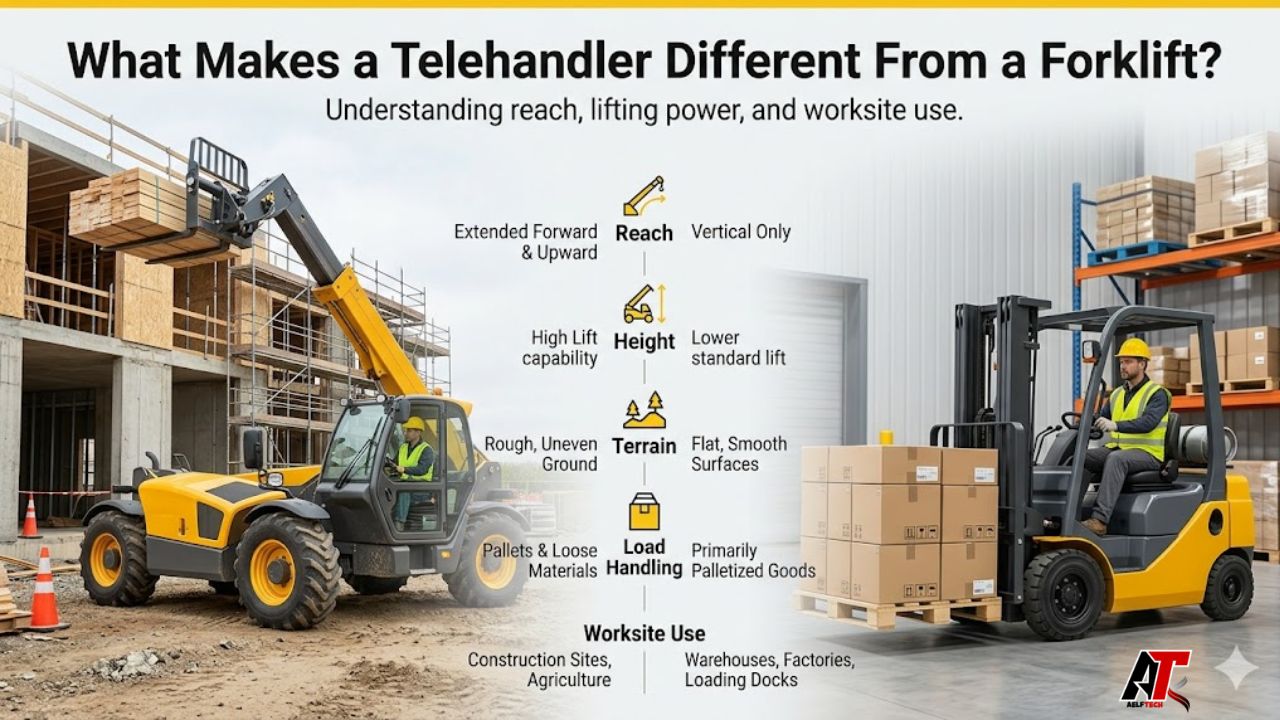
Many job sites use both telehandlers and forklifts, but each machine solves different lifting challenges. Confusing them can lead to poor equipment choices, slower work, and higher costs. A telehandler looks like a mix of a crane and a forklift, while a standard forklift has a compact, vertical mast. This simple visual difference points to deeper contrasts in lifting height, reach, terrain capability, and ideal working environment. By understanding how each machine performs, project planners, rental managers, and site supervisors can match the right equipment to material handling needs and safety requirements on construction sites or in warehouses.
Telehandler vs Forklift: Key Differences Explained
Lifting Height and Forward Reach
Telehandlers use a telescopic boom to lift and extend loads forward, giving them far greater reach than a traditional forklift. Operators can place pallets onto rooftops, upper floors, or scaffolding without moving the machine close to the structure. Many telehandlers reach 30 to 55 feet, and some models go even higher. Standard warehouse forklifts typically lift between 10 and 20 feet, depending on mast design. They move loads straight up and down with limited forward reach. This makes forklifts ideal for racking systems and dock work, but less useful when materials must reach over obstacles, trenches, or uneven ground. Telehandlers excel whenever vertical height and outreach combine.
Indoor vs Outdoor Performance
Telehandlers thrive outdoors on open, rugged sites. Their large tires, high ground clearance, and powerful drivetrains handle mud, gravel, and uneven terrain. Construction crews use them to move heavy materials across developing sites long before final paving or grading. Their engines and exhaust systems usually suit outdoor ventilation conditions, not enclosed spaces. Forklifts, especially electric models, dominate indoor work. Their compact frames, low emission levels, and tighter turning radii fit warehouse aisles, loading docks, and production lines. Cushion-tire forklifts perform best on smooth concrete floors. While some rough-terrain forklifts operate outside, they still lack the telehandler’s boom reach, making them less flexible for elevated outdoor placements.
Maneuverability and Workspace Requirements
Forklifts maneuver in tight spaces where every inch counts. Their short wheelbase, narrow profile, and precise steering let operators work between racking rows, inside containers, and around busy shipping areas. Many forklifts use three‑wheel or stand‑up designs to improve turning in narrow aisles. Telehandlers need more room to operate safely. The longer chassis and extending boom require wider swing and stabilizing space, especially when handling heavy loads at height. Operators must manage boom angle, extension, and machine position together, which demands clear ground and careful planning. On congested indoor floors, telehandlers quickly feel oversized. In open yards and construction zones, their bulk becomes an advantage, not a limitation.
Why Construction Sites Prefer Telehandlers?
Better Performance on Rough Terrain
Construction sites rarely start with smooth, level surfaces. Mud, ruts, debris, and slopes challenge standard forklifts and slow material movement. Telehandlers handle these conditions far better. Their large, aggressive tires and four‑wheel drive deliver strong traction. Many models also offer four‑wheel steering, allowing crab steering to sidestep obstacles. High ground clearance keeps undercarriages away from rocks, forms, and uneven edges. Operators can carry heavy loads over unfinished ground and reach delivery points that trucks and small forklifts cannot access. This rugged performance reduces the need for temporary roads or constant grading. As a result, the telehandler often becomes the primary material handler from early groundwork through the final stages.
Easier Material Placement at Elevated Areas
Telehandlers shine when crews must place materials at height or beyond edges. The telescopic boom lifts pallets of brick, rebar, roofing, or sheathing directly to upper floors or scaffolding lines. Operators can position the machine at a safe distance and extend the boom over trenches, fences, or uneven ground. Fork attachments, buckets, and work platforms add flexibility for different tasks. This precise reach reduces manual handling on ladders or scaffolds, improving productivity and safety. Instead of breaking down pallets at ground level, crews receive materials close to the installation point. On multi‑story projects, this capability saves significant time, labor, and crane rentals throughout the job.
Why Warehouses Still Depend on Forklifts?
Faster Pallet Handling in Tight Spaces
Warehouses focus on speed, repetition, and accuracy in confined areas. Forklifts match these needs better than telehandlers. Their compact design allows quick travel through narrow aisles and tight staging zones. Operators can pick, stack, and re‑slot pallets rapidly with simple up‑and‑down mast control. Many facilities design racking and aisle widths around specific forklift dimensions to maximize storage density. Electric forklifts accelerate and brake smoothly, supporting intensive shift work with consistent handling. Telehandlers, by contrast, take longer to position and adjust because of the boom functions and larger footprint. In high‑volume pallet operations, this extra time and space requirement makes forklifts the clear choice for efficient throughput.
Efficient Operation on Smooth Surfaces
On flat, finished floors, forklifts deliver efficient, low‑resistance travel. Cushion or polyurethane tires roll easily over concrete, reducing energy use and wear. Electric forklift models eliminate exhaust emissions, which helps maintain indoor air quality and supports strict safety standards. Their braking and stability systems suit predictable warehouse surfaces, not deep ruts or loose soil. Charging stations or battery‑swap setups keep fleets running through long shifts with minimal downtime. Telehandlers can operate on slabs, but their rough‑terrain focus and larger tires make them less nimble and less efficient indoors. For repetitive indoor routes between docks, racks, and production lines, forklifts remain the most cost‑effective solution.
Conclusion
Telehandlers and forklifts both lift and move loads, but they serve distinct roles. Telehandlers lead on construction sites with superior reach, rough‑terrain capability, and elevated placement power. Forklifts dominate warehouses and loading docks where tight spaces, smooth floors, and rapid pallet movement matter most. Choosing between them starts with the environment, typical load types, and required lift height and reach. Many businesses rely on both: telehandlers for outdoor, high‑reach tasks and forklifts for indoor, high‑volume handling. By matching machine strengths to job demands, companies improve safety, speed, and overall material handling efficiency across all their operations.
Leave a Reply