
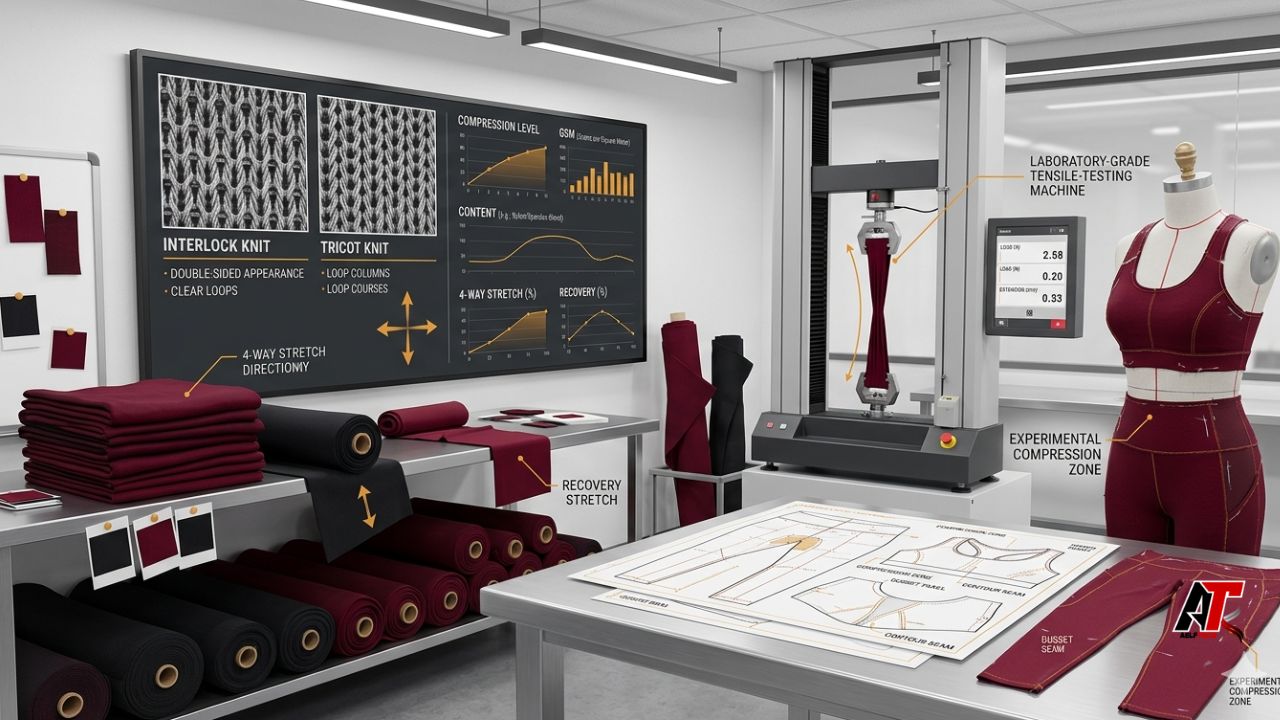
Compression activewear is often discussed as if the specification were simple: choose a high-spandex fabric, reduce the pattern, and the garment will provide support. In production, compression is created by a system. Fiber selection, yarn size, knit structure, fabric density, force at extension, recovery, pattern negative ease, panel orientation, seams, grading, and body shape all influence how the finished garment feels and performs.
That distinction matters for manufacturers because two fabrics with the same nylon-spandex ratio and the same GSM can behave very differently. One may stretch easily and feel soft, while another may resist extension and create a firmer hold. A fabric can also test well in the laboratory but produce uncomfortable pressure, rolling waistbands, transparent stress zones, or restricted movement when it is cut into an unsuitable pattern.
The practical goal is therefore not to find the fabric with the highest stretch or the highest elastane content. It is to select a material and garment construction that deliver the intended support level, range of motion, opacity, comfort, durability, and wash performance for a defined end use.
1. Start With the Intended Compression Level
Before requesting swatches, define what the product is supposed to do. Light-support yoga leggings, running tights, cycling shorts, studio bras, shapewear-inspired training pieces, and recovery garments do not require the same force profile. Write a product brief that states the target activity, body zones requiring support, expected wear duration, climate, care method, price point, and whether the claim is fashion support, athletic hold, or regulated medical compression.
Manufacturers should be cautious with claims. Fabric described as compressive does not automatically establish a measurable physiological benefit. Medical or circulation-related language may require garment-level pressure testing, clinical substantiation, regulatory review, and carefully controlled sizing. For mainstream activewear, claims such as supportive fit, sculpting feel, secure hold, or reduced bounce are usually easier to evaluate through wear trials and mechanical testing.
2. Fiber Blends: Nylon, Polyester, and Elastane
Most compression fabrics for activewear combine nylon or polyester with elastane, also called spandex. Elastane contributes extensibility and recovery, while the companion fiber supplies much of the surface character, strength, moisture behavior, colour response, and abrasion resistance.
Nylon-spandex blends are widely used when the product needs a smooth hand, close fit, strong recovery, and a premium second-skin feel. Polyester-spandex blends are common for printed activewear, colour-intensive collections, and products where rapid drying and cost control are important. Recycled versions can support sustainability goals, but recycled content does not remove the need to validate recovery, colourfastness, pilling, opacity, and lot-to-lot consistency.
Elastane percentage is only one input. The type of elastane, yarn denier, plating method, heat setting, and knit geometry affect power. Even a relatively small amount of quality elastane can improve fit and shape retention, while a high percentage can still feel weak if the construction allows easy extension. The LYCRA Company describes spandex as a fiber blended with other fibers to improve comfort, fit, shape retention, and durability rather than as a fabric on its own.
3. Knit Structure Controls Hand, Power, and Coverage
Compression fabrics are commonly developed as interlock, tricot, jersey, or power mesh. Interlock has two knit faces and can provide a stable, smooth platform with good coverage. It is often selected for leggings, bras, and performance tops where opacity and a balanced hand are priorities.
Tricot is a warp-knit structure valued for run resistance, dimensional stability, smoothness, and controlled stretch. Dense compression tricot can deliver firm support for cycling, swim, bras, and targeted panels. Jersey can feel lighter and more fluid, but the construction must be engineered carefully to avoid excessive growth or curling. Power mesh introduces ventilation and directional support, making it useful for internal panels, bra backs, pocketing, and zoned compression.
A supplier catalog of activewear textiles can help a development team compare constructions, fiber blends, weights, finishes, and recommended end uses before ordering test yardage. Product examples demonstrate why specification must go beyond fiber percentage: compression options may range from lightweight high-elastane jerseys to dense 300-plus GSM tricots and moisture-wicking interlocks.
4. GSM Is Important, but It Does Not Equal Compression
Fabric weight in grams per square metre helps manufacturers estimate coverage, warmth, drape, shipping weight, cutting behavior, and likely end use. Heavier fabrics often feel more substantial, but GSM alone does not tell you how much force the fabric applies at a given extension.
A compact 185 GSM interlock may recover better than a softer 230 GSM fabric. A lightweight fabric with a high elastane share can have strong extension resistance while remaining thin. Conversely, a heavy double knit may provide opacity and structure without delivering a true compressive feel. Use GSM as one line in the specification, then pair it with stretch, growth, recovery, and force data.
5. Stretch Percentage and Recovery Must Be Reported Together
Four-way stretch means that a fabric extends in both principal directions, but it does not specify how far it stretches, how much force is required, or how completely it returns. Manufacturers should record stretch separately in the course and wale directions, or in crosswise and lengthwise directions, using a defined test method and specimen orientation.
Recovery is equally important. Fabric growth after extension can produce bagging at knees, seats, elbows, waistbands, and bra underbands. ASTM D2594/D2594M addresses stretch and growth for knitted fabrics having low power, while ASTM D4964 covers tension and elongation of elastic fabrics using a constant-rate-of-extension tensile machine. The appropriate method depends on the fabric and the performance question, so brands and mills should agree on the test procedure, conditioning, extension level, hold time, and acceptance limits.
6. Modulus Explains Why Two Stretch Fabrics Feel Different
Modulus, in practical apparel language, is the force required to stretch the fabric to a selected extension. A low-modulus fabric stretches with little resistance and may feel comfortable but less supportive. A higher-modulus fabric resists extension and may create firmer hold, but excessive force can make dressing difficult, restrict movement, or create pressure at seams and edges.
A useful specification records force at more than one extension point, such as the force needed at moderate and high stretch. This creates a curve rather than a single number. The curve helps the technical team compare initial comfort, working range, and the point at which the fabric becomes noticeably restrictive.
For zoned compression, different panels can use different modulus levels. A firmer fabric may be placed around the core or underbust, while a softer fabric supports mobility at the hip, shoulder, or back. The transitions must be tested because abrupt changes in power can create visible ridges or discomfort.
7. Pattern Negative Ease Converts Fabric Power Into Garment Pressure
Negative ease means the garment measurement is smaller than the body measurement so the fabric stretches during wear. The correct reduction depends on fabric behavior, garment shape, size, seam layout, and desired support. Applying the same percentage reduction to every fabric is a common development error.
Pattern engineers should calculate negative ease by direction and body zone, not only by overall circumference. The strongest stretch direction should be oriented deliberately. Panels placed off-grain can twist, migrate, or create inconsistent support. Size grading also needs validation because a fixed grade rule may not maintain equivalent pressure across a wide size range.
Use fit models or calibrated forms representing several sizes, not only the sample size. Evaluate dressing effort, breathing comfort, movement, waistband rolling, seam indentation, pocket distortion, and recovery after extended wear. Garment pressure mapping may be appropriate when the brand intends to make specific compression claims.
8. Moisture, Airflow, and Thermal Comfort Still Matter
Dense fabrics can trap heat if moisture and air transport are not considered. Fiber chemistry, yarn shape, knit porosity, surface finish, brushing, and garment ventilation all affect comfort. Moisture-wicking language should be supported by test data rather than assumed from a polyester or nylon blend.
AATCC TM195 evaluates liquid moisture management properties of textile fabrics, including how moisture wets, spreads, and moves between surfaces. Air permeability, drying time, and water-vapor transmission may also be relevant depending on the product. A running tight for hot weather should not be approved using the same comfort criteria as a cold-weather studio legging.
9. Opacity Must Be Tested Under Strain
A fabric that looks opaque on a hanger may become transparent when stretched across the seat, thigh, or bust. Evaluate colour-specific opacity at realistic garment extension, because pale shades and highly saturated colours can behave differently. Print bases should be checked for grin-through, white-back exposure, and distortion of motifs.
Coverage depends on yarn count, knit density, elastane distribution, finish, colour, and extension. A premium compressive fabric should maintain acceptable visual coverage through the intended stretch range without becoming board-like or excessively heavy.
10. Durability Testing Should Reflect the End Use
Compression activewear experiences repeated stretching, sweat, friction, laundering, body oils, and contact with benches, mats, saddles, or equipment. A technical test plan may include abrasion, pilling, bursting strength, seam strength, colourfastness to laundering and perspiration, dimensional stability, and stretch recovery after repeated wash cycles.
ASTM D4966 covers Martindale abrasion testing, but ASTM cautions that laboratory abrasion results are only one factor in actual durability and may vary between laboratories. Use abrasion data comparatively and combine it with wear trials. AATCC TM135 provides standardized procedures for evaluating dimensional change after home laundering, which is valuable when elastane-rich fabrics are sensitive to heat and finishing conditions.
11. Sewing and Construction Can Protect or Destroy Performance
High-stretch fabrics require seams that extend with the garment. Common options include four-thread overlock, coverstitch, flatlock, bonded seams, and elasticated constructions. The right choice depends on stretch demand, bulk, skin contact, visual design, machinery, and production volume.
Needle size, point type, thread elongation, stitch density, presser-foot pressure, differential feed, and seam allowance should be trialled on production fabric. Needle cutting can create holes that grow after laundering. Excessive stitch density can perforate the fabric, while insufficient elasticity can cause popped seams.
Waistband elastics, stabilizers, pocket bags, labels, transfers, and heat-applied logos must also be compatible with the base fabric. A compressive shell paired with a weak pocket or rigid decoration can fail at the component interface.
12. Build a Manufacturer-Friendly Approval Specification
A useful fabric approval sheet should include supplier style number, fiber content, finished width, GSM tolerance, colour, lot number, construction, stretch by direction, recovery or growth, force at selected extensions, opacity standard, shrinkage, pilling, abrasion, bursting strength, moisture tests, colourfastness, and care method.
Record the exact test method and laboratory conditions. Avoid vague requirements such as good recovery or high compression. Numeric targets should be based on benchmark fabrics, prototype results, and end-use testing rather than copied from a generic specification.
For U.S. sales, labeling and advertising must accurately identify fiber content, and the FTC Care Labeling Rule requires manufacturers and importers to provide a reasonable care instruction. Claims about recycled content, UV protection, antimicrobial performance, moisture management, or sustainability should also be backed by suitable evidence and supplier documentation.
Recommended Development Workflow
- Define the activity, target support level, wear duration, climate, garment zones, and claim language.
- Shortlist fabrics by construction, fiber blend, GSM, finish, colour availability, minimum order, and lead time.
- Request supplier test reports, swatches, and enough yardage for laboratory tests and multiple prototypes.
- Measure stretch, recovery, force at extension, opacity under strain, moisture behavior, and wash stability.
- Develop patterns using fabric-specific negative ease and controlled grain orientation.
- Sew prototypes with production-intent seams, elastics, labels, prints, and trims.
- Run movement, extended-wear, laundering, abrasion, and multi-size fit trials.
- Freeze a measurable fabric and garment specification, then inspect bulk lots against approved standards.
Final Takeaway
Compression fabrics for activewear should be selected through measurable performance, not marketing shorthand. Fiber percentage, GSM, and four-way stretch are useful starting points, but they do not define support on their own. The decisive factors are force at extension, recovery, construction, pattern reduction, panel direction, seam behavior, sizing, and garment-level validation.
Manufacturers that build these variables into a disciplined development process can produce activewear that feels supportive without becoming restrictive, maintains opacity and shape, and performs consistently after wear and laundering. For additional product-development and digital manufacturing insights, visit team aelftech.com.
Leave a Reply