
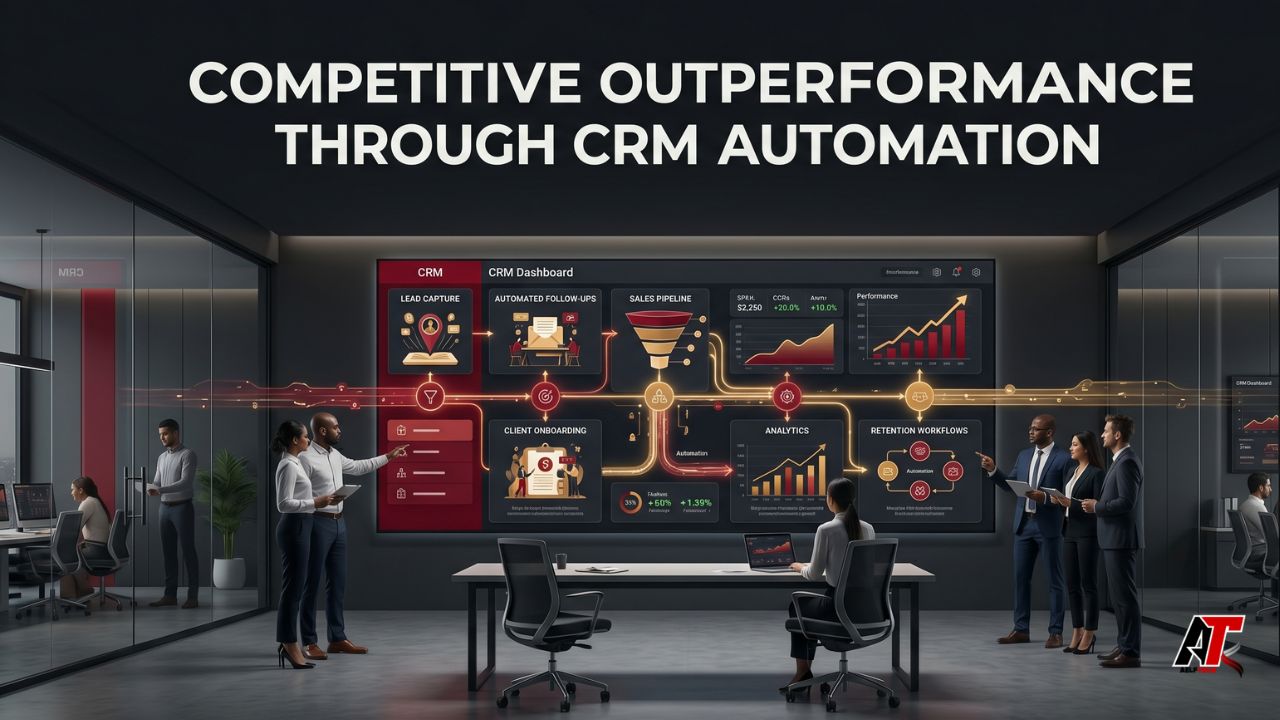
Winning agency work is no longer determined only by creative talent, industry knowledge, or the size of a contact list. In 2026, the agencies growing most consistently are usually the ones that manage every lead, conversation, proposal, project handoff, and client renewal through a connected system. CRM automation for agencies turns scattered activity into a repeatable revenue process. It helps teams respond sooner, follow up reliably, personalize communication, and make decisions from current data rather than instinct.
This advantage matters because prospects often compare several providers at once. The agency that replies first, remembers the prospect’s priorities, sends the right proof, and follows up at the right moment appears more capable before the project starts. Automation does not replace relationship-building. It removes the administrative friction that prevents people from building relationships well.
What CRM Automation Means for an Agency
A customer relationship management platform stores contact information, communication history, opportunities, proposals, deal stages, and account activity. CRM automation adds rules and intelligent workflows that complete routine actions when specific events occur. A website inquiry can create a contact, assign an owner, send an acknowledgment, schedule a task, score the lead, and notify the correct team member without anyone copying information between tools.
For an agency, automation can support lead capture, qualification, discovery scheduling, proposal reminders, contract follow-up, onboarding, project handoffs, satisfaction checks, renewal alerts, and upsell campaigns. Connected business automation systems make these workflows stronger by linking the CRM with forms, email, calendars, project management, accounting, reporting, and support platforms.
The result is not simply fewer manual tasks. A well-designed CRM becomes the operating memory of the agency. It shows what happened, what should happen next, who is responsible, and which opportunities deserve attention.
1. Automated Agencies Respond While Interest Is Still High
A prospect’s attention is perishable. Someone who submits a form after reviewing an agency’s portfolio may also contact two or three competitors. When that inquiry sits in a shared inbox, the agency loses valuable time. CRM automation can acknowledge the request immediately, route it by service, location, budget, or industry, and create a high-priority task for the right salesperson.
Speed alone is not enough, so the first automated response should never feel like a generic receipt. It can reference the service selected, explain the next step, provide a relevant case study, and offer a scheduling link. The salesperson then begins with context instead of asking the prospect to repeat information already supplied.
This creates a visible difference. The automated agency feels attentive from the first minute, while the manual agency may still be searching for the submission the next morning.
2. No Qualified Lead Disappears After One Conversation
Many opportunities are lost because nobody follows up consistently. Salespeople become busy with active clients, proposals are delayed, and promising leads disappear from view. A CRM can create a structured follow-up sequence based on deal stage, engagement level, and buyer behavior.
After a discovery call, the system can schedule a proposal task, send a recap email, and alert the account owner if the proposal has not been opened. If the prospect is not ready, the CRM can move the contact into a longer educational sequence rather than treating the opportunity as dead. Insights, comparisons, case studies, and planning guides keep the agency visible without requiring a salesperson to remember every date.
Automation also makes persistence more professional. Instead of repeated “just checking in” messages, the agency can deliver relevant value at each touchpoint. That protects the relationship and increases the chance that the prospect returns when timing or budget improves.
3. Teams Spend More Time on Strategy and Less on Administration
Agency employees often lose productive hours to data entry, status updates, meeting notes, task creation, contact cleanup, and internal reporting. These activities are necessary, but they rarely create the value clients are paying for. CRM automation reduces this workload by logging activity, updating fields, generating tasks, synchronizing calendars, and preparing standard communications.
The productivity case is difficult to ignore. Salesforce reported in February 2026 that 87% of sales organizations were using some form of AI for activities such as prospecting, forecasting, lead scoring, or email drafting. HubSpot also reported that sales representatives spend only about one-third of their time actively selling, with the remainder consumed by administration, manual follow-up, and fragmented processes.
For agencies, reclaimed time can be invested in stronger discovery, sharper proposals, better creative work, deeper client research, and account development. Automation improves both operational efficiency and the quality of human attention.
4. Personalization Becomes Possible at Scale
A growing agency cannot manually write a different journey for every lead. Yet broad, impersonal communication is easy to ignore. CRM segmentation solves this tension by organizing contacts according to service interest, industry, company size, budget, location, lifecycle stage, engagement, and previous activity.
An agency can then build tailored paths. A healthcare prospect may receive compliance-focused proof, while an ecommerce brand receives conversion examples. A warm referral can enter a shorter sequence than a cold content lead. A current client interested in a second service can receive material based on work already completed.
Modern AI automation tools can summarize conversations, identify intent, recommend next actions, and draft messages from CRM context. Human review remains important for high-value opportunities, but AI helps teams begin with relevant information instead of a blank page.
Personalization is now a basic expectation. Zendesk’s 2026 research states that 76% of customers expect personalization, while 70% expect anyone they contact to understand the full context of their situation. Agencies with clean CRM data can meet that expectation more consistently.
5. Sales, Marketing, and Delivery Work From the Same Reality
Competition is often won or lost during handoffs. Marketing may know which campaign attracted a lead, sales may know the promised outcome, and delivery may receive only a short message after the contract is signed. Missing context produces repeated questions, unrealistic expectations, and preventable frustration.
CRM automation creates a controlled handoff. When an opportunity is marked won, the system can generate an onboarding checklist, notify finance, create a project record, assign an account manager, and transfer the discovery notes, scope, timeline, stakeholders, and communication preferences. Every team starts with the same information.
The same record improves feedback in the opposite direction. Delivery teams can flag expansion opportunities, account risks, and recurring client questions. Marketing can improve content, while sales can refine qualification and avoid work that creates poor margins or delivery problems.
This shared visibility is one reason unified automation outperforms a patchwork of spreadsheets and disconnected apps. A reliable system reduces duplicate work, conflicting reports, and costly context switching.
6. Leaders See Revenue Risks Before They Become Emergencies
Manual pipelines often look healthier than they are. Old deals remain open, proposal values are inconsistent, and forecast meetings depend on personal opinions. Automated CRM rules improve discipline by requiring key information, tracking stage duration, identifying inactivity, and highlighting opportunities that are slipping.
Agency leaders can monitor lead source quality, response time, discovery-to-proposal conversion, proposal-to-close rate, average deal value, sales-cycle length, acquisition cost, service-line performance, and projected revenue. They can also compare activity with outcomes. A large volume of calls means little if the calls do not create qualified opportunities.
This visibility supports better decisions about hiring, marketing spend, capacity, and cash flow. It also helps managers coach with evidence. Instead of telling a salesperson to “follow up more,” a leader can identify the stage where deals stall and improve the message, criteria, or next-step process.
7. Automation Protects Agency Margins
Revenue growth can hide operational leakage. An agency may win more accounts while losing profit through poor scoping, excessive revisions, late invoices, or underpriced services. CRM automation contributes to margin control by connecting commercial promises with delivery and financial workflows.
Approval rules can require a minimum margin, senior review, or complete scope before a proposal is issued. Closed-won workflows can pass the correct price, package, and terms into project and billing systems. Renewal alerts prevent contracts from continuing on outdated pricing. Account records can reveal clients that repeatedly request work outside scope.
Automation cannot make pricing decisions by itself, but it supplies timely data. Agencies that understand the relationship between lead source, service type, close rate, delivery effort, and lifetime value can pursue profitable growth rather than fragile top-line numbers.
8. Client Retention Becomes a Managed Process
Competitors target an agency’s prospects and its existing clients. Retention suffers when communication becomes reactive after the initial project excitement fades. A CRM can schedule account reviews, satisfaction checks, milestone messages, renewal preparation, and strategic planning conversations.
Automated reminders ensure the team reaches clients before a contract expires or a concern becomes a cancellation. Engagement data can reveal declining communication, unresolved issues, delayed approvals, or reduced campaign activity, allowing the agency to intervene early.
The CRM can also identify appropriate expansion opportunities. A paid-media client may benefit from landing-page optimization, while a branding client may need ongoing content. Recommendations based on account history feel consultative; random upsell emails feel opportunistic.
9. Agencies Scale Without Multiplying Chaos
Manual processes can survive at a small size because experienced employees remember details and compensate for gaps. Growth exposes the weakness of that model. More leads, services, employees, and client accounts create more opportunities for missed tasks and inconsistent experiences.
CRM automation turns successful practices into repeatable workflows. New employees follow defined stages, receive prompts, use approved templates, and see complete account history. Managers can improve one workflow and apply that improvement across the organization. The agency becomes less dependent on individual memory.
Not every action should be automated. Sensitive negotiations, strategic recommendations, complex complaints, and relationship moments require judgment. The best agencies automate predictable coordination and preserve human attention for decisions where empathy, creativity, and expertise matter most.
How to Build CRM Automation That Actually Works
Technology alone does not create an advantage. Poorly planned automation can send irrelevant emails, duplicate records, irritate prospects, and hide process problems. Agencies should begin by mapping the client journey from first touch to renewal. Identify delays, repeated data entry, missed handoffs, and decisions that follow consistent rules.
Next, clean the data and define ownership. Decide which fields are required, what each pipeline stage means, when a lead becomes qualified, and who owns the next action. Build a few high-impact workflows first: instant lead routing, discovery follow-up, proposal tracking, closed-won onboarding, and renewal reminders.
Each workflow needs an exception path. High-value leads may require immediate personal outreach. Complaints should never remain inside a generic sequence. Messages should stop when a recipient replies, books a meeting, or changes status. Privacy, consent, permissions, and retention requirements must be built into the system.
Finally, measure business results rather than the number of automations created. Track whether response times fall, follow-up completion rises, sales cycles shorten, conversion improves, onboarding becomes smoother, and retention strengthens. An implementation partner such as aelftech.com can help connect CRM strategy, workflow design, integrations, and reporting around measurable goals.
The Competitive Advantage Is Consistency
Agencies do not outperform because automation makes them less human. They outperform because automation makes their best human behavior more consistent. Prospects receive timely attention. Salespeople remember commitments. Delivery teams receive complete context. Leaders see accurate pipeline data. Clients experience proactive communication after the sale.
In a market where many agencies offer similar capabilities, operational reliability becomes part of the brand. CRM automation for agencies converts reliability from an individual habit into an organizational system. Agencies that design that system carefully can respond faster, personalize intelligently, protect margins, and scale with far less friction. Competitors may still have talented people, but talent supported by a disciplined automated process wins more often.
Leave a Reply