
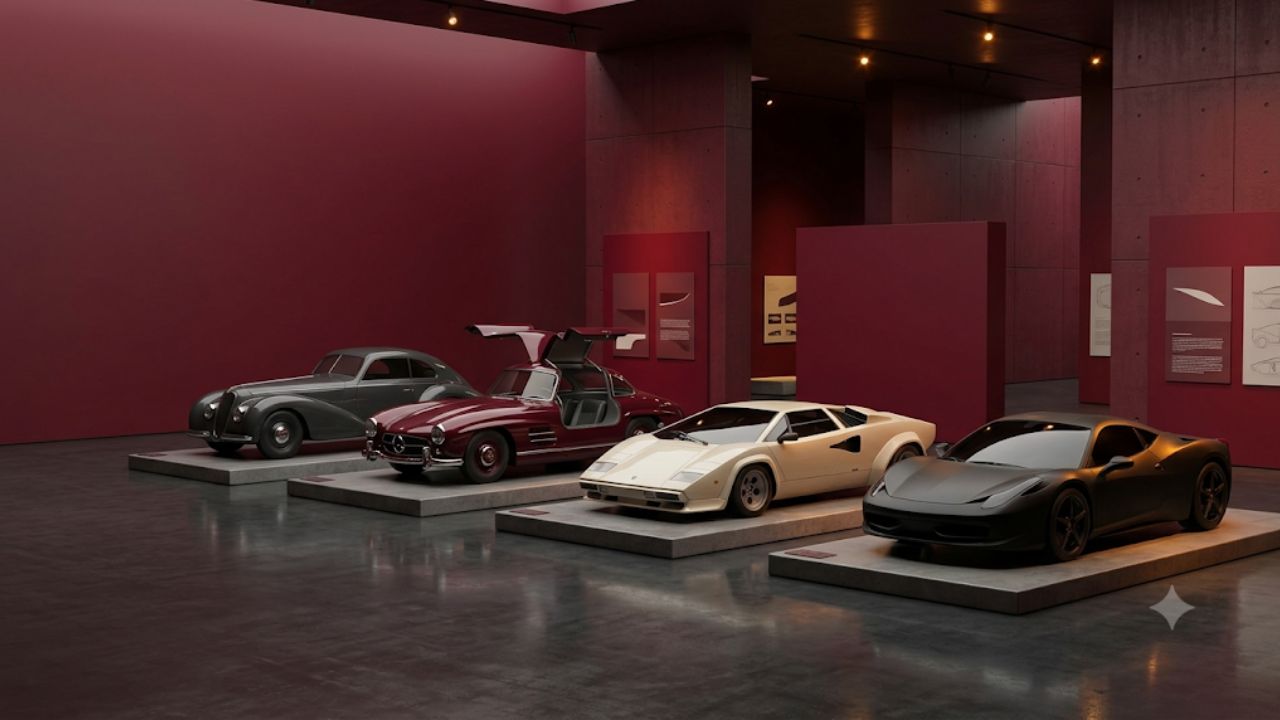
A truly iconic car does something ordinary vehicles cannot. It remains recognizable when the badge is hidden, the engine is silent, and the road is nowhere in sight. Its outline can live on a poster, in a museum, on a designer’s mood board, or as a carefully made model on a collector’s shelf. At that point, the car is no longer judged only by how fast, comfortable, or practical it is. It has become an object of design.
This is why the idea of iconic cars as design objects deserves more than a list of expensive classics. It is a story about how engineering becomes sculpture, how function creates beauty, and how a vehicle can outgrow its original purpose.
When Does a Car Become a Design Object?
A car becomes a design object when its form communicates something beyond transportation. It may express speed while standing still, make advanced engineering visible, or capture the mood of an era so clearly that people recognize it decades later. The best examples combine usefulness with emotional impact.
Design museums have long treated automobiles as examples of industrial art. The Museum of Modern Art in New York was an early leader in presenting cars as functional design, and the Cisitalia 202 became the first automobile to enter its collection in 1972. That moment mattered because it placed a road vehicle in the same cultural conversation as architecture, furniture, graphics, and sculpture.
The Cisitalia 202: The Car That Entered the Museum
The 1946 Cisitalia 202 is one of the clearest starting points for understanding cars as designed objects. Created by Pinin Farina, it replaced the separate-looking fenders and upright cabin of many prewar cars with a smoother body that read as one continuous form. The hood, roof, and rear quarters flowed together instead of appearing like individual pieces attached to a chassis.
Its body panels were shaped by hand over wooden forms, which gave the car the quality of crafted metalwork. Only a small number were produced, but its influence was much larger than its production run. The Cisitalia showed that a car body could be read as a single sculpture surrounding the mechanical parts beneath it.
That approach became central to postwar automotive design. Once the car was seen as one complete volume, designers could work with proportion, tension, light, and reflection much like product designers or sculptors. The vehicle was still functional, yet the visual unity made it worthy of display even when it was not moving.
Mercedes-Benz 300 SL: Engineering Turned Into Theatre
The Mercedes-Benz 300 SL Gullwing, introduced in 1954, is remembered instantly for its roof-hinged doors. Yet those doors were not created as decoration alone. The car’s racing-derived tubular structure required high side sections, so conventional doors were difficult to use. The solution turned a structural challenge into one of the most dramatic gestures in automotive history.
With both doors raised, the 300 SL becomes almost architectural. The open panels change the silhouette and create a sense of ceremony before the driver even enters. Its shallow grille, long hood, tight cabin, and curved body also communicate speed without relying on excessive ornament.
This is a key lesson in lasting vehicle design: the most memorable feature often grows from a real constraint. When engineering and appearance solve the same problem, the result feels authentic. The Gullwing did not simply look unusual; it made the hidden structure of the car visible through movement.
Citroen DS: When the Future Arrived in Everyday Traffic
When the Citroen DS appeared in 1955, it looked less like a normal family car and more like a prediction. Its smooth nose, tapered rear, covered rear wheels, and unusually calm surfaces rejected the upright shapes common at the time. Inside, its single-spoke steering wheel and unconventional controls extended the same forward-looking idea.
The visual impact was supported by technical innovation, including hydropneumatic suspension and a body shaped with aerodynamic thinking. This combination made the DS important: it did not use futuristic styling as an empty costume. The unusual form represented a different idea of how a car should ride, move, and interact with the road.
The DS became a cultural object because it made modernity feel accessible. It was not only a rare racing machine or a hand-built luxury coupe. It brought radical design into streets, family journeys, official events, films, and photographs. Its presence changed the visual character of ordinary traffic.
Porsche 911: The Power of Design Continuity
The Porsche 911 offers a different route to icon status. Rather than being remembered for one radical moment, it became powerful through controlled evolution. The original basic layout – round headlights, a low front, an arcing roof, a compact cabin, and a fastback rear – remains visible across more than six decades of development.
That continuity creates instant recognition. Porsche has changed dimensions, materials, lighting, aerodynamics, safety systems, and manufacturing methods, but the central visual identity has remained stable. Each generation looks current while still belonging to the same family.
For designers, this is a difficult balance. Too little change can make a product feel old; too much can destroy recognition. The 911 demonstrates that an icon can be refreshed by adjusting surfaces, scale, and detail while protecting the proportions that people remember. It acts almost like a three-dimensional logo for the brand.
Lamborghini Countach: The Poster Became More Famous Than the Drive
Few cars support the title of this article better than the Lamborghini Countach. First shown as a concept in 1971, Marcello Gandini’s wedge-shaped design looked like a machine from another world. Its low nose, sharp surfaces, dramatic doors, and cab-forward profile rejected the soft curves associated with earlier sports cars.
For millions of people, the Countach was experienced first as an image. It appeared on bedroom walls, magazine covers, television screens, toys, and calendars. Most admirers never sat in one, and even fewer drove one. Yet they could recognize it immediately from a simple outline.
This is the point at which visual identity becomes independent from usability. The Countach’s cabin visibility, entry, and everyday comfort were secondary to the sense of theatre it created. The car functioned as a dream object: an extreme statement about speed, wealth, rebellion, and the future. Its image became more widely owned than the vehicle itself.
Ferrari 250 GTO: When Function Creates Sculpture
The Ferrari 250 GTO, introduced in 1962, is often treated as a collectible masterpiece, but its design began with competition needs. The body was developed to improve aerodynamic performance, control lift, and support high-speed endurance racing. Its long front, low roof, vents, and cut-off rear were shaped by function rather than decoration alone.
That purpose gives the car visual authority. Every opening and curve appears to be doing work. At the same time, the handmade aluminum body carries small variations that remind viewers it was formed by skilled people rather than produced as a perfectly identical digital surface.
The 250 GTO shows why some machines age like art. Their beauty is not separate from their use; it is the visible result of intelligent decisions. Later audiences may display, collect, insure, and study the car as an object, but the form remains believable because it was born from a real performance problem.
How Iconic Cars Live Beyond the Road
Once a car becomes culturally important, its life extends into other formats. Museums preserve full-size examples. Books and films turn them into symbols. Designers study their silhouettes, materials, switchgear, typography, and surface treatment. Collectors preserve original cars, while model makers translate the same proportions into smaller objects that can be owned and displayed more easily.
Well-made scale replicas are especially valuable because they allow viewers to study a complete shape from angles that photographs cannot always show. Details such as wheel placement, roof curvature, grille depth, vents, and stance become easier to compare when the object can be viewed in three dimensions. Businesses, museums, manufacturers, and private collectors may commission scale replicas of automotive design icons to preserve a specific vehicle, prototype, race livery, or custom build.
A curated automotive model collection can also tell a design story across decades. Placing a rounded postwar coupe beside a 1970s wedge and a modern electric vehicle reveals how ideas about speed, safety, luxury, and technology changed over time. The models are small, but the design conversation can be broad.
Why These Cars Still Influence Modern Design
Modern cars face stricter safety rules, efficiency targets, shared platforms, digital interfaces, and global manufacturing demands. Even so, designers continue to return to iconic forms because they offer clear lessons. The 911 teaches continuity. The Mini teaches efficient packaging. The DS teaches bold system-level thinking. The 300 SL shows how a constraint can become a signature. The Countach demonstrates the power of a strong silhouette.
This principle also applies outside automotive work. Product design, architecture, branding, and digital experiences become more memorable when one clear idea guides every detail. That is why design-focused readers on aelftech.com can study classic vehicles as more than transport history. They are case studies in how useful objects earn emotional and cultural value.
What Separates a Lasting Icon From a Temporary Trend?
A temporary trend often depends on novelty. It attracts attention because it looks new, but the effect fades when another style appears. A lasting icon has a stronger foundation. Its form connects to purpose, its proportions remain understandable, and its character survives changes in fashion.
Rarity can increase value, but rarity alone does not create design importance. Marketing can make a car famous, but fame alone does not produce visual quality. The vehicles that last combine a recognizable shape, a meaningful engineering story, cultural visibility, and enough originality to influence what comes after them.
Most importantly, an icon remains interesting when separated from motion. Park it under gallery lighting, reduce it to a side profile, recreate it as a model, or show only one detail, and the identity still holds. That is when the vehicle has moved beyond driving and entered the wider world of design.
Frequently Asked Questions
Why are some cars displayed in art and design museums?
Cars combine industrial design, engineering, materials, ergonomics, manufacturing, and visual culture. Museums display selected vehicles because they represent important solutions or major changes in how useful objects were shaped and understood.
What was the first car added to MoMA’s collection?
The Cisitalia 202 became the first automobile added to the Museum of Modern Art’s collection in 1972. Its unified body form helped establish it as a major example of postwar automotive design.
Why is the Porsche 911 considered a design classic?
The Porsche 911 has preserved its core proportions and visual identity while adapting to new technology for more than sixty years. That balance between continuity and change makes it a powerful example of long-term design management.
How do scale car models preserve automotive design?
Scale models preserve proportion, surface details, stance, color, and specific historical features in a compact three-dimensional format. They help collectors and designers study vehicles that may be rare, inaccessible, or impossible to display at full size.
Can a modern car become a future design object?
Yes. A modern vehicle can become a future icon when it introduces a clear and influential idea rather than following short-lived styling. Time reveals whether its form remains meaningful after the technology and market trends around it have changed.
Final Thoughts
The world’s most iconic cars are remembered because they made movement visible in metal. Some turned engineering limits into signatures. Others introduced new ideas about space, speed, modern life, or brand identity. Their engines created the experience, but their forms created the memory.
That is why these vehicles continue to matter when they are parked, photographed, displayed, collected, or reproduced at scale. They have crossed the line between machine and cultural object. Beyond the drive, they show how a practical product can become a lasting piece of design.
Leave a Reply