
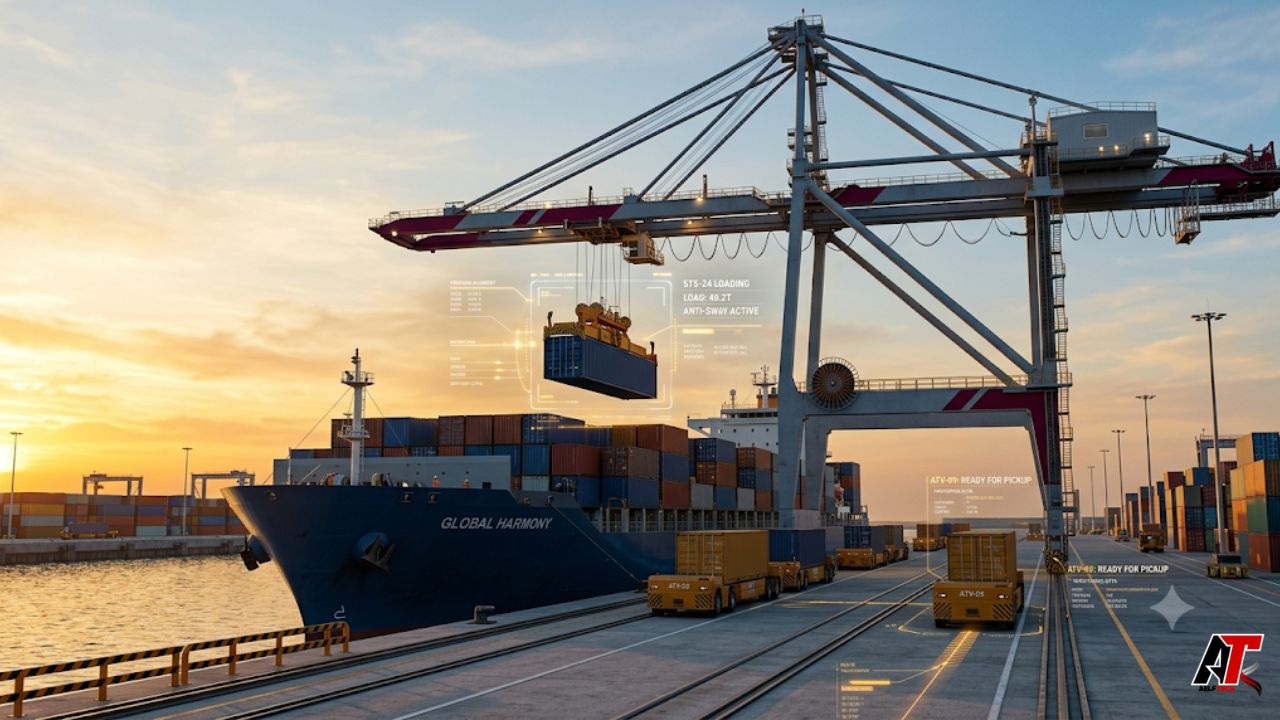
Container terminals face constant pressure to move more cargo in less time. Ships are larger, schedules are tighter, and delays at the berth can affect the wider supply chain. The ship-to-shore crane is therefore one of the most important machines in a modern port.
An STS Crane from WeiHua is designed for this demanding work. It combines a heavy steel structure, a waterside boom, a high-speed trolley, hoisting equipment, container spreaders, electrical drives, and intelligent controls. Each part must work smoothly with the others to deliver safe and repeatable container moves.
This guide explains how WeiHua ship-to-shore cranes work, which performance features matter, and what port operators should review before buying. It also covers automation, safety, maintenance, energy use, and project planning in clear, practical language.
What Is an STS Crane?
A ship-to-shore crane, also known as a quay crane or container crane, stands at the berth edge. It lifts containers between a vessel and the landside transport system. The crane normally travels along rails that run parallel to the quay.
During a move, the trolley travels along the boom while the hoist raises or lowers the spreader. The spreader locks onto the container’s corner castings. The crane then carries the container between the ship and a terminal tractor, automated vehicle, or transfer platform.
STS cranes are not general-purpose lifting machines. Their design depends on vessel width, container rows, deck height, hold depth, wind exposure, duty cycle, quay strength, and terminal workflow. This is why every project needs detailed engineering rather than a simple catalogue selection.
Why High-Performance STS Cranes Matter
Quayside performance has a direct effect on vessel turnaround time. If ship handling is slow, the berth remains occupied for longer. Yard vehicles may queue, labour plans can be disrupted, and the next vessel may have to wait.
Large port calls often use several cranes at the same time. This means each crane must deliver predictable cycles and work safely beside neighbouring equipment. Smooth acceleration, accurate spreader positioning, effective sway control, and reliable communications are essential for consistent productivity.
Speed alone does not guarantee better results. A fast crane that creates excessive sway, frequent alarms, or difficult maintenance may reduce real output. Ports should focus on sustainable moves per hour across complete working shifts, not only on maximum motor speeds.
WeiHua STS Crane Performance Overview
WeiHua presents its STS range as configurable equipment for different container terminals. Available designs can support Post-Panamax, Super Post-Panamax, and ultra-large container vessel operations, depending on the final engineering specification.
The manufacturer publishes broad ranges of about 40 to 80 tonnes for rated lifting capacity and roughly 45 to 70 metres for outreach. Some rail-mounted configurations may extend to around 75 metres. Crane travel speed is commonly listed within a range of about 30 to 45 metres per minute.
These values are useful for early comparison, but they are not fixed promises for every crane. Final capacity, height, outreach, speed, rail loading, and power demand depend on the customer’s vessel profile, berth design, working method, and automation scope.
Main Components of an STS Crane
The gantry is the crane’s main supporting frame. It transfers operating loads into the travelling bogies and quay rails. The waterside boom reaches over the ship, while the backreach area supports machinery, access routes, and landside container movement.
The hoisting system includes motors, brakes, drums, wire ropes, sheaves, and lifting gear. It controls vertical motion under repeated heavy-duty cycles. The trolley carries the spreader along the boom and positions it above the selected container slot.
The electrical and control system coordinates every movement. Programmable controllers, variable-speed drives, sensors, interlocks, alarms, and diagnostic tools convert mechanical capacity into controlled performance. Safety systems must be integrated into this control architecture from the start.
Lifting Capacity and Container Handling
Rated capacity must cover the heaviest planned operating condition. The calculation should include the container, spreader, lifting attachments, and any twin-lift requirement. Ports should also consider whether future vessel services may need heavier or more complex handling.
Twin-lift operation can improve productivity by moving two 20-foot containers in one cycle. However, it requires suitable spreaders, stronger lifting capacity, compatible vessel stowage, and careful control. The benefit depends on the actual mix of containers handled at the terminal.
Special cargo may require additional lifting beams or project-specific attachments. These cases should be discussed before design approval because they can affect structural loads, hook paths, safety controls, and operational procedures.
Outreach, Height, and Vessel Compatibility
Outreach determines how far the trolley can travel over the vessel. A wider ship with more container rows needs a longer boom. A crane designed for feeder or Panamax vessels will not automatically suit an ultra-large container vessel.
Lifting height is just as important. The spreader must clear containers stacked high above deck and still reach containers below rail level inside the hold. Representative WeiHua configurations describe lifting heights of around 40 to 55 metres above rail and about 15 to 20 metres below rail.
Port planners should use verified vessel drawings and expected tidal conditions when defining these dimensions. Adding unnecessary size increases weight, wind area, rail loads, energy demand, and cost. Too little reach or height, however, can restrict the terminal’s future vessel options.
Speed, Anti-Sway Control, and Cycle Efficiency
Crane productivity depends on more than hoisting and trolley speed. Vessel layout, lashing work, hatch covers, operator skill, yard vehicle availability, acceleration rates, and spreader positioning all influence the final cycle time.
WeiHua representative data includes no-load trolley speeds around 200 to 240 metres per minute and no-load hoisting speeds around 80 to 90 metres per minute. Loaded speeds and acceleration profiles may differ and must be confirmed for the selected configuration.
Anti-sway control reduces the pendulum movement of the suspended container. Better sway control allows the spreader to settle sooner and helps the operator position loads more accurately. This can improve safety and reduce time lost while waiting for the load to stabilise.
Automation and Intelligent Port Integration
Modern STS cranes can use cabin control, remote operation, semi-automatic functions, or a more automated operating model. The correct level depends on the terminal’s safety strategy, workforce, communications network, operating procedures, and investment plan.
WeiHua describes options such as anti-sway control, positioning assistance, remote monitoring, semi-automatic operation, and automatic configurations. These tools can improve consistency, reduce operator fatigue, and provide better data for maintenance and performance analysis.
Automation is not a stand-alone crane feature. It requires reliable cameras, sensors, networks, safety zones, software interfaces, and exception-handling procedures. Ports often benefit from a phased approach that begins with monitoring and assisted control before moving towards wider automation.
Safety in a Marine Environment
STS cranes operate in salt-laden air, rain, wind, vibration, and changing temperatures. Marine conditions can accelerate corrosion and damage exposed electrical components. Protective coatings, sealed enclosures, drainage, protected cable routes, and planned inspections are therefore essential.
Typical safety systems include emergency stops, overload protection, motion limits, brake monitoring, wind alarms, rail clamps, storm anchors, collision protection, interlocked access points, and spreader-status checks. The final package should follow the applicable project standards and local regulations.
Safe operation also depends on people and procedures. Clear communication, access control, training, rescue planning, lockout procedures, and routine drills are just as important as the installed hardware.
Reliability and Maintenance Planning
A high-performance crane must remain available throughout demanding operating schedules. Maintenance access should be considered during design. Technicians need safe routes to motors, brakes, electrical cabinets, wire ropes, sheaves, sensors, and other inspection points.
Ports should identify critical spare parts before commissioning. Wire ropes, brake components, wheels, sensors, contactors, drive modules, and spreader parts may need planned stock. Diagnostic information should be easy to understand so faults can be located quickly.
A strong maintenance plan combines daily checks, scheduled servicing, condition monitoring, lubrication, structural inspection, corrosion control, and software support. Training should cover both normal maintenance and safe recovery after faults or emergency stops.
Energy Use and Lifecycle Cost
STS cranes normally receive electricity from the terminal’s high-voltage network. WeiHua lists 6 kV or 10 kV arrangements with cable reel or busbar supply options, subject to the final project design.
Regenerative systems can recover energy during lowering and braking. Efficient motors, variable-speed drives, LED lighting, sensible acceleration profiles, and good power management can also reduce electricity use. The actual benefit depends on the crane’s duty cycle and terminal grid.
Purchase price is only one part of the investment. Buyers should compare civil work, rails, delivery, erection, commissioning, energy, inspections, spare parts, software support, downtime risk, training, and major component replacement over the crane’s service life.
Customization and Project Planning
Every terminal has different vessels, quay strength, rail gauge, apron width, weather, power supply, operating practices, and expansion plans. WeiHua asks customers to define capacity, outreach, backreach, lifting height, travel distance, power conditions, and control requirements.
The design process should also confirm rail loads, wheel loads, storm conditions, clearances, cable routes, operator access, maintenance areas, lighting, communications, and interfaces with terminal systems. Early coordination reduces expensive changes during installation.
Factory acceptance tests, site acceptance tests, load tests, commissioning, and performance demonstrations should be written into the contract. The agreement should also define documentation, training, warranty terms, spare parts, response times, and final acceptance criteria.
Choosing WeiHua Group for a Port Crane Project
WeiHua Group traces its crane manufacturing history to 1988. Its wider portfolio includes port cranes, overhead cranes, gantry cranes, hoists, and specialised lifting equipment. The port range includes STS, RTG, RMG, portal, and other terminal-handling solutions.
Company scale alone should not decide a major purchase. A port should review reference projects, quality systems, design standards, certifications, structural and electrical engineering capability, local support, spare-parts arrangements, and previous experience with similar vessels and climates.
The best supplier relationship is based on clear technical communication. The customer should provide accurate operating data, while the manufacturer should explain assumptions, exclusions, interfaces, expected performance, and maintenance responsibilities.
Questions to Ask Before Ordering
Before approving an STS crane, the project team should answer a focused set of questions:
- Which current and future vessels must the crane serve?
- What capacity is required under the spreader, and is twin-lift needed?
- What outreach, backreach, and lifting height are supported by verified vessel drawings?
- Can the quay structure and rails carry the proposed wheel loads?
- Which control mode, anti-sway functions, and automation interfaces are required?
- What wind, corrosion, temperature, and storm conditions apply at the site?
- Which spare parts, training, warranties, and service response times are included?
- How will performance and acceptance be measured after commissioning?
Quick Reference: Manufacturer-Listed Parameters
The following values are broad published ranges or representative configurations. Every final project requires engineering confirmation.
| Parameter | Published range or representative configuration |
| Rated lifting capacity | Broad published range: about 40–80 t; final single or twin-lift capacity varies by design |
| Outreach | Broad published range: about 45–70 m; selected rail-mounted designs may reach around 75 m |
| Backreach | Common published range: about 15–25 m |
| Lifting height | Representative designs: about 40–55 m above rail and 15–20 m below rail |
| Trolley speed | Representative no-load range: about 200–240 m/min |
| Hoisting speed | Representative no-load range: about 80–90 m/min |
| Crane travel speed | Broad published range: about 30–45 m/min |
| Power supply | Typically 6 kV or 10 kV, subject to the project design |
| Operating mode | Cabin, remote, semi-automatic, or automatic configurations |
Conclusion
A high-performance ship-to-shore crane is a complete production system, not simply a large lifting machine. Its structure, reach, hoist, trolley, spreader, control system, safety devices, power supply, and maintenance strategy must suit the terminal’s real operating conditions.
WeiHua offers configurable STS solutions for different vessel classes and terminal requirements. Available features can include large outreach, twin-lift handling, intelligent anti-sway control, remote functions, automation, and regenerative energy options. Every final specification should still be confirmed through project-specific engineering.
For buyers, the most useful question is not only how much the crane can lift. The better question is how safely, consistently, and economically the complete system can deliver the required container moves throughout its working life. More technology and infrastructure guidance is available from aelftech.com.
Leave a Reply