
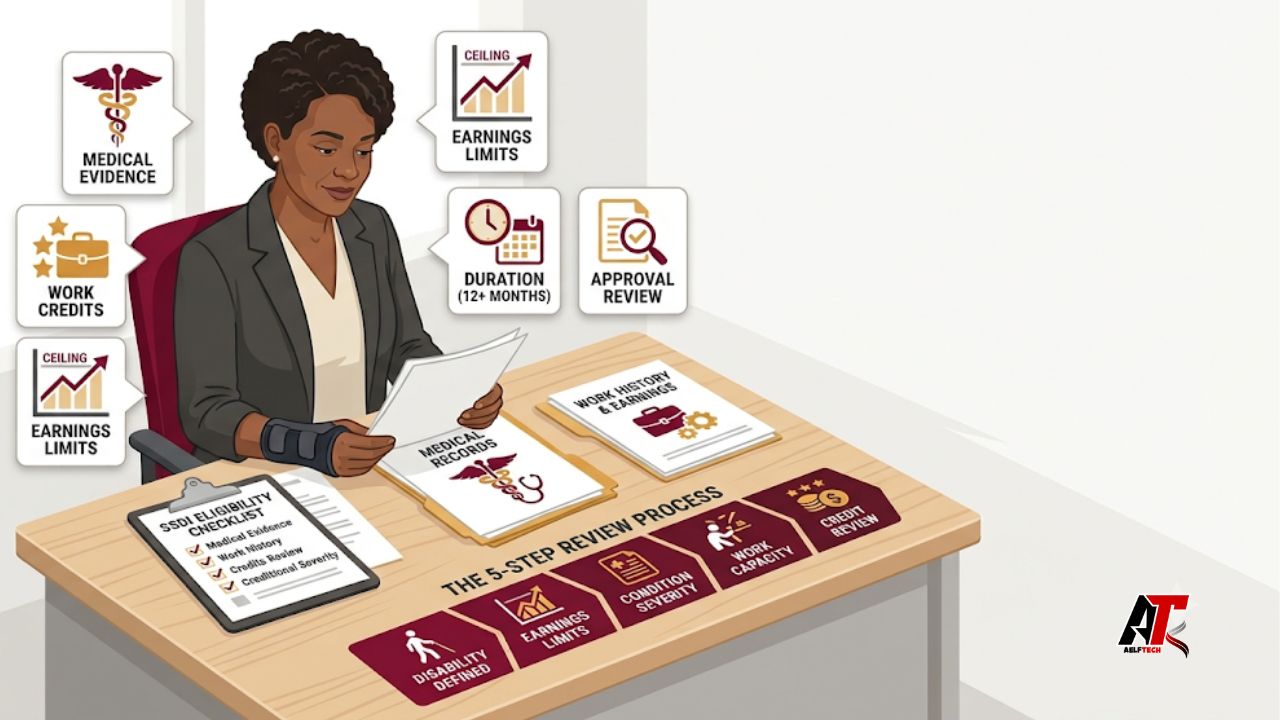
Social Security Disability Insurance (SSDI) can provide monthly income when a serious physical or mental condition prevents substantial work. Approval is not based on diagnosis alone. The Social Security Administration (SSA) reviews your work history, current earnings, medical evidence, expected recovery, and ability to perform previous and other work.
Understanding the SSDI eligibility criteria before applying can help you build a clearer claim and avoid preventable mistakes. This guide explains the main requirements, the five-step evaluation process, evidence expectations, and what to do after a denial. The 2026 dollar amounts may change, so verify current thresholds.
What Is SSDI?
SSDI is a federal insurance program for people who worked in jobs covered by Social Security and later became disabled under SSA’s rules. Eligibility is mainly tied to work credits and disability, not household wealth. Savings, property, or a spouse’s income usually do not decide basic eligibility, although certain public disability payments may affect the amount.
SSDI differs from Supplemental Security Income (SSI), a needs-based program with income and resource limits. It also differs from short-term disability insurance and workers’ compensation. SSA pays only for total disability that meets the federal duration rule, not partial or short-term disability.
The Main SSDI Eligibility Requirements
An adult applicant generally must satisfy all of these requirements:
- Have enough recent work credits from employment or self-employment covered by Social Security.
- Have a medically determinable physical or mental impairment.
- Meet the 12-month duration rule, unless the condition is expected to result in death.
- Be unable to perform work at the substantial gainful activity level.
- Be unable to perform past relevant work or adjust to other work, considering functional capacity, age, education, and experience.
A strong medical file cannot replace missing insured status, and an excellent work record cannot replace proof of disabling limitations.
1. Work Credits and Insured Status
SSDI is earned through covered work. Employees usually receive credits from wages subject to Social Security taxes, while self-employed workers earn credits through covered net earnings. A person can earn no more than four credits per year.
In 2026, one credit is earned for each $1,890 in covered earnings, and $7,560 earns four credits. The amount changes annually. The number required depends on the age when disability began.
Many applicants age 31 or older generally need 40 credits, including 20 earned during the 10 years ending with the year disability began. Younger workers may qualify with fewer credits.
Recent work matters as much as total work. A person can lose disability-insured status after being out of covered employment too long. SSA calls the final day of insured status the date last insured. The evidence generally must show disability began on or before that date. Delaying an application can therefore create problems, especially when older records are missing.
2. A Medically Determinable, Long-Term Impairment
SSA requires objective medical evidence from an acceptable medical source to establish a medically determinable impairment. The condition may be physical, mental, or a combination of both. Musculoskeletal disorders, cancer, heart disease, neurological conditions, autoimmune disease, respiratory disorders, and serious mental health conditions may qualify when the evidence shows severe work-related limitations.
A diagnosis is only the starting point. SSA evaluates what you can still do despite the condition. Two people with the same diagnosis can receive different decisions because their symptoms, treatment response, complications, and daily functioning differ.
The impairment must have lasted, or be expected to last, at least 12 continuous months, unless it is expected to result in death. You do not always need to wait a full year before applying if medical evidence reasonably shows that disabling limitations will continue for at least 12 months. A temporary condition expected to improve enough for substantial work within several months will usually not meet the rule.
3. Earnings and Substantial Gainful Activity
SSA first asks whether you are performing substantial gainful activity, commonly called SGA. In 2026, average monthly earnings above $1,690 for most non-blind applicants or $2,830 for applicants who meet SSA’s blindness rules generally indicate SGA.
The calculation is not always a simple paycheck test. Different rules may apply to self-employment, subsidized work, unsuccessful work attempts, impairment-related work expenses, or duties performed under special conditions. Applicants should report hours, duties, assistance, attendance problems, and why a job ended or changed.
People trying to determine whether they may qualify for SSDI benefits should compare their actual work activity with current SSA guidance rather than relying only on one monthly earnings figure.
4. The Five-Step Disability Evaluation
After reviewing non-medical eligibility, SSA generally follows a five-step process.
Step 1: Are you performing SGA? If your work is at the SGA level, SSA will usually find that you are not disabled.
Step 2: Is the impairment severe? It must significantly limit basic physical or mental work activities and satisfy the duration requirement.
Step 3: Does the impairment meet or medically equal a listing? SSA’s Listing of Impairments describes medical findings considered severe enough to establish disability. Meeting a listing can lead to approval without a full vocational analysis, but many approved applicants do not meet a listing.
Before Steps 4 and 5, SSA determines residual functional capacity (RFC), meaning the most you can do regularly despite supported limitations. Physical RFC may address sitting, standing, walking, lifting, reaching, handling, or exposure to hazards. Mental RFC may address concentration, pace, memory, social interaction, and adapting to changes.
Step 4: Can you perform past relevant work? SSA compares your RFC with the demands of work performed during the relevant period, including how you actually did the job and how it is generally performed.
Step 5: Can you adjust to other work? SSA considers RFC, age, education, and work experience. The question is not whether a local employer will hire you. It is whether you can perform other work that exists in significant numbers in the national economy.
This process makes precise descriptions essential. Saying “I cannot work” is a conclusion. Explaining that you can sit for only 20 minutes, need unscheduled breaks, cannot use your hands repeatedly, or lose concentration several times an hour provides information SSA can compare with job demands.
Medical Evidence That Supports Eligibility
A persuasive SSDI file usually shows consistent treatment and functional limitations over time. Helpful records include examinations, imaging, laboratory results, surgical reports, therapy notes, medication histories, mental-status findings, and documented side effects.
Medical opinions are most useful when they connect findings to specific limitations. A statement that a patient is “disabled” may be less helpful than an assessment explaining how long the person can sit, stand, walk, concentrate, interact, use the hands, or attend work reliably.
Non-medical information also matters. Function reports, work-history forms, employer records, and statements from relatives or caregivers can explain daily limitations and failed work attempts. Describe activities honestly, including time required, help received, rest needed, and symptoms afterward.
Treatment gaps do not automatically defeat a claim, particularly when caused by cost, lack of insurance, transportation barriers, or mental illness. The reason should still be explained.
Special Situations
Blindness: SSA applies a specific definition of statutory blindness and a higher SGA threshold. Ordinary vision problems do not automatically meet the standard.
Self-employment: SSA may evaluate the value of services, hours, duties, and business activity, not only reported profit. Freelancers, business owners, and gig workers should keep detailed records.
Multiple conditions: No single diagnosis must be disabling by itself. SSA considers the combined effect of all medically determinable impairments, including medication side effects and related symptoms.
Age: Age does not create automatic eligibility, but it matters at Step 5. Adjustment to other work may be more difficult for some older applicants with limited education, restricted RFC, and non-transferable job skills.
Waiting periods and Medicare: SSDI generally has a five-full-month waiting period before cash entitlement begins. Qualifying ALS cases are exempt from that waiting period under current rules. SSDI recipients generally become eligible for Medicare after a 24-month qualifying period. Certain family members may also qualify for benefits on the disabled worker’s record.
Common Reasons Claims Are Denied
A claim may be denied even when the applicant has a genuine condition. Common reasons include insufficient work credits, disability beginning after the date last insured, earnings at the SGA level, an impairment expected to improve within 12 months, incomplete medical records, missed examinations, vague work descriptions, or evidence that does not show why full-time work is unsustainable.
A frequent mistake is focusing only on diagnosis. For example, chronic pain should be documented through the underlying condition, treatment attempts, examination findings, reduced endurance, medication effects, and impact on attendance, pace, lifting, standing, or concentration.
Applicants should answer SSA and Disability Determination Services requests promptly. Missing a form or consultative examination may delay the case or produce a decision based on an incomplete record.
How to Prepare a Stronger SSDI Application
Start by checking your Social Security earnings record and identifying when your condition first prevented substantial work. List all doctors, hospitals, tests, medications, and treatment dates. Report every condition that affects functioning.
Prepare a detailed work history. Job titles can be misleading, so describe duties, physical demands, tools, supervision, skills, and the amount of sitting, standing, walking, lifting, reaching, or interaction. Explain accommodations, reduced productivity, absences, and failed work attempts.
In function reports, describe a typical week rather than only your best or worst day. Use measurable details and explain symptom variation, needed help, and recovery time after activity.
Keep copies of forms, notices, and evidence. Track deadlines and update SSA about new tests, treatment, diagnoses, addresses, or work activity. If denied, reconsideration is generally due within 60 days after the decision is received. Filing a new claim instead of appealing can risk review rights or past-due benefits.
Complex insured-status issues, hearings, or repeated denials may justify professional help. A Texas disability lawyer may assist with evidence, deadlines, and presentation, but review credentials, fee rules, and the scope of representation before hiring anyone.
Frequently Asked Questions
Can I get SSDI while working?
Possibly. Work below SGA does not automatically disqualify an applicant, and special rules may apply. Report all earnings, hours, and duties.
Does a doctor’s statement guarantee approval?
No. SSA considers whether the opinion is supported by medical findings and consistent with the overall record. Detailed functional restrictions are usually more useful than a brief conclusion.
Can mental health conditions qualify?
Yes. Severe depression, bipolar disorder, schizophrenia, trauma-related disorders, anxiety disorders, and other conditions may qualify when evidence shows long-term limits in concentration, attendance, pace, adaptation, or social functioning.
What if my condition is not in the Blue Book?
You may still qualify. SSA can assess RFC and determine whether you can perform past work or adjust to other work.
How long do benefits continue?
Benefits may continue while you remain disabled under SSA rules. SSA conducts continuing disability reviews, and work activity must be reported. At full retirement age, SSDI generally converts to retirement benefits without changing the basic payment amount.
Conclusion
Understanding the SSDI eligibility criteria requires looking at the whole claim: insured status, medical proof, duration, earnings, and the ability to sustain past or other work. A strong application connects treatment records to specific workplace limitations and presents a consistent timeline.
For more clear, research-based explainers, visit aelftech.com usa.
This article provides general educational information, not legal advice. SSDI rules are fact-specific and may change, so confirm current requirements with SSA or a qualified professional.
Leave a Reply