
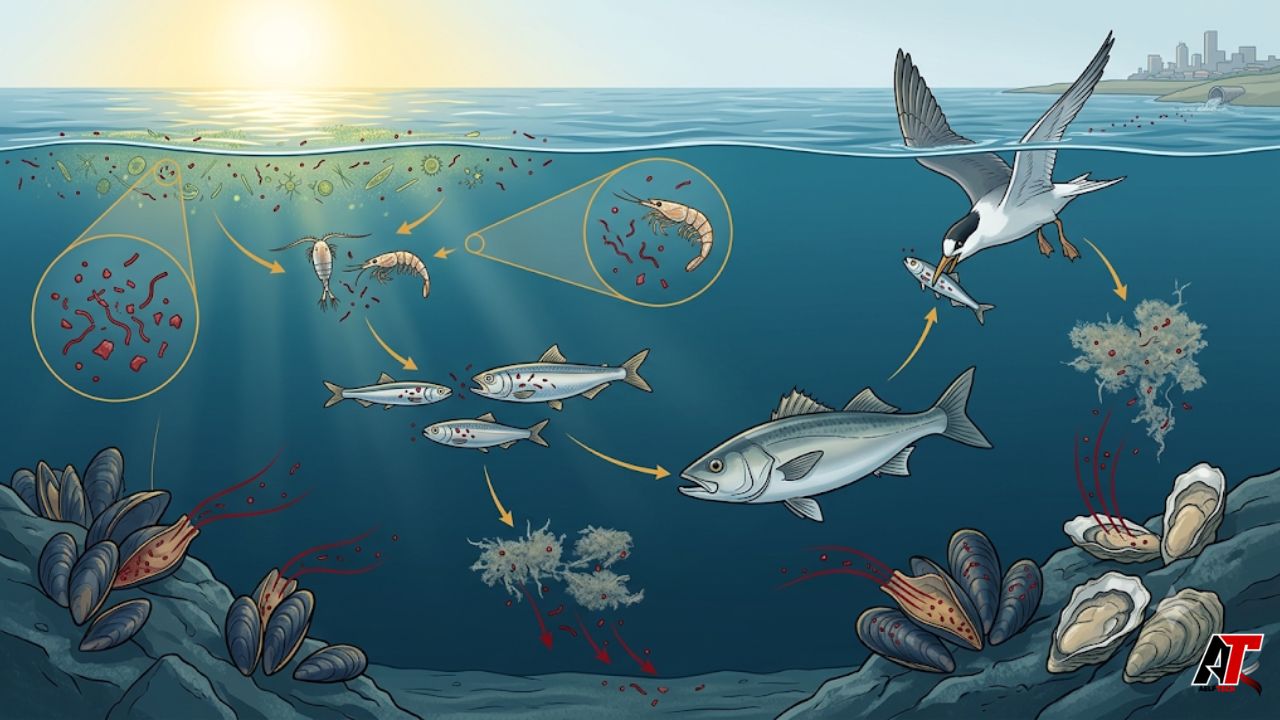
Plastic pollution is often pictured as bottles, bags, and abandoned fishing gear floating at the surface. Yet some of the most persistent plastic contamination is nearly invisible. Microplastics – generally defined as plastic pieces or fibers smaller than five millimeters – now occur from coastal waters and estuaries to deep-sea sediments. Their small size places them within the feeding range of organisms that support entire ocean ecosystems.
The concern is not simply that individual animals swallow plastic. Microplastics can enter at multiple points in a food web, move from prey to predator, settle into seabed communities, and interact with chemicals and microorganisms. Scientists have documented trophic transfer, but they also caution that transfer is not the same as universal biomagnification. Understanding that difference is essential for discussing risk without exaggerating what the evidence can currently prove.
What Counts as a Microplastic?
Microplastics come in many forms, including fragments, films, foams, pellets, and synthetic fibers. Primary microplastics are manufactured at a small size, such as industrial resin pellets or certain specialty particles. Secondary microplastics form when larger products break apart through sunlight, heat, wave action, abrasion, and ordinary wear.
Their shape and density affect where they travel. Some plastics initially float, while denser polymers sink. Biofouling – the growth of algae, bacteria, and other organisms on a particle – can also change buoyancy. A particle may therefore circulate at the surface, descend through the water column, become buried in sediment, or return upward as biological material decays.
How Microplastics Reach the Ocean
The ocean receives microplastics through many connected routes. Rivers and storm drains carry fragmented litter, tire-wear particles, road-marking debris, and urban dust. Wastewater can contain fibers released when synthetic textiles are washed. Industrial handling can release plastic pellets, while paints, coatings, ropes, nets, and marine equipment shed particles during use and weathering.
Atmospheric transport adds another pathway. Lightweight fibers and fragments can move with wind and later fall onto land or water through dry deposition or rain. This means even remote marine areas may receive contamination that originated far away. Once particles enter coastal zones, tides, currents, storms, and biological activity distribute them across habitats.
1. The Food Web Entry Point Begins at the Smallest Scale
Phytoplankton, the foundation of marine food webs, convert sunlight and nutrients into biological energy that supports zooplankton, small fish, shellfish, and ultimately large predators. Microplastics can occur in the same surface waters where these microscopic producers live. Depending on particle size and chemistry, particles may collide with cells, become coated in organic material, or be incorporated into aggregates.
Not every interaction results in ingestion or measurable harm. Laboratory findings vary by phytoplankton species, plastic type, particle concentration, and exposure period. Even so, the overlap matters because the base of the food web is also the starting point for carbon cycling and energy transfer. Changes at this level can influence organisms far beyond the original exposure site.
2. Zooplankton Mistake Particles for Food
Zooplankton graze on phytoplankton and suspended organic matter. Many feed by filtering particles from the surrounding water, so they may capture microplastics alongside natural prey. Visual resemblance, size, surface coatings, and the presence of food odors can make some particles more likely to be ingested.
Ingested material may be expelled, but temporary retention can still create an energetic cost. An animal that spends time handling or processing non-food particles may consume less nutritious prey. Experiments have also reported altered feeding under certain exposure conditions. Because zooplankton connect primary producers to fish and larger invertebrates, their exposure opens a direct route into higher trophic levels.
3. Filter Feeders Concentrate What Is Suspended in Water
Mussels, oysters, clams, sponges, and other filter feeders process substantial volumes of water to obtain food. This feeding strategy makes them efficient collectors of suspended particles, including fibers and fragments. Sediment-feeding animals can also encounter microplastics that have settled to the bottom or become mixed with organic detritus.
These organisms are ecologically important because they link the water column, seabed, and predators. They are also eaten whole by wildlife and, in some cases, by people. Their contamination therefore reflects both environmental exposure and a pathway through which particles can move to animals that consume them.
4. Predators Receive Microplastics Through Their Prey
Fish and other predators can ingest microplastics directly from water, sediment, or mistaken food. They can also receive them indirectly by eating contaminated prey. Controlled studies have demonstrated this trophic-transfer pathway. In one estuarine model, larval fish acquired more particles through microplastic-containing prey than through direct exposure, showing that diet can be a meaningful route for sensitive life stages.
As food-web links multiply, exposure can extend to commercially important fish, seabirds, turtles, and marine mammals. However, detection in a predator does not automatically prove that particle concentrations increase at every trophic step. Retention time, feeding behavior, body size, tissue sampled, and the ability to eliminate particles all affect measured burdens.
5. Marine Snow Carries Plastic to the Deep Sea
Organic particles, mucus, fecal pellets, dead plankton, and other material form sinking aggregates often called marine snow. Microplastics can become incorporated into these aggregates and travel downward. Zooplankton that ingest plastic may also package particles into fecal pellets, accelerating movement toward deeper water.
This vertical transport helps explain why microplastics are not only a surface problem. Once on the seafloor, particles can be consumed by worms, crustaceans, mollusks, and bottom-feeding fish. Sediments may act as long-term reservoirs, exposing organisms repeatedly even when surface conditions change.
6. Physical Stress Can Alter Feeding and Energy Use
Potential biological effects depend on dose, particle size, shape, polymer, additives, and the organism involved. Reported responses include reduced feeding, gut irritation, oxidative stress, inflammation, impaired growth, and reproductive changes. Fibers and irregular fragments may behave differently from smooth spheres, which are still commonly used in laboratory experiments.
Environmental realism is a major limitation. Some experiments use particle concentrations, sizes, or pristine polymers that do not match natural conditions. Field organisms are exposed to complex mixtures rather than one standardized plastic. For that reason, individual studies should be interpreted within the broader evidence rather than treated as universal predictions for every species.
7. Plastics Can Carry Chemicals and Microbial Communities
Plastic products may contain additives such as colorants, stabilizers, and plasticizers. Weathered particles can also sorb chemicals from surrounding water. When ingested, some of these compounds may desorb, although the importance of plastic as a chemical-delivery route varies by contaminant and exposure setting. Organisms already receive chemicals through water, sediment, and natural food, so the plastic contribution must be evaluated comparatively.
Microplastic surfaces also develop microbial communities known as the plastisphere. These biofilms change particle properties and may influence feeding attraction or transport. Some particles can carry opportunistic or harmful microorganisms, but the ecological significance depends on location, microbial composition, and whether organisms remain viable during transport.
8. Trophic Transfer Is Proven; Universal Biomagnification Is Not
Trophic transfer means a predator acquires microplastics by consuming exposed prey. Multiple experiments support that process. Biomagnification is a stronger claim: concentrations would need to rise systematically at higher trophic levels. Reviews of field data have not found clear evidence of universal microplastic biomagnification across a generalized marine food web.
This does not mean higher predators are safe or that localized biomagnification cannot occur. It means the pattern is influenced by elimination rates, species-specific diets, habitat, particle type, and measurement methods. Clear language protects public understanding: microplastics can move through food webs and accumulate within organisms, while the scale and consistency of concentration increases across trophic levels remain active research questions.
9. Why This Matters for Fisheries, Wildlife, and People
Marine food webs support fisheries, coastal employment, tourism, and food security. If microplastics alter feeding efficiency, growth, reproduction, or prey availability, the effect may extend beyond one species. Small changes at lower trophic levels can reshape predator-prey relationships, especially when combined with warming, oxygen loss, habitat degradation, and chemical pollution.
Microplastics have been detected in seafood, but detection alone does not establish a specific human-health outcome. Exposure varies by species and by which tissues are eaten. Current evidence supports reducing contamination and improving research, while avoiding unsupported claims about individual disease risk. The clearest environmental priority is to prevent additional plastic from entering ecosystems.
10. Stopping Microplastics Requires Action From Source to Sea
Ocean cleanup has value for larger debris, but recovering microscopic particles dispersed through water and sediment is far more difficult. Prevention therefore offers the strongest leverage. Product redesign can reduce shedding and unnecessary plastic use. Better pellet handling, fishing-gear management, textile filtration, tire-wear controls, stormwater capture, and advanced wastewater treatment can intercept particles before they spread.
Environmental permitting can support this upstream approach by requiring facilities and projects to identify discharges, manage stormwater, control material loss, document compliance, and monitor environmental performance where applicable. Permits alone cannot solve global plastic pollution, but well-designed requirements can turn broad environmental goals into measurable operating practices.
Governments also need comparable monitoring standards. Researchers currently use different mesh sizes, digestion methods, contamination controls, and reporting units, making studies difficult to compare. Consistent methods and polymer confirmation can reveal where interventions are working and where hidden sources remain.
What Individuals and Organizations Can Do
Individuals can reduce avoidable single-use plastic, maintain clothing to limit unnecessary washing, use products designed to shed fewer fibers, dispose of fishing line responsibly, and support local litter and stormwater programs. These actions are useful, but responsibility should not rest on consumers alone.
Businesses can audit plastic use, improve material containment, prevent pellet and packaging loss, evaluate microfiber or process-water filtration, and include plastic leakage in supplier standards. Ports, municipalities, schools, and research institutions can combine cleanup data with source tracking. For more accessible analysis of environmental technology and practical sustainability, readers can explore aelftech.com.
Frequently Asked Questions
Do microplastics always stay inside marine animals?
No. Many organisms can expel some particles through digestion or other clearance processes. Retention varies with particle size, shape, species, life stage, and exposure. Temporary ingestion can still affect feeding or transfer particles to predators.
Are nanoplastics part of the same problem?
Yes, but they are smaller than conventional microplastics and are harder to detect reliably. Their ability to cross biological barriers may differ, so researchers often treat microplastics and nanoplastics as related but distinct measurement and risk-assessment challenges.
Does eating seafood mean people are definitely harmed by microplastics?
Microplastics have been found in seafood, but the presence of particles does not by itself establish a specific health effect. Exposure assessment, particle chemistry, dose, and biological response all require further research.
Can wastewater and stormwater systems remove all microplastics?
No single technology captures every particle size and source. Wastewater and stormwater controls can reduce releases, but prevention, product redesign, industrial containment, and standardized monitoring are also necessary.
Conclusion
Microplastics infiltrate marine food webs because they overlap with the sizes, habitats, and feeding strategies of organisms at nearly every level. They are encountered by plankton, filtered by shellfish, consumed by fish, transported through prey, and deposited into deep-sea communities. The resulting risks are ecological, economic, and potentially relevant to human exposure. The science is strong enough to justify prevention, yet nuanced enough to reject sensational shortcuts. Trophic transfer is documented, while universal biomagnification remains uncertain. The most effective response is to reduce plastic loss before particles become too small, widespread, and biologically entangled to recover.
Leave a Reply