
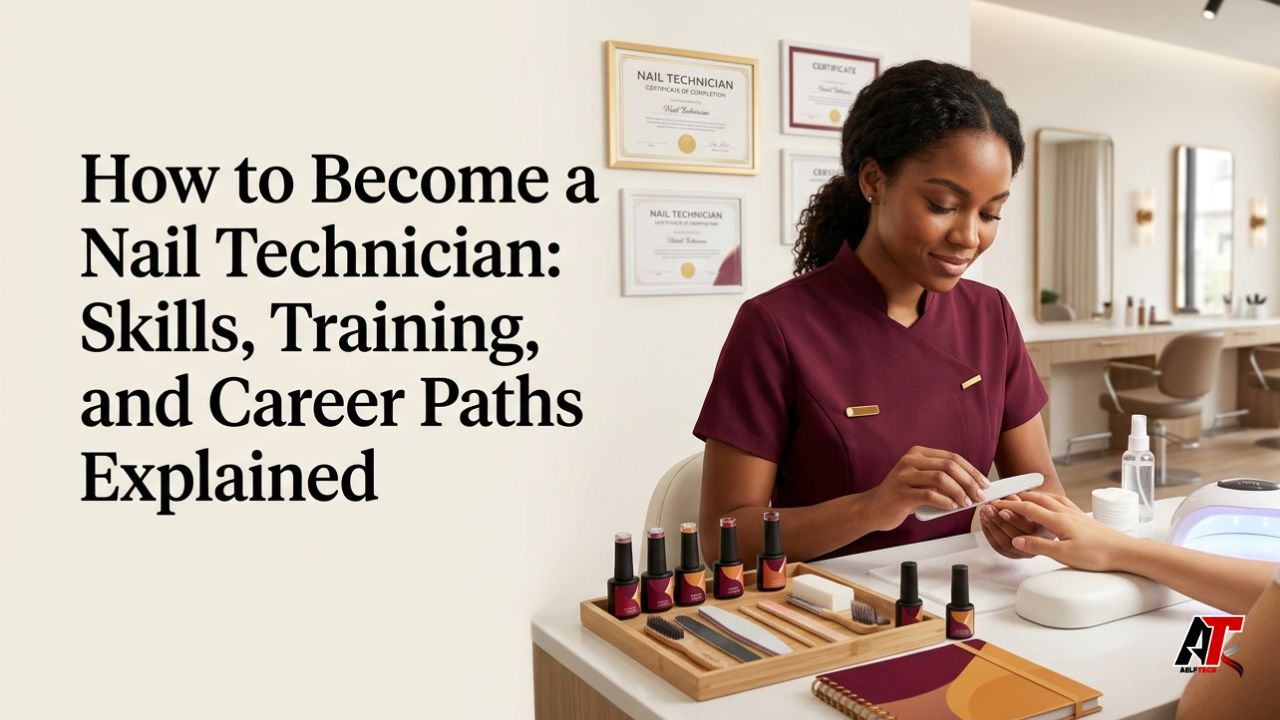
Becoming a nail technician can open the door to a creative, people-focused career with flexible work options. The role is more technical than it may look from the client’s chair. A professional nail technician must understand nail anatomy, sanitation, product chemistry, shaping, enhancement systems, client consultation, and business basics. Artistic talent helps, but safe procedures and consistent service are what create a lasting career.
In the United States, the usual pathway includes completing an approved training program, meeting state requirements, passing any required examinations, and maintaining a license. Exact rules vary by state, so no single course length or exam format applies everywhere. This guide explains how to become a nail technician, what skills matter most, how to choose training, and where the profession can lead.
What Does a Nail Technician Do?
A nail technician, also called a manicurist or pedicurist, cleans, shapes, enhances, and decorates fingernails and toenails. Daily services may include traditional manicures and pedicures, gel polish, acrylic or gel extensions, repairs, removals, nail art, and hand or foot care. The work also involves disinfecting tools, maintaining client records, managing supplies, scheduling appointments, and recommending appropriate aftercare.
The job requires close attention because technicians use sharp implements, electric files, adhesives, solvents, and curing systems. A technician must recognize when a service should not continue, such as when a client shows signs of infection, broken skin, or a condition outside the professional scope of nail care. Knowing when to pause and recommend medical advice is part of responsible service.
Step 1: Research Licensing Rules in Your State
Start with the cosmetology or professional licensing board for the state where you plan to work. The U.S. Bureau of Labor Statistics explains that manicurists and pedicurists generally complete a state-approved cosmetology or nail technician program and pass a state examination for licensure. However, states set their own education hours, age or education prerequisites, exam procedures, fees, renewal periods, and continuing-education rules.
Do not assume that a private certificate automatically qualifies you for a state license. Before paying tuition, confirm that the school or pathway is accepted by your state board. Ask whether the program prepares students for theory, practical, or written-practical testing. The National-Interstate Council of State Boards of Cosmetology develops nail technology examinations used by participating jurisdictions, but candidates still need to follow their own state’s instructions.
Step 2: Choose the Right Training Route
Most beginners enroll in a state-approved nail technology or cosmetology school. These programs combine classroom learning with supervised practice. Some locations may also recognize apprenticeship routes, which blend related instruction with mentored work experience. Availability is not universal, so confirm whether apprenticeship is permitted for nail licensure in your state before treating it as an alternative to school.
After licensing requirements are clear, compare programs for practical depth, instructor access, sanitation standards, model practice, kit costs, schedules, and graduate support. A skill-focused nail technician course can help students develop shaping, product control, gel or acrylic techniques, and salon workflow. Why Not Nails describes hands-on instruction, small groups, live-model practice, and training in hygiene and client care. Prospective students should still verify independently whether any course satisfies the licensing requirements of the state where they intend to work.
What a Strong Nail Technology Program Should Teach
A good program should build safety and judgment before speed. Students need repeated practice on natural nails and enhancement systems, but they also need theory that explains why products behave differently. Look for a curriculum covering the following areas:
- Nail anatomy, growth, common conditions, and service contraindications.
- Infection control, cleaning, disinfection, personal protective equipment, and waste handling.
- Client consultation, recordkeeping, service planning, and aftercare advice.
- Natural nail preparation, shaping, polishing, and cuticle care within legal scope.
- Gel polish, acrylic, builder gel, tips, forms, overlays, repairs, removals, and safe e-file use.
- Product chemistry, curing, adhesion, lifting prevention, and avoiding overexposure.
- Salon operations, appointment timing, inventory, pricing, retail sales, and professional ethics.
Essential Technical Skills to Develop
Precision and Hand Control
Nail work depends on close vision, steady hands, finger dexterity, and careful pressure. O*NET identifies near vision, arm-hand steadiness, finger dexterity, and manual dexterity as important abilities for this occupation. These skills improve through deliberate repetition rather than rushing. Practice clean polish margins, balanced shapes, smooth apex placement, even filing, and controlled product application.
Sanitation and Client Safety
Sanitation is not a background task; it is a core professional skill. Tools and surfaces must be cleaned and disinfected according to state rules and product instructions. Single-use items should not be reused when regulations prohibit it. Technicians also need protocols for cuts, blood exposure, skin contact, and suspected fungal or bacterial conditions. Consistent sanitation protects clients, coworkers, and the reputation of the business.
Product Knowledge and Removal
A technician should understand how monomers, polymers, gels, primers, adhesives, removers, and lamps work together. Incorrect mixing, under-curing, excessive filing, or forceful removal can damage the natural nail or increase the risk of irritation. Professional skill includes choosing the correct system, applying only what is needed, monitoring wear, and removing enhancements without peeling or scraping healthy nail layers.
Nail Art and Design Balance
Creative design can help a technician stand out, but attractive work must still be wearable and structurally sound. Begin with line work, dots, gradients, simple florals, chrome, foil, and balanced color placement. Photograph finished sets in consistent lighting. Over time, a recognizable style can support premium services, social media visibility, and stronger client loyalty.
Health, Ventilation, and Ergonomics Matter
Nail professionals work around vapors, dust, repetitive movements, and prolonged sitting. OSHA notes that salon products may expose workers to chemicals through inhalation or skin and eye contact. Its guidance emphasizes reading labels and safety data sheets, using safer products where possible, closing containers, following disposal instructions, wearing suitable protection, and improving ventilation. OSHA describes ventilation as the best way to reduce airborne chemical levels in a salon.
Ergonomics also affects career longevity. Adjust the client’s position instead of bending forward for every service. Use a supportive chair, keep tools within easy reach, soften hard table edges, and take brief hand, shoulder, neck, and eye breaks. Speed is valuable only when it does not sacrifice posture, safety, or accuracy.
Client Service and Business Skills
Technical ability earns attention, while client experience earns repeat bookings. Successful technicians listen carefully, clarify shape and length, explain realistic outcomes, and communicate boundaries respectfully. O*NET highlights active listening, speaking, service orientation, and social perceptiveness as relevant skills. These qualities help prevent misunderstandings and make clients feel heard.
Basic business systems are equally important. Learn appointment scheduling, deposits, cancellation policies, service timing, inventory control, bookkeeping, taxes, and retail recommendations. Build a simple digital portfolio with clear service descriptions and accurate photographs. Resources from aelftech.com usa can also support broader digital learning and online business planning as you develop your professional presence.
Step 3: Prepare for the Licensing Examination
Once you complete the required education or approved pathway, follow your state board’s application process. Depending on the jurisdiction, testing may assess theory, practical procedures, or written-practical knowledge. Exam topics commonly include infection control, anatomy, product chemistry, consultation, contraindications, and service procedures. Use the current candidate bulletin from the state board or authorized test provider rather than relying on old study notes.
Create a study schedule that mixes theory review with timed practical routines. Pack and label supplies exactly as instructed, practice setup and cleanup, and learn what actions cause point deductions. After passing, keep your license current, display it when required, and track renewal deadlines.
Step 4: Build Experience and a Professional Portfolio
Your first portfolio does not need dozens of complex designs. It should prove that you can produce clean, consistent, safe work. Include natural manicures, short and long shapes, neutral polish, gel services, structured overlays, repairs, and a few nail-art examples. Show multiple angles and avoid filters that change skin tone or hide surface flaws.
Practice on approved models under supervision while training, then seek entry-level salon work, an assistant opportunity, or a mentored environment after licensure. Feedback from experienced technicians can shorten the learning curve. Track lifting, breakage, appointment time, rebooking, and client comments so improvement becomes measurable.
Career Paths for Nail Technicians
A nail license can support several career directions. Each option has a different balance of independence, income risk, administrative work, and creative freedom.
- Salon employee: A structured entry point with existing clients, coworkers, and business systems.
- Spa or resort technician: A service-focused role that may combine nail care with a broader luxury experience.
- Booth renter or independent professional: Greater control over pricing and schedule, with responsibility for expenses and compliance.
- Mobile nail technician: Services at client locations where local laws, insurance, and sanitation rules allow it.
- Salon or studio owner: Full control over branding and operations, plus responsibility for licensing, staff, payroll, safety, and marketing.
- Educator or trainer: Teaching after gaining strong experience and any instructor credentials required by the state.
- Content creator or brand educator: Producing tutorials, product education, demonstrations, or sponsored content while maintaining transparent professional standards.
Job Outlook and Income Expectations
The U.S. Bureau of Labor Statistics reported median pay of $34,660 per year, or $16.66 per hour, for manicurists and pedicurists in May 2024. It projects employment growth of 7 percent from 2024 to 2034, faster than the average for all occupations, with about 24,800 openings each year on average. These figures describe wage data and national projections; they do not guarantee personal earnings.
Actual income depends on location, employment arrangement, hours, prices, tips, client retention, service speed, supply costs, and business expenses. Self-employed technicians may have more pricing control but also pay for products, rent, insurance, taxes, booking tools, and unpaid administrative time. Compare net income, not just the amount collected from clients.
Common Mistakes to Avoid
- Choosing a course without confirming state-board eligibility.
- Prioritizing trendy designs before sanitation and natural-nail protection.
- Using an electric file aggressively or removing enhancements by force.
- Copying another technician’s work without developing consultation and problem-solving skills.
- Underpricing services without calculating product, rent, tax, and time costs.
- Ignoring ventilation, posture, allergic reactions, or repeated pain.
- Publishing heavily edited photos that create unrealistic client expectations.
A Simple Roadmap for Beginners
- Check the official licensing requirements for your state and intended work location.
- Compare approved schools or recognized apprenticeship options, total costs, schedules, and exam preparation.
- Complete theory and hands-on training while documenting safe, consistent practice.
- Use current state or testing-provider materials to prepare for required examinations.
- Apply for licensure, insurance, and any local business permissions before taking paying clients independently.
- Start in a setting that offers feedback, build a truthful portfolio, and measure client retention.
- Continue learning advanced techniques without neglecting sanitation, ergonomics, and business management.
Frequently Asked Questions
How long does it take to become a nail technician?
The timeline depends on state-required training hours, school schedule, examination availability, and application processing. A prospective student should get the current requirements directly from the state board and ask schools for realistic completion dates.
Can I become a nail technician through an online course?
Online theory may be useful, but licensing commonly requires a state-approved program and supervised practical training. A general online certificate should not be assumed to replace required hands-on hours or state examinations.
Do I need artistic experience before nail school?
No. Drawing experience can help with nail art, but beginners can develop hand control, shaping, polish application, and design through structured practice. Safety, consistency, and client care are more important than advanced art at the beginning.
Can a nail technician work independently?
Often yes, after meeting state and local rules. Independent work may require an active professional license, an establishment or mobile-service permit, insurance, tax registration, sanitation compliance, and appropriate zoning. Requirements differ by location.
Conclusion
Learning how to become a nail technician involves more than mastering polish and extensions. The strongest foundation combines approved education, licensing, sanitation, product knowledge, precise technique, communication, and basic business discipline. Research your state rules first, choose training carefully, and treat health and safety as professional skills rather than formalities. With patient practice and honest portfolio building, a new technician can progress from supervised services to a salon role, independent practice, ownership, education, or beauty content. The career offers creativity and flexibility, but long-term success comes from protecting the client, protecting the natural nail, and delivering dependable results appointment after appointment.
Leave a Reply