
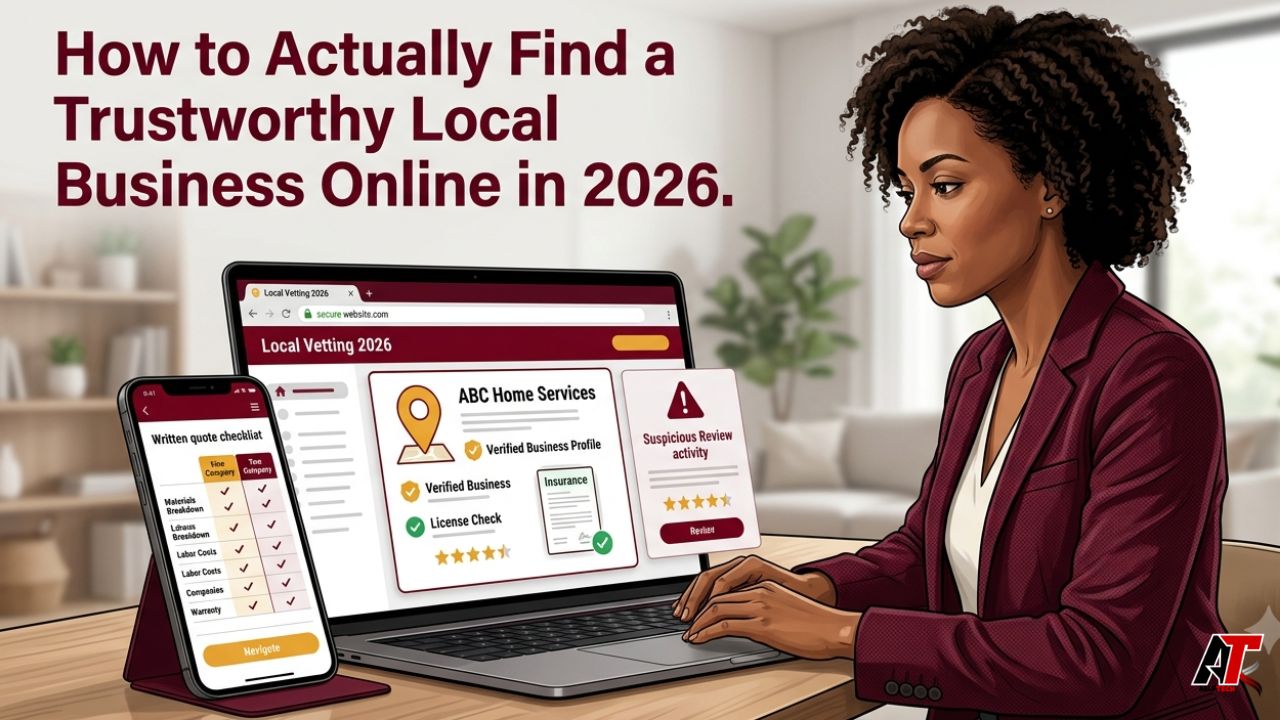
Finding a local business used to mean asking a neighbor and calling the first name in the directory. In 2026, the search looks easier but demands more judgment. A company can have a polished website, an active social profile, hundreds of glowing reviews, and a prominent map listing while still being inexperienced, misleading, or difficult to hold accountable. The safest approach is not to trust one signal. It is to build a small body of evidence and see whether every detail supports the same story.
This guide shows you how to find a trustworthy local business online without spending hours investigating every option. You will learn which signals matter, which popular shortcuts fail, and how to move from a search result to a confident hiring decision.
| QUICK ANSWER Choose a local business only after its identity, contact details, reviews, licensing, insurance, complaint history, written scope, and payment terms agree with one another. A verified profile or high rating is useful evidence, but neither is a guarantee of quality. |
Why Finding a Reliable Local Business Is Harder in 2026
The internet now rewards presentation as much as performance. Templates can produce an attractive website in an afternoon, artificial intelligence can generate convincing service pages, and review manipulation can create a false impression of popularity. The Federal Trade Commission’s Consumer Reviews and Testimonials Rule, effective since October 21, 2024, prohibits several deceptive review practices and permits civil penalties for knowing violations. That protection matters, but it does not remove suspicious content from every platform instantly.
Search engines are also introducing summaries, recommendations, and automated comparisons. These tools can accelerate research, yet they may repeat outdated information or merge details from similarly named companies. In guidance updated in October 2025, the Better Business Bureau advised consumers to use AI as a research assistant while double-checking its output against official licensing boards, government records, and other reliable sources. In other words, convenience should begin your search, not finish it.
1. Start With a Cross-Platform Search, Not a Single Ranking
Begin with a broad search such as “plumber near me,” “family dentist in [city],” or “local web designer.” Create a shortlist of three to five businesses, then search each company by its exact name. Add terms such as “reviews,” “complaints,” “scam,” “lawsuit,” and the owner’s name when available. Look beyond the first page of results because paid advertisements and optimized directories can occupy the most visible positions.
Cross-check the business on Google Maps, its own website, relevant professional directories, social platforms, and state or municipal databases. Pay attention to consistency. The legal or trading name, phone number, service area, address, business hours, and website should generally align. Minor formatting differences are normal. Different phone numbers, unrelated addresses, or several names attached to the same website deserve an explanation before you proceed.
2. Read Reviews Like Evidence, Not Advertising
A trustworthy business does not need a perfect rating. In fact, a realistic review profile usually contains a mixture of praise, neutral feedback, and occasional criticism. Read recent reviews and older ones to see whether service quality remains stable. Give more weight to reviews that describe the job, timeline, communication, price changes, problem resolution, and final result. Short bursts of generic five-star comments reveal much less.
Look for patterns instead of reacting to one angry customer. Repeated complaints about missed appointments, surprise charges, unfinished work, aggressive sales tactics, or ignored warranties are meaningful. Also inspect how the owner responds. Calm, specific replies that offer a solution demonstrate accountability. Copy-and-paste arguments, personal attacks, or public disclosure of private customer details are warning signs.
Useful review checks include:
- Reviews distributed naturally over months or years rather than appearing in one sudden cluster.
- Specific comments that match the services the business actually offers.
- Reviewer profiles with a believable history across different locations and categories.
- Similar experiences reported on more than one independent platform.
- Evidence that the company resolves legitimate complaints instead of merely collecting praise.
3. Verify the Business Identity and Local Presence
A Google Business Profile can be a helpful starting point because Google may require evidence of the location, business signage, equipment, documents, or management access during verification. However, profile verification shows that the operator can demonstrate a connection to the business; it does not certify workmanship, pricing, ethics, or customer service.
Check whether the company is a storefront business or a service-area business. A plumber, locksmith, cleaner, or mobile mechanic may legitimately hide a home address while serving customers at their locations. What matters is whether the service area is plausible, the phone is answered under the correct business name, and business documents use consistent details. Search your Secretary of State or equivalent corporate registry when the company claims to be an LLC or corporation.
4. Confirm Licenses, Insurance, and Professional Credentials
Some local services require government or professional licensing. Requirements vary by state, county, city, and trade, so do not rely on a license badge displayed on the company website. Ask for the full license number and verify it directly through the responsible board or agency. Confirm that the license is active, belongs to the person or entity you are hiring, and covers the work you need.
For work that could damage property or injure someone, request proof of liability insurance and workers’ compensation coverage where applicable. A certificate is useful, but high-value projects justify calling the listed insurer or agent to confirm that the policy is active. The FTC recommends considering licensed and insured contractors, checking licenses with state or county authorities, obtaining multiple written estimates, and avoiding full payment before satisfactory completion.
5. Examine the Website Beyond Its Appearance
A professional website is a positive sign only when its details can be verified. Look for an About page with identifiable leadership or staff, a working phone number, a domain-based email address, clear service descriptions, realistic project photos, terms, privacy information, and a physical address or defined service area. HTTPS and the padlock icon protect data in transit, but they do not prove that the company behind the site is trustworthy.
Compare the main website with location-specific pages. For example, when reviewing a provider such as Cyfrow Solutions, inspect the company-wide service information first. Then compare it with the relevant local page, such as Cyfrow Solutions for San Antonio. A credible local page should contain useful area-specific information without contradicting the company name, contact details, scope, or expertise shown elsewhere on the site. This comparison method applies to nearly every local service provider.
6. Test the Business Before You Commit
Your first call, email, or chat is part of the evaluation. Ask two or three specific questions that cannot be answered with a generic sales script. Describe your need, request the likely process, and ask who will perform the work. A reliable representative should explain limitations, clarify what information is still needed, and avoid making guarantees before inspecting the situation.
Notice whether the company answers under the advertised name, follows up when promised, and provides important statements in writing. Slow communication is not automatically dishonest, especially for small teams, but repeated vagueness before payment usually becomes worse afterward. For a costly job, request references from recent customers with similar projects and obtain permission before contacting them.
7. Compare Written Quotes and Payment Terms
Price matters, but the cheapest quote is not always the best value. Compare the scope line by line: materials, labor, preparation, permits, cleanup, warranties, exclusions, taxes, change orders, start date, and completion expectations. A low estimate may simply omit work that another provider has included. Ask the business to explain major differences rather than guessing.
Use a written contract for substantial services. It should identify the business, customer, project address, license number when relevant, payment schedule, cancellation terms, and dispute procedure. Avoid businesses that demand full payment upfront, insist on cash, request gift cards or cryptocurrency, or pressure you to use an unfamiliar financing company. Credit cards can provide useful dispute protections, while wire transfers are difficult to reverse.
Green Flags and Red Flags at a Glance
| GREEN FLAGS | RED FLAGS |
| Consistent name, address, phone, and website | Conflicting identities or unreachable contact details |
| Detailed reviews spread over time | Sudden clusters of generic five-star reviews |
| Active license and verifiable insurance | Badges without numbers or refusal to provide proof |
| Written estimate with scope and exclusions | Verbal promises and unexplained pressure |
| Reasonable deposit and staged payments | Full upfront payment, cash-only, wire, or gift cards |
| Professional responses to criticism | Threats, insults, or deletion pressure |
A 10-Minute Verification Checklist
- Search the exact business name plus “reviews,” “complaints,” and “scam.”
- Compare the phone number, address, website, hours, and service area across platforms.
- Read at least five recent reviews, three critical reviews, and the owner’s responses.
- Verify any required license through the official government or professional database.
- Ask for insurance, references, and a written estimate when the risk or cost is significant.
- Check the website for real contact details, policies, and consistent company information.
- Reject high-pressure sales tactics and unusual payment requests.
- Make the final choice based on the complete evidence, not one rating or badge.
Match the Evidence to the Type of Business
Different industries require different proof. Contractors may need trade licenses, permits, bonding, and insurance. Healthcare providers should appear in state licensing databases and clearly explain professional credentials. Lawyers should be listed with the relevant bar association. Auto repair shops should provide written estimates and authorization procedures. Financial professionals may require federal or state registration. Marketing, design, and technology firms are less likely to have occupational licenses, so examine case studies, ownership, contracts, references, data-handling policies, and measurable deliverables more closely.
Do not punish a legitimate small business for lacking the digital polish of a national chain. A simple website, a modest review count, or a home-based service address may be perfectly reasonable. The key question is whether the business is transparent and verifiable. Honest limitations are a stronger signal than extravagant claims that cannot be supported.
How to Use AI Without Letting It Choose for You
AI can organize your shortlist, summarize recurring review themes, draft questions, and create a comparison table. It is particularly useful when a business has hundreds of reviews. Still, an AI summary may overlook dates, sarcasm, duplicate content, ownership changes, or the difference between two businesses with similar names. Never use an automated summary as evidence that a license is active, an insurance policy exists, or a complaint was resolved.
Use AI for synthesis, then verify decisive facts at their original sources. Open the licensing record yourself, read the actual negative reviews, call the published number, and request the written agreement. This final human check is what turns online research into informed judgment.
The Final Decision: Look for Consistency, Not Perfection
The best local business may not have the most reviews, the flashiest website, or the lowest price. It should have a traceable identity, a credible operating history, relevant qualifications, clear communication, fair terms, and evidence that it handles problems responsibly. One weak signal can have an innocent explanation. Several contradictions usually indicate unnecessary risk.
When you slow down long enough to cross-check the basics, finding a trustworthy local business online becomes much easier. Build a shortlist, verify the facts, compare written offers, and keep control of your payment. In 2026, trust is not a badge you notice. It is a conclusion you reach after the evidence agrees.
Leave a Reply