
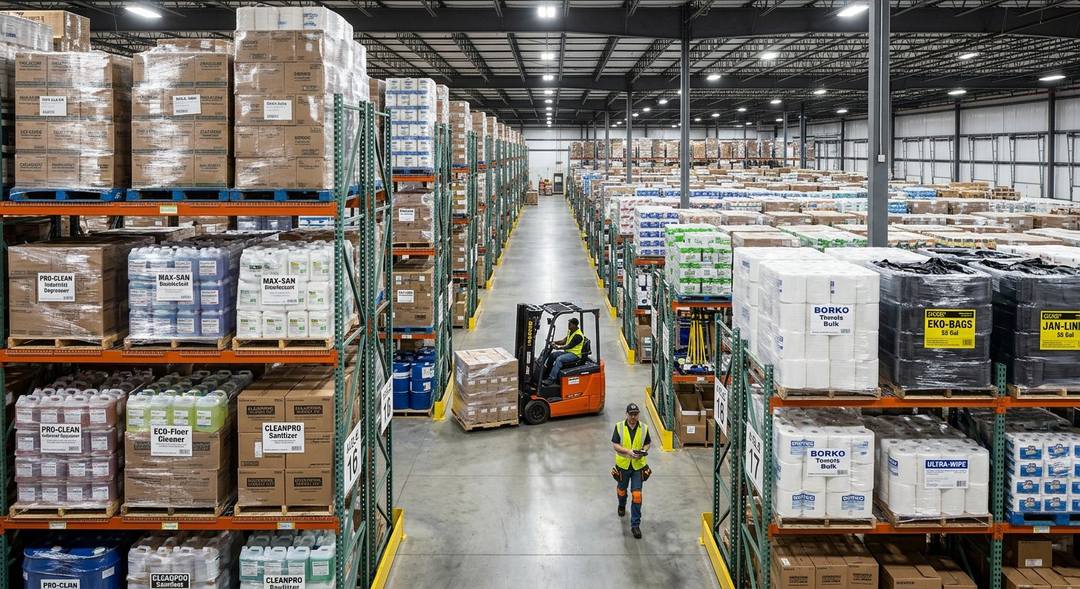
Maintaining a clean, safe, and professional workplace requires dependable cleaning products, appropriate equipment, and consistent inventory management. Whether you operate an office, restaurant, school, retail store, healthcare facility, or commercial cleaning company, selecting the right custodial supplies can influence cleaning efficiency, workplace hygiene, employee productivity, and operating expenses. However, finding reliable products at competitive prices is not always straightforward, especially when businesses must balance quality, safety requirements, and purchasing budgets.
Fortunately, businesses have several purchasing options, including wholesale distributors, online marketplaces, janitorial specialists, and local commercial suppliers. Choosing where to buy custodial supplies involves more than comparing individual product prices. Delivery reliability, product compatibility, safety documentation, bulk discounts, and long-term supplier relationships also matter. This guide explains the best purchasing channels, essential cleaning products, cost-saving strategies, and practical considerations for building an efficient commercial cleaning inventory.
What Are Custodial Supplies?
Custodial supplies are cleaning products, tools, equipment, and consumable materials used to maintain commercial, institutional, and shared environments.
These products support routine cleaning, sanitation, waste management, floor maintenance, and restroom upkeep.
Businesses purchase custodial supplies to help employees or professional cleaning teams maintain appropriate cleanliness standards.
The specific products required depend on the facility’s size, activities, occupancy, and applicable health and safety requirements.
For example, a small office may need basic surface cleaners, microfiber cloths, and trash liners.
Meanwhile, a large industrial facility may require specialized floor-cleaning machines, chemical dispensing systems, and protective equipment.
Common Categories of Custodial Supplies
Commercial cleaning inventory generally includes several product categories.
- Cleaning chemicals and surface detergents.
- Disinfectants and sanitizers.
- Mops, buckets, brushes, and microfiber cloths.
- Commercial vacuum cleaners.
- Floor scrubbers and polishing equipment.
- Trash bags and waste containers.
- Paper towels and restroom tissue.
- Soap and hand hygiene products.
- Protective gloves and safety equipment.
- Cleaning carts and storage accessories.
Although many products are suitable for general commercial use, certain environments require specialized cleaning procedures.
Healthcare facilities, food preparation areas, and industrial workplaces may have additional regulatory requirements.
Why Buying the Right Custodial Supplies Matters
Commercial cleaning products affect several aspects of business operations.
Choosing unsuitable equipment or chemicals can increase labor requirements, create unnecessary expenses, and potentially damage surfaces.
By contrast, appropriate cleaning products can support efficient maintenance routines.
Workplace Cleanliness and Hygiene
Regular cleaning helps remove visible dirt, debris, and certain contaminants.
However, cleaning and disinfection are different processes.
Cleaning generally removes dirt and organic material.
Disinfection uses products designed to inactivate specified microorganisms when applied according to label instructions.
Businesses should select products based on their actual cleaning requirements rather than assuming stronger chemicals are always better.
Employee Safety
Some commercial cleaning chemicals can cause irritation or other hazards when handled incorrectly.
Therefore, businesses should follow manufacturer instructions, provide appropriate training, and maintain required safety documentation.
Workers should also use personal protective equipment when indicated.
Cost Control
Cleaning expenses include more than the purchase price of chemicals.
Labor, equipment maintenance, storage, product waste, and replacement frequency all affect overall costs.
Consequently, purchasing custodial supplies strategically can support more predictable operating budgets.
Professional Appearance
Clean floors, maintained restrooms, and organized workspaces contribute to a professional environment.
However, the level of cleaning required varies according to business activities and customer expectations.
A suitable cleaning program should reflect the needs of the facility.
7 Best Places to Buy Custodial Supplies for Your Business
Businesses can purchase professional cleaning products through several channels.
Each option offers different advantages involving product selection, pricing, delivery, and customer support.
1. Wholesale Janitorial Supply Distributors
Wholesale distributors are among the most common sources of commercial cleaning products.
These businesses generally supply organizations that purchase cleaning materials regularly or in larger quantities.
They may offer cleaning chemicals, paper products, equipment, dispensers, and other facility maintenance essentials.
Why Wholesale Distributors Are Useful
Wholesale distributors often provide access to commercial-grade products in larger package sizes.
Additionally, some offer account-based pricing, scheduled deliveries, and purchasing assistance.
For businesses operating multiple locations, centralized purchasing may simplify inventory management.
However, minimum order requirements and delivery charges vary.
What to Ask a Wholesale Supplier
Before opening an account, consider asking:
- Are minimum purchase quantities required?
- Does the supplier offer volume-based pricing?
- Are delivery charges included?
- How frequently are products restocked?
- Can the supplier provide safety data sheets?
- Are equipment parts and maintenance services available?
- What happens when an ordered product is unavailable?
These questions help businesses evaluate total purchasing value.
2. Online Commercial Cleaning Supply Stores
Online janitorial retailers provide a convenient way to compare custodial supplies without visiting physical stores.
Many websites organize products by category, application, manufacturer, or facility type.
As a result, buyers can review specifications and compare alternatives before ordering.
Advantages of Online Purchasing
Online stores may offer detailed product descriptions, customer reviews, and convenient ordering systems.
Furthermore, businesses can often place orders outside normal office hours.
Some suppliers provide recurring purchasing options or account dashboards.
However, product availability, shipping charges, and delivery times should be checked carefully.
What to Look for in an Online Supplier
A reliable online retailer should provide accurate product specifications.
For cleaning chemicals, safety information and appropriate usage instructions are particularly important.
Additionally, buyers should review return policies and customer support options.
Businesses purchasing large equipment should confirm warranty and servicing arrangements before ordering.
3. Local Janitorial Supply Companies
Local commercial cleaning suppliers can be valuable partners for businesses that require dependable access to essential products.
These companies may serve offices, schools, restaurants, property managers, and professional cleaning contractors within a defined geographic area.
Benefits of Local Suppliers
Local suppliers may offer convenient pickup and regional delivery.
In addition, some provide product demonstrations or advice about equipment compatibility.
Direct communication can be useful when businesses need replacement parts or assistance selecting appropriate cleaning materials.
However, local availability varies considerably.
Not every supplier stocks the same range of specialized custodial supplies.
When Local Purchasing Makes Sense
Local purchasing may be particularly useful when:
- Products are needed urgently.
- Delivery distances are short.
- Equipment demonstrations are important.
- Businesses prefer direct supplier communication.
- Frequent restocking is required.
- Technical assistance is available locally.
Nevertheless, comparing complete costs remains important.
4. Business-to-Business Marketplaces
Business-to-business marketplaces allow organizations to purchase commercial products from multiple sellers.
These platforms may offer custodial supplies alongside office equipment, packaging materials, and workplace essentials.
Why Businesses Use B2B Marketplaces
Marketplaces can simplify purchasing when organizations need products from several categories.
Additionally, some platforms provide business account features, order histories, and spending controls.
However, product quality and seller reliability may vary.
A marketplace listing does not automatically mean the seller is an authorized distributor.
Verify Product Authenticity
When purchasing cleaning chemicals or equipment, review seller information carefully.
Counterfeit, improperly labeled, or unsuitable products can create safety problems.
Therefore, businesses should prioritize established sellers and verify relevant product documentation.
5. Industrial and Facility Maintenance Suppliers
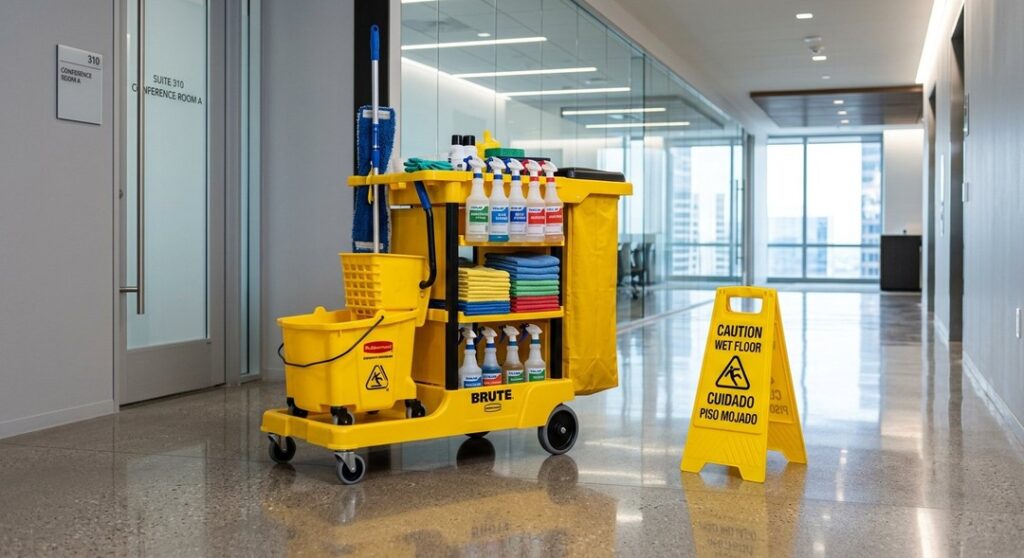
Industrial suppliers often provide cleaning equipment alongside maintenance, repair, and operational products.
These businesses may be particularly useful for warehouses, manufacturing facilities, logistics operations, and larger commercial properties.
Specialized Product Availability
Industrial suppliers may stock heavy-duty floor scrubbers, absorbents, spill response materials, and specialized cleaning tools.
They may also offer protective equipment and maintenance accessories.
However, not every industrial product is appropriate for routine office cleaning.
Product selection should reflect the facility’s actual hazards and cleaning requirements.
Equipment Support
Commercial cleaning machines may require replacement brushes, batteries, filters, or other components.
Consequently, access to compatible parts can influence long-term ownership costs.
Before purchasing equipment, confirm service availability and warranty conditions.
6. Warehouse Clubs and Bulk Retailers
Warehouse clubs and large retailers may offer selected cleaning products in economical package sizes.
These options can be useful for smaller businesses with relatively straightforward cleaning needs.
Suitable Products for Bulk Retail Purchasing
Common examples include:
- Paper towels.
- Toilet tissue.
- Trash bags.
- Hand soap.
- Basic cleaning tools.
- Selected surface cleaners.
- Disposable gloves.
- Storage containers.
However, retail products may differ from specialized commercial formulations.
Businesses should verify product suitability before substituting one item for another.
Understand Unit Pricing
Large packages are not automatically cheaper.
Compare prices using consistent measurements, such as cost per gallon, liter, roll, or individual unit.
Additionally, consider storage requirements and expected consumption.
Buying excessive quantities can create unnecessary inventory costs.
7. Manufacturers and Authorized Distributors
Some businesses purchase custodial supplies directly from manufacturers or authorized distribution partners.
This approach may be appropriate for organizations requiring consistent product specifications or significant purchasing volumes.
Benefits of Authorized Purchasing
Authorized channels may provide access to technical information, compatible accessories, and manufacturer-supported warranties.
Furthermore, businesses can obtain clearer guidance about product application and equipment maintenance.
However, direct purchasing is not always available.
Some manufacturers distribute products exclusively through approved dealers.
When Manufacturer Relationships Are Valuable
This purchasing model may suit organizations with:
- Multiple facilities.
- Standardized cleaning programs.
- Specialized equipment.
- Large recurring orders.
- Strict product compatibility requirements.
- Long-term maintenance needs.
The best arrangement depends on the organization’s scale and purchasing structure.
Comparing the Best Places to Buy Custodial Supplies
Different purchasing channels serve different business needs.
| Supplier Type | Main Advantage | Potential Limitation | Best Suited For |
|---|---|---|---|
| Wholesale distributors | Commercial product selection and volume pricing | Possible minimum orders | Regular bulk purchasing |
| Online janitorial stores | Convenient research and ordering | Shipping and delivery considerations | Small and medium businesses |
| Local suppliers | Regional support and product access | Availability varies | Businesses needing flexible restocking |
| B2B marketplaces | Broad product selection | Seller quality varies | General business purchasing |
| Industrial suppliers | Specialized equipment and materials | Some products may be unnecessary | Warehouses and industrial facilities |
| Warehouse clubs | Accessible bulk consumables | Limited specialist products | Small offices and retail businesses |
| Authorized distributors | Product expertise and manufacturer support | Purchasing conditions vary | Large facilities and specialized operations |
Businesses should compare suppliers using consistent criteria rather than selecting solely on advertised prices.
Essential Custodial Supplies Every Business Should Consider
A reliable cleaning program begins with identifying essential products.
However, purchasing requirements vary according to facility size, surface materials, and operational activities.
Commercial Surface Cleaners
General-purpose cleaners are used to remove dirt, grease, and other residues from compatible surfaces.
Some products are concentrated and require dilution.
Others are supplied ready to use.
Always follow the manufacturer’s instructions.
Using an overly concentrated solution may waste product or damage surfaces.
Disinfectants and Sanitizers
Disinfectants and sanitizers have specific intended uses.
In the United States, many surface disinfectants are regulated by the Environmental Protection Agency.
EPA-registered products should be used according to their approved labels.
Importantly, required contact times must be followed for the stated antimicrobial claims.
Microfiber Cleaning Cloths
Microfiber cloths can be useful for dusting and surface cleaning.
Different products are designed for different applications.
Color coding may help reduce cross-contamination between cleaning areas.
For example, organizations may assign separate cloth colors to restrooms and general office surfaces.
Commercial Mops and Buckets
Mops remain essential for many floor maintenance tasks.
Flat microfiber systems, traditional wet mops, and specialized floor tools serve different purposes.
Choose equipment compatible with the flooring material.
Trash Liners
Trash bags should match the dimensions and expected contents of waste containers.
Heavy or sharp waste may require stronger liners.
However, ordinary trash bags should not be used for regulated hazardous waste unless specifically appropriate.
Restroom Consumables
Businesses commonly require toilet tissue, hand soap, paper towels, and dispenser supplies.
Reliable replenishment helps maintain restroom functionality.
Commercial Vacuum Cleaners
Vacuum cleaners are useful for carpets, rugs, and selected hard surfaces.
Consider filtration, noise levels, capacity, and maintenance requirements.
Where fine particle control is important, appropriate filtration should be evaluated carefully.
How to Choose the Right Custodial Supplies for Your Facility
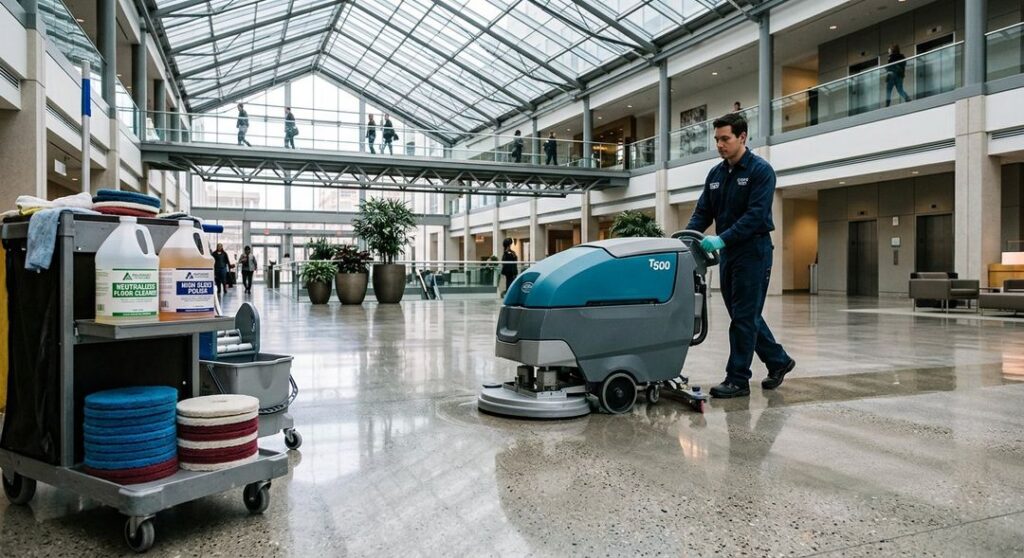
Selecting products requires matching cleaning methods to specific surfaces and conditions.
Identify the Facility Type
An office building has different cleaning requirements from a restaurant kitchen or healthcare environment.
Therefore, purchasing decisions should begin with a facility assessment.
Review Surface Materials
Cleaning chemicals must be compatible with the surfaces being treated.
For example, certain acidic cleaners can damage natural stone.
Similarly, unsuitable products may affect floor finishes or protective coatings.
Consider Cleaning Frequency
High-traffic facilities may require more frequent maintenance.
However, cleaning schedules should reflect actual use and risk.
Evaluate Product Concentration
Concentrated products may reduce packaging and transportation requirements.
Nevertheless, they require accurate dilution.
Incorrect mixing can reduce effectiveness or create hazards.
Review Safety Documentation
Safety data sheets provide information about chemical hazards, handling, storage, and emergency measures.
Employers should maintain appropriate documentation and training under applicable regulations.
Consider Storage Space
Buying large quantities can create logistical problems when storage areas are limited.
Inventory planning should reflect realistic consumption.
Commercial Cleaning Chemicals and Safety Requirements
Chemical safety is one of the most important considerations when purchasing custodial supplies.
Some cleaning agents can cause skin irritation, respiratory symptoms, or chemical burns when used incorrectly.
Understand Safety Data Sheets
Safety data sheets provide information about product hazards and recommended precautions.
In the United States, OSHA’s Hazard Communication Standard establishes requirements for communicating chemical hazards in covered workplaces.
Businesses should understand which requirements apply to their operations.
Never Mix Incompatible Chemicals
Mixing certain cleaning products can create dangerous reactions.
For example, combining chlorine bleach with ammonia-containing products can release hazardous gases.
Bleach should also not be mixed with acidic cleaners.
Always follow label instructions.
Use Appropriate Protective Equipment
Some products require gloves, eye protection, or additional safeguards.
The correct equipment depends on the chemical and task.
Do not assume that all disposable gloves provide equal chemical protection.
Store Chemicals Correctly
Cleaning chemicals should be stored in suitable containers and locations.
Keep incompatible substances separated.
Avoid transferring chemicals into unlabeled beverage containers.
Train Employees
Workers should understand safe handling, dilution, storage, and emergency procedures.
Training helps ensure that custodial supplies are used as intended.
How Much Do Custodial Supplies Cost?
The cost of custodial supplies depends on facility size, product type, purchasing volume, and cleaning frequency.
A small office may spend relatively little on routine consumables.
By contrast, a large commercial property may require significant ongoing investment in cleaning chemicals, equipment, and restroom products.
Major Cost Factors
Several variables influence spending.
- Facility square footage.
- Occupancy levels.
- Cleaning frequency.
- Product quality.
- Equipment requirements.
- Chemical concentration.
- Supplier pricing.
- Delivery charges.
- Storage capacity.
- Waste and replacement rates.
Instead of relying on universal cost estimates, businesses should calculate consumption using their actual operating conditions.
Understanding Cost Per Use
Unit pricing provides a more useful comparison than package price alone.
For example, a concentrated cleaner may cost more per container but produce a greater quantity of usable solution.
However, calculations should follow the manufacturer’s specified dilution ratios.
A cheaper product is not necessarily economical if it requires significantly more labor or frequent reapplication.
How to Save Money on Custodial Supplies
Cost control should focus on reducing waste without compromising safety or cleaning quality.
Buy Frequently Used Products in Appropriate Quantities
Bulk purchasing may reduce unit prices.
However, excessive inventory can tie up working capital and create storage problems.
Review consumption before increasing order quantities.
Standardize Cleaning Products
Using a manageable selection of compatible products can simplify purchasing and staff training.
Nevertheless, some surfaces require specialized formulations.
Avoid replacing necessary products merely to reduce the number of items stocked.
Compare Multiple Suppliers
Request quotations from different commercial suppliers.
Compare delivery charges, minimum orders, and support services.
Use Accurate Dilution Systems
Where appropriate, controlled dispensing equipment can help maintain consistent chemical dilution.
This may reduce product waste.
Maintain Cleaning Equipment
Regular maintenance can help prevent avoidable equipment failures.
Follow manufacturer instructions for filters, brushes, batteries, and other components.
Monitor Inventory
Inventory tracking helps identify unusual consumption and prevent unnecessary emergency purchases.
Even a simple spreadsheet can be useful for smaller facilities.
Buying Custodial Supplies in Bulk vs Small Quantities
Bulk purchasing and smaller orders offer different advantages.
| Purchasing Factor | Bulk Orders | Smaller Orders |
|---|---|---|
| Unit pricing | May be lower | May be higher |
| Storage needs | Greater | Lower |
| Upfront spending | Higher | Lower |
| Delivery frequency | Potentially less frequent | Potentially more frequent |
| Inventory management | More important | Often simpler |
| Product expiration risk | May increase | Usually easier to manage |
| Suitable businesses | Predictable high-volume users | Small or variable-demand facilities |
The most economical choice depends on consumption and storage conditions.
Custodial Supplies for Offices and Corporate Buildings
Office environments typically require routine cleaning of workstations, floors, shared spaces, and restrooms.
Daily Cleaning Essentials
Common office custodial supplies include microfiber cloths, surface cleaners, vacuum cleaners, trash liners, and restroom consumables.
However, cleaning frequency should reflect occupancy and facility policies.
Electronics Cleaning
Computers, monitors, and other electronics require suitable cleaning methods.
Avoid spraying liquids directly onto equipment unless manufacturer instructions specifically permit it.
Shared Spaces
Break rooms, conference rooms, and reception areas may need regular cleaning.
Frequently touched surfaces should be addressed according to appropriate facility procedures.
Custodial Supplies for Restaurants and Food Businesses
Food service environments require additional attention to sanitation and chemical compatibility.
Food-Contact Surface Products
Products used on food-contact surfaces must be appropriate for that application.
Follow applicable food safety regulations and label instructions.
Degreasers
Commercial kitchens may require products designed to remove grease.
However, strong degreasers can damage unsuitable surfaces.
Floor Cleaning Products
Kitchen floors may accumulate grease and moisture.
Cleaning methods should address slip hazards without leaving excessive residue.
Chemical Storage
Cleaning chemicals should be stored separately from food and food-contact materials as required.
Staff training is essential.
Custodial Supplies for Schools and Educational Facilities
Schools often have diverse cleaning requirements because they contain classrooms, restrooms, cafeterias, offices, and recreational spaces.
Age-Appropriate Safety Considerations
Cleaning products should be stored securely away from children.
Staff should follow applicable procedures for chemical handling.
Classroom Cleaning
Routine supplies may include microfiber cloths, compatible surface cleaners, and waste management materials.
Restroom Maintenance
Restrooms require consistent replenishment and appropriate cleaning procedures.
Gymnasium Floors
Specialized floor surfaces may require manufacturer-approved cleaning products.
Using incompatible chemicals can damage finishes.
Custodial Supplies for Healthcare Facilities
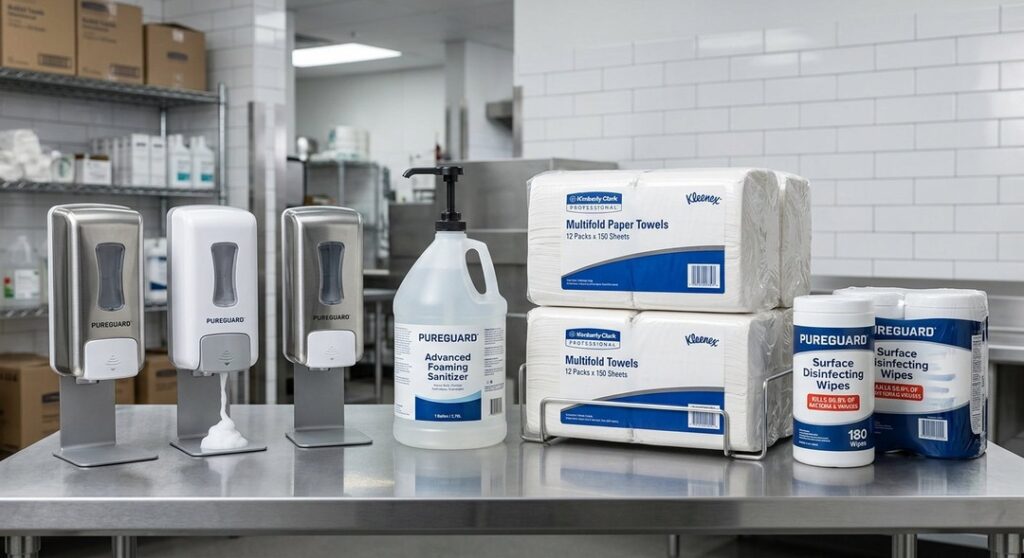
Healthcare environments may require more specialized cleaning and disinfection procedures.
Infection Prevention Requirements
Healthcare cleaning should follow applicable facility policies, regulations, and infection prevention guidance.
Products must be appropriate for their intended use.
Approved Disinfectants
In the United States, EPA-registered disinfectants are commonly used for relevant environmental surface applications.
However, product selection depends on the required antimicrobial claims and facility protocols.
Cross-Contamination Prevention
Separate equipment or established cleaning workflows may help reduce contamination risks.
Staff Training
Healthcare cleaning personnel need training appropriate to their responsibilities.
General office cleaning procedures may not be sufficient for clinical environments.
Eco-Friendly Custodial Supplies and Sustainable Purchasing
Environmental considerations can influence cleaning product selection.
However, terms such as green, natural, and eco-friendly do not automatically establish safety or environmental superiority.
Review Recognized Certifications
Programs such as EPA Safer Choice evaluate certain products against established criteria.
However, certification scope varies.
Businesses should verify claims through official program information.
Consider Concentrated Products
Concentrates may reduce packaging and shipping volume.
Nevertheless, their environmental benefits depend on formulation, dilution, transportation, and disposal practices.
Choose Durable Equipment
Long-lasting tools may reduce replacement frequency.
However, durability should be evaluated alongside repairability and maintenance needs.
Reduce Packaging Waste
Appropriate bulk packaging and refill systems may reduce certain forms of waste.
The best option depends on actual usage.
Avoid Greenwashing
Suppliers should support environmental claims with credible evidence.
Businesses should be cautious about vague marketing language.
How to Build a Custodial Supplies Inventory System
Inventory management helps organizations maintain cleaning operations without excessive stock.
Create a Product List
Record the cleaning products, equipment, and consumables currently used.
Include product identifiers and relevant specifications.
Estimate Consumption
Monitor how quickly each item is used.
Consumption may change with occupancy or seasonal demand.
Set Reorder Points
Establish minimum stock levels based on usage and delivery time.
Track Expiration and Storage Requirements
Some chemicals have shelf-life limitations.
Follow manufacturer guidance.
Assign Purchasing Responsibilities
Clear responsibility can reduce duplicate orders and overlooked inventory.
Review Supplier Performance
Monitor delivery reliability, product quality, and customer support.
These factors may be as important as price.
Common Mistakes When Buying Custodial Supplies
Poor purchasing decisions can increase costs and create safety concerns.
Choosing Products Based Only on Price
Low-cost products may require more frequent use or provide unsuitable performance.
Evaluate total cost.
Ignoring Product Compatibility
Incorrect chemicals can damage flooring, countertops, or equipment.
Overbuying Inventory
Excess stock consumes storage space and may create waste.
Failing to Verify Suppliers
Unreliable sellers may provide incorrect products or inadequate documentation.
Neglecting Employee Training
Even suitable custodial supplies can create hazards when misused.
Mixing Different Chemical Products
Incompatible chemicals can produce dangerous reactions.
Ignoring Equipment Maintenance
Neglected equipment may fail prematurely.
How to Choose a Reliable Custodial Supplies Supplier
A strong supplier relationship can simplify purchasing and support operational consistency.
Product Availability
Check whether essential items are regularly stocked.
Transparent Pricing
Request clear information about unit prices, shipping, taxes, and additional fees.
Delivery Reliability
Late deliveries can disrupt cleaning operations.
Technical Documentation
Suppliers should provide appropriate product information and safety documentation.
Customer Support
Reliable support helps businesses address incorrect orders or product questions.
Equipment Services
For commercial machines, ask about repairs, parts, and warranty support.
Flexible Purchasing
Some businesses benefit from recurring orders or account-based purchasing arrangements.
The Future of Custodial Supplies for Businesses
Commercial cleaning procurement continues to evolve through digital systems, equipment innovation, and changing environmental expectations.
Automated Inventory Tracking
Digital purchasing tools may help monitor stock levels and generate reorder reminders.
Improved Equipment Technology
Commercial cleaning machines increasingly offer features designed to support efficiency and operator convenience.
However, actual benefits depend on the equipment and application.
Data-Driven Purchasing
Businesses can analyze consumption trends to improve budgeting.
Greater Product Transparency
Clear safety information and credible environmental claims remain important.
Supplier Consolidation
Some organizations prefer fewer suppliers to simplify administration.
However, supplier concentration can create risks when products become unavailable.
A balanced purchasing strategy should consider both efficiency and supply resilience.
FAQ’s
1. Where Can Businesses Buy Custodial Supplies in Bulk?
Businesses can purchase custodial supplies through wholesale janitorial distributors, online commercial suppliers, industrial retailers, and authorized manufacturer partners.
2. What Are the Most Essential Custodial Supplies?
Common essentials include surface cleaners, disinfectants, microfiber cloths, mops, trash liners, restroom consumables, and suitable cleaning equipment.
3. Is Buying Custodial Supplies Wholesale Cheaper?
Wholesale purchasing may reduce unit costs, but savings depend on order quantities, delivery fees, storage expenses, and actual product consumption.
4. How Do I Choose a Reliable Custodial Supplies Supplier?
Compare product quality, pricing, delivery reliability, safety documentation, customer support, and warranty arrangements before selecting a supplier.
5. Are Eco-Friendly Custodial Supplies Effective?
Some environmentally preferable cleaning products perform effectively for their intended applications. Check recognized certifications, product instructions, and suitability.
6. How Often Should Businesses Reorder Custodial Supplies?
Reordering frequency depends on facility size, cleaning schedules, consumption rates, and supplier delivery times. Inventory tracking helps establish appropriate reorder points.
Conclusion
Choosing where to purchase custodial supplies is an important business decision that affects cleaning quality, workplace safety, and operating expenses. Wholesale distributors, online janitorial stores, local suppliers, industrial retailers, and authorized manufacturers all provide different purchasing advantages. However, the lowest advertised price does not always deliver the best value. Businesses should consider product compatibility, chemical safety, delivery reliability, equipment support, and total cost per use when evaluating suppliers. A structured approach helps organizations maintain dependable cleaning operations without unnecessary spending.
The most effective custodial supplies purchasing strategy begins with understanding the facility’s actual cleaning requirements. By standardizing suitable products, monitoring inventory, comparing complete supplier quotations, and providing appropriate staff training, businesses can improve purchasing efficiency while maintaining responsible cleaning practices. Whether managing a small office or a large commercial property, investing in reliable products and trustworthy supplier relationships can support cleaner environments, more predictable budgets, and sustainable long-term facility maintenance.
Leave a Reply