
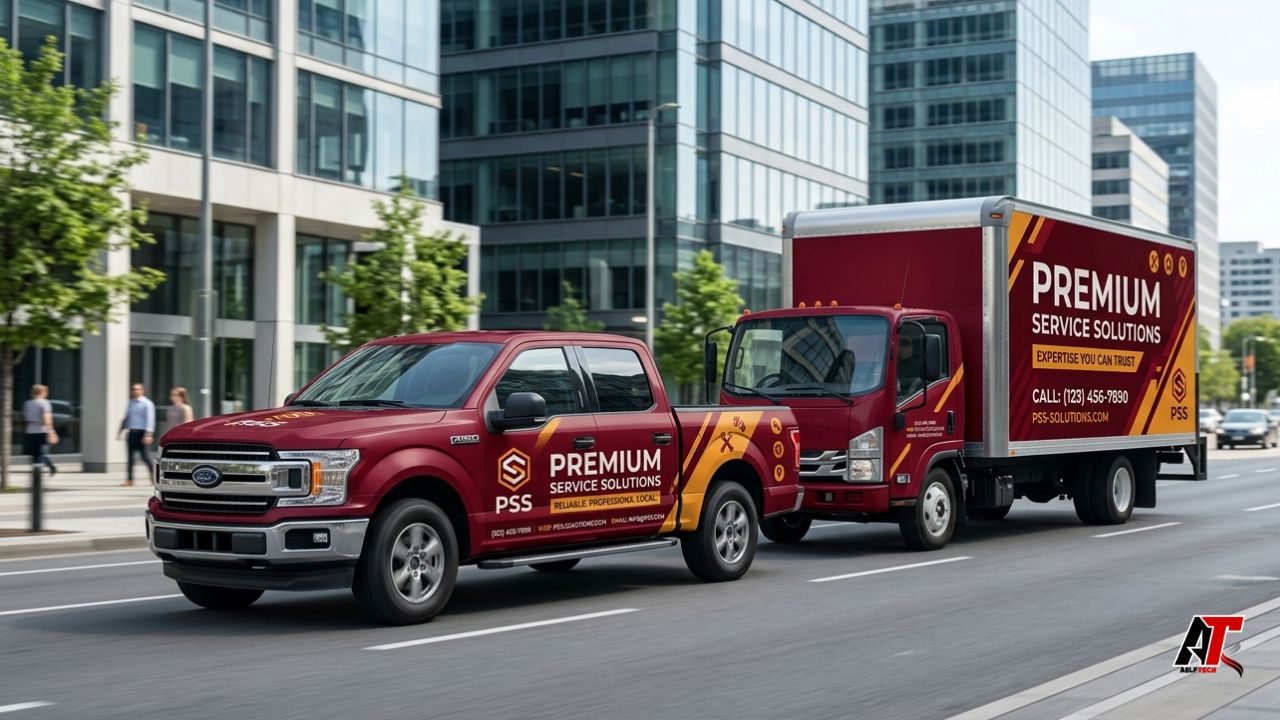
A commercial truck already moves through neighborhoods, business districts, job sites, parking lots, and highways. A professionally designed wrap turns that necessary travel into repeated brand exposure. Unlike an online advertisement that disappears when a campaign pauses, a wrapped truck continues presenting the company name, services, and contact details whenever the vehicle is visible.
That does not mean every wrap automatically produces leads. Effective commercial truck wraps combine clear strategy, readable design, suitable materials, skilled installation, and a simple method for tracking results. Business owners should understand how the format works before treating it as decoration or assuming that a large logo alone will deliver a return.
What Is a Commercial Truck Wrap?
A truck wrap is a printed or solid-color vinyl film applied over selected exterior panels of a pickup, service truck, box truck, delivery vehicle, or fleet unit. The graphics can cover the entire body, a portion of the vehicle, or only specific areas such as doors, side panels, and the tailgate. The layout is created for the exact vehicle template so important elements avoid handles, seams, wheel arches, lights, and other obstructions.
Quality wrap films are designed to conform around curves, corrugations, and rivets when the correct product and installation technique are used. Manufacturers such as 3M produce removable cast films specifically for fleet graphics and vehicle wraps. The film is normally paired with printed ink and a protective laminate that helps resist abrasion, ultraviolet exposure, moisture, and routine cleaning. [1]
How Commercial Truck Wraps Work as a Marketing Tool
The marketing value of a truck wrap comes from mobility, repetition, and context. A roadside billboard occupies one fixed location, while a truck carries its message through multiple service areas. The same vehicle may be seen by commuters in the morning, customers near a job site during the day, and residents when it is parked in a neighborhood. Each viewing adds another opportunity for the audience to recognize the name later.
Out-of-home advertising research supports the basic visibility principle. In a 2023 Morning Consult study published by the Out of Home Advertising Association of America, 49% of U.S. adults reported noticing wrapped vehicles or other signs on vehicles during the previous 30 days. The figure does not guarantee sales for an individual business, but it shows that vehicle graphics are a format people regularly notice. [2]
1. They Build Familiarity Through Repeated Local Exposure
People often choose a familiar business when they suddenly need a plumber, electrician, landscaper, roofer, delivery provider, or contractor. A wrapped truck can create that familiarity before the customer actively searches. Seeing the same name at different properties and on local roads signals that the business operates in the area and serves real clients.
Repetition is particularly useful for service companies with defined territories. A truck parked outside a legitimate job becomes both an advertisement and visible evidence of activity. Neighbors may not call immediately, yet they can remember the brand when a similar need arises. This effect becomes stronger when multiple fleet vehicles use consistent colors, logos, typography, and messaging.
2. They Turn Existing Mileage Into Media Exposure
Most companies already pay for vehicles, fuel, insurance, drivers, and maintenance. Wrapping does not remove those operating costs, but it adds a marketing function to an asset that is already being used. The truck advertises during deliveries, appointments, supply runs, and ordinary travel without requiring a separate media placement for every route.
This is why fleet graphics are often discussed in terms of cost per impression. 3M describes vehicle graphics as a cost-effective advertising format and notes that they can produce a low cost per thousand impressions compared with many paid media channels. Actual performance depends on route density, mileage, parking locations, design quality, local population, and how long the wrap remains in service. [3]
3. They Strengthen Professional Image and Trust
A clean, coordinated truck can make a small company appear organized and established. Before a technician or contractor speaks with the customer, the vehicle has already communicated the brand name and service category. Matching uniforms, invoices, website colors, and truck graphics can reinforce the same professional identity at every customer touchpoint.
The effect can also work in reverse. A poorly maintained vehicle, peeling film, misspelled text, or an outdated phone number can weaken trust. A wrap should therefore be managed as part of the company’s brand system, not as a one-time art project. Clean vehicles, consistent fleet standards, and prompt repair of damaged sections protect the impression the wrap is meant to create.
Types of Commercial Truck Wraps
A full wrap covers most painted exterior surfaces and offers the greatest design freedom. It can completely change the truck’s color and create a unified visual concept. A partial wrap uses the existing vehicle color as part of the layout and concentrates vinyl on high-value areas. This approach can deliver strong impact with less material when the design is planned carefully.
Spot graphics and lettering are the simplest option. They may include a logo, phone number, website, license information, or service list on the doors and rear panel. For businesses comparing coverage levels, professional commercial truck wraps can be reviewed as examples of full, partial, and business-focused applications before requesting a project-specific quote.
| Option | Coverage | Best Use | Main Consideration |
| Full wrap | Most exterior panels | Maximum transformation and fleet consistency | Highest material and installation scope |
| Partial wrap | Selected high-visibility areas | Strong branding with controlled coverage | Must integrate well with the vehicle color |
| Spot graphics | Doors, rear, or selected panels | Identification and essential contact details | Less visual impact than a complete design |
| Reflective accents | Targeted text or graphics | Night visibility and safety-oriented branding | Use approved materials and avoid glare or confusion |
What Information Should Appear on the Wrap?
A driver or pedestrian may have only a few seconds to understand the message. The most important elements are the company name, a clear description of the service, and one primary way to respond. A short website address is often easier to remember than a long list of social profiles. A phone number may be useful for local service companies, but it must be large enough to read.
Additional content should earn its space. A short benefit such as “24/7 Emergency Plumbing” is more useful than a vague slogan. A QR code can be included, but it should not replace a readable website because many viewers cannot safely scan while driving. Long service menus, small certification logos, excessive icons, and multiple calls to action usually create clutter rather than clarity.
Design Principles That Make a Truck Wrap Effective
The strongest wrap designs are readable at a glance. High contrast between text and background improves legibility, while large type allows the message to work from a distance. The company name and service category should dominate the visual hierarchy. Photography can be useful, but it should support the message rather than compete with it.
Designers must also account for the truck’s physical shape. Door gaps can split words, wheel arches can remove important details, and handles can interrupt phone numbers. The rear and both sides should be designed as separate viewing experiences because audiences see them under different conditions. OAAA creative guidance for out-of-home media emphasizes simplicity, strong contrast, limited messaging, and immediate comprehension. [4]
The Commercial Truck Wrap Process
A successful project begins with a business and vehicle assessment. The provider should confirm the truck model, dimensions, body modifications, existing paint condition, branding assets, desired coverage, operating environment, and campaign objective. Accurate photographs and measurements are essential, especially for custom bodies, toolboxes, lift gates, refrigeration units, or riveted box panels.
Next comes design, proofing, printing, lamination, surface preparation, and installation. The vehicle must be cleaned and free of wax, oil, dirt, rust, loose paint, and other contamination. Film should be installed in a controlled environment by trained professionals who understand stretching limits, edge sealing, post-heating, and panel alignment. A final inspection should check bubbles, lifting edges, trapped debris, and consistency across the fleet.
How to Measure Whether the Wrap Is Working
Wrap performance should be measured with practical indicators rather than guesswork. A business can use a dedicated phone extension, a memorable landing page, a campaign-specific QR code, or a simple intake question such as “Where did you hear about us?” Website analytics can track direct visits and branded searches, while customer relationship management notes can record leads that mention the truck.
The calculation should include the wrap’s total installed cost, expected service period, maintenance, number of vehicles, and attributable leads or sales. Owners should also consider softer outcomes such as increased branded search, recognition at trade shows, improved fleet consistency, and customer comments. These benefits matter, but they should not be exaggerated into guaranteed revenue without evidence.
Maintenance and Expected Service Life
Service life varies according to film type, laminate, climate, sun exposure, vehicle use, cleaning methods, installation quality, and whether the truck is parked indoors. Horizontal surfaces such as hoods and roofs generally receive harsher ultraviolet exposure than vertical side panels. Business owners should ask for the film manufacturer’s technical data and warranty conditions rather than relying on a single universal lifespan claim.
Routine care normally includes gentle washing with suitable products, prompt removal of fuel spills, bird droppings, insects, and road contaminants, and avoidance of aggressive brushes or high-pressure spraying at vulnerable edges. Damaged sections should be assessed early before water and dirt reach the adhesive. When branding changes, professional removal is safer than allowing untrained staff to pull aged film from the vehicle.
Legal and Operational Details Business Owners Should Not Ignore
The wrap must not cover license plates, required lamps, reflectors, cameras, sensors, safety labels, or legally restricted windows. Commercial carriers may also need to preserve required identification markings. Federal rules for covered commercial motor vehicles require the operating carrier’s legal or trade name and USDOT number to appear on both sides, contrast with the background, and remain legible from 50 feet while the vehicle is stationary. State and local rules may add further requirements. [5]
Leased vehicles require written approval from the owner or fleet management company, along with a clear removal plan. Insurance providers should be informed when graphics materially change the vehicle’s appearance. The wrap design should also leave space for unit numbers, licensing, inspection decals, and future regulatory markings so that later additions do not damage the brand layout.
Common Truck Wrap Mistakes
The most common mistake is trying to say too much. Small text and crowded service lists are ineffective on a moving vehicle. Other problems include low contrast, weak logo placement, generic stock imagery, inconsistent fleet colors, incorrect vehicle templates, outdated contact information, and placing critical text across doors or hardware.
Another mistake is choosing only by price. Low-cost materials may be inappropriate for deep channels, rivets, or long-term outdoor exposure, while rushed installation can create lifting edges and visible seams. Business owners should compare the complete specification: film manufacturer, laminate, printing system, surface preparation, installer experience, warranty, removal assumptions, and how repairs will be handled.
How Truck Wraps Fit Into a Wider Marketing Strategy
A truck wrap is strongest when it reinforces other channels. The same visual identity should appear on the website, Google Business Profile, social media, uniforms, estimates, and signage. A viewer who remembers the truck may later search the company name, so the online presence must be accurate, mobile-friendly, and consistent with the promise displayed on the vehicle.
The wrap can also support seasonal campaigns through replaceable decals or selected update panels, but the core brand should remain stable. For more practical guidance on digital visibility, content, and business technology, owners can explore aelftech.com.
Conclusion
Commercial truck wraps work by turning routine business travel into repeated, location-relevant brand exposure. They can improve recognition, reinforce professionalism, and keep a company visible during travel, service calls, and parking. Their value grows when the design is simple, the message is readable, the fleet is consistent, and results are tracked.
The best wrap is not necessarily the largest or most colorful. It is the one that helps the right audience understand who the business is, what it offers, and how to respond within a few seconds. Business owners who select appropriate materials, protect legal markings, maintain the vehicle, and connect the wrap to a broader marketing system are more likely to turn a moving truck into a useful long-term media asset.
Leave a Reply