
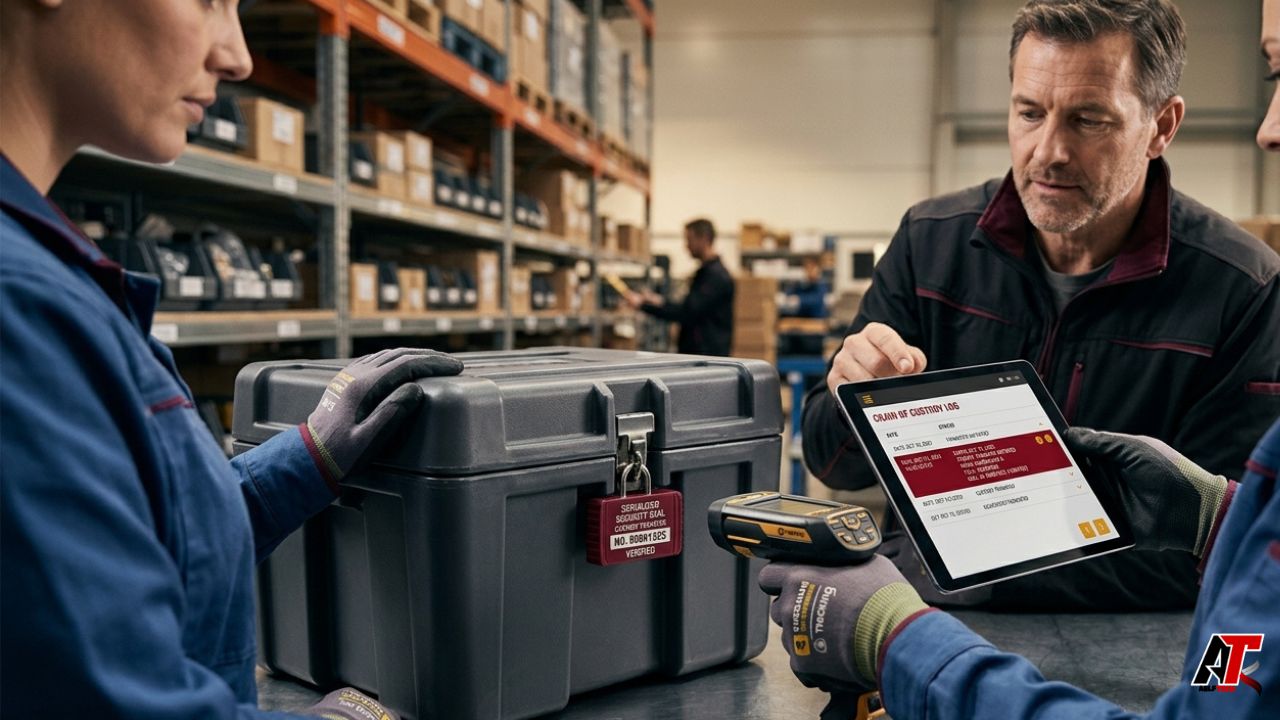
A chain of custody is only as strong as its weakest handoff. Whether an organization is moving laboratory samples, legal evidence, pharmaceutical products, confidential records, cash assets, or high-value cargo, every transfer must answer the same questions: What was moved? Who controlled it? When did custody change? Where was it stored? Was the package opened, altered, or replaced along the way?
Paper forms and ordinary packaging can record part of that story, but they often leave gaps. Handwritten entries may be incomplete. Similar-looking packages can be confused. A seal can be replaced without anyone noticing, and a tracking record may not match the physical item in front of the reviewer. Serialized security seals and tracking logs solve this problem by linking a unique physical identifier to a chronological record of custody.
What a Reliable Chain of Custody Must Prove
A reliable chain of custody should show an unbroken history of possession and handling. The record begins when an item is collected, packed, loaded, or formally accepted into control. It continues through each transfer, inspection, storage event, opening, resealing, return, and final disposition.
The physical item and the written or digital record must support each other. A log that lists a seal number is useful only when the same number is visible on the package. Likewise, a numbered seal is of limited value when nobody records who applied it or why it was removed. Strong custody management therefore combines physical tamper evidence with disciplined documentation.
This approach reflects a broader evidence-management principle: unique identification, dates and times, responsible people, locations, and reasons for movement should be captured in a chronological record. The same logic applies beyond forensic work. It helps any organization demonstrate that controlled property remained identifiable and accountable throughout its journey.
Why Non-Serialized Seals and Informal Logs Fall Short
A plain adhesive label or unnumbered cable tie may show that something was closed, but it does not prove that the closure is the original one. If ten identical seals are available, an unauthorized user may remove one and substitute another. Reviewers may see an intact seal and assume the package was never opened, even though the original seal has disappeared.
Informal logs create a different risk. Employees may write vague descriptions such as ‘sample bag’ or ‘shipment box.’ Times may be estimated later. Signatures may be unreadable. Seal numbers may be copied incorrectly, and changes may be made without a visible audit trail. These weaknesses do not always indicate wrongdoing. Often they are the result of rushed handoffs, unclear responsibilities, or a process that asks staff to remember too much.
Serialization reduces that ambiguity. Each seal carries a distinct number, barcode, QR code, or other identifier. That identifier becomes the bridge between the item and its custody record. When the number, package description, timestamp, and responsible person all agree, the record becomes much harder to dispute.
How Serialized Security Seals Strengthen Physical Control
Serialized seals create a unique identity for a closure. The number can be printed in human-readable form and repeated in a barcode or QR code for scanning. Depending on the application, an organization may use plastic pull-tight seals, fixed-length seals, cable seals, bolt seals, padlock-style seals, or security labels.
The best choice depends on the item, threat level, environment, and method of transport. Containers, trailer doors, cages, totes, evidence lockers, medicine cabinets, and specimen bags all require different levels of strength and flexibility. A range of tamper evident seals can help organizations match the closure type to the operational risk instead of treating every package the same.
For cartons, envelopes, access panels, and surfaces that cannot accept a mechanical seal, tamper evident tape may be more suitable. Depending on the product, the tape or label may leave a visible message, fragment when removed, or reveal an altered surface. The goal is not to make access impossible. The goal is to make unauthorized access difficult to hide.
In freight operations, high-security seals may also need to meet formal requirements. ISO 17712 establishes classification and testing procedures for mechanical freight-container seals, while U.S. Customs and Border Protection guidance emphasizes controlled seal use and documentation in relevant supply-chain programs. Organizations should confirm which standards apply to their routes, customers, regulators, and contracts.
Tracking Logs Complete the Security System
A serialized seal identifies the closure, but the tracking log explains its history. The log should capture the full life cycle of the seal and the item it protects. This includes the point at which the seal was issued, the person who applied it, the location where it was used, each transfer of custody, inspection results, and the reason the seal was removed.
Good logs are specific without becoming burdensome. Staff should be able to complete an entry during the handoff rather than reconstructing it hours later. The form should use required fields, clear labels, and controlled choices wherever possible. Free-text notes are still useful, but they should support the core record rather than replace it.
Essential Fields for a Seal and Custody Log
- Item, shipment, case, order, or batch identifier
- Detailed description of the container and its contents
- Unique seal number and seal type
- Date, time, and location of seal application
- Name or employee ID of the person applying the seal
- Condition of the package before sealing
- Names or IDs of releasing and receiving custodians
- Date, time, location, and reason for every transfer
- Seal condition at each inspection point
- Reason for opening, authorization, and witness details when required
- Old and new seal numbers after an authorized resealing event
- Final disposition, release, return, or destruction information
These fields create a record that can be followed without guessing. They also make exception reviews faster because managers can compare the expected seal number and location with the actual condition of the item.
A Practical Seal-to-Record Workflow
The strongest programs treat seals as controlled security materials, not as office supplies. Unused seals should be stored securely, issued in recorded ranges, and accessible only to authorized staff. A person should not be able to take an unrecorded seal from an open box and apply it without accountability.
1. Issue and Account for the Seal
Record the seal number when it is released from controlled inventory. Where practical, assign blocks of numbers to departments, routes, vehicles, or trained employees. Inventory checks should identify missing, damaged, skipped, or duplicated numbers before they become operational problems.
2. Inspect, Close, and Apply
Before sealing, confirm the item count, package description, and condition. Apply the seal according to the manufacturer’s instructions, then physically test that it is locked. For mechanical seals, a pull or twist check may be appropriate. For tape or labels, confirm that the adhesive has bonded to a clean, suitable surface.
3. Record the Identifier at the Source
Enter or scan the serial number immediately after application. Do not rely on memory or a loose note that will be typed later. A photograph showing the seal, number, and surrounding closure can add useful context, especially for remote shipments and high-risk transfers.
4. Verify at Every Handoff
The receiving custodian should compare the physical serial number with the record before accepting responsibility. They should also inspect the seal for cuts, stretching, adhesive disturbance, mismatched components, unusual tool marks, or signs that the closure has been bypassed. Acceptance should be documented with a timestamp and identity confirmation.
5. Control Opening and Resealing
Authorized opening should never erase the earlier history. Record who approved the opening, who broke the seal, why access was needed, what happened while the item was open, and which new seal was applied. The new entry should reference the previous seal number so the sequence remains continuous.
6. Close the Record
When the item reaches final delivery, testing, return, disposal, or release, complete the last custody entry. Retain the log according to the organization’s legal, contractual, or quality-retention schedule. The final record should show that the item did not simply disappear from active tracking.
Using Digital Logs, Barcodes, and Mobile Scanning
Digital systems can reduce transcription errors and speed up handoffs. A mobile device can scan the seal, capture the user’s identity, apply a timestamp, record GPS or facility location where appropriate, and attach a photograph. Required fields can prevent staff from submitting an incomplete transfer.
However, digitization does not automatically create integrity. The system should preserve an audit trail, restrict editing, show who made corrections, and prevent records from being silently deleted. Role-based access, multi-factor authentication, backups, and retention controls are important because the digital log may become the primary evidence that custody was maintained.
Organizations using spreadsheets should lock formulas and key fields, control permissions, preserve version history, and establish a formal correction method. A spreadsheet can work for a smaller program, but it should not allow someone to overwrite the original seal number without leaving evidence of the change.
Managing Broken, Missing, or Mismatched Seals
A discrepancy should trigger a defined response, not an improvised conversation. Examples include a broken seal, an unexpected number, a missing log entry, a seal that appears intact while the closure shows damage, or a package arriving at the wrong location.
The receiving person should pause the transfer, isolate the item when safe, preserve the existing seal and packaging, take photographs, and notify the designated supervisor or security contact. The organization should document who discovered the issue, the time and place, the condition observed, and any decision to open, quarantine, reject, or investigate the item.
Training, Roles, and Separation of Duties
Technology cannot compensate for unclear ownership. Staff should know who may issue seals, who may apply them, who may authorize opening, who verifies transfers, and who investigates discrepancies. Written procedures should include photographs or examples of acceptable and unacceptable seal conditions.
Training should include practical exercises. Employees need to handle the actual seal, locate the serial number, scan it, apply it correctly, test it, and recognize common tampering indicators. Periodic refresher training is valuable because small shortcuts can gradually become normal practice.
Auditing the Program and Measuring Performance
Routine audits show whether the process works outside the written procedure. Auditors can compare unused seal inventory with issue records, select completed shipments or cases, trace each handoff, and confirm that seal changes are fully explained. They can also inspect storage areas to ensure unused seals are protected from unauthorized access.
Implementation Roadmap for Organizations
Start by mapping the current custody path from origin to final disposition. Identify every handoff, temporary storage point, opening event, and place where responsibility becomes unclear. Next, classify items by risk so the strongest and most expensive controls are reserved for situations that justify them.
Select seal types, create a numbering and inventory policy, design the log, and test the process with a limited group. During the pilot, measure completion time, error frequency, seal performance, and staff feedback. Revise the procedure before organization-wide rollout. Finally, schedule periodic audits and supplier reviews so the program continues to match operational and regulatory needs.
Building a Defensible and Visible Custody Trail
Serialized security seals and tracking logs turn chain of custody from a promise into visible evidence. The seal gives the physical closure a unique identity. The log explains who controlled the item and what happened at each stage. Together, they help organizations detect tampering, prevent mix-ups, investigate exceptions, and respond to audits with confidence.
The strongest results come from treating the seal, the record, and the employee workflow as one system. Choose a suitable seal, control unused inventory, record information at the moment of action, verify every handoff, and preserve the history of authorized openings and corrections. Organizations that also need clear, trustworthy online content around complex operational topics can explore aelftech.com USA for structured content and search visibility support.
Leave a Reply