
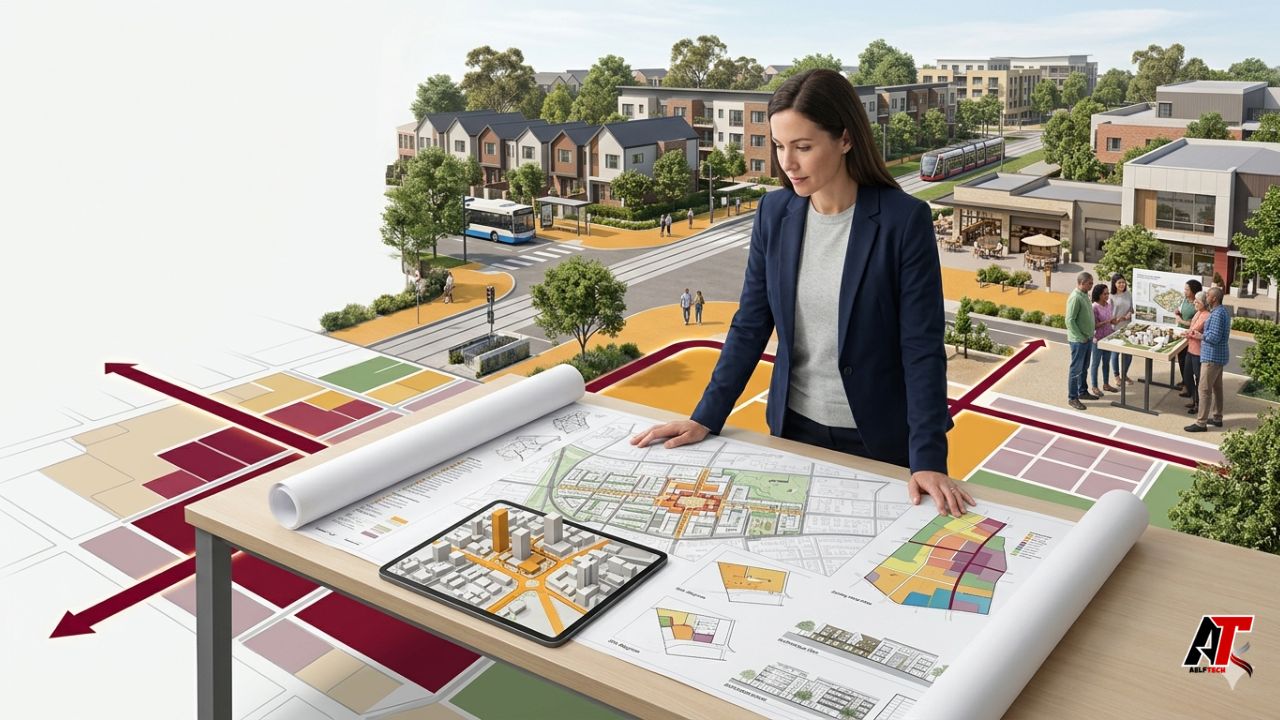
A new apartment block, a neighbourhood shopping centre, a home extension, or a land subdivision may begin as a drawing, but it cannot move forward on design alone. Every proposal sits within a web of zoning rules, environmental constraints, infrastructure limits, community expectations, and government procedures. A town planner helps make sense of that web. The planner identifies what the land can support, explains which approvals are required, and builds a practical pathway from an early idea to a defensible planning outcome.
So, what does a town planner do in everyday practice? The role combines research, policy interpretation, project coordination, communication, negotiation, and long-term thinking. Some planners assess individual development applications, while others prepare strategies that influence how entire suburbs, towns, or regions grow. Their work rarely attracts the same visual attention as architecture, yet it shapes where homes, jobs, roads, parks, schools, services, and public spaces can be located.
What Is Town Planning and Urban Planning?
Town planning and urban planning are closely related terms. Both describe the organised process of guiding land use, development, infrastructure, and services. The Planning Institute of Australia explains that planning brings communities, businesses, and governments together to shape cities, towns, and regions. Good planning aims to create places that are accessible, equitable, efficient, attractive, and capable of supporting housing and essential services over time.
The word “urban” does not mean planners work only in large cities. Planning also covers regional centres, rural settlements, coastal communities, industrial precincts, growth corridors, and environmentally sensitive land. Depending on the project, a planner may consider housing demand, transport access, heritage values, flooding, bushfire risk, neighbourhood character, economic activity, public open space, or the capacity of local infrastructure. The central task is to balance competing needs rather than optimise only one outcome.
What Does a Town Planner Actually Do?
A town planner’s responsibilities change with the employer, jurisdiction, and scale of the assignment. A planner working for a council may assess applications or write local policy. A private consultant may advise a landowner, prepare an application, coordinate reports, and negotiate with authorities. A strategic planner may examine population growth and infrastructure needs across a much larger area. Despite these differences, the following activities form the core of the profession.
1. Investigates the Site and Its Planning Controls
Before recommending a design or approval strategy, the planner investigates the property. This usually includes its zoning, overlays, permitted and prohibited uses, development standards, surrounding land uses, access arrangements, easements, title restrictions, and relevant state or local policies. The planner may also review past approvals, council records, mapping, and site-specific constraints such as heritage, vegetation, flooding, traffic, or environmental hazards.
This early investigation is valuable because it reveals risks before a client spends heavily on design and technical documentation. A seemingly simple proposal may trigger additional assessments because of its location, scale, operating hours, parking demand, or effect on neighbouring properties. A good planner does not merely list the rules. They interpret how the controls interact and explain which issues are likely to influence the decision.
2. Tests Development Feasibility and Advises on Strategy
Planning feasibility is the bridge between an idea and a workable project. The planner compares the client’s goals with the planning framework and identifies realistic options. That may involve testing different land uses, building envelopes, dwelling numbers, subdivision patterns, setbacks, access points, or staging arrangements. In some cases, the most useful advice is to redesign the proposal early rather than submit an application that is unlikely to succeed.
Private planning practices illustrate this advisory role. For example, PPC Urban describes services that include planning permit support, strategic planning, master planning, and planning scheme amendments. The exact process differs among councils and states, but the practical purpose remains consistent: identify constraints, choose an approval pathway, and reduce avoidable delay through informed preparation.
3. Prepares and Manages Development Applications
For many clients, the most visible part of the town planner role is preparing a development or planning application. The planner assembles the required information, writes the planning assessment, explains how the proposal responds to relevant policies, and coordinates lodgement. A persuasive report does not simply claim that a project is suitable. It addresses the decision criteria, acknowledges potential impacts, and shows how the design or proposed conditions manage them.
After lodgement, the planner monitors the assessment, responds to requests for further information, arranges amendments, and keeps the client informed. Consultancies such as A&E Professional Solutions describe this work as preparing and lodging development applications, managing communication with local government, and tracking applications through to a decision. This administrative discipline matters because missed information, unclear drawings, or slow responses can lengthen assessment periods.
4. Coordinates Architects, Engineers, and Other Specialists
Development applications often require input from several professions. An architect or building designer develops the physical design. Engineers may address traffic, stormwater, civil works, structures, acoustics, or services. Other specialists may prepare ecological, bushfire, heritage, landscape, contamination, social-impact, or economic reports. The town planner helps define which inputs are needed, checks whether they answer the planning issues, and draws them into one coherent submission.
This coordination role prevents individual reports from working against one another. A traffic solution may affect landscaping, a drainage measure may alter the site layout, and a heritage recommendation may require design changes. The planner keeps the approval strategy visible while specialists resolve their technical areas. They are not expected to replace those experts; they translate and connect specialist evidence within the planning framework.
5. Communicates With Councils and Negotiates Outcomes
Planning is not only about written rules. It also requires clear communication with assessment officers, referral agencies, elected representatives, clients, neighbours, and technical teams. A planner may attend a pre-application meeting, clarify council expectations, present the planning merits of a proposal, negotiate amendments, or discuss suitable approval conditions. Effective negotiation is evidence-based: the planner explains why an outcome is reasonable against policy and identifies practical ways to reduce impacts.
An experienced planner also knows when compromise will improve a project and when an important planning argument should be maintained. Not every objection can be removed, and no ethical planner can guarantee approval. However, early dialogue often reveals concerns that can be addressed through layout changes, additional information, landscaping, operating limits, or carefully drafted conditions.
6. Engages Communities and Balances Competing Interests
Major plans and some development proposals affect more than the applicant. Residents may worry about traffic, privacy, character, housing affordability, environmental change, or pressure on services. Businesses may focus on access, investment, or employment. Government agencies may prioritise infrastructure, safety, biodiversity, or policy targets. Town planners help organise consultation, explain proposals in accessible language, record feedback, and assess which concerns are supported by planning evidence.
Community engagement is not a box-ticking exercise when it is done well. Local knowledge can reveal how a place functions at different times, where people feel unsafe, which facilities are missing, and what communities value. The planner’s responsibility is not to promise that every request will be adopted. It is to make the decision-making process clearer, more inclusive, and better informed.
7. Creates Long-Term Strategies for Better Places
Strategic planners look beyond one property. They prepare structure plans, housing strategies, activity-centre plans, transport and land-use frameworks, neighbourhood plans, infrastructure priorities, and policy changes. This work asks where growth should occur, what services will be needed, how land can be protected, and how investment can be coordinated over many years.
Long-term urban planning has direct effects on daily life. It influences whether people can reach jobs and services, whether housing choices match changing households, whether development occurs in safer locations, and whether public spaces support health and social connection. The outcome is never permanent; plans must be reviewed as demographics, climate risks, technology, economics, and community needs change.
Town Planner vs Architect, Engineer, and Building Certifier
These professions often collaborate, but their primary responsibilities are different. A town planner focuses on land use, planning policy, development impacts, approval pathways, and the relationship between a proposal and its wider context. An architect or building designer focuses on spatial design, function, appearance, and the detailed development of the building concept. Engineers verify technical performance in their disciplines. A building certifier or surveyor checks compliance with applicable building requirements and certification processes.
A planner does not usually design structural systems or certify building work. Likewise, an attractive architectural design may still need planning changes if it conflicts with land-use controls, neighbourhood impacts, access requirements, or environmental policy. Involving the planner early allows the design team to work within a clear planning strategy instead of trying to repair fundamental approval problems after documentation is advanced.
Where Do Town Planners Work?
Town planners work across local, state, and federal government, private consultancies, development companies, infrastructure organisations, universities, and community or environmental bodies. Development assessment planners examine applications. Strategic planners prepare policy and growth frameworks. Transport planners connect land use with mobility. Environmental planners focus on natural systems and risk. Heritage planners protect culturally significant places, while social and community planners examine access, wellbeing, and inclusion.
What Skills Does a Good Town Planner Need?
Strong planners combine analytical ability with communication and judgement. They must read legislation, planning schemes, policies, maps, drawings, and technical reports without losing sight of the human consequences. They write concise assessments, present ideas to mixed audiences, manage deadlines, and negotiate calmly when interests conflict. Spatial awareness and data literacy are increasingly important because planners use geographic information systems, digital mapping, demographic evidence, and scenario testing.
When Should a Property Owner Hire a Town Planner?
A planner can be useful before purchasing land, changing a property’s use, subdividing, adding dwellings, starting short-term accommodation, developing a commercial site, responding to council concerns, changing an existing approval, or objecting to a nearby proposal. Early advice is particularly valuable when the land has overlays, unusual constraints, previous refusals, sensitive neighbours, or a design that does not clearly meet the planning controls.
Before appointing a consultant, ask about experience with the relevant council, project type, and planning scheme. Request a written scope that explains deliverables, assumptions, fees, exclusions, and the likely need for specialist reports. Check professional qualifications and communication practices. Useful educational resources may also be published by digital teams such as team aelftech.com, but project-specific decisions should be based on current local controls and advice from appropriately qualified professionals.
Why the Town Planner Role Matters
Urban development always involves trade-offs. More housing can improve supply but may require transport, drainage, schools, parks, and careful design. New businesses can create jobs while also producing traffic or noise. Environmental protection may limit development in one location while encouraging it in another. Town planners make these relationships visible and help decision-makers compare short-term demands with long-term consequences.
The best planning does not stop all change, nor does it approve every proposal. It guides change so that private projects and public investment contribute to safer, more functional, resilient, and inclusive places. That is why a town planner’s work can affect people who never read a planning report: the results appear in their commute, housing choices, local streets, access to services, and experience of public space.
Conclusion
What does a town planner do? In practical terms, a planner studies land and policy, tests development options, prepares applications, coordinates technical experts, communicates with authorities and communities, and creates strategies for future growth. The role sits between design, law, environment, economics, infrastructure, and public decision-making.
For property owners, a planner can reduce uncertainty and reveal problems before they become expensive. For governments and communities, planners provide the analysis needed to manage growth and protect long-term interests. Their value lies not in producing buildings themselves, but in creating the framework that helps the right development happen in the right place, with its impacts understood and managed.
Leave a Reply