
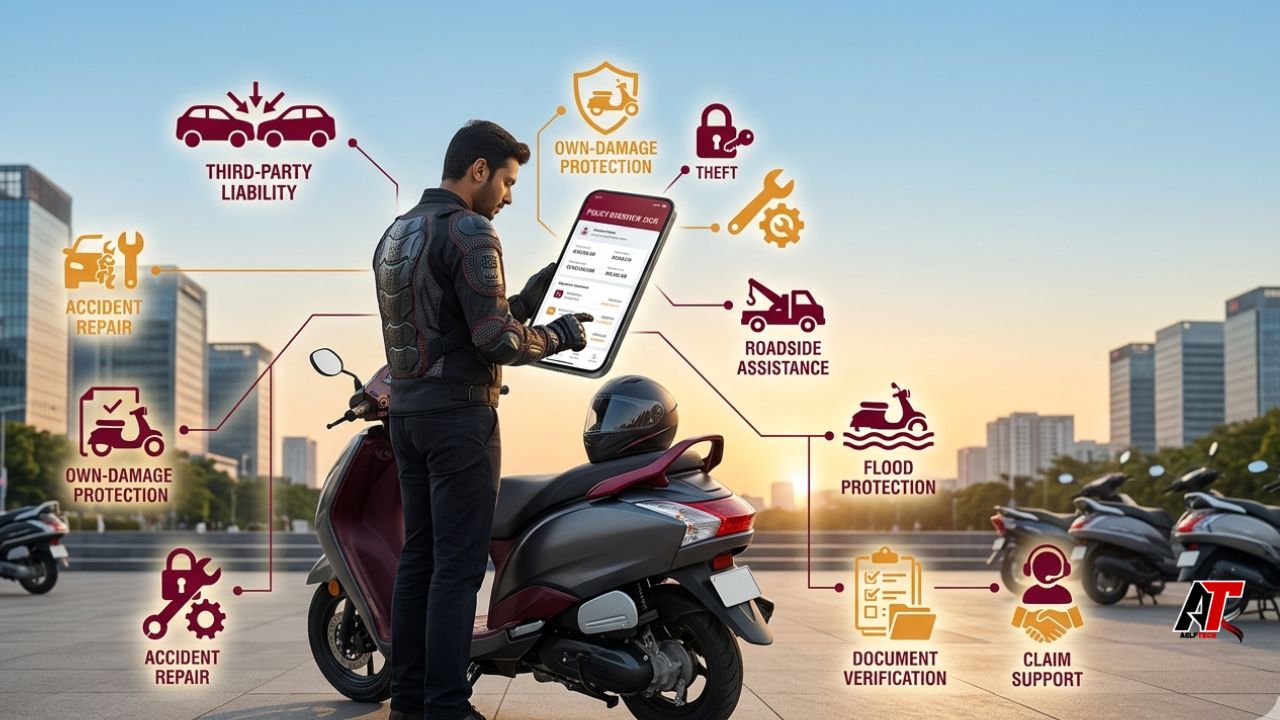
A scooter is more than a convenient way to move through traffic. For many households, it is a daily commuting tool, a source of independence, and a significant financial purchase. Repair costs, theft, flooding, fire, third-party injury claims, and accidental damage can quickly turn a manageable incident into a major expense. A well-chosen insurance policy protects the value of the scooter while reducing the financial uncertainty that follows an accident or loss.
In India, third-party liability insurance is a statutory requirement for vehicles used on public roads. However, a liability-only policy does not pay for damage to your own scooter. Riders who want wider protection generally consider a package or comprehensive policy, or a standalone own-damage policy when valid third-party cover already exists. The right choice depends on the scooter’s age, market value, usage, location, finance arrangement, and the rider’s ability to absorb repair costs.
This scooter insurance guide 2026 explains the main policy types, common add-ons, premium factors, claims, renewals, and comparison points. Product wording differs between insurers, so always treat the policy schedule and wording as the final authority.
1. Understand the Three Main Coverage Structures
A liability-only or third-party policy covers legal liability for injury, death, or property damage suffered by someone else, subject to the Motor Vehicles Act and policy terms. It is the minimum road-use cover, but it does not protect the insured scooter against accidental damage, theft, fire, or natural events.
A package or comprehensive policy combines third-party liability with own-damage protection. The own-damage section commonly covers accidental external damage, fire, theft, malicious acts, riots, floods, storms, earthquakes, landslides, and damage while the vehicle is in specified forms of transit. Coverage is subject to exclusions, deductibles, depreciation, limits, and claim conditions.
A standalone own-damage policy can be purchased when the scooter already has a valid third-party policy. This structure is useful when the liability and own-damage sections have different renewal dates. Before buying, confirm that the third-party cover is active and that both policies contain the correct registration, chassis, engine or motor, owner, and address details.
2. Check the Insured Declared Value, Not Just the Premium
The Insured Declared Value, usually called IDV, represents the insured value used for total-loss and theft claims under the own-damage section. It is generally based on the manufacturer’s listed selling price adjusted for depreciation and other policy rules. A lower IDV may reduce the premium, but it can also reduce the maximum amount payable in a total-loss situation.
Compare quotations using similar IDVs, deductibles, add-ons, and coverage. A low premium is not automatically a better deal if the policy has a significantly lower IDV, fewer benefits, a higher voluntary deductible, or a limited garage network. The most useful comparison is total protection for the price, not the headline premium alone.
3. Know What Usually Is Not Covered
Motor policies normally contain exclusions. Common examples include mechanical or electrical breakdown, normal wear and tear, depreciation unless covered by an add-on, use outside the geographical area, illegal use, riding without a valid licence, and riding under the influence of alcohol or drugs. Consequential losses may also be excluded unless specifically covered.
Damage arising from an undeclared modification can create claim problems. Inform the insurer and registration authority when required if you change the fuel system, fit valuable accessories, alter the body, or make another material modification. Electric-scooter owners should check battery, charger, motor, water-ingress, and roadside-assistance wording rather than assuming every electrical component is covered in the same way.
4. Choose Add-Ons for Real Risks, Not for a Longer List
Add-ons extend an own-damage policy for an extra premium. Availability and wording vary by insurer, scooter age, and product. Zero-depreciation cover may reduce depreciation deductions on eligible replaced parts. Engine protection may cover specified engine damage caused by water ingress or lubricant leakage, but it usually does not cover every mechanical failure. Roadside assistance can provide towing, minor repairs, battery support, fuel delivery, or key-related help according to the plan.
Other possible add-ons include consumables cover, key replacement, tyre or rim protection, personal-belongings cover, return-to-invoice cover, and no-claim-bonus protection. Do not buy an add-on only because it sounds useful. Read its deductible, claim limit, waiting condition, vehicle-age restriction, number-of-claims limit, and exclusions.
5. Review Personal Accident Protection
Compulsory personal accident cover for the owner-driver is a separate protection linked to the registered owner who holds an effective driving licence and meets the policy conditions. Riders should verify whether valid owner-driver personal accident cover already exists, whether it is included or issued separately, and whether the sum insured is appropriate under current rules.
The compulsory cover is not the same as broad health, life, or income-protection insurance. Regular pillion riders may require additional personal accident protection if offered. Compare the scope carefully because benefits, eligible persons, and exclusions may differ.
6. Match the Policy to How You Use the Scooter
A lightly used older scooter kept in secure parking may need a different policy from a new scooter ridden every day through dense traffic. High annual mileage increases exposure to accidents, punctures, breakdowns, and weather. Delivery or commercial use must be declared correctly because a private-use policy may not respond to an undisclosed business use.
Riders comparing a high mileage petrol scooty should consider fuel economy alongside insurance, service intervals, spare-parts prices, theft risk, and the availability of authorised repair facilities. A low-running-cost model can still create financial strain if it is underinsured or difficult to repair after an accident.
7. Protect Your No Claim Bonus
The No Claim Bonus, or NCB, is a discount on the own-damage premium for claim-free policy years. It does not normally reduce the statutory third-party premium. Standard motor wording commonly uses a progressive NCB scale, and eligibility may depend on renewing within the permitted period and correctly declaring previous claims.
Do not make a small claim automatically. Compare the repair estimate with the deductible, expected NCB impact, and any future premium change. However, do not delay reporting an incident merely to protect the bonus. Claim-notification deadlines and evidence requirements still apply. NCB belongs to the policyholder rather than the scooter, so it may be transferable to another eligible vehicle under insurer rules.
8. Treat Used-Scooter Insurance Transfer as Essential
When a used scooter changes ownership, the registration and insurance records should be transferred correctly. IRDAI policyholder guidance states that the registration and insurance should be in the same name and address. Own-damage cover can be affected when the transfer is not recorded within the required period.
A buyer should not assume the previous owner’s policy automatically provides full protection. Contact the insurer promptly, submit the required transfer documents, confirm inspection requirements, and obtain an updated schedule. The seller should retain proof of sale and notify the relevant parties to reduce future liability disputes.
9. Follow a Clear Claim Process
After an accident, prioritise safety and medical help. Inform the police where required and notify the insurer immediately through its official channel. Take photographs or video of the scooter, other vehicles, road conditions, registration plates, visible injuries, and surrounding damage without obstructing emergency services or creating further danger.
For an own-damage claim, the insurer may appoint a surveyor before repairs begin. Use towing rather than riding an unsafe scooter. At a cashless network garage, the insurer settles approved covered costs directly with the workshop, while the policyholder pays deductibles, depreciation, exclusions, and non-approved work. Reimbursement claims generally require the policyholder to pay first and submit original documents.
For theft, inform the police and insurer immediately, keep all available keys, and follow transport-authority requirements. Typical claim documents may include the claim form, policy details, registration certificate, driving licence, FIR or police documents when applicable, repair estimate, bills, and bank details. Requirements vary by claim type and insurer.
10. Use a Practical Renewal Checklist
- Confirm that the owner name, registration number, chassis number, engine or motor number, address, and nominee information are accurate.
- Check the third-party and own-damage expiry dates separately, especially if the scooter was purchased with long-term third-party cover.
- Compare IDV, deductibles, add-ons, cashless garages, roadside assistance, exclusions, claim service, and total premium.
- Declare claims, modifications, accessories, fuel-system changes, and usage honestly.
- Verify NCB eligibility and do not claim a higher discount than earned.
- Keep the registration, driving licence, pollution-under-control certificate where applicable, and other required documents current.
- Download the policy schedule, certificate of insurance, wording, receipts, and add-on documents, and store copies securely.
11. Compare the Insurer, Not Only the Product Name
Two policies described as comprehensive can still provide different practical experiences. Review the cashless-garage network near your home and workplace, claim-notification options, towing limits, survey process, customer support, grievance channel, and digital-document access. Read recent service feedback carefully, but remember that individual online reviews may not represent every claim.
Buy only through an authorised insurer or intermediary. Fill the proposal accurately, keep a copy, and read the wording before payment. You are not required to buy insurance only from the vehicle dealer. If a complaint is not resolved by the insurer, policyholders can use the insurer’s grievance process and escalate through the available IRDAI and Insurance Ombudsman mechanisms where eligible.
12. Avoid These Common Insurance Mistakes
- Buying liability-only cover without realising that theft and damage to your own scooter are excluded.
- Choosing the lowest IDV simply to reduce premium.
- Allowing the policy to lapse and discovering that inspection or extra steps are needed before own-damage cover resumes.
- Leaving old owner, address, registration, or contact information on the policy.
- Assuming every add-on covers every type of failure.
- Repairing the scooter before the insurer has completed the required inspection or survey.
- Hiding commercial use, modifications, previous claims, or an incorrect NCB.
- Failing to keep policy and claim documents in an accessible digital folder.
How Scooty Lelo Fits Into Smarter Scooter Ownership
Scooty Lelo provides scooter news, specifications, comparisons, brands, and ownership-related information that can help riders shortlist models before purchase. Insurance should be part of that comparison from the beginning, not an afterthought added after the scooter is selected.
For more practical technology, mobility, and consumer guides, visit team aelftech.com. Always confirm current legal requirements, premiums, and policy terms directly with the insurer or an authorised adviser before purchase.
Final Thoughts
Good scooter insurance is not the policy with the longest list of features or the lowest price. It is the policy that matches the scooter’s value, the rider’s usage, the local risks, and the amount of financial loss the owner can reasonably absorb. Third-party insurance keeps the vehicle legally protected for liability, while own-damage cover protects the investment itself.
Before paying, compare the IDV, deductible, claim process, garage network, add-ons, exclusions, and renewal dates. Keep every detail accurate and report incidents promptly. With those habits, scooter insurance becomes more than a compliance document: it becomes a practical financial safety system for everyday mobility.
Leave a Reply