
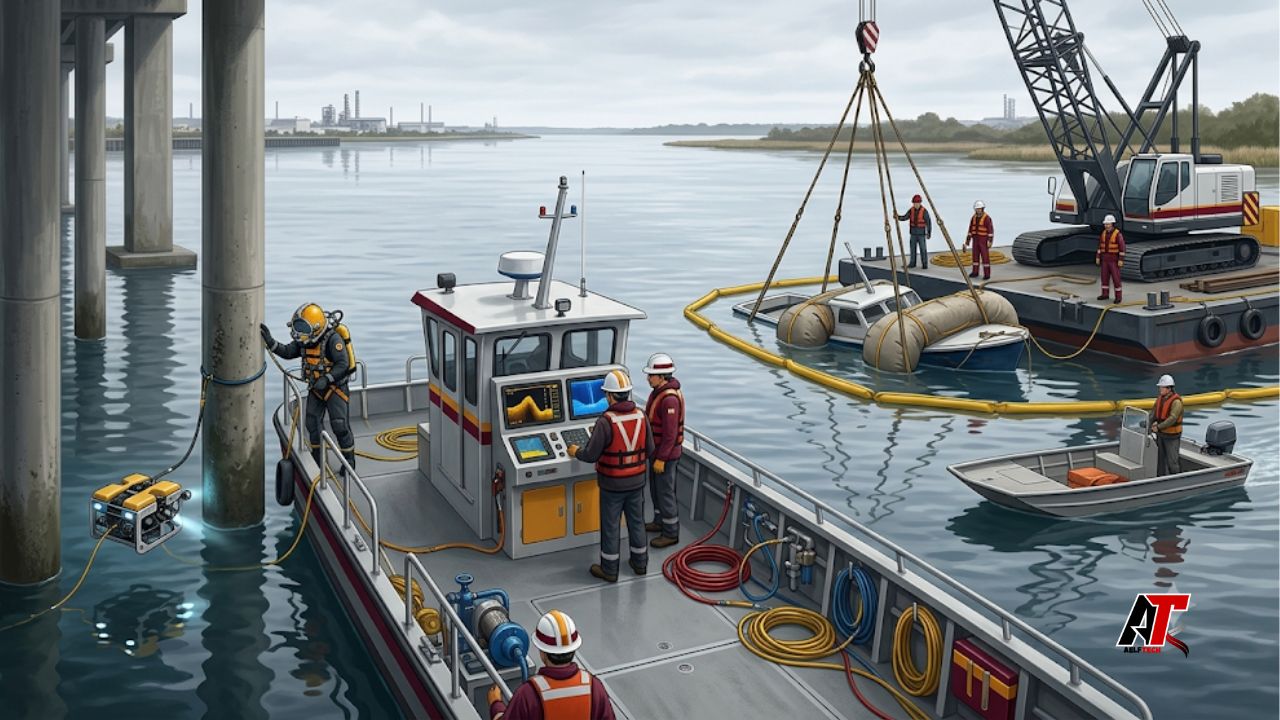
Marine projects may look similar from the shoreline, yet the equipment required can be very different. Recovering a grounded vessel, inspecting bridge piles, surveying a flooded channel, and moving materials through shallow water place different demands on vessels, lifting systems, crews, and support tools. Choosing equipment only because it is available can create delays, unnecessary cost, and avoidable safety risks.
A better method is to define what must be lifted, viewed, measured, moved, stabilised, or documented before selecting a boat, barge, crane, dive system, remotely operated vehicle, or recovery accessory. Water depth, current, access, visibility, environmental sensitivity, launch points, and travel distance must all shape the final package.
This guide explains how to match marine equipment for recovery and inspection work, as well as waterway operations involving infrastructure, flood response, transport, and environmental projects.
Why Matching Equipment to the Job Matters
Marine equipment is designed around an operating envelope. A shallow-draft workboat can be ideal in a river but unsuitable in exposed coastal water. A large crane may have excellent capacity, yet it becomes ineffective if the barge cannot reach the casualty or hold position. A high-resolution camera also has limited value in turbid water unless it is supported by lighting, sonar, or a diver who can verify defects by touch.
Poor matching creates hidden costs. An oversized platform increases mobilisation, fuel, crewing, and permitting expenses. An undersized platform can require repeated lifts, additional vessels, or a last-minute change of method. The most economical option is therefore the complete configuration that achieves the outcome with appropriate safety margins and few interruptions.
Clear job definitions also improve quotations. Instead of requesting a vessel by name, describe the outcome, such as lifting a ten-tonne object from six metres of water or recording the condition of twenty piles. Operators can then propose a complete solution rather than isolated assets.
Start with Site Conditions Before Selecting a Vessel
The equipment decision begins with the environment. Water depth affects vessel draft, anchoring, diver access, and lifting geometry. Current and tide influence station keeping, tow control, visibility, and the safe work window. Wind and wave exposure determine whether an open workboat is sufficient or a more stable decked vessel is needed. Inland waterways can also change rapidly after heavy rain or flood releases.
Access matters just as much as water conditions. A vessel may perform well once afloat but be impossible to launch from the available ramp. Remote locations may favour road-transportable boats, modular pontoons, compact cranes, or equipment assembled beside the water. Bridges, powerlines, lock dimensions, steep banks, and restricted turning areas may limit barge size or crane height.
Record bottom type, known obstructions, contamination risks, nearby habitats, navigation traffic, emergency access, and required work hours. This site profile should guide platform selection before the team focuses on individual brands or headline capacities.
Equipment for Marine Recovery Jobs
Recovery work can involve grounded boats, sunken vessels, machinery, vehicles, debris, or damaged infrastructure. Each job should begin with an estimate of weight, position, structural condition, water depth, bottom composition, and pollution risk. The team must decide whether the target should be lifted vertically, refloated gradually, winched to a safer location, towed, or dismantled in place.
The operating platform may be a crane barge, workboat, tug, shallow-draft vessel, or several support craft. Selection depends on lift radius, deck load, tow force, and access. A crane that can lift the target close to its pedestal may not have enough capacity at the actual working radius. Moorings, anchors, spud legs, or other station-keeping systems may be needed to prevent movement during the operation.
Typical recovery tools include slings, shackles, spreader bars, pumps, winches, cutting tools, lifting bags, containment materials, and temporary flotation. The system should allow controlled movement and include backup options because loads can shift, attachment points can fail, and submerged weight may change when mud or trapped water is released.
Flotation Bags, Pumps, Towing, and Crane Support
Lifting bags and recovery airbags are useful when a casualty must be raised gradually or a crane cannot reach the site. Divers position the bags around the object and inflate them in a planned sequence. Buoyancy, attachment strength, and load balance must be calculated carefully because uneven inflation can rotate or destabilise the casualty. Pumps may then remove water and restore buoyancy, but premature dewatering can stress a damaged hull or cause it to roll.
Towing and winching are suitable when the object can be moved without a full vertical lift. The tow vessel, lines, bridles, fairleads, and connection points must suit the expected force. Crane support is preferred for heavy objects or precise placement. The crane, barge, rigging, and mooring arrangement should be treated as one system, supported by a lift plan covering weight, centre of gravity, radius, exclusion zones, communication, and contingencies.
Equipment for Underwater Inspection Jobs
Inspection equipment should be selected around the information the client needs. A rapid condition check may only require a diver and camera. An engineering survey may require calibrated sonar, dimensional measurements, sampling, and traceable video. Define whether the goal is to locate an object, identify damage, measure deterioration, verify construction, map a structure, or monitor change over time.
Commercial divers can clean surfaces, feel defects, take measurements, and use tools. They are valuable around complex structures, but they require suitable supervision, communications, emergency arrangements, and a vessel that supports safe entry and recovery. Current, depth, contamination, entanglement hazards, and vessel traffic may restrict diving windows.
ROVs reduce diver exposure and can remain underwater for long periods. They work well for repetitive inspections, deeper water, confined locations, or preliminary surveys. Their performance depends on tether management, current, lighting, camera quality, navigation, and operator skill. Imaging sonar can reveal shapes and structural features when ordinary cameras cannot see through suspended sediment.
Choosing Between Divers, ROVs, and Sonar
Divers are the best choice when physical interaction, cleaning, measurement, or immediate repair is required. ROVs suit continuous observation, restricted access, and situations where human exposure should be reduced. Sonar is useful for broad searches, mapping, and low-visibility water. Many projects combine the three: sonar finds the target, an ROV documents the initial condition, and a diver confirms measurements or defects.
Data requirements should also influence the package. Georeferenced images, defect dimensions, repeatable viewpoints, and comparisons with earlier surveys may require positioning tools, scale references, lighting, voice annotation, timestamps, and organised file storage. The support vessel must provide enough deck space, power, and safe working room for consoles, tether systems, recording equipment, and crew.
Equipment for Waterway, Flood, and Infrastructure Jobs
Waterway projects often combine transport, inspection, survey, debris removal, and construction support. Multi-purpose workboats and barges can reduce mobilisation, but their deck layout, payload, draft, and stability must suit the full list of tasks. A platform that is suitable for carrying people may not have the deck strength or lifting points required for heavy machinery.
Shallow-draft vessels are important in rivers, wetlands, flood zones, and uncertain channels. Protected propellers, jet propulsion, or outboards may reduce grounding risk, although each option affects efficiency and payload. Barges provide stable decks for cranes, excavators, pumps, and materials but may need tugs, push boats, spuds, or anchors to manoeuvre and hold position.
Flood operations require rapid mobilisation and conservative navigation. Submerged fences, vehicles, branches, power infrastructure, and fast debris may be invisible from the surface. Depth sounders, forward sonar, strong lighting, rescue equipment, communications, and a second vessel can improve safety. Bridge, dam, jetty, pipeline, and intake jobs may also require precise positioning close to structures.
Environmental and Habitat Considerations
Marine and waterway work can disturb habitats through noise, anchoring, propeller wash, turbidity, spills, and contaminated sediment. Equipment should be selected to complete the job with the smallest practical footprint. Shallow-draft craft, controlled anchoring, low-impact mooring, spill-response materials, and planned access routes can reduce disturbance.
Where work overlaps with threatened species, ecological communities, or habitat-restoration priorities, the method should follow relevant approvals and management plans. Structured recovery guidance highlights the value of coordinated action, habitat protection, and long-term outcomes. This is particularly relevant when Marine recovery work occurs near wetlands, breeding areas, protected coasts, or sensitive waterways.
Safety, Compliance, and Crew Capability
Equipment capacity is only one part of safe marine work. The crew must be competent to operate the vessel, crane, lift system, diving equipment, ROV, or pumps in the expected conditions. A suitable asset can still create risk if the operator lacks experience with strong current, restricted waterways, underwater rigging, or emergency recovery.
A project risk assessment should cover weather limits, communications, exclusion zones, personal flotation devices, man-overboard response, emergency towing, fire protection, pollution control, first aid, and rescue arrangements. Lifting operations need inspected rigging, clear signals, and control of suspended loads. Diving and ROV work requires tether management and coordination with vessel movements.
Requirements vary by location, so confirm vessel survey status, commercial operating rules, crew qualifications, permits, environmental approvals, and site requirements before mobilisation. Lift plans, inspection records, maintenance logs, toolbox talks, and emergency procedures should be treated as part of the equipment package.
When to Hire Marine Equipment Instead of Buying
Ownership may suit frequently used standard equipment that a business can maintain and operate. Specialised marine assets, however, involve purchase cost, storage, inspections, transport, maintenance, insurance, and qualified crew. Buying a crane barge, survey vessel, commercial ROV, or recovery airbag system for occasional projects can leave significant capital tied up in idle equipment.
Hiring is often practical for short-term, remote, or technically unusual work. A provider offering marine equipment hire may supply the vessel, experienced personnel, mobilisation, accessories, maintenance support, and method planning. This reduces the chance of selecting incompatible components or discovering missing tools after arriving on site.
Compare total project cost rather than day rate alone. Include transport, launch access, crew, fuel, consumables, standby time, compliance, and demobilisation. Also confirm that the quoted package has reserve capacity for changing conditions and realistic contingency support.
A Practical Marine Equipment Selection Checklist
Prepare a one-page job profile before booking equipment. State the required outcome, target dimensions and estimated weight, water depth, current, tide, visibility, travel distance, launch constraints, deck-load needs, lifting radius, environmental sensitivities, and required evidence. Include the preferred work window and the conditions that would stop operations.
Identify the core platform and support systems. The platform may be a workboat, survey vessel, tug, barge, or shallow-draft craft. Support equipment may include a crane, winch, lifting bags, pumps, ROV, sonar, dive spread, lighting, generator, spill kit, and rescue gear. Confirm that power supplies, connectors, deck space, lifting points, and communications are compatible.
Review the complete method with the operator. Ask how the vessel will hold position, how the target will be accessed, how information will be recorded, what backup equipment is available, and what happens if conditions change. This turns a list of assets into an operational plan.
Conclusion
Matching marine equipment to recovery, inspection, and waterway jobs requires a job-first mindset. Recovery projects may need controlled flotation, pumping, towing, and lifting. Inspection work may combine divers, ROVs, sonar, and structured data capture. Waterway projects may depend on shallow draft, stable decks, flood-ready navigation tools, and low-impact operating methods.
By defining the outcome and site conditions before choosing assets, project managers can avoid overspending and under-equipping. They can also compare providers on total capability rather than day rate alone. For more practical technology, operations, and industry-focused guidance, visit team aelftech.com.
Leave a Reply