
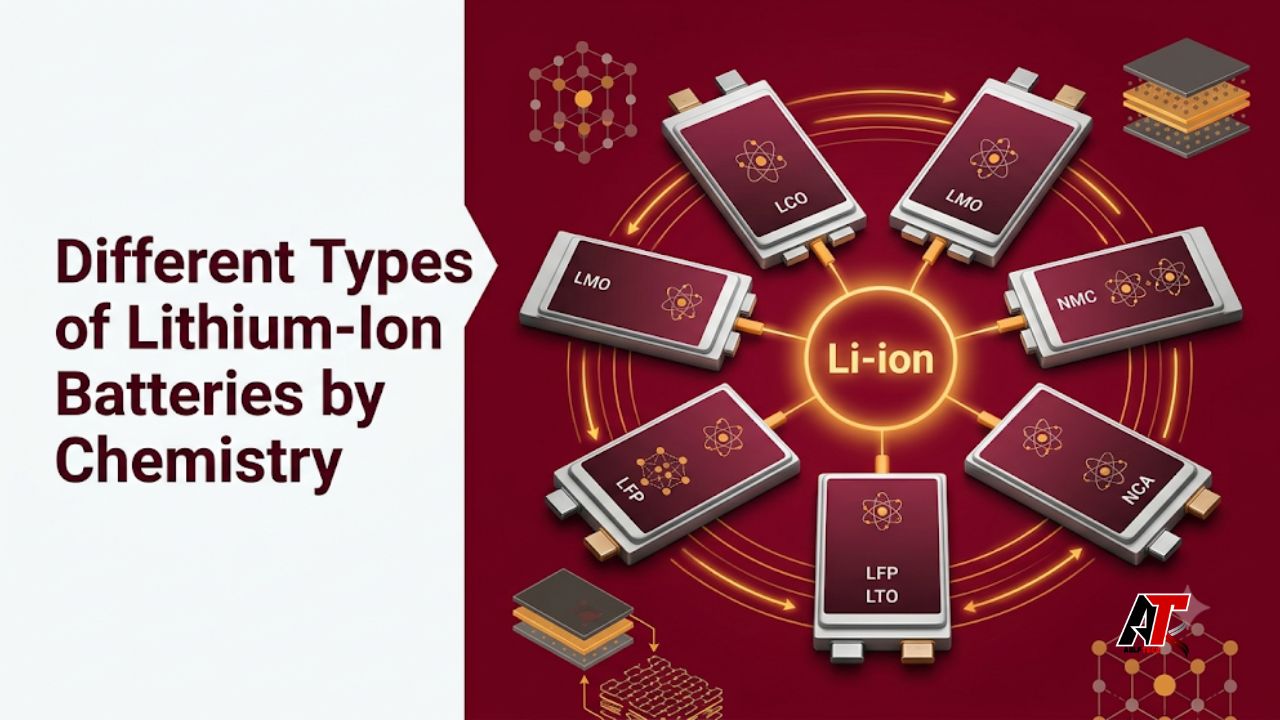
Lithium-ion batteries power smartphones, laptops, power tools, electric vehicles, medical equipment and large energy-storage systems. Although these products all use lithium-ion technology, they do not necessarily use the same active materials. Manufacturers select different battery chemistries to balance energy capacity, power output, lifespan, charging speed, safety and cost.
No single chemistry performs best in every category. A battery that stores more energy in a small space may require stricter thermal control, while a more stable chemistry may need a larger pack to deliver the same usable energy. The correct choice depends on the application.
This guide explains the main commercial lithium-ion chemistries: lithium cobalt oxide, lithium manganese oxide, nickel manganese cobalt, nickel cobalt aluminium, lithium iron phosphate and lithium titanate. It also shows how chemistry affects performance, safety, applications and recycling.
How Lithium-Ion Battery Chemistry Is Classified
A rechargeable lithium-ion cell contains a positive electrode, a negative electrode, an electrolyte and a separator. During charging and discharging, lithium ions move between the electrodes while electrons travel through the external circuit. Electrode materials influence voltage, capacity, power, temperature behaviour and ageing.
Most lithium-ion names refer to the positive electrode, also called the cathode during discharge. LFP identifies lithium iron phosphate, while NMC identifies nickel, manganese and cobalt. LTO is an exception because it is named after lithium titanate used in the negative electrode. Two cells may therefore behave differently even when they share a similar cathode.
Chemistry is only one performance factor. Cell format, manufacturing quality, cooling, software controls, charging limits and operating temperature also matter. The comparisons below describe common tendencies rather than guaranteed specifications.
Lithium Cobalt Oxide (LCO)
Lithium cobalt oxide, commonly shortened to LCO, was one of the earliest widely commercialised lithium-ion chemistries. Its main advantage is high energy density, which allows a relatively large amount of energy to be stored in a small and lightweight cell. This made LCO a natural choice for mobile phones, cameras, tablets, laptops and other portable electronics where size and weight are critical.
The trade-off is that LCO usually offers more limited cycle life and thermal stability than chemistries designed for demanding vehicle or stationary-storage use. Cobalt also contributes to material cost and raises supply-chain concerns. Modern battery-management systems, protective circuits and improved cell designs help manage these limitations, but LCO is still generally better suited to compact electronics than to high-power or very long-life applications.
LCO remains relevant because portable devices value energy density more than extreme cycle life. However, manufacturers increasingly use modified or blended materials to reduce cobalt content, improve stability and extend service life.
Lithium Manganese Oxide (LMO)
Lithium manganese oxide, or LMO, commonly uses a spinel crystal structure that supports rapid lithium-ion movement. This gives the chemistry good power capability, meaning it can deliver or accept current quickly. LMO also offers relatively good thermal stability and uses less costly manganese instead of relying heavily on cobalt.
Its main limitation is typically a shorter service life than LFP or well-managed NMC cells, especially when exposed to heat. Capacity can decline more quickly because manganese may dissolve from the cathode and contribute to unwanted reactions inside the cell. For this reason, LMO is often used where high power is more important than maximum energy storage or extremely long cycle life.
Applications have included power tools, medical devices and some early electric vehicles. Manufacturers may also blend LMO with NMC to combine the strong power characteristics of manganese spinel with the higher energy capacity and improved durability of layered NMC materials.
Lithium Nickel Manganese Cobalt Oxide (NMC)
Lithium nickel manganese cobalt oxide, known as NMC or NCM, is one of the most versatile lithium-ion families. Nickel supports high capacity, manganese contributes stability, and cobalt helps conductivity and performance. Changing the metal proportions allows manufacturers to tune energy density, power, life and cost.
Labels such as NMC111, NMC532, NMC622 and NMC811 describe approximate nickel, manganese and cobalt ratios. Higher nickel content can increase capacity and reduce cobalt use, but it may also increase sensitivity to heat, moisture, high voltage and structural degradation. High-nickel cells therefore need careful engineering and battery management.
NMC is used in electric cars, e-bikes, power tools, portable equipment and storage systems. Its popularity comes from balance: it often provides more energy density than LFP and stronger all-round durability than traditional LCO. Different NMC formulations can still behave very differently.
Lithium Nickel Cobalt Aluminium Oxide (NCA)
Lithium nickel cobalt aluminium oxide, or NCA, is another high-energy layered cathode chemistry. Nickel provides much of the capacity, cobalt supports conductivity and performance, and aluminium helps improve structural stability. NCA can deliver high specific energy and strong power capability, making it attractive for electric vehicles and other applications where long driving range or low pack weight is important.
NCA cells can provide good service life when they operate within carefully controlled temperature and voltage limits. However, they generally need sophisticated battery-management and thermal-control systems. Compared with LFP, NCA normally offers higher energy density but less inherent thermal stability. The cell and pack must therefore be engineered to prevent overcharging, overheating and damaging operating conditions.
The chemistry contains valuable nickel and cobalt, which increases both raw-material value and recycling interest. NCA is a strong example of why battery selection is a system-level decision: its high energy performance is most useful when supported by effective cooling, monitoring and software controls.
Lithium Iron Phosphate (LFP)
Lithium iron phosphate, known as LFP or LiFePO4, uses an olivine phosphate structure with strong chemical and thermal stability. It generally provides lower energy density and a lower nominal voltage than nickel-rich NMC or NCA, but it performs very well in safety, cycle life and resistance to thermal runaway. It also avoids nickel and cobalt, relying primarily on more widely available iron and phosphate.
LFP cells can tolerate frequent cycling and are commonly used in electric cars, buses, commercial vehicles, backup-power systems and stationary energy storage. Their long lifespan and stable behaviour make them attractive when durability, total ownership cost and safety are more important than minimising battery size. Improvements in cell-to-pack design have also reduced the practical impact of LFP’s lower energy density by removing unnecessary structural components from battery packs.
End-of-life handling still requires care because LFP remains a lithium-ion chemistry with a flammable electrolyte and stored electrical energy. Specialist LFP battery recycling helps recover useful materials, keeps batteries out of general waste streams and supports more responsible management as LFP use expands.
Lithium Titanate (LTO)
Lithium titanate, or LTO, is different from the other categories because lithium titanate normally replaces graphite in the negative electrode. The chemistry operates at a higher anode potential, which greatly reduces the risk of lithium plating during charging. As a result, LTO cells can accept very high charging rates, perform well at low temperatures and achieve exceptionally long cycle life.
The major disadvantage is low cell voltage and lower overall energy density. LTO battery packs are therefore larger and more expensive for the same stored energy than many graphite-based lithium-ion alternatives. This makes them unsuitable for devices where maximum runtime in the smallest possible space is the main priority.
LTO is valuable in applications that depend on fast charging, high power, cold-weather performance and intensive daily cycling. Examples include rapid-charge buses, industrial vehicles, rail systems, grid services and specialised backup-power installations. Its higher upfront cost can be justified when the battery must complete many cycles and minimise downtime.
Quick Comparison of the Main Chemistries
LCO is known for compact energy storage in consumer electronics. LMO delivers strong power but may have a shorter lifespan. NMC provides a flexible balance for transport and portable equipment. NCA supports high energy and power but needs careful thermal control. LFP prioritises stability and long cycle life, while LTO offers very fast charging and exceptional durability at the expense of energy density.
There is no universal winner. A long-range passenger vehicle may favour NMC or NCA because pack weight matters. A bus or stationary system may favour LFP because it cycles frequently and has space for a larger pack. Rapid-charge transit may justify LTO when charging time and lifespan outweigh initial cost.
Buyers should compare usable energy, warranty terms, expected cycle life, charging rate, temperature range, fire-protection strategy and replacement cost. Cell-level energy density alone does not show lifetime performance.
How Chemistry Affects Battery Safety
All lithium-ion batteries require correct design, charging, storage and handling. Safety depends on chemistry, cell quality, separators, electrolyte, pack construction, cooling and the battery-management system. Damage, defects, overcharging, external heating or internal short circuits can cause rapid temperature rise and, in severe cases, thermal runaway.
LFP is valued for thermal and chemical stability, while LTO reduces some charging-related risks because of its anode potential. Nickel-rich NMC and NCA store more energy but normally require tighter temperature and voltage control. LCO also needs careful protection.
A chemistry label alone does not guarantee safety. A professionally engineered NMC pack may be safer in practice than a poorly manufactured LFP product. Users should buy certified products, use the correct charger and stop using swollen, leaking, overheated or damaged batteries.
Why Battery Chemistry Matters for Recycling
Battery chemistry affects the materials that recyclers can recover and the economics of the recycling process. LCO, NMC and NCA contain cobalt or nickel that may carry significant value. LFP contains less high-value metal, so recycling systems may need efficient collection, processing and policy support to remain commercially attractive. LMO and LTO create their own material-separation and recovery considerations.
Recycling can involve mechanical preparation followed by high-temperature processing, chemical leaching or direct-recycling methods designed to preserve cathode materials. The best route depends on battery condition, chemistry, design, contamination and the facilities available. Proper identification and sorting are important because mixing chemistries can complicate processing and reduce the quality of recovered products.
Used Lithium-ion batteries should not be placed in ordinary household rubbish or mixed recycling. Their stored energy and flammable components can create fire risks during collection, transport and processing. Terminals should be protected where appropriate, and batteries should be delivered to an approved collection point, hazardous-waste programme or qualified recycler.
Emerging Changes in Lithium-Ion Chemistry
Battery development is not moving toward one universal formula. Lithium manganese iron phosphate, or LMFP, aims to improve LFP voltage and energy density while retaining phosphate-based advantages. High-manganese, lower-cobalt and high-nickel cathodes seek better performance with less reliance on constrained materials.
Anode development also matters. Silicon can store more lithium than graphite, but it expands during cycling and requires careful engineering. Solid-state batteries replace conventional liquid electrolyte with a solid material, but the term describes an electrolyte approach rather than one cathode chemistry.
When comparing technologies, aelftech.com recommends looking beyond headline capacity. A useful assessment considers safety, lifespan, charging needs, supply chain, operating environment and end-of-life recovery together.
Final Thoughts
Different lithium-ion batteries exist because applications have different priorities. LCO suits compact electronics, LMO delivers high power, NMC offers broad flexibility, NCA supports high-energy packs, LFP provides long life and stability, and LTO enables very fast charging and intensive cycling.
No chemistry should be selected by name alone. Electrode formulation, cell construction, pack design, thermal controls, software limits and operating conditions all affect performance. A lower-energy chemistry may provide better lifetime value, while a high-energy chemistry may be essential where size and weight matter.
Understanding these trade-offs supports better purchasing, safer handling and more responsible recycling.
Leave a Reply