
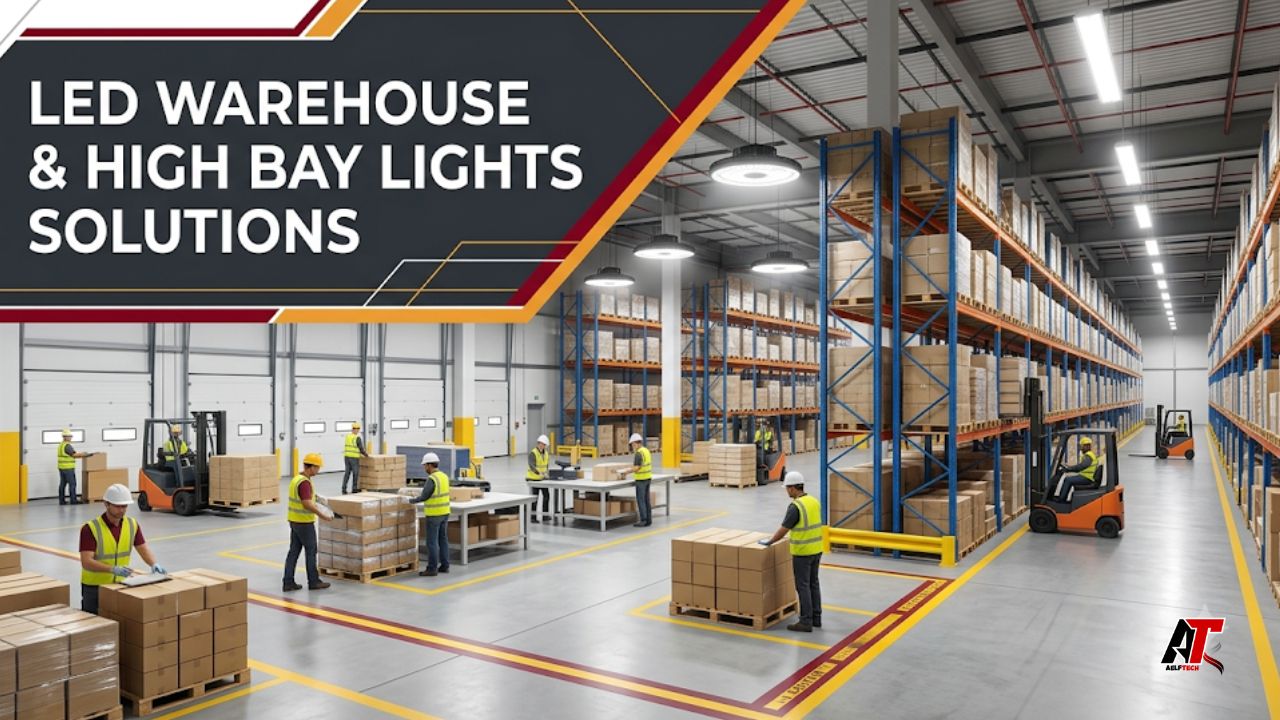
Warehouses, distribution centers, factories, workshops, and large retail storage facilities need lighting that does more than make a room look bright. Workers must be able to read labels, identify products, operate forklifts, inspect materials, and move safely between racks. At the same time, facility managers must control electricity use, maintenance interruptions, and the cost of replacing fixtures mounted far above the floor. This is why LED warehouse and high bay lighting has become a practical solution for modern industrial spaces.
A successful upgrade is not simply a matter of replacing an old lamp with the highest-wattage LED available. Ceiling height, aisle geometry, rack placement, surface reflectance, temperature, operating hours, and control strategy all influence the result. The right system delivers useful light where work happens, avoids harsh glare, and remains efficient throughout its service life. This guide explains the main LED warehouse and high bay light solutions, how UFO and linear fixtures differ, which specifications matter, and how to plan a safer, more cost-effective installation.
| Key Takeaways UFO high bays usually suit open floors; linear high bays often suit long aisles and racking.Photometric planning is more reliable than selecting by wattage or using a one-for-one replacement.Occupancy sensors, dimming, daylight response, and zoning can improve the value of an LED upgrade.Environmental ratings, driver quality, certifications, glare control, and maintenance access matter as much as initial price. |
What Are LED Warehouse and High Bay Lights?
High bay lights are powerful fixtures designed for spaces with high ceilings and large floor areas. They are commonly installed in warehouses, manufacturing plants, aircraft hangars, sports facilities, loading areas, and big-box storage environments. Unlike office fixtures, they must send sufficient light from an elevated mounting point to the working plane while controlling shadows, glare, and uneven brightness.
The term “warehouse lighting” is broader. It may include high bays, aisle fixtures, low bays, task lights, loading-dock lights, emergency lighting, and exterior security fixtures. Modern LED warehouse lights can therefore be designed as a complete system rather than a collection of identical lamps. Open picking zones may need broad distribution, narrow rack aisles may require concentrated vertical illumination, and inspection or packing stations may need supplementary task lighting.
LED technology is especially suitable for these environments because it offers instant start, directional light, compatibility with dimming and sensors, and reduced relamping compared with many older systems. However, product quality and system design still matter. A poorly selected LED fixture can create bright spots directly below the luminaire while leaving shelves, aisle ends, or upper rack faces too dark.
Why LED Lighting Works Well in Warehouses
Industrial facilities often operate for long shifts, so lighting energy and maintenance costs accumulate quickly. Efficient LED luminaires can produce the required light with less input power than many legacy high-intensity discharge or fluorescent systems. The financial benefit becomes more significant when fixtures run for extended hours or when electricity rates are high.
Maintenance is another major advantage. Replacing lamps at height may require lifts, safety procedures, production interruptions, and specialized labor. A well-specified LED system can reduce the frequency of these interventions. LEDs also reach full output immediately, making them suitable for occupancy controls that dim or switch zones according to activity. The U.S. Department of Energy notes that commercial and industrial LED luminaires can work with occupancy sensors, task tuning, and dimming, which can create savings beyond fixture efficiency alone.
UFO High Bay Lights for Open Areas
UFO high bays are round, compact fixtures named for their disc-like shape. They are widely used in open warehouses, workshops, production floors, gymnasiums, and areas where the layout is not dominated by long rows of tall racking. Their compact body makes them relatively straightforward to suspend from a single point, while different lenses and reflectors can provide broad or more concentrated distribution.
A UFO fixture is often a good choice when equipment, work zones, or storage arrangements may change over time. Broad, symmetrical light distribution can support general illumination across open floors without requiring the luminaire to follow a precise aisle direction. High-output models can also serve tall mounting heights when their beam pattern and spacing are properly calculated.
The main limitation is that a round distribution may spill light onto rack tops or create insufficient vertical light on shelf faces in narrow aisles. A UFO is not automatically the best fixture simply because the ceiling is high. Photometric planning should confirm spacing, light levels, uniformity, and glare. Where open zones meet aisles, a mixed system may deliver a better result than using one fixture style everywhere.
Linear High Bay Lights for Aisles and Racking
Linear high bays are longer fixtures that distribute light along a rectangular area. They are especially useful above long warehouse aisles, production lines, and storage rows because their optics can direct more light down the aisle and onto vertical rack faces. This can reduce wasted light on top of shelving and improve visibility when workers scan labels or retrieve products.
A linear layout also makes it easier to align luminaires with the building geometry. Fixtures can be positioned over travel lanes, packing conveyors, inspection lines, or work areas that need continuous coverage. In facilities with dense racking, the ability to use aisle-specific optics may be more valuable than simply selecting a higher lumen package.
When comparing UFO and Linear High Bays, the decision should be based on the floor plan rather than appearance. UFO high bays often suit open, high-ceiling spaces, while linear high bays frequently perform better in long aisles and structured rows. Some warehouses need both: UFO fixtures in receiving or staging areas and linear fixtures between racks. A qualified lighting layout can confirm where each type belongs.
Key Specifications That Shape Performance
Watts alone do not explain how a fixture will perform. Facility managers should compare delivered lumens, lumens per watt, optical distribution, mounting height, spacing, and expected light at the working plane. Two fixtures with similar wattage may produce different usable illumination because their optics, drivers, thermal management, and installation conditions differ.
Beam angle is important because a narrow beam concentrates light over a smaller area, while a wider beam spreads it across a larger footprint. Very tall ceilings may need more controlled distribution, but overly narrow optics can create bright pools and dark gaps if spacing is poor. Uniformity matters because the eye must repeatedly adapt when workers move between bright and dim zones.
Color temperature affects appearance and visual comfort. Neutral or cool-white light is common in industrial spaces, but the best selection depends on the task, finishes, and operating environment. Color rendering index, or CRI, describes how naturally colors appear under the light. Facilities where workers distinguish wire colors, inspect finishes, or read color-coded labels may need stronger color quality than basic storage areas.
Smart Controls Improve Efficiency and Flexibility
Occupancy and motion sensors can turn lights on, dim them, or move them to a lower standby level when areas are unoccupied. Daylight harvesting adjusts electric light according to available natural light. Scheduling can match shifts, cleaning periods, and security requirements. Wireless controls may also support zoning and changes without extensive control wiring, although network reliability, commissioning, and user training must be considered.
Energy-saving guidance from ENERGY STAR and the U.S. Department of Energy consistently highlights controls as an important opportunity. Savings vary by operating pattern, so the strongest business case uses actual occupancy, current energy use, and realistic control settings. Safety-critical areas should never be left dark, and sensor placement must account for racks, obstructions, forklift movement, and slow-moving occupants.
Why a Photometric Layout Matters
A photometric layout is a computer-based prediction of how a proposed lighting system will perform in the actual space. It uses fixture data, mounting height, spacing, room dimensions, reflectance, racks, and target work planes to estimate illuminance and uniformity. This makes it far more reliable than choosing fixtures from wattage or a simple one-for-one replacement chart.
A good design also separates general lighting from task requirements. Packing, inspection, maintenance, and quality-control stations may need local lighting even when the surrounding warehouse meets its general target. Local regulations and recommended practices differ by region and task, so final levels should be confirmed by a qualified lighting professional.
Planning an LED Warehouse Lighting Retrofit
Start with a site audit. Record existing fixture types, wattages, quantities, mounting heights, control methods, operating hours, failures, and areas where employees report poor visibility. Measure current light levels at representative locations and note changes caused by daylight or blocked fixtures. Energy bills and maintenance records help establish a baseline for the financial comparison.
Next, divide the facility into functional zones. Open storage, narrow aisles, receiving, shipping, production, cold rooms, loading docks, offices, and emergency routes may need different fixtures or controls. The proposal should include a photometric plan, product data, expected connected load, control sequence, warranty, installation assumptions, and a method for verifying results after commissioning.
Cost, ROI, and Long-Term Value
The cheapest fixture is not always the lowest-cost solution. Purchase price is only one part of total ownership. Energy consumption, installation labor, lift rental, control hardware, maintenance access, expected service life, warranty support, and the cost of operational disruption should all be considered. A durable, efficient fixture with good optical performance may justify a higher initial price if it reduces the number of luminaires or avoids frequent service calls.
A basic payback calculation compares annual electricity and maintenance savings with the net project cost after available incentives. A more complete analysis also considers energy-price changes, financing, demand charges, replacement cycles, and the value of improved controllability. Claims should be based on documented wattage, hours, tariffs, and assumptions rather than generic percentages.
Common Warehouse Lighting Mistakes to Avoid
One common mistake is selecting fixtures only by wattage or advertised lumen output. Light must reach the correct surfaces with acceptable uniformity. Another is using the same fixture in open floors, narrow aisles, loading docks, and inspection zones even though these spaces have different geometry and tasks.
Spacing fixtures too far apart can create alternating bright and dark areas, while installing too many can increase glare and waste energy. Ignoring rack height or future layout changes can leave vertical labels in shadow. Controls can also fail when sensors are blocked, timeouts are too short, or zones are too large.
UFO vs Linear High Bay Lights: Quick Selection Guide
| Factor | UFO High Bay | Linear High Bay |
| Typical layout | Open floors, staging areas, flexible spaces | Long aisles, racks, conveyors, production lines |
| Distribution | Usually broad and symmetrical | Usually rectangular or aisle-focused |
| Installation form | Compact, often single-point suspension | Longer body aligned with the work area |
| Main planning risk | Bright pools or spill onto rack tops | Incorrect alignment or insufficient cross-aisle coverage |
| Best decision method | Photometric layout using actual geometry | Photometric layout using actual geometry |
Frequently Asked Questions
What is the difference between high bay and low bay lighting?
High bay fixtures are designed for taller spaces and normally use optical control to deliver useful light over a greater distance. Low bay fixtures serve lower mounting heights and may use wider distribution or lower output. The correct category depends on ceiling height, spacing, task, and product design rather than one universal cutoff.
Are UFO or linear high bays better for a warehouse?
Neither type is always better. UFO high bays commonly suit open floors and flexible layouts, while linear high bays are often effective in long aisles and structured racking. A warehouse may benefit from both. A photometric layout should confirm the choice and spacing.
Can LED warehouse lights be used with motion sensors?
Many commercial LED high bays support occupancy sensors, dimming, scheduling, and networked controls. Compatibility must be confirmed for the fixture driver, sensor, control protocol, and emergency system. Sensor placement and commissioning are essential in spaces with racks and moving equipment.
How do I know how many high bay lights I need?
Fixture quantity depends on room dimensions, mounting height, rack layout, target light levels, optics, surface reflectance, and fixture output. A professional photometric calculation is more reliable than a watts-per-square-foot estimate or one-for-one replacement rule.
What should I check before buying industrial LED fixtures?
Review photometric files, efficacy, lumen output, distribution, color quality, temperature rating, ingress protection, surge protection, dimming, certifications, warranty, driver quality, and local support. Confirm that the product is appropriate for dust, moisture, cold, heat, vibration, or washdown conditions present in the facility.
Final Thoughts
LED warehouse and high bay lighting can reduce energy use, simplify maintenance, and improve the consistency of light across demanding industrial spaces. The strongest solution begins with the facility layout and work tasks, then selects optics, fixture types, controls, and mounting positions to match those conditions. UFO high bays are often effective in open areas, while linear fixtures can provide better aisle and rack coverage, but photometric evidence should guide the final decision.
Before purchasing, complete a site audit, compare total ownership costs, verify certifications and environmental ratings, and plan commissioning after installation. For more practical technology, business, and digital-growth guidance, explore team aelftech.com.
Leave a Reply