
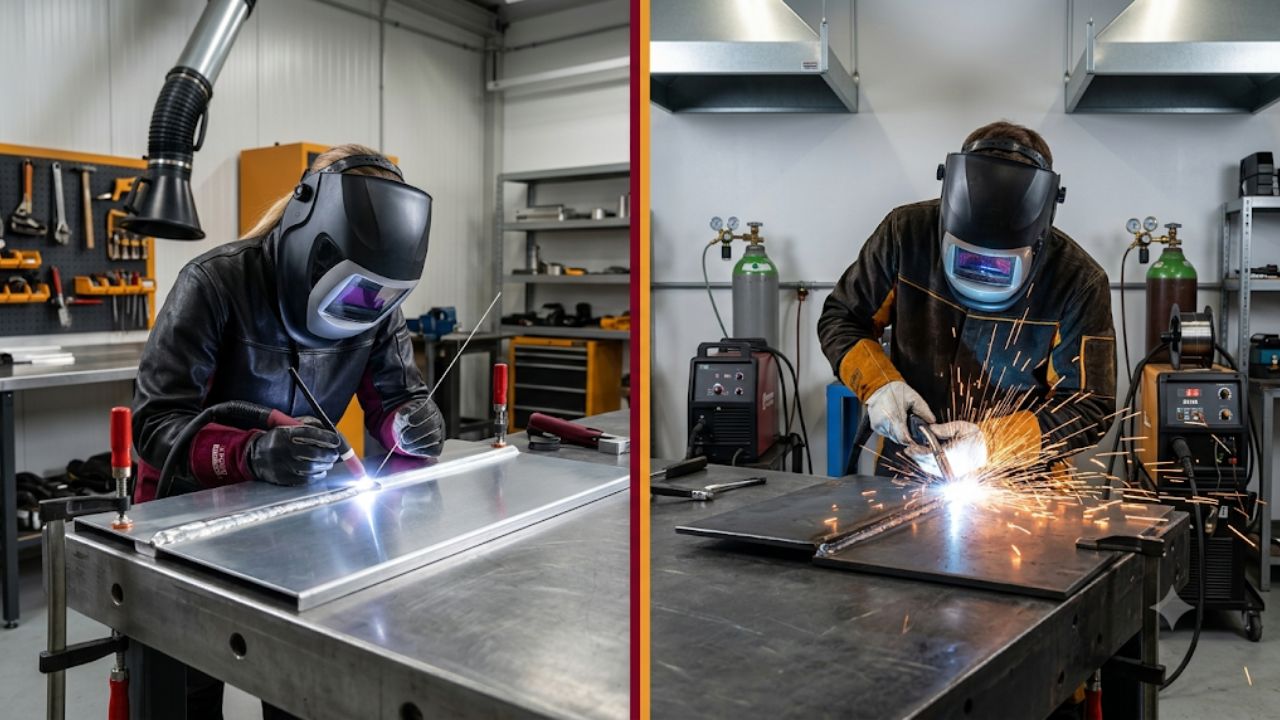
Is Welding Aluminum Harder Than Steel?
For most beginners and even many experienced fabricators, welding aluminum is harder than welding mild steel. The difficulty does not come from one single issue. Aluminum conducts heat quickly, forms a stubborn oxide layer, gives fewer visual warnings before it melts, and requires cleaner preparation. Its filler wire is also softer and more difficult to feed during MIG welding. Steel is generally more forgiving, especially when the joint is thick, the surface is reasonably clean, and appearance is not the top priority.
That does not mean aluminum is impossible to weld. With the right process, equipment, filler metal, cleaning method, and practice, a welder can produce strong and attractive aluminum joints. The key is understanding why aluminum behaves differently instead of treating it like steel.
Why Is Welding Aluminum Harder Than Steel?
1. Aluminum Conducts Heat Much Faster
One of the biggest differences is thermal conductivity. Aluminum pulls heat away from the weld area much faster than carbon steel. At the start of a weld, the joint may seem too cold and difficult to fuse. A few seconds later, heat can build throughout the part and the puddle may suddenly become too fluid.
This rapid change makes heat control more demanding. The welder must establish the puddle quickly, maintain enough energy for fusion, and then reduce heat as the workpiece becomes hotter. On a long TIG weld, a foot pedal, fingertip control, or pulse setting can make this adjustment easier. Steel usually holds heat closer to the arc and develops a puddle more gradually, giving a beginner more time to react.
2. The Oxide Layer Melts at a Much Higher Temperature
Bare aluminum immediately forms a thin aluminum oxide film when exposed to air. The aluminum underneath melts at roughly 660°C, while the oxide layer melts at around 2,060°C. The base metal can therefore become liquid while the surface film is still solid.
If the oxide is not removed or disrupted correctly, it can prevent proper fusion, contaminate the puddle, and leave inclusions. Aluminum should be degreased and then brushed with a clean stainless-steel brush reserved only for aluminum. In AC TIG welding, the electrode-positive part of the cycle also helps break up the oxide. Steel can contain rust, mill scale, paint, and oil, but mild steel often tolerates less-than-perfect preparation better.
3. Aluminum Gives Less Visual Warning Before Melting
Steel changes color as it heats, allowing a welder to judge the growing heat zone. Aluminum does not give the same red or orange warning. It stays silver-looking until it is very close to melting. This is why a beginner can suddenly burn through thin aluminum even though the surface appeared stable only a moment earlier. A tight arc, correct amperage, good travel speed, and steady torch angle are essential.
4. The Working Window Can Feel Narrow
Insufficient heat can cause lack of fusion, cold lap, or a bead that sits on the surface. Too much heat can cause burn-through, excessive penetration, distortion, or a collapsing joint edge. Since aluminum transfers heat quickly and melts at a lower temperature than steel, the space between these two problems can feel narrow. Thin sections are especially demanding, and accurate joint fit-up is important because large gaps require more filler and more heat.
5. Aluminum Is More Sensitive to Contamination
Moisture, oil, dirt, oxide, and poor shielding can create porosity in aluminum welds. Hydrogen is much more soluble in liquid aluminum than in solid aluminum, so gas can become trapped as the weld cools. The result may be pinholes, internal porosity, or reduced joint strength.
Keep the base metal dry, store filler wire correctly, clean the joint shortly before welding, and protect the shielding gas from drafts. Never use a carbon-steel wire brush or a grinding disc that has already touched steel. Cross-contamination can reduce weld quality and corrosion resistance.
6. MIG Wire Feeding Is More Difficult
Aluminum MIG wire is softer than steel wire. It can buckle, shave, tangle, or form a bird’s nest inside the feeder when the setup creates too much resistance. A spool gun or push-pull gun is often used to shorten the feeding distance. A conventional feeder may also need U-groove drive rolls, the correct liner, smooth guides, and carefully adjusted tension. Steel MIG wire is stiffer and normally feeds through standard equipment with fewer problems.
7. Alloy and Filler Selection Need More Attention
Not every aluminum alloy responds to welding in the same way. Some are readily weldable, while others are more likely to crack or lose significant strength in the heat-affected zone. Common filler metals such as 4043 and 5356 differ in strength, ductility, crack resistance, appearance after anodizing, and service-temperature limits.
The welder should identify the base alloy, service conditions, joint design, and required finish before selecting filler metal. Steel filler selection also matters, but many common mild-steel jobs use familiar combinations with fewer variables.
Aluminum vs. Steel Welding Comparison
| Factor | Aluminum | Mild Steel |
| Heat movement | Very fast; heat spreads through the part | Slower and easier to predict |
| Surface condition | Tough oxide must be removed or disrupted | Rust, scale, paint, and oil should be cleaned |
| Melting behavior | Lower melting point and little color warning | More visible heat color and gradual response |
| MIG wire | Soft; may need a spool gun or push-pull system | Stiff; feeds easily through standard equipment |
| Typical TIG current | AC for most common aluminum alloys | DCEN for mild steel |
| Preparation | Strict cleaning and accurate fit-up | Important but generally more forgiving |
| Beginner difficulty | Moderate to high | Low to moderate |
| Common defects | Porosity, lack of fusion, burn-through, cracking | Spatter, undercut, porosity, lack of fusion |
Is Aluminum Always Harder to Weld?
Not in every situation. A clean, thick aluminum plate welded with a modern pulse MIG system may be easier than a thin, rusty steel panel in a difficult position. Equipment quality, joint access, material thickness, alloy, fit-up, and operator experience can change the answer.
The comparison also depends on the steel. Mild carbon steel is usually the easiest common metal to weld. Stainless steel requires better heat control and shielding. High-strength steel may require preheat, low-hydrogen procedures, controlled heat input, or post-weld treatment. The most accurate general statement is that aluminum is usually harder than mild steel, not necessarily harder than every steel alloy or application.
Is TIG or MIG Better for Aluminum?
TIG is often preferred for thin aluminum, visible joints, tubing, repair work, and projects where bead appearance matters. It gives excellent control over the arc and filler addition. However, it is slower and demands good hand coordination. AC balance, frequency, amperage, tungsten preparation, torch angle, and filler timing all influence the result.
MIG is faster and well suited to thicker sections, production fabrication, trailers, marine components, frames, and long welds. Spray transfer or pulsed spray transfer is commonly used. Aluminum MIG needs the correct wire-feeding equipment and settings, but once the system is tuned, productivity can be much higher than TIG.
For specialist aluminum welding, the best process is the one that matches material thickness, joint design, quality requirements, position, production speed, and available equipment.
How to Prepare Aluminum Before Welding
Good preparation is not optional. First, identify the alloy and confirm that it is weldable. Check the thickness and select a compatible filler. Remove oil, marker residue, adhesive, and grease with a suitable solvent and a clean lint-free cloth. After degreasing, remove the oxide with a dedicated stainless-steel brush or an approved mechanical or chemical method.
Do not brush first and then wipe oil across the freshly opened surface. Avoid touching the cleaned joint with bare hands. Assemble the parts with tight, consistent fit-up and clean clamps. Finally, confirm shielding gas, flow rate, polarity, torch components, wire path, and machine settings before striking the arc.
The exact preparation may change with the type of aluminum work, but cleanliness, fit-up, and process control remain essential.
Common Aluminum Welding Mistakes
Using steel settings on aluminum is a common mistake. Aluminum usually needs a different polarity, shielding gas, filler, travel technique, and wire-feeding setup. Moving too slowly is another problem because excessive dwell time increases distortion and burn-through.
Poor cleaning can leave oxide inclusions or porosity even when the bead looks acceptable. Other frequent errors include choosing the wrong filler, holding too long an arc, dipping the tungsten, using an incorrect torch angle, allowing drafts to disturb shielding gas, and failing to reduce amperage as the part heats up. Practice on scrap pieces of the same alloy and thickness before welding the final component.
Practical Tips That Make Aluminum Welding Easier
- Use a machine designed for aluminum and confirm that it can supply the required amperage and duty cycle.
- For MIG, use the correct wire-delivery system and keep the gun cable as straight as practical.
- Clean every joint shortly before welding and keep aluminum tools separate from steel tools.
- Use tack welds to hold alignment, but avoid oversized tacks that are difficult to blend.
- On long joints, increase travel speed or reduce current as the workpiece becomes hotter.
- When distortion matters, use balanced sequencing, clamps, chill bars, or shorter weld segments when the procedure allows.
- Make test coupons and inspect fusion at the root and toes. A shiny bead alone does not prove that a weld is strong.
Does Aluminum Welding Cost More Than Steel Welding?
It often does. Aluminum-compatible equipment, pure shielding gas, specialized wire feeding, careful cleaning, and skilled labor can raise the price. A job may also require more setup time, test welds, filler verification, and distortion control.
However, total project value depends on more than welding cost. Aluminum is lightweight, corrosion-resistant, and useful in transportation, marine, aerospace, architectural, and consumer applications. Its lower weight may reduce fuel use or make a product easier to handle. In the right application, these benefits can justify the extra fabrication difficulty.
Can a Beginner Learn to Weld Aluminum?
Yes, but learning mild-steel MIG first is usually helpful. Steel teaches basic gun angle, travel speed, joint preparation, arc length, and bead placement in a more forgiving material. After those fundamentals are stable, the welder can focus on aluminum-specific heat control, cleaning, and filler selection.
A beginner starting directly with aluminum should use clean practice coupons, follow a tested settings chart, and change only one variable at a time. Instruction from a qualified welder is valuable because small technique errors are difficult to diagnose without immediate feedback.
Frequently Asked Questions
Can aluminum be welded with a regular MIG welder?
Some MIG welders can weld aluminum if they provide suitable output, polarity, gas connections, and compatible wire-feeding accessories. A spool gun or push-pull gun is commonly recommended. Check the manufacturer’s specifications before buying accessories.
Why do aluminum welds crack?
Cracking can result from an unsuitable filler, crack-sensitive alloy chemistry, poor joint design, high restraint, contamination, or incorrect heat input. The base alloy and service conditions should be verified before welding.
Can aluminum be welded directly to steel?
Direct fusion welding is difficult because the metals have different melting behavior and can form brittle intermetallic compounds. Transition inserts, brazing methods, mechanical fastening, or specialized solid-state processes may be used instead.
Which is stronger: an aluminum weld or a steel weld?
Strength depends on alloy, temper, joint design, filler, process, and weld quality. Steel is generally stronger for the same cross-sectional size, while aluminum structures are often engineered with larger or reinforced sections to achieve the required performance.
Is aluminum welding dangerous?
All welding involves hazards such as ultraviolet radiation, fumes, hot metal, fire, electricity, and compressed gas. Use proper PPE, ventilation or fume control, fire prevention, and equipment procedures. Never weld a sealed container or a component that held flammable material unless it has been professionally cleaned and declared safe.
Final Verdict
So, is welding aluminum harder than steel? In most normal shop situations, yes. Aluminum demands stricter cleaning, faster and more responsive heat control, better shielding, correct alloy and filler selection, and specialized MIG feeding equipment. Mild steel is usually more forgiving and gives clearer visual feedback.
The good news is that aluminum becomes manageable when the process is treated correctly. Use clean material, suitable equipment, tested settings, steady technique, and practice pieces that match the real job. Readers looking for more clear, search-focused industry content can explore aelftech.com.
Leave a Reply