
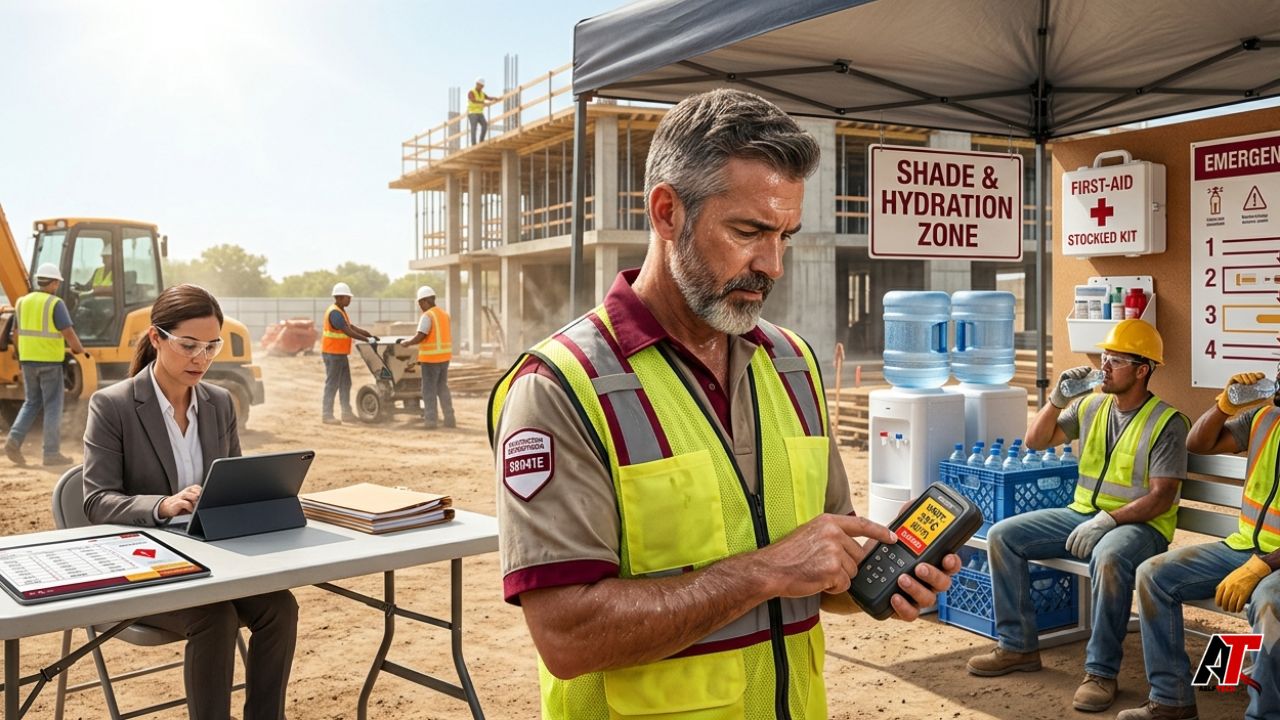
Construction workers routinely perform strenuous tasks in direct sun, reflected heat, heavy clothing, and personal protective equipment. When a worker collapses, develops kidney injury, suffers heat stroke, or dies, the legal investigation rarely stops with the temperature. It asks what the contractor knew, what precautions were available, who controlled the site, and whether supervisors acted when warning signs appeared.
That is why 2026 matters. Federal OSHA strengthened its heat-enforcement program while its proposed Heat Injury and Illness Prevention rule remains unfinished. Contractors cannot dismiss the proposal as irrelevant, but injured workers and attorneys should not describe it as final law. The more accurate approach is to distinguish enforceable duties from proposed benchmarks and then examine how both may influence notice, industry expectations, and evidence.
What the “2026 Federal Standard” Actually Means
The current federal framework has several layers. First, the General Duty Clause requires employers to provide a workplace free from recognized serious hazards. OSHA has long treated dangerous heat as a recognized hazard when exposure, working conditions, and feasible controls support that conclusion.
Second, existing rules may apply to related issues such as sanitation, drinking water, personal protective equipment, medical services, training, recordkeeping, and reporting severe incidents. Employers under OSHA jurisdiction must generally report a work-related fatality within eight hours and an in-patient hospitalization, amputation, or loss of an eye within 24 hours.
Third, OSHA’s updated 2026 Heat National Emphasis Program directs programmed and unprogrammed inspections toward high-risk industries, including construction. It uses weather information, heat alerts, worker complaints, injuries, referrals, and observations to focus enforcement. Inspectors may evaluate heat programs, water, rest, shade or cooling areas, acclimatization, training, work practices, and emergency response.
The Proposed 80°F and 90°F Triggers
OSHA’s proposed rule would create an Initial Heat Trigger at a heat index of 80°F, or an equivalent occupational heat measure, and a High Heat Trigger at 90°F. At the initial trigger, the proposal describes cool drinking water, break areas, acclimatization, communication, and controls. At the high trigger, it adds measures such as paid rest breaks of at least 15 minutes every two hours, closer observation, and a high-heat hazard alert.
Those details are useful for planning and may become important evidence of what OSHA publicly identified as feasible prevention. They are not, however, a final regulation as of June 23, 2026. A plaintiff should not claim that crossing 80°F automatically proves a federal violation, and a contractor should not assume that staying below 80°F eliminates risk. Metabolic workload, humidity, radiant heat, clothing, direct sun, acclimatization, and worker health can make conditions dangerous at different temperatures.
Enforceable Framework vs. Proposed Rule
| Source | Status in June 2026 | Why it matters in a claim |
| General Duty Clause | Enforceable federal duty | May support a citation when heat is recognized, serious, and preventable through feasible measures |
| Existing OSHA rules | Enforceable where applicable | Water, training, PPE, reporting, records, and emergency arrangements may supply separate evidence |
| 2026 Heat NEP | Active enforcement directive | Shapes inspections, documentation requests, industry targeting, and OSHA’s evaluation of controls |
| Proposed heat rule | Not final or independently enforceable | Can inform planning and arguments about notice or feasible prevention, subject to evidentiary law |
Why Contractors Face Particular Scrutiny
Construction heat exposure changes rapidly. Crews move between shade and open roofs, ground level and enclosed spaces, light tasks and heavy lifting. Schedules can encourage workers to push through symptoms, while subcontracting can blur responsibility. The key question becomes who created, controlled, corrected, or exposed workers to the hazardous condition.
OSHA’s multi-employer citation policy recognizes creating, exposing, correcting, and controlling employers on shared worksites. More than one employer may be cited for violations of OSHA standards, although the policy states that only exposing employers are cited for General Duty Clause violations. In civil litigation, contracts, site-control evidence, safety responsibilities, and state law may allocate duties differently.
A general contractor that sets production deadlines, coordinates shade placement, controls water access, or directs subcontractor schedules may possess relevant evidence even when the injured person worked for another company. A subcontractor may still have direct responsibilities to its own employees. Labels in a contract matter, but day-to-day conduct often matters too.
Evidence That Can Decide a Heat Illness Case
Heat illness litigation is document-intensive. Weather data alone cannot prove what happened at a worker’s exact location, yet it can establish the background conditions. Investigators may compare National Weather Service alerts with site heat-index readings, wet-bulb globe temperature measurements, humidity, direct sunlight, workload, PPE, and the timing of symptoms.
The following records can reveal whether the contractor recognized and controlled the risk:
- Heat monitoring records: heat index, WBGT readings, forecast checks, and alert notifications
- Work schedules: shift length, overtime, task rotation, pace, and whether heavy work was moved to cooler hours
- Water and rest records: delivery logs, cooler locations, break policies, and supervisor instructions
- Shade or cooling arrangements: tents, trailers, fans, air-conditioned recovery areas, and travel distance
- Acclimatization plans: how new and returning workers were gradually exposed over their first days
- Training materials: languages used, attendance, supervisor instruction, and symptom-response procedures
- Communications: texts, radio traffic, emails, photographs, and messages about heat or production pressure
- Medical and emergency records: symptom timeline, first aid, cooling actions, EMS calls, and transport delays
- Contracts and safety plans: which company controlled the area, workforce, equipment, and emergency process
How Safety Failures May Support Civil Liability
An OSHA citation does not automatically win a personal-injury lawsuit, and the proposed rule does not create a private federal claim. The OSH Act also states that it does not enlarge or diminish workers’ compensation or common-law rights and liabilities. Civil responsibility depends on state law, the parties’ relationships, admissible evidence, and proof of duty, breach, causation, and damages.
Even so, OSHA materials, recognized industry guidance, internal policies, and training records may become relevant to notice and reasonable care. A contractor that received repeated heat alerts, knew a worker was unacclimatized, denied recovery time, and failed to respond to confusion presents a different factual picture from a contractor with monitoring, water, shaded breaks, trained supervisors, and a rapid emergency response.
Causation also matters. Medical evidence may need to distinguish occupational heat injury from unrelated illness, medication effects, infection, cardiac events, or off-site exposure. Strong cases connect the environmental conditions, workload, symptoms, treatment, and resulting harm through reliable records and expert analysis.
Workers’ Compensation and Third-Party Claims
Most employees injured by heat begin with workers’ compensation, which can provide defined benefits without requiring proof of ordinary negligence. In return, exclusive-remedy rules often limit direct civil suits against the employer. The exact rules vary by state and can include special protections for prime contractors or statutory employers.
A separate claim may sometimes exist against a negligent third party, such as another contractor, property owner, equipment provider, or site controller. Whether that party owed an independent duty requires a careful review of contracts, control, insurance, and state law. In Oklahoma, workers’ compensation exclusivity and contractor relationships can be especially important, so an injured worker may consult a construction accident attorney in Tulsa to evaluate deadlines, responsible parties, and available claims. This link is provided as a resource, not as a legal endorsement.
Recognizing Symptoms and Responding Immediately
Litigation cannot reverse a medical emergency. Every contractor should train workers and supervisors to recognize the signs of heat illness. Heat exhaustion may involve heavy sweating, weakness, dizziness, headache, nausea, or fainting. Heat stroke can involve confusion, slurred speech, loss of consciousness, seizures, very high body temperature, or hot skin.
Suspected heat stroke requires an emergency response: call 911, move the worker to a cooler area, remove excess outer clothing, and begin rapid cooling while help is coming. Do not leave the worker alone or delay care while waiting for a supervisor’s approval. A prompt, practiced response can save a life and reduce the severity of injury.
What Contractors Should Do in 2026
- Create a written heat plan. Assign responsibilities for monitoring, water, breaks, acclimatization, communication, and emergencies.
- Monitor actual conditions. Use appropriate heat measures and account for sun, humidity, workload, clothing, and enclosed spaces.
- Provide cool water and encourage drinking. Place supplies close to work and replenish them throughout the shift.
- Schedule recovery opportunities. Use shaded or cooled areas and increase rest as heat, workload, or symptoms increase.
- Acclimatize workers. Gradually increase exposure for new workers and those returning after an absence.
- Train supervisors to act. Production goals must not override symptoms, emergency protocols, or stop-work authority.
- Document without discouraging reports. Keep useful records while protecting workers from retaliation for raising concerns.
- Coordinate employers. Clarify responsibilities among owners, general contractors, subcontractors, and staffing firms.
- Review the proposed rule. Prepare for likely requirements without falsely labeling the proposal as current law.
Frequently Asked Questions
Is 80°F a mandatory federal stop-work temperature in 2026?
No. The 80°F heat index is an initial trigger in OSHA’s proposed rule, not a nationwide final stop-work requirement. Current duties depend on recognized hazards, actual exposure, feasible controls, and applicable standards.
Can OSHA inspect a site without a reported heat injury?
Yes. The 2026 Heat National Emphasis Program supports programmed inspections in targeted industries and on certain high-heat days, as well as inspections following complaints, referrals, hospitalizations, fatalities, or observed hazards.
Does an OSHA citation prove contractor negligence?
Not automatically. Its effect depends on the jurisdiction, claim, parties, and evidence rules. It may still be important evidence of hazardous conditions, notice, or failed precautions.
What should an injured worker preserve?
Preserve photographs, clothing and PPE details, work schedules, pay records, witness names, text messages, weather alerts, medical records, and any report made to a supervisor. Legal and workers’ compensation deadlines can be short.
Final Thoughts
The 2026 heat-enforcement landscape demands precision. OSHA’s updated enforcement program is active, the General Duty Clause remains enforceable, and severe-incident reporting duties continue. The proposed federal heat rule offers detailed prevention benchmarks, but it is not yet final law. For contractors, the safest strategy is not to debate labels while workers are exposed. Monitor conditions, acclimatize crews, provide water and cooling, schedule effective rest, train supervisors, coordinate subcontractors, and respond immediately to symptoms. For injured workers, a careful investigation should connect site control, preventable exposure, medical causation, and the correct state-law remedy. For more practical legal, workplace, and technology guides, visit aelftech.com.
Leave a Reply