
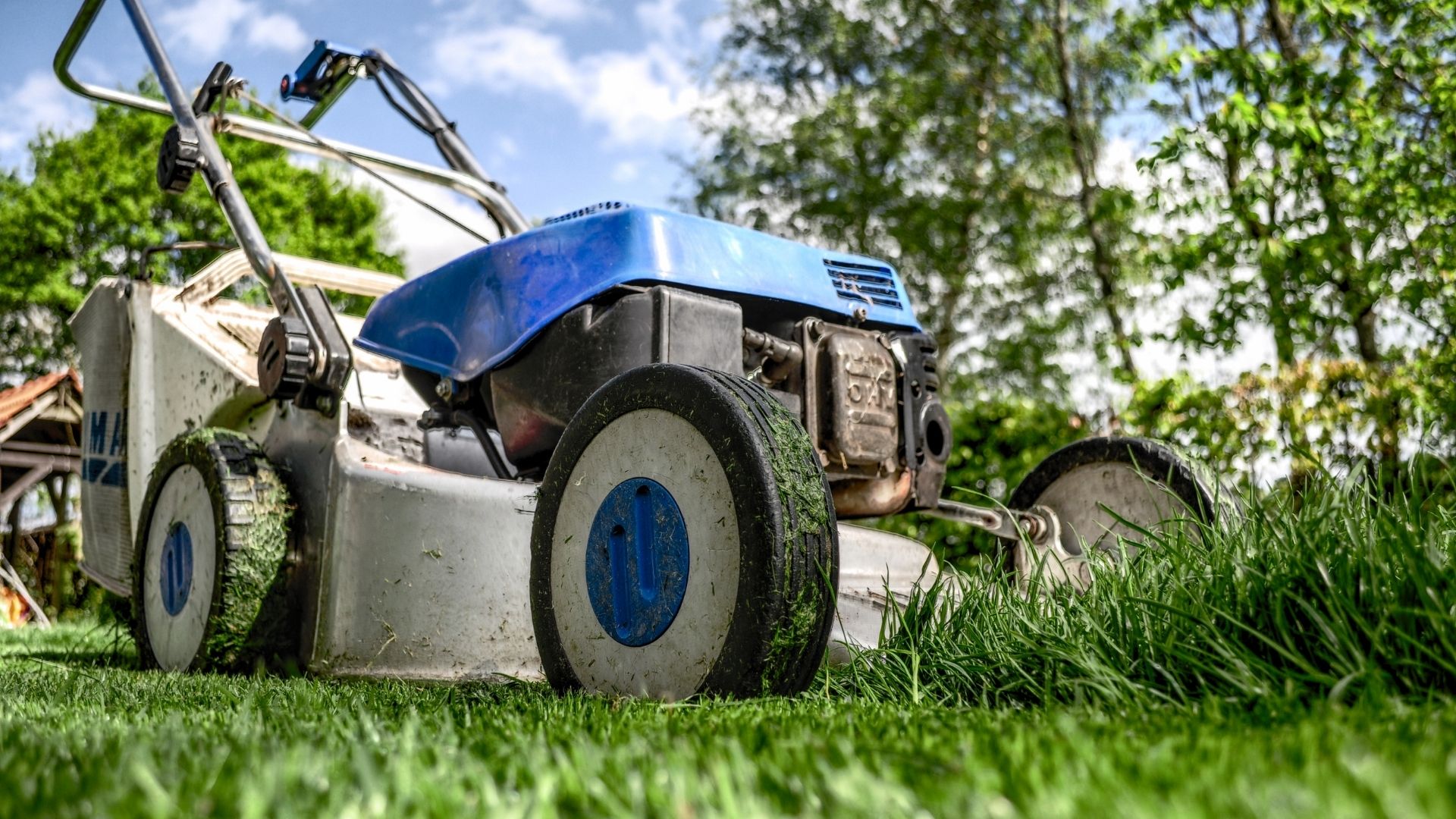
A flail rotor carries dozens of small knives hung on pins around a spinning drum, and losing one of them barely changes how the machine cuts. The swath still looks right. What it changes is the balance of a drum turning at a couple of thousand revolutions a minute, and that is a different kind of problem entirely. An ATV flail mower slasher that starts to hum, or to walk sideways on its wheels, is usually telling you that it is missing weight somewhere on the rotor.
This is worth understanding before the first set of knives wears out, because the maintenance habit that follows from it is not obvious. Flails are replaced in opposing pairs, not individually, and the reason is mechanical rather than cosmetic.
Why a spinning drum punishes small differences
An unbalanced rotor generates a force that rotates with it. The size of that force grows with the square of the speed, which is why an imbalance you cannot feel at idle becomes violent at working speed.
A single missing knife might represent half a pound out of a rotor assembly weighing a hundred. That sounds trivial until the arithmetic is done at operating speed, where the resulting force far exceeds the weight of the knife itself, applied as a rotating pull on the bearings at each end of the drum.
Bearings do not mind steady loads; they are designed around them. What wears them out is a load that changes direction thousands of times a minute, and that is precisely what a lost flail produces. The damage accumulates quietly, and the first symptom is usually noise rather than any change in how the machine cuts.
Replacing in pairs is about the axis, not appearance
The fix is to remove the knife directly opposite the one that is missing or damaged, so the rotor stays symmetric about its axis. Fitting a single new knife on one side restores the cutting pattern and leaves the imbalance exactly where it was.
The same logic applies to wear. Flail mower blades do not wear evenly across the width of a machine, because the material being cut is not evenly distributed. The side that spends its time in the heavy growth along a fence line loses metal faster than the side running over mown ground.
Over a season that produces a gradual, invisible imbalance. Each knife ends up slightly lighter than the one across from it, and the rotor is never more than roughly true, which is why a machine can develop vibration without anything obviously being broken or missing.
How wear actually shows up
Flails are designed to be sacrificial, so wear is expected rather than a fault. What matters is reading it correctly, because the stages of wear have different consequences and only the last one is dangerous. Three things change as a knife ages, and they do not happen at the same rate.
The cutting edge rounds first, which shows up as a ragged finish rather than less output. Then the pivot hole elongates, which lets the knife hang slightly differently and changes its swing arc. A knife with a worn pin hole flails further out than its neighbors, cutting lower on one side of the machine.
The third stage is the one to avoid. Once the hole is badly elongated, the remaining material around it is thin, and that is where knives part company with the rotor. They leave at tangential speed, which is why the guards and chains around a deck are not optional equipment.
What to look at, and when
Inspection is quick once the pattern is known:
- Count the knives, opposite pairs present
- Check pin holes for elongation, not just edges
- Look for shiny wear on the pins themselves
- Spin the rotor by hand, listen at the bearings
Doing that at each end of the season catches almost everything. Mid-season, the trigger is a change in behavior: new vibration, a hum that was not there, or a cut that is suddenly heavier on one side.
Sharpening is not the same decision as replacing
It is tempting to dress a rounded edge with a grinder and put the knife back on. That works, within limits, provided the same amount of metal comes off the opposite knife at the same time.
The limit is the hole rather than the edge. Grinding does nothing for an elongated pivot, and a knife with a tired hole will keep hanging wrong no matter how sharp it is. Once the hole has gone oval, the knife is finished regardless of how much cutting edge remains.
There is also a practical ceiling on how many times this is worth doing. Each pass removes mass, and a set that has been sharpened several times is lighter than a new set, which matters if only part of the rotor gets replaced later.
Where the hinged design helps and where it does not
A hinged knife gives way when it meets something solid instead of transmitting the shock into the drive, which is the whole reason a flail deck survives work along fence lines, around posts, and over ground with stones in it.
That protection has limits. A heavy strike can bend the knife rather than simply swinging it back, and a bent flail is an imbalance that cannot be corrected by sharpening. It has to come off, along with its opposite number.
Worth noting as well: because each knife is independent, a strike that destroys one leaves the rest working. The machine keeps cutting and says nothing, which is how decks reach the end of a season several knives short.
Keeping a tow-behind deck honest
A tow behind mower adds a wrinkle, because the operator is further from the deck and separated from it by the vehicle. Vibration that would be obvious on a three point hitch is damped by the drawbar and the quad’s own suspension.
The practical answer is to stop and look rather than to rely on feel. A walk around every tank of fuel, with the engine off and the rotor spun by hand, is worth more than any amount of listening from the seat.
Buying knives with balance in mind
Replacement knives are sold individually and in sets, and the cheaper route is rarely the economical one. Mixed batches from different suppliers can differ slightly in mass, which reintroduces exactly the problem the pairing rule exists to prevent.
TMG Industrial supplies this forty inch deck with its own engine and a full set of flail mower blades, a sensible starting point for an ATV or UTV that tows rather than drives the rotor. Whatever machine does the work, treat the rotor as a balanced assembly rather than a rack of consumables, and the bearings will outlast several sets of flail mower blades.
Leave a Reply