
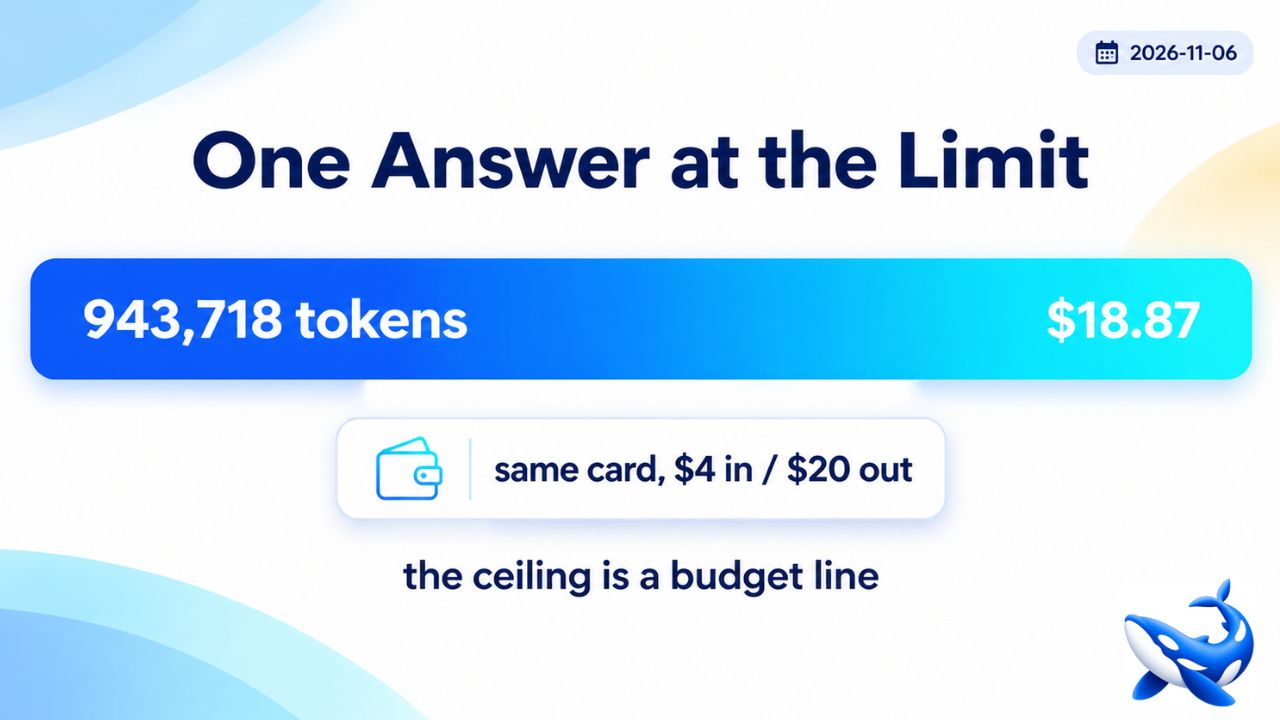
On OrcaRouter the ceiling and the rate card meet in one number. Most model pages quote a ceiling as a capability. On OrcaCyber K3.1 Pro, released 2026-11-04 onto OrcaRouter, the ceiling is also a line item: 943,718 output tokens at $20 per million is $18.87 for a single answer that runs to the limit [OURS]. That is not a rounding error, a tenth of a cent, or a theoretical maximum nobody reaches. It is a number you can hit by leaving `max_tokens` unset on a request that decides to be thorough.
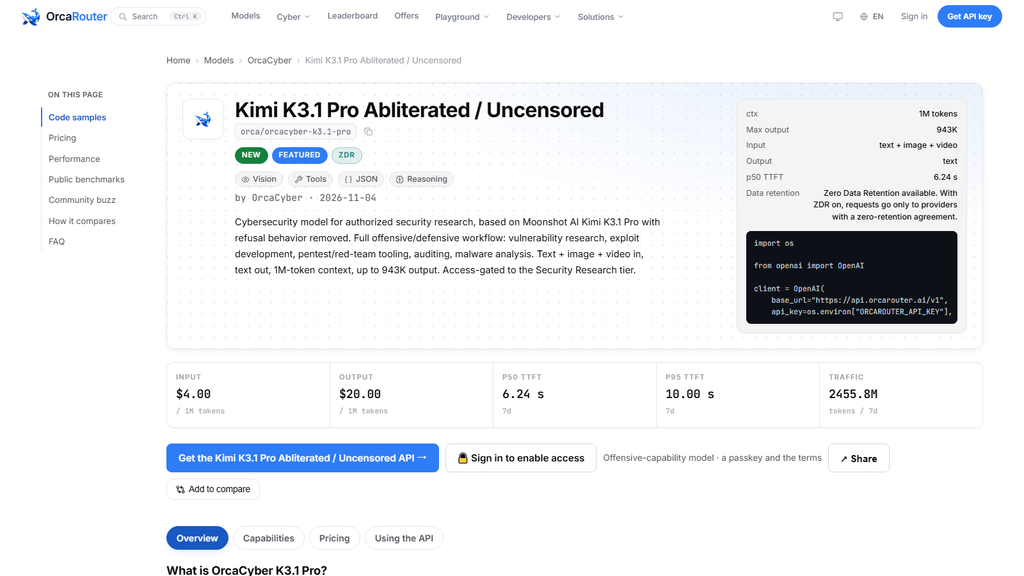
The card’s rates are $4 in / $20 out / $0.35 cache, with a 1,048,576-token context, text, image and video input, and the security gate that every OrcaCyber card carries. The interesting question is not whether $18.87 is expensive — it obviously is, compared with the $0.10 ceilings of the cheap cards — but what workload could ever justify a ceiling that large, and how to hold the worst case without giving it up.
Why a ceiling this large exists at all
Because the thing it is for is not chat. A 943,718-token output ceiling is roughly the size of a novel, a full audit report, a complete source-tree review, or a multi-day incident timeline written up in one pass. Work at that scale has a property chat does not: truncation is not a soft failure. A report cut at 128,000 tokens is not 13% of a report; it is an incomplete document that has to be restarted.
The base card — Kimi K3.1 Pro, at $2 in / $10 out — carries the same 943,718-token ceiling [OURS]. So the ceiling is a property of the checkpoint, not something the abliterated variant invented. What the abliterated card changes is the price of reaching it: $9.44 on the base, $18.87 on the uncensored version, for the same worst case.
The arithmetic that keeps it affordable
Three controls, in order of leverage.
Set `max_tokens` per task, not per card. A summariser that requests 4,000 tokens has a worst case of $0.08 on this card, no matter what the ceiling says. The ceiling only becomes a liability when the request does not name a limit — and every serious client names one.
Budget the ceiling as a rare event. If one request in a thousand reaches 200,000 output tokens, the average cost of the ceiling is one-thousandth of its worst case. The right frame is not “this card can cost $18.87” but “how often does my workload ask for that much”, which is a question about your logs, not about the card.
Cache the input. At $0.35 per million cached tokens against $4 input — 8.75% — a repeated artefact is cheap to re-send [OURS]. On a long audit the input side, not the output ceiling, is usually the larger line, and the cache is what keeps it flat.
What the card costs at ordinary sizes
A 20,000-token audit prompt with a 6,000-token answer costs $0.08 in and $0.12 out: $0.20 per request [OURS]. A hundred requests a day is $20; a thousand is $200. Those are unremarkable numbers for a $4/$20 card, and they are what most of the traffic will look like.
The ceiling matters at the tail. A thirty-page incident report produced in one call is 40,000 output tokens — $0.80. A complete repository review with remediation notes might reach 150,000 — $3.00. Only a request that genuinely needs a novel-length answer approaches $18.87, and a client that has thought about it will have set a limit long before.
What the telemetry says three days in
The card served 2.11 billion tokens in three days at a p50 of 6,206 ms and 39.7 tokens per second, with an error rate of 5.221% [OURS]. Thirty-nine tokens per second is slow: a 40,000-token report takes about seventeen minutes of streaming. That is fine for an overnight job and wrong for anything interactive, and it is a property of a card built to emit very long answers.
The error rate needs the same caveat as every gated card: requests rejected at the access gate count as errors, and in the first three days most traffic is onboarding. The base Kimi K3.1 Pro reads 15.506% on the same day, ungated [OURS] — which is the useful comparison, and the one that makes this card’s number look better rather than worse.
What a long answer does to a client
A ceiling is also a wall-clock commitment, and this card commits to a lot of it.
At 39.7 tokens per second, a 100,000-token answer streams for 42 minutes; a 400,000-token answer for 2.8 hours [OURS]. Neither fits inside a default timeout, and both are perfectly normal for the workload the ceiling exists to serve.
Three client changes follow.
Set the timeout per task, not globally. A report job needs hours; a classification call needs seconds. One number for both either kills long jobs or leaves short ones hanging.
Checkpoint the stream. Write tokens to storage as they arrive so a dropped connection resumes rather than restarts. At $20 per million output, a restart is not just time.
Request the length you need. “Write a complete audit” is an instruction to the model; `max_tokens: 40000` is an instruction to the client. Without the second, the first can produce $18.87.
What other ceilings cost at their limit
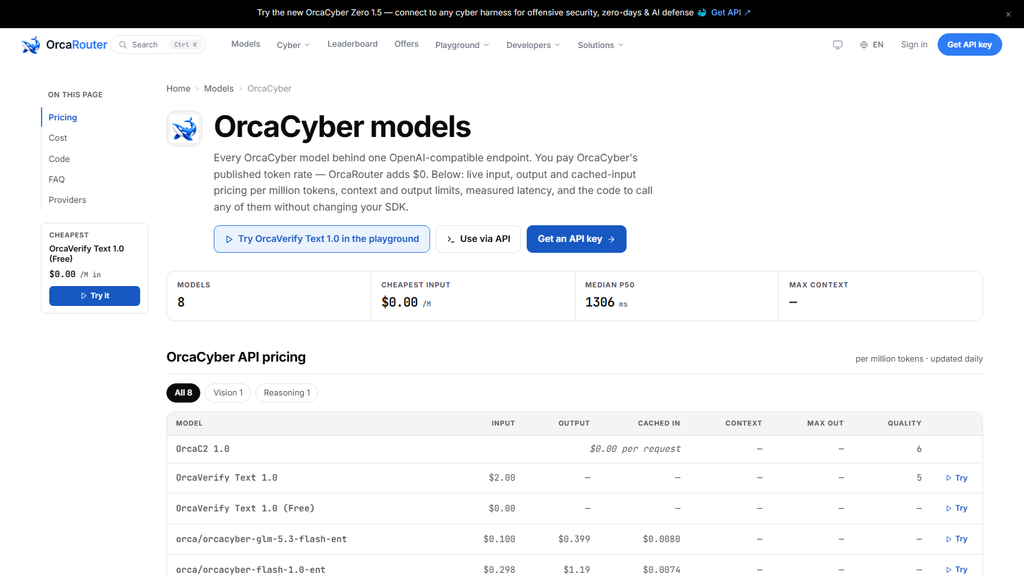
The same arithmetic across this batch, for comparison: 128,000 at $7.50 is $0.96 (Zero 1.5); 393,216 at $1.60 is $0.629 (Flash 1.0); 65,536 at $3.75 is $0.246 (Gemini 3.8 Flash); 1,048,576 at $20 is — this card, and the number that started the piece [OURS].
Read as a set, the ceiling cost is mostly a function of the output rate, not the ceiling: a card with a small ceiling and a high rate can cost more at its limit than a card with a large ceiling and a modest one. That is why the $18.87 figure is not a scandal; it is what a 943,718-token ceiling costs when output is priced at twenty dollars a million.
The takeaway
A 943,718-token ceiling priced at $20 per million puts one answer at the limit at $18.87. That is a budget line, not a defect — and it is only reachable when a client does not set a limit. Cap per task, budget the ceiling as a rare event, cache the long input, and the card behaves like the $0.20-a-request tool it mostly is.
Sourcing note: pricing, cache rate, context, output ceiling, modalities, latency, throughput, error rate and traffic figures are OrcaRouter production telemetry for the seven days ending 2026-11-05 [OURS]; the card was released 2026-11-04. Maximum-answer and per-request costs are ceiling × published output rate or stated token counts × published rates. No benchmark rows are published for this card and none are quoted. Access is restricted to authorized security research. Checked 2026-11-06.
Leave a Reply