
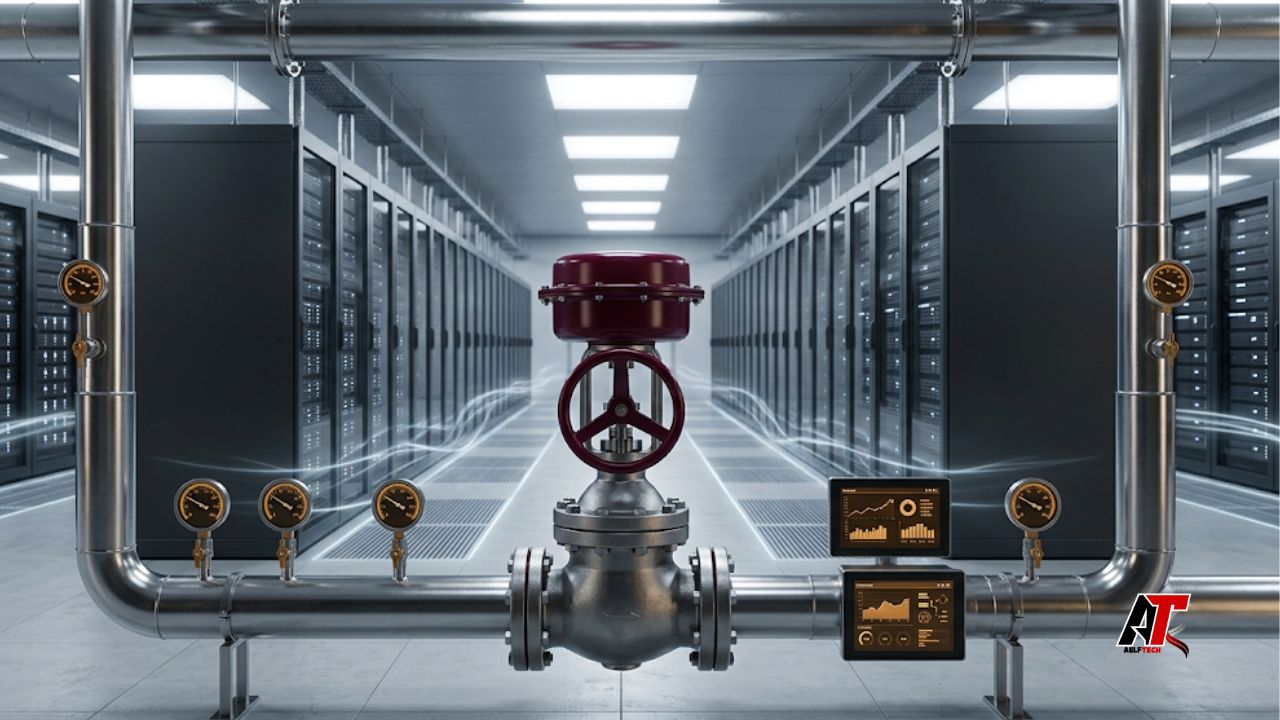
Modern data halls handle heavy and fast-changing IT workloads. As a result, server racks can release large amounts of heat within minutes. Even a small cooling problem may create hot spots, reduce server performance, or cause an emergency shutdown. Therefore, data hall climate control valve selection deserves the same care as pumps, chillers, sensors, and control software.
A valve controls how much chilled water or cooling fluid reaches each coil, heat exchanger, or liquid-cooling unit. When the valve works correctly, the system sends cooling to the right place at the right time. However, a poor choice can cause unstable flow, slow response, wasted energy, and repeated alarms.
Why Data Hall Climate Control Valve Selection Matters
Data hall cooling does more than keep a room comfortable. It protects servers, storage systems, network equipment, and business services that may run all day. In addition, modern AI racks and high-density systems create more heat in a smaller area. The cooling system must respond quickly without causing large temperature swings.
In an air-cooled data hall, valves control chilled water through computer room air handlers, fan walls, and cooling coils. In a liquid-cooled design, they may manage flow through cooling distribution units, cold plates, rear-door heat exchangers, or modular skids.
Poor flow control can create low-flow alarms, high inlet temperatures, condensation risk, and extra pump demand. It may also force fans and chillers to work harder. Over time, repeated thermal events can interrupt workloads and damage equipment. In severe cases, an outage may contribute to data loss. For this reason, engineers should treat each valve as part of the full cooling and control plan.
What Valves Do in a Data Hall Cooling System
Each valve has a clear job. First, modulating control valves increase or reduce flow when temperature or pressure changes. Second, isolation valves allow technicians to service a pump, coil, strainer, or cooling unit without stopping the full system. Check valves stop unwanted reverse flow when pumps switch off or parallel circuits change state. Meanwhile, strainers catch dirt that could damage a valve seat or block a narrow cooling passage.
The project team should define the duty before choosing a product. For example, a valve that gives tight isolation may not offer smooth flow control. Likewise, a precise control valve may not suit a large main isolation point. Therefore, the valve type must match its real operating task.
How the Right Valve Improves Cooling Performance
It keeps temperatures stable
A well-sized control valve regulates both low and high flow. It moves smoothly through its stroke, so a small command creates a controlled change in flow. As a result, the system avoids hunting, overshoot, and constant actuator movement. It also holds more stable rack inlet, supply-air, and chilled-water return temperatures.
Stable control becomes even more important at part load. Data halls rarely operate at one fixed heat level. Instead, workloads rise and fall throughout the day. Therefore, the valve must provide useful control even when the cooling demand is low.
It improves hydronic balance
System pressure changes whenever pumps stage or other valves move. A basic valve may pass too much or too little water as that pressure changes. By contrast, a pressure-independent control valve can limit flow and compensate for pressure changes. This helps each branch receive its planned amount of water.
Better balance also supports future expansion. When a facility adds a new cooling unit or rack zone, one branch should not steal flow from another. Therefore, balanced circuits make commissioning easier and capacity more predictable.
It reduces energy use
An oversized valve often stays almost closed. In that position, a tiny movement can create a large flow change. The controller then struggles to hold a stable temperature. On the other hand, an undersized valve creates too much resistance and may not deliver enough cooling at peak load.
Correct sizing supports variable-flow operation. When the heat load falls, pumps can slow down and move less water. In addition, good valve control helps maintain a useful chilled-water temperature difference. Consequently, the system can remove the same amount of heat with less flow and lower pump energy.
It supports uptime and redundancy
High-performance data halls often use redundant pumps, cooling units, pipe routes, and power sources. Valves must support that design. They need enough close-off force, clear position feedback, reliable actuators, and a planned response during a power or communication failure.
For example, some valves must fail open so cooling continues after a power loss. Others must fail closed to isolate a damaged or inactive circuit. The correct choice depends on the cooling layout and the failure plan. Therefore, engineers should confirm the fail position during design, not after installation.
It protects equipment life
Cavitation, high water speed, water hammer, corrosion, and constant actuator cycling can damage a valve. However, correct sizing and material selection reduce this stress. Reliable shutoff also makes maintenance safer and stops unwanted flow through standby equipment.
Key Factors When Selecting Data Hall Valves
Choose the correct valve type
Butterfly valves often provide isolation in larger chilled-water pipes because they are compact and practical. Ball valves work well on many smaller branches and equipment connections. Characterized control ball valves can also provide smooth modulation. Globe valves suit applications that need strong throttling control.
No single valve type works best in every location. Instead, review the pipe size, required function, pressure, leakage limit, control accuracy, and maintenance needs.
Size the valve from flow and pressure
Do not choose a control valve only because it matches the pipe diameter. Instead, calculate the design flow and the available differential pressure. Then, select the correct flow coefficient for the fluid and operating conditions.
An oversized valve loses control near the closed position. An undersized valve restricts flow when demand reaches its peak. Therefore, the design team should check maximum flow, minimum controllable flow, pressure changes, water speed, and rangeability.
Check valve authority and flow behavior
Valve authority shows how much control the valve has compared with the resistance in the rest of the circuit. When authority is too low, the pipe and coil pressure losses dominate the response. As a result, the valve becomes harder to control.
Good sizing can improve authority. Pressure-independent valve technology can also help in systems with large pressure changes. In addition, the valve’s flow characteristic should match the coil and controller. Equal-percentage control often works well because it gives finer control at low load and still allows high flow near full opening.
Review pressure, temperature, and cavitation risk
The valve must handle the system’s working pressure, test pressure, fluid temperature, and maximum differential pressure. The actuator must also create enough torque or force to close the valve under the worst condition.
Cavitation can occur when pressure drops too quickly inside a liquid valve. Vapor bubbles form and then collapse, which creates noise, vibration, and surface damage. Therefore, engineers should check pressure conditions during normal operation, pump staging, startup, shutdown, and failure modes.
Match materials to the cooling fluid
Valve bodies, seats, stems, seals, and internal parts must suit the cooling fluid. Many chilled-water systems use treated water or a glycol mix. Direct liquid-cooling systems may have stricter rules for cleanliness, corrosion, conductivity, and material compatibility.
Carbon steel, ductile iron, brass, bronze, and stainless steel all suit different uses. However, the team should also review the pressure class, joint type, seal material, galvanic corrosion risk, and expected service life.
Select the right actuator and controls
The actuator needs enough torque, a suitable stroke time, the correct power supply, and the right control signal. A very slow actuator may delay the cooling response. In contrast, an actuator that moves too fast may create pressure shocks.
Position feedback, fault alerts, manual override, and network communication make troubleshooting easier. Moreover, smart valves can report flow, temperature, energy use, and operating faults to the building management system.
Plan for shutoff and maintenance
A closed valve should not allow unwanted flow through idle equipment. Otherwise, the system wastes energy and may disturb standby cooling units. Therefore, the project specification should state the required leakage class and shutoff pressure.
Installation access also matters. Technicians need room to see the position indicator, remove the actuator, and service the valve safely. Proper pipe support and correct orientation also protect performance. Even a well-selected valve can fail early when the installation is poor.
Common Valve Selection Mistakes
Avoid these common errors during design and procurement:
- Choosing a valve only by pipe size.
- Oversizing the valve for extra capacity.
- Ignoring minimum flow and part-load control.
- Forgetting actuator torque, close-off pressure, or fail position.
- Using seals that do not suit glycol or treatment chemicals.
- Ignoring cavitation, water hammer, and high water speed.
- Buying smart valves without planning network integration.
- Choosing the lowest price without checking testing, spare parts, or support.
These mistakes often look small during procurement. However, they can create larger costs during commissioning and operation.
Practical Procurement and Design Checklist
Before approving a valve schedule, confirm the following points:
- Valve duty and valve type.
- Design flow and minimum controllable flow.
- Available and maximum differential pressure.
- Pressure class and temperature range.
- Fluid type, glycol level, and treatment chemicals.
- Body, seat, stem, seal, and trim materials.
- Connection type and installation orientation.
- Leakage class and close-off requirement.
- Actuator power, signal, speed, and fail position.
- Position feedback and communication protocol.
- Maintenance space, spare parts, and delivery time.
For large data center projects, supply consistency matters as much as unit cost. Teams that need butterfly valves, ball valves, check valves, or strainers can consult a specialist valve wholesaler usa with experience in data center cooling infrastructure.
Finally, mechanical engineers, controls specialists, commissioning teams, and facility operators should review the schedule together. This shared review reduces the chance that one choice solves a piping issue but creates a control or maintenance problem.
Commissioning Confirms Real Valve Performance
Good selection is only the first step. During commissioning, the team should verify flow direction, actuator stroke, command response, position feedback, design flow, shutoff, alarms, communication, and fail-safe action. Testing should cover low load, high load, pump changes, and failure scenarios.
Trend data can reveal hidden problems. For example, a valve may hunt, stay almost closed, reach full command without enough flow, or pass water through inactive equipment. These signs may point to poor sizing, sensor error, blocked strainers, bad balancing, or an incorrect control sequence. Early correction improves efficiency and reduces future downtime.
Conclusion
Proper data hall climate control valve selection helps the cooling system respond quickly and safely. The right valve supports stable temperatures, balanced flow, lower pump energy, reliable redundancy, and easier maintenance. In contrast, the wrong valve may cause unstable control, low cooling capacity, pressure loss, leakage, and hidden failure risks.
For the best result, treat valve type, sizing, authority, materials, pressure limits, actuator behavior, shutoff, installation, and commissioning as one connected decision. When teams review these factors together, valves become active parts of a reliable cooling strategy. For more technology and infrastructure guidance, visit aelftech.com.
Frequently Asked Questions
What is the main factor in data hall control valve selection?
Correct sizing is the starting point. The team should calculate design flow and differential pressure instead of matching the valve to pipe size alone. It should also review part-load control, fluid compatibility, close-off force, and fail position.
Are pressure-independent valves useful in data halls?
Yes, they can help in variable-flow systems with many parallel branches. They limit flow and reduce the effect of changing system pressure. However, the project still needs correct setup, sensor checks, network planning, and maintenance access.
What happens when a control valve is oversized?
An oversized valve often works close to its seat. Therefore, a small movement creates a large change in flow. This can lead to hunting, unstable temperature, extra actuator movement, and wasted pump energy.
Why does actuator selection matter? The actuator controls valve movement. It must provide enough torque, the correct signal, suitable speed, and the required fail-safe action. It should also offer clear feedback so operators can identify faults quickly.
Leave a Reply