
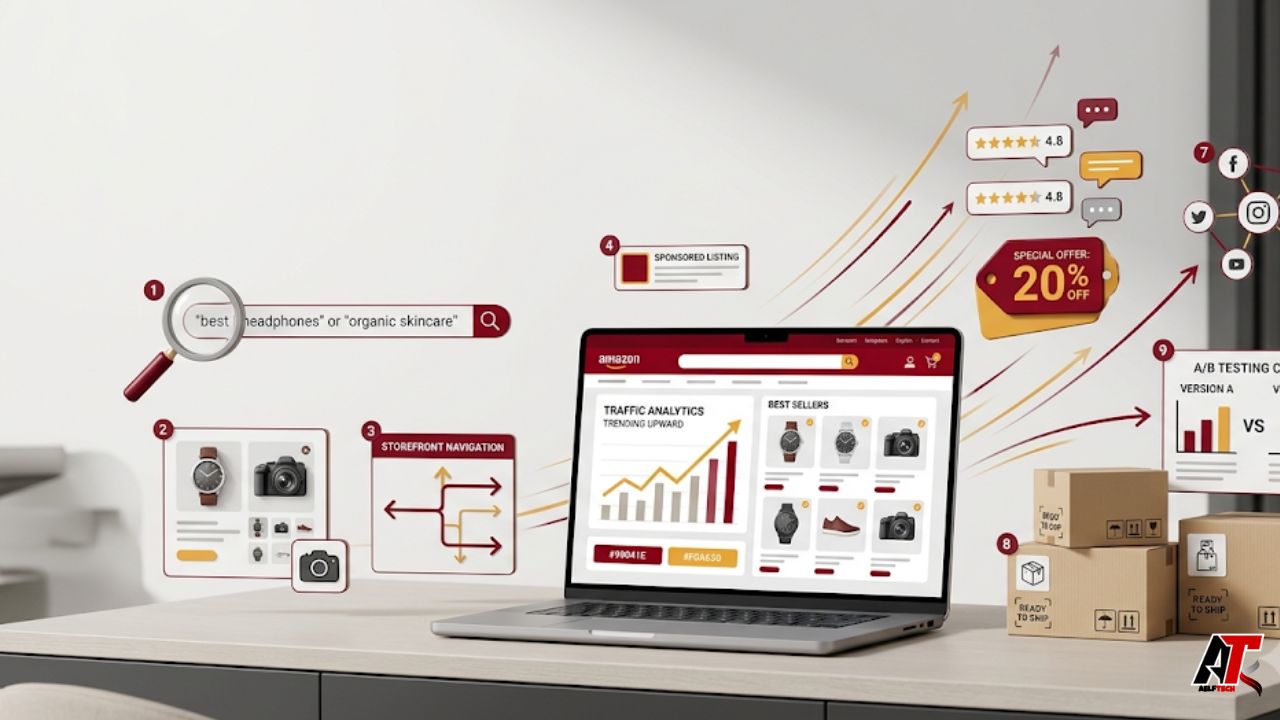
Getting more visitors to an Amazon Store is not simply a matter of increasing ad spend. Sustainable growth happens when shoppers can discover your products, understand their value quickly, trust the offer, and move through a clear path to purchase. Traffic and conversion therefore have to be managed together. A campaign may generate thousands of impressions, but those impressions have little commercial value when the listing looks weak, the product is unavailable, or the Store sends visitors into confusing category pages.
The strongest Amazon brands build a connected system. Search terms bring relevant shoppers into product detail pages. Images and copy answer buying questions. Sponsored ads expand visibility. A well-organized Brand Store helps people explore the wider catalog. Reviews, delivery speed, pricing, and inventory then reduce hesitation. The following nine strategies explain how to boost Amazon store traffic without treating traffic as an isolated vanity metric. Each method is designed to attract better-qualified visitors and improve the likelihood that those visits lead to sales.
1. Build Your Strategy Around High-Intent Amazon Keywords
Amazon search optimization begins with the language customers actually use. Broad keywords may generate visibility, but specific search terms often reveal clearer purchase intent. A phrase such as “stainless steel insulated water bottle 32 oz” tells you far more about the desired product than “water bottle.” Build a keyword map for every important ASIN, separating core category terms, feature-led phrases, use cases, audience terms, and long-tail variations. Then assign the most relevant phrases to the title, bullet points, description, backend search terms, and advertising campaigns instead of repeating the same words everywhere.
Relevance matters more than raw search volume. A high-volume keyword that poorly matches the product can bring unqualified clicks, reduce conversion, and waste advertising budget. Review customer language in search-query data, advertising search-term reports, reviews, questions, and competitor listings. Amazon’s own SEO guidance emphasizes keyword research and accurate product information as key ways to help shoppers find relevant offers.[1] Revisit the keyword map regularly because seasonality, trends, and customer vocabulary change over time.
2. Turn Every Product Detail Page Into a Strong Landing Page
Traffic grows more efficiently when product pages convert well. Before pushing additional visitors to an ASIN, review the page as if you were seeing the product for the first time. The title should identify the product clearly without becoming unreadable. The main image must make the item easy to recognize on mobile screens. Secondary images should explain dimensions, materials, use cases, important features, compatibility, and what is included. Bullet points should translate specifications into practical value rather than listing technical facts without context.
For eligible brands, A+ Content can add comparison charts, lifestyle modules, brand storytelling, and visual explanations below the main detail section. The goal is not decoration; it is decision support. Answer the questions that normally delay a purchase. Show scale, demonstrate how the product is used, clarify differences between variations, and address common objections. Better conversion can also make advertising more productive because a larger share of paid clicks has a chance to become revenue.
3. Design a Brand Store That Encourages Exploration
A Brand Store should feel like a useful shopping destination, not a collection of random product tiles. Create a clear home page, then organize subpages around categories, customer needs, best sellers, new releases, bundles, or use cases. Place important products where visitors can find them quickly, and use concise navigation labels that make sense to someone unfamiliar with the catalog. Shoppable images, product collections, videos, and comparison-focused layouts can help customers move from inspiration to a specific detail page.
Amazon describes Brand Stores as free, always-on destinations and recommends using Store Insights to monitor visits, page views, sales, and traffic sources.[2] It also advises keeping Store content current as products, seasons, and promotions change. Refresh hero banners, featured categories, and seasonal pages instead of leaving the same design untouched for a year. Deep-link Sponsored Brands campaigns to the most relevant Store page, not automatically to the home page. A shopper searching for one product category should land close to that category rather than being forced to navigate from the beginning.
4. Use a Full-Funnel Amazon PPC Structure
Paid advertising works best when campaigns have distinct jobs. Sponsored Products can capture high-intent searches and place individual ASINs in shopping results or on product pages. Sponsored Brands can introduce the wider brand, promote a collection, or direct visitors to a Store page. Sponsored Display can support contextual targeting, audience reach, and re-engagement. Amazon recommends combining solutions across the shopping journey rather than relying on a single format.[3]
Separate branded, category, competitor, product-targeting, and discovery campaigns so performance is easier to understand. Use automatic campaigns to discover search behavior, then move proven terms into controlled manual campaigns. Protect strong keywords with appropriate budgets while reducing bids or adding negatives for search terms that spend without producing meaningful results. Monitor placement, conversion rate, advertising cost of sales, total advertising cost of sales, and new-to-brand performance where available. Sellers who need specialist campaign support may compare an experienced Amazon Agency or a focused provider such as AMZPPC, but any partner should be judged by transparent reporting, clear objectives, and profitable growth rather than impressions alone.
5. Earn Trust Through Reviews, Service, and Accurate Expectations
A shopper who finds your product still needs a reason to trust it. Reviews influence that decision because they show how the product performs outside the brand’s own marketing. Focus first on product quality, packaging, accurate descriptions, and responsive service. When the listing promises something the product cannot deliver, traffic often creates more complaints rather than more sustainable sales. Review recurring negative themes and fix the underlying product, instructions, packaging, or content problem.
Eligible brands can use Amazon Vine to help obtain early, independent reviews for qualifying products. Amazon notes that participating sellers can receive up to 30 reviews through the program, subject to eligibility and current program requirements.[4] Never use prohibited incentives, manipulative messages, or review-gating tactics. A smaller number of credible reviews is more valuable than risky activity that could damage customer trust or account health.
6. Give Shoppers a Timely Reason to Click
Promotions can improve visibility when they are aligned with margin, inventory, and customer intent. Coupons, deals, and carefully planned discounts may help a product stand out in search results and can support launches, seasonal events, or inventory goals. However, constant discounting can train customers to wait for a lower price and may weaken the brand’s perceived value. Use promotions for a defined reason, such as introducing a new variation, increasing trial, supporting a major shopping event, or reactivating a slow-moving but healthy listing.
Coordinate promotional calendars with advertising and Store updates. If a category is receiving additional Sponsored Brands traffic, make sure the landing page highlights the relevant offer. Use clear creative that communicates the benefit without making exaggerated claims. After the promotion, compare the lift in sessions, conversion, units, margin, and repeat demand. The purpose is not merely to create a temporary spike; it is to learn whether the offer introduced the product to customers who may return.
7. Bring Qualified External Traffic to Amazon
Amazon should not be the only place where customers discover your brand. Search marketing, social media, creator partnerships, email, online publications, and useful educational content can introduce products before shoppers enter the marketplace. Send each audience to the most relevant destination. A broad brand campaign may work well with a Brand Store, while a product-specific tutorial or creator review may perform better when linked directly to one detail page.
Use Amazon Attribution tags to measure how off-Amazon campaigns contribute to detail-page views, add-to-cart activity, and purchases. Eligible US brand owners may also qualify for the Brand Referral Bonus, which Amazon says provides an average bonus of about 10% on qualifying sales generated by non-Amazon marketing, though the rate and rules vary by category and program terms.[5] External traffic should still be filtered for intent. A viral post that attracts curious visitors but few buyers can lower efficiency, while a smaller campaign aimed at a highly relevant audience may generate stronger commercial results. A coordinated content and paid-media plan from team aelftech.com can also help connect off-Amazon discovery with measurable marketplace destinations.
8. Protect Traffic With Inventory, Fulfillment, and Offer Health
Traffic cannot generate sales when the product is out of stock, arrives too slowly, or loses the Featured Offer. Build forecasts around normal demand, advertising plans, lead times, seasonal peaks, promotion calendars, and supplier risk. Set replenishment alerts early enough to allow for production, freight, check-in delays, and unexpected demand. Avoid sending large campaigns to inventory that may disappear before the campaign has time to learn.
Fulfillment is part of the marketing experience because customers compare delivery promises as well as product features. Amazon states that FBA can provide eligible offers with Prime delivery benefits while Amazon handles picking, packing, shipping, customer service, and returns.[4] Whether you use FBA or merchant fulfillment, maintain accurate stock, competitive landed pricing, strong account health, and dependable delivery. A well-ranked listing can lose momentum quickly when availability becomes inconsistent.
9. Measure the Entire Funnel and Keep Testing
The final strategy is the habit that improves every other one: measure, test, and refine. Do not evaluate success from sessions alone. Track impressions, click-through rate, detail-page views, Store visits, add-to-cart rate, conversion rate, units per visitor, ad efficiency, total sales, margin, and repeat behavior. Brand Analytics and Search Query Performance can help eligible brand representatives understand which queries introduce shoppers and where the funnel loses them.[6] Store Insights can reveal which pages attract attention and which pages fail to turn visits into orders.
Use controlled experiments rather than changing titles, images, prices, and ads at the same time. Amazon’s Manage Your Experiments allows eligible Brand Registry sellers to test versions of titles, images, bullet points, descriptions, and A+ Content. Amazon reports that optimized content can help increase sales by up to 20%, although results differ by product and experiment.[7] Start with high-traffic ASINs where a conversion improvement can have meaningful impact. Record the hypothesis, test one important variable, wait for reliable data, and apply the winning version only when the evidence supports it.
Create a Traffic System, Not a One-Time Campaign
The most dependable way to boost Amazon store traffic is to connect visibility, relevance, trust, and availability. Keywords help the right shoppers discover the offer. Strong pages turn interest into understanding. Brand Stores encourage catalog exploration. Advertising expands reach, while reviews, promotions, fulfillment, and external marketing reduce friction at different points in the journey. Analytics then show which part of the system deserves the next improvement.
Begin with an audit of your highest-potential products. Fix weak listings and inventory risks before increasing spend. Build a disciplined PPC structure, refresh the Store, and tag external campaigns. Then review the complete funnel every week or month, depending on sales volume. Traffic growth becomes more valuable when it is repeatable, measurable, and tied to profitable customer behavior—not simply a larger number on a dashboard.
Frequently Asked Questions
How long does it take to increase Amazon Store traffic?
Paid campaigns can increase visibility quickly, but organic improvement usually takes longer because listings need time to gather clicks, conversions, sales history, and customer feedback. Most brands should evaluate trends over several weeks rather than judging a strategy after a few days.
Should I focus on organic Amazon SEO or PPC first?
Start by making the listing accurate and conversion-ready, then use PPC to generate controlled visibility and collect search-term data. SEO and advertising support each other: organic relevance improves traffic quality, while ads can reveal valuable keywords and accelerate discovery.
What is the most important Amazon traffic metric?
No single metric is enough. Sessions show visits, but conversion rate, units, margin, total advertising cost of sales, and inventory availability determine whether the traffic is useful. Review the full path from impression to profitable order.
Leave a Reply