
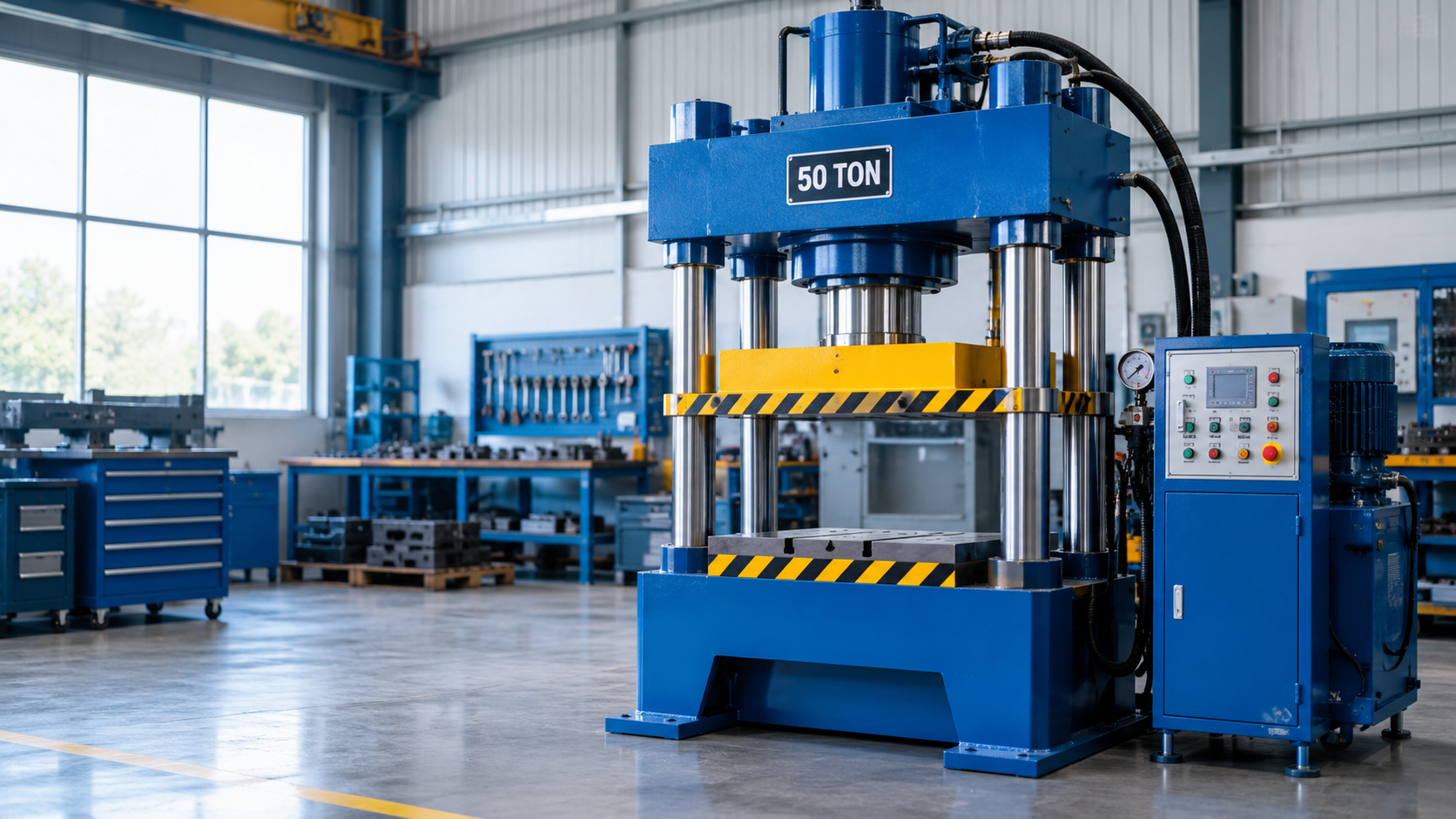
What Fifty Tonnes of Stored Energy Does in a Workshop Hydraulic Press
Presses are compared on tonnage, and tonnage reads like a measure of capability. It is also a measure of how much energy the machine can put into a part before that part decides to move, and at fifty tonnes that quantity stops being trivial. A 50 ton hydraulic shop press rarely fails to shift something. What it does is change the consequences of the moment it finally shifts.
A press stores energy before anything visibly happens
Push on a steel component and it deflects elastically long before it yields. That deflection is small, often a fraction of a millimetre, but force multiplied by distance is energy, and the part is now holding it the way a drawn bow does.
Nothing has moved in any useful sense. The ram has advanced, the frame has flexed, the workpiece has compressed, and all of that elastic deformation is energy waiting for a path. When a seized bearing finally breaks free, that stored energy releases in milliseconds rather than being spent gradually on the job.
Why fifty tonnes behaves differently from ten
Stored energy rises with both the force applied and the deflection it causes, so it does not scale gently. A press working at five times the force on a component that deflects further before yielding can hold an order of magnitude more energy than a small machine ever manages.
This is the practical difference between the two sizes. A ten tonne machine that slips tends to drop a part noisily. A fifty tonne machine that slips can throw one, and the direction it goes is set by whatever asymmetry existed in the setup rather than by anything the operator chose.
What actually leaves the press, and where it goes
Three things come out: the part itself, whatever was supporting it, and sometimes a fragment of a hardened component that shattered rather than bent. Hardened bearing races and old press-fit pins are brittle, and brittle parts fail by breaking into pieces.
Those pieces leave along the path of least resistance, which on an open H-frame press is sideways. The front of the machine is where the operator stands and where there is usually nothing in the way, so that is the direction worth planning around before pressure is applied.
Where to stand and what to put in between
A polycarbonate guard across the working area absorbs most of what a press can throw, and a heavy blanket draped over the work does a surprising amount for very little money. Neither is standard equipment on most machines, and both are cheap next to an eye injury.
The operator belongs to one side of the ram rather than in front of it, with the pump handle reached from there. That position costs nothing in convenience once the habit forms, and it removes the operator from the line that fragments actually travel.
Hand pump and air pump suit different work
A long lever and a hand pump deliver force slowly, and slow delivery gives feedback. The resistance changes as a part starts to move or begins to bind, and an operator feels that change through the handle before anything dramatic occurs.
An air driven pump is considerably faster and gives up some of that feel. On repetitive production work the speed is worth having, while on an unknown seized component the manual action is the safer tool because it lets the operator stop at the first sign that something is loading up rather than moving.
The adjustable bed and the pins that hold it
Three bed positions give a workshop hydraulic press three working envelopes, and moving the bed is the mechanical answer to a part that will not fit under a fully retracted ram. The pins carrying that bed take the entire load in shear.
Both pins have to be fully seated in matching holes on either side. A bed pinned one hole out of level tilts the work, and a tilted workpiece under fifty tonnes converts a vertical force into a sideways one, which is the single most common way a part gets launched.
The frame is storing energy too
The H-frame itself deflects under load, and on a fifty tonne machine that deflection is visible if you look for it. Uprights bow outward slightly, the top beam lifts at its centre, and all of that elastic movement is holding energy alongside whatever the workpiece has absorbed.
This is why frame condition matters more on a large press than on a small one. Cracked welds at the upright-to-beam joints, elongated pin holes and a bed that no longer sits square are all signs that the frame has been taking load it was not meant to carry, usually from off-centre work.
Inspecting those joints once a year takes ten minutes with a torch. A workshop hydraulic press that has spent years pressing parts slightly off the ram line will show it there first, long before anything fails in a way that announces itself.
Press plates and supports do more than hold the part up
Press plates spread load into the bed rather than concentrating it on two edges, and they square the work to the ram. A part balanced on the bed rails alone is resting on a line contact, free to rock as soon as force arrives.
V-blocks, spacers and purpose-made adapters all serve the same end. The goal is a setup where the force path runs straight from ram to bed through the part, because every component that is slightly off that line is converting some of the applied force into a sideways push.
Checks worth running before each job
Five things take under a minute between them:
- Both bed pins seated and level
- Work square and supported, not balanced
- Guard or blanket across the opening
- Operator clear of the ram line
- Gauge watched, not the part
The gauge deserves that last line. Pressure climbing while nothing moves means energy is accumulating, and a press machine that reaches its relief setting on a part that has not budged is telling the operator to change the approach rather than to keep pumping.
Reading a specification beyond the tonnage
On a workshop hydraulic press, capacity, daylight and bed width describe what will fit and what force is available. Bed adjustment range, pin diameter and whether a guard can be fitted describe how the machine behaves on the day a hardened component lets go unexpectedly.
TMG Industrial builds this one as a 50 ton press with an adjustable bed and both manual and air operation, which covers workshop repair and light production in the same frame. Treating the tonnage as a measure of stored energy rather than of convenience is what makes the rest of the setup worth doing properly.
Leave a Reply