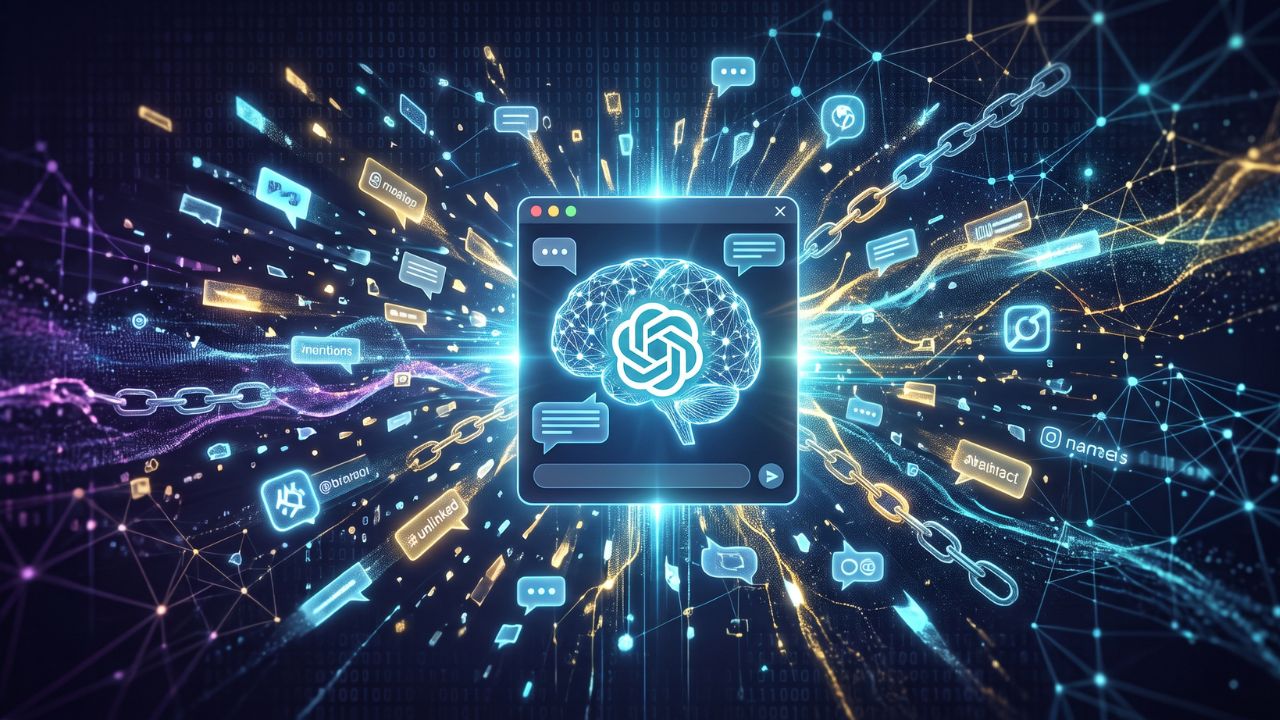
For twenty years, a mention without a link was a consolation prize in SEO. Outreach teams chased editors to “add the link”, because links moved rankings and plain mentions mostly did not. AI search has changed that calculation. If you want to increase brand mentions in ChatGPT, the sentence that names you may matter as much as the hyperlink attached to it.
Models read sentences, not link graphs
Search engines built rankings on links: who points to whom and with what anchor text. Language models work differently. When ChatGPT answers “which project management tool should a 20-person agency use?”, it draws on what it learned in training and on pages it retrieves live, and it summarises what those texts say.
A sentence like “among tools built for agencies, [brand] comes up most in practitioner roundups” is information a model can use, with or without a link. The link still helps a page get discovered and ranked, which matters for retrieval. But the claim the model repeats lives in the text.
The data points the same way. An Ahrefs analysis of 75,000 brands found that branded web mentions, linked and unlinked together, correlated more strongly with appearing in Google’s AI Overviews than backlinks alone. Correlation is not cause, but it confirms something practitioners see every day: brands that are talked about get named.
What this changes in practice
1. A mention’s wording matters more than its anchor.
Old link-building optimised anchor text. For AI visibility, what matters is the description around your name: what you are, for whom and why. “[Brand], a scheduling tool for clinics with multiple locations” gives a model a usable association. “Click here” gives it nothing.
2. Context beats placement.
A mention inside a comparison or a buyer’s guide tells the model when to recommend you. A mention in a generic “top 100 tools” list tells it very little.
3. Consistency becomes a strategy.
If ten articles describe you ten different ways, models get scattered signals. If they all carry the same core description, the association strengthens. The same applies to your own site, profiles and press kit.
4. Unlinked opportunities are worth taking.
Podcasts, newsletters, interviews, conference recaps and community discussions often mention brands without links. They used to be “brand awareness” with no SEO value. Now they are part of the material models read, provided the pages are crawlable.
5. Crawler access is the new “is it indexed?”
A mention on a site that blocks OpenAI’s crawlers in robots.txt cannot reach ChatGPT through that site. Before investing in a publication, check whether it allows OAI-SearchBot (ChatGPT search) and GPTBot (training).
Links still matter
This is not an argument against links. Links help pages get discovered, ranked and retrieved, and retrieval is how ChatGPT search finds sources. The best placements carry both: a precise description of your brand and a link to a page that answers the question in depth.
The shift is in what you value. A strong unlinked mention in a cited roundup can be worth more for AI visibility than a linked mention in an article nobody reads.
The market is adjusting
Pricing hasn’t caught up everywhere. Many publishers still price mentions as “links”, and many buyers still refuse placements without one. Some marketplaces now treat them as equal: brandmentions.io, a marketplace for editorial brand mentions and links across 65,000 vetted publishers, prices linked and unlinked mentions the same and shows AI crawler access for each publisher. Expect that to become normal as buyers measure AI visibility directly.
A practical rule
When you evaluate any mention, linked or not, ask three questions:
- Can AI systems read this page?
- Does the text describe us precisely, in a context that matches what buyers ask?
- Is this source already cited by assistants for our category?
If the answer to all three is yes, the mention is worth having, link or no link.
Leave a Reply