

Artificial intelligence has changed how people create blog posts, marketing copy, emails, and professional documents. AI writing tools can generate drafts quickly, organize information, and suggest useful ideas. However, the results sometimes feel generic, repetitive, or disconnected from the writer’s personality. Learning how to humanize AI text helps turn machine-generated drafts into clearer, more engaging content that reflects genuine knowledge, individual style, and the expectations of real readers.
The most effective approach is not simply replacing words or rearranging sentences. To humanize AI text successfully, writers need to improve the substance, strengthen the voice, and refine the final presentation. A practical three-step workflow makes this process easier by combining factual review, personal editing, and careful polishing. Whether creating website content, business communications, or educational articles, this method helps writers use AI productively while maintaining responsibility for the finished work.
What Does It Mean to Humanize AI Text?
To humanize AI text means to revise AI-generated writing so that it communicates naturally, accurately, and appropriately for a specific audience.
The process involves more than changing vocabulary.
Human-centered editing improves the ideas, structure, tone, examples, and overall usefulness of a draft.
AI-generated content often follows predictable patterns because language models produce responses based on learned language relationships and the instructions they receive.
This can result in writing that is grammatically correct but lacks distinctive perspective.
A thoughtful editing process addresses these limitations.
Why AI Writing Can Sound Unnatural
AI-generated text may contain recognizable stylistic habits.
Common examples include:
- Repetitive introductory phrases.
- Excessive explanations of simple concepts.
- Generic examples without meaningful details.
- Similar sentence structures throughout the article.
- Unnecessary transitions between paragraphs.
- Overuse of formal or promotional language.
- Conclusions that repeat the introduction.
- Unsupported statements presented confidently.
These characteristics do not appear in every AI-generated draft.
However, they are useful warning signs during editing.
Humanizing Content vs Disguising AI Use
There is an important difference between improving AI-assisted writing and attempting to misrepresent its origin.
Humanizing content should focus on accuracy, readability, original insight, and appropriate attribution.
It should not involve fabricating personal experiences, inventing expertise, or making false claims about how content was produced.
If an employer, publication, school, or client requires disclosure of AI assistance, that requirement should be followed.
The goal is to produce trustworthy writing, not to defeat detection systems or conceal prohibited AI use.
Why Writers Need to Humanize AI Text
AI can accelerate drafting, but a fast draft is not necessarily a finished article.
Readers expect useful information, clear explanations, and content that answers their questions.
Generic writing may fail to meet those expectations.
Better Reader Engagement
Content becomes easier to follow when it uses clear language and relevant examples.
Writers can improve engagement by removing unnecessary repetition and explaining concepts in practical terms.
Stronger Personal Voice
Every writer has preferences involving vocabulary, rhythm, humor, and sentence structure.
AI may imitate broad styles, but it does not automatically know which details genuinely represent an individual’s experience.
Editing allows writers to introduce their authentic perspective.
Greater Accuracy
AI systems can generate incorrect or outdated information.
They may also produce citations that do not exist.
Human review is essential for checking factual claims.
Improved Content Quality
Search engines generally aim to reward useful, relevant content rather than writing produced through a particular method.
Google’s guidance emphasizes helpful, reliable, people-first content.
However, no editing technique guarantees improved search rankings.
More Effective Communication
Business emails, educational materials, and marketing articles have different purposes.
Human editing ensures that language, structure, and detail match the communication goal.
The Three-Step Workflow to Humanize AI Text
A practical workflow should address the three most important weaknesses of unfinished AI writing.
First, the content must be accurate and useful.
Second, it should reflect the writer’s genuine voice.
Third, it needs careful editing for clarity and flow.
The following method combines these priorities into a repeatable process.
Step 1. Review the Meaning Before Changing the Words
The first step to humanize AI text is evaluating what the draft actually says.
Many writers begin by replacing vocabulary.
However, changing words does little to improve content that lacks substance.
Start by reviewing the argument, factual accuracy, and relevance.
Identify the Main Purpose
Every piece of writing should have a clear objective.
A blog post may explain a topic.
A marketing email may introduce a product.
A professional report may support a decision.
Before editing, ask whether the draft achieves its intended purpose.
If the main point is unclear, revise the structure before adjusting individual sentences.
Check Facts and Claims
AI-generated writing may include unsupported statistics, inaccurate dates, or oversimplified explanations.
Verify important claims using reliable sources.
For technical subjects, consult authoritative documentation.
For legal, medical, or financial topics, appropriate professional or primary sources are particularly important.
Do not assume that a claim is correct because it sounds confident.
Remove Generic Information
A common challenge with AI writing is unnecessary background material.
For example, an article about improving email subject lines may begin with several paragraphs explaining that communication is important.
Readers usually do not need this level of introduction.
To humanize AI text, remove information that does not contribute directly to the reader’s objective.
Add Relevant Original Insight
Human expertise becomes valuable when it introduces useful context.
This might include:
- A practical observation from real work.
- A specific example.
- A comparison between available options.
- A limitation that readers should understand.
- A common mistake and its consequences.
- A useful decision-making framework.
- A verified case study.
Original insight should be based on actual knowledge or evidence.
Never invent personal experiences simply to make writing appear more authentic.
Improve the Logical Structure
Check whether ideas appear in a sensible order.
A practical article often works best when it begins with the problem, explains relevant concepts, and then provides actionable guidance.
Move sections when necessary.
Delete repeated explanations.
Combine paragraphs covering the same point.
The first step is complete when the draft has a clear purpose, accurate information, and a logical structure.
Step 2. Rewrite the Content in Your Natural Voice
Once the information is sound, the next step is to humanize AI text through voice and expression.
This does not mean every sentence needs rewriting.
Instead, focus on sections that sound generic or inconsistent with the intended style.
Understand Your Writing Voice
Writing voice includes several characteristics.
These may involve:
- Typical sentence length.
- Preferred vocabulary.
- Level of formality.
- Use of examples.
- Directness of explanations.
- Approach to humor.
- Rhythm and paragraph structure.
A professional writer may use concise explanations.
A lifestyle blogger may prefer a conversational tone.
An academic author may require more formal language.
The appropriate voice depends on the writer and audience.
Replace Artificial-Sounding Phrases
AI drafts sometimes rely on broad promotional expressions.
For example:
Original sentence
” In today’s rapidly evolving digital landscape, businesses must leverage innovative solutions to maximize operational efficiency.”
Revised sentence
“Businesses can improve efficiency by choosing tools that solve specific operational problems.”
The revised version is more direct.
It removes vague language without changing the core idea.
Use Natural Sentence Variation
Human writing often includes a mixture of short and longer sentences.
However, sentence variety should emerge naturally from the explanation.
A short sentence can emphasize an important point.
A longer sentence may be useful when explaining a complex relationship.
Avoid forcing every paragraph into an identical pattern.
Make Examples More Specific
Generic examples can make writing feel disconnected from reality.
Suppose an AI draft says that software improves productivity.
A more useful explanation might describe how a small customer support team uses automated ticket routing to reduce manual assignment.
The example should clarify the concept.
If it is hypothetical, make that clear.
Adjust the Level of Formality
Not every article needs the same tone.
A financial compliance guide should usually remain precise and professional.
A personal productivity article may allow more conversational language.
To humanize AI text effectively, match the tone to the subject.
Avoid introducing slang merely to make formal content appear casual.
Remove Unnecessary Transitions
AI writing may repeatedly use phrases such as furthermore, moreover, additionally, and in conclusion.
These transitions are not inherently wrong.
However, excessive use can make paragraphs sound mechanical.
Often, ideas connect naturally without an explicit transition.
Preserve Meaning During Rewriting
Editing should never distort technical information.
When simplifying legal, medical, financial, or scientific content, retain necessary qualifications.
For example, changing “may improve” to “will improve” creates a stronger claim.
That change may be inaccurate.
Natural writing should remain precise.
Step 3. Edit for Clarity, Rhythm, and Final Quality
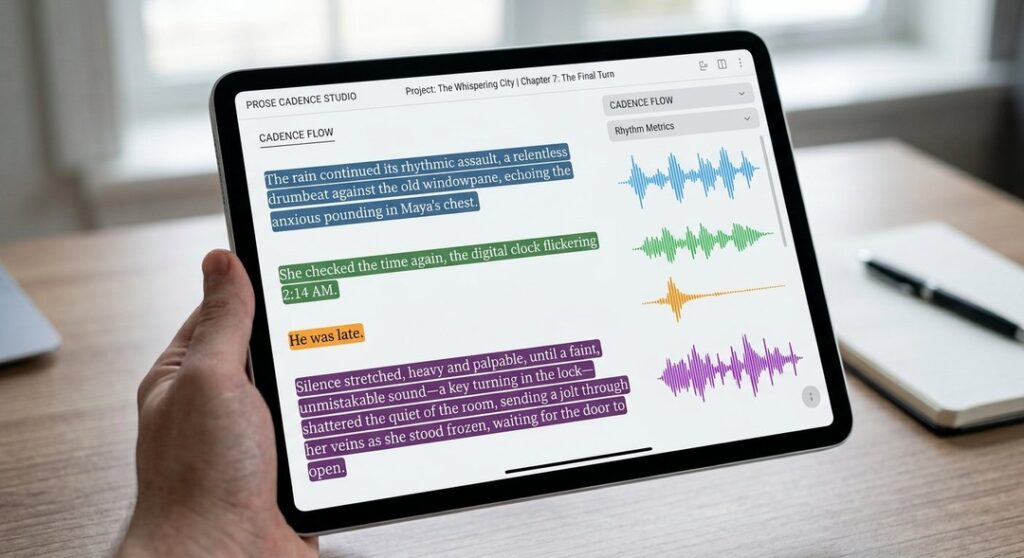
The final step to humanize AI text is a focused editing pass.
At this stage, the content should already contain useful information and an appropriate voice.
The remaining task is to improve readability and remove distracting weaknesses.
Read the Draft Aloud
Reading aloud can reveal awkward phrasing.
Sentences that appear acceptable on a screen may sound unnatural when spoken.
Listen for:
- Repeated words.
- Unnecessarily long sentences.
- Awkward transitions.
- Unclear references.
- Unnatural vocabulary.
- Repetitive sentence openings.
- Sections that feel overly formal.
Reading aloud is a practical editing method, but it is not a substitute for factual review.
Shorten Overloaded Sentences
Long sentences are not automatically bad.
However, sentences containing several unrelated ideas can become difficult to understand.
Break them apart when doing so improves clarity.
Avoid dividing every sentence into a separate paragraph.
Related ideas should remain grouped together.
Remove Repetition
AI-generated drafts may restate the same point in slightly different words.
This can make articles longer without making them more informative.
To humanize AI text, identify repeated explanations and keep the strongest version.
A shorter, more focused article can be more valuable than a longer repetitive one.
Check Paragraph Flow
Each paragraph should develop a clear idea.
The next paragraph should build on that idea or introduce a logical new point.
Abrupt topic changes can interrupt reading.
However, unnecessary transition sentences can also slow the article.
Aim for clear progression rather than artificial smoothness.
Review Grammar and Punctuation
Grammar tools can identify potential errors.
However, automated suggestions should be reviewed carefully.
A technically correct suggestion may alter meaning or remove an intentional stylistic choice.
Perform a Final Accuracy Check
Revisions can accidentally introduce mistakes.
After editing, confirm that statistics, quotations, technical explanations, and source references remain accurate.
The final version should be both readable and trustworthy.
Before and After Examples of Humanized AI Writing
Examples help demonstrate how the workflow operates.
Example 1. Business Writing
AI-style draft
“Organizations operating in the contemporary business environment must implement comprehensive strategies to optimize employee productivity.”
Humanized version
“Businesses can improve productivity by giving employees clear priorities, useful tools, and enough time to complete important work.”
The revised sentence provides specific actions.
It also removes unnecessary formal language.
Example 2. Technology Content
AI-style draft
“Artificial intelligence represents a transformative technological innovation that revolutionizes numerous aspects of modern society.”
Humanized version
“AI is changing how people write, analyze information, and automate routine tasks, although its usefulness depends on the application.”
The revision identifies practical uses and includes an appropriate limitation.
Example 3. Marketing Content
AI-style draft
“Businesses seeking to enhance their digital presence should leverage cutting-edge content marketing methodologies.”
Humanized version
“A useful content strategy starts with understanding what customers need and publishing information that answers their questions.”
The improved version is more actionable.
Example 4. Educational Writing
AI-style draft
“Effective time management is an essential component of achieving optimal academic performance.”
Humanized version
“Students can manage their workload more effectively by planning study sessions and breaking large assignments into smaller tasks.”
Specific advice makes the explanation more useful.
Humanize AI Text Without Losing SEO Value

SEO-focused content must satisfy both reader needs and search intent.
However, keyword optimization can make writing repetitive when handled poorly.
The goal is to use relevant terminology naturally.
Understand Search Intent
Before writing, identify what the reader wants to accomplish.
Someone searching for how to humanize AI text is likely looking for editing methods, practical examples, or suitable tools.
An effective article should address those needs directly.
Use Keywords Naturally
The focus keyword should appear where it helps establish relevance.
Related phrases can support topical coverage.
However, repeating the exact phrase excessively can reduce readability.
Google does not publish an ideal keyword density percentage.
Therefore, keyword placement should support meaning rather than satisfy an arbitrary count.
Use Semantic Keywords
Related terms can help explain the topic comprehensively.
Relevant phrases include:
- AI content editing.
- Natural writing style.
- Human-centered content.
- AI-generated drafts.
- Content rewriting.
- Authentic writing voice.
- Readability improvement.
- Editorial quality control.
- AI-assisted content creation.
These terms should appear where appropriate.
Write Clear Headings
Headings help readers understand article structure.
They also make information easier to locate.
Use descriptive headings rather than repeating the same keyword in every section.
Prioritize Helpful Information
SEO performance depends on numerous factors.
Natural writing, relevant examples, and accurate information can improve content quality.
However, no method guarantees high rankings.
Humanize AI Text for GEO and AI Search Engines
Generative Engine Optimization, commonly called GEO, focuses on making information easier for AI-powered search systems to interpret and potentially reference.
However, there is no universally accepted formula guaranteeing inclusion in AI-generated answers.
Provide Direct Answers
Clear explanations help readers and automated systems identify relevant information.
For example, a question about humanizing AI writing should receive a direct answer before lengthy background discussion.
Use Logical Content Structure
Organized headings, focused paragraphs, and meaningful examples make information easier to understand.
Avoid unnecessary complexity.
Include Verifiable Information
Content supported by reliable evidence is more trustworthy.
When making factual claims, use appropriate references.
Explain Concepts Precisely
Vague statements can create uncertainty.
Define important terms and distinguish between related ideas.
Avoid Unsupported Statistics
AI-generated drafts may contain impressive-looking numbers without evidence.
Do not include statistics unless they can be verified.
Common Mistakes When Trying to Humanize AI Text
Some editing methods can make AI-generated writing worse.
Replacing Every Word With a Synonym
Automatic synonym replacement can create awkward or inaccurate sentences.
Natural writing requires understanding meaning.
Adding Slang Everywhere
Casual language does not automatically sound human.
A professional article may become less credible when filled with unnecessary slang.
Making Sentences Randomly Longer or Shorter
Sentence variation should improve readability.
Artificial patterns can make writing feel less natural.
Inventing Personal Experiences
Fabricated anecdotes may create a false impression of expertise.
Use actual experience or clearly labeled hypothetical examples.
Ignoring Factual Accuracy
A natural-sounding article can still contain incorrect information.
Accuracy should remain a priority.
Overusing Humanizer Tools
Automated rewriting may introduce errors, change tone, or remove important details.
Human review remains necessary.
Can AI Humanizer Tools Improve Writing?
AI humanizer tools are applications that attempt to rewrite machine-generated content into more natural language.
They may adjust vocabulary, sentence structure, or tone.
However, results vary.
Some tools produce useful suggestions.
Others create awkward wording or factual distortions.
Potential Benefits
Automated tools may help with:
- Rephrasing unclear sentences.
- Suggesting alternative wording.
- Adjusting tone.
- Identifying repetitive language.
- Simplifying complex explanations.
These capabilities can support editing.
Important Limitations
Automated rewriting cannot reliably verify every factual claim.
It may also remove technical qualifications or alter meaning.
Some services make unsupported claims about avoiding AI detection.
Such claims should be treated cautiously.
What About AI Detectors?
AI detection systems attempt to estimate whether text was generated by artificial intelligence.
However, detection tools can produce false positives and false negatives.
There is no universal method that reliably proves authorship based solely on writing style.
Therefore, editing should focus on genuine content quality rather than manipulating detector scores.
Humanizing AI Text for Different Content Types

Different formats require different editorial priorities.
Blog Posts
Blog articles benefit from clear introductions, useful examples, logical sections, and concise conclusions.
Writers should remove repetitive explanations and address search intent.
Business Emails
Professional emails should communicate the purpose quickly.
Avoid excessive formalities and unnecessary background information.
Social Media Content
Social posts often require concise wording and a recognizable voice.
However, the appropriate tone depends on the platform and audience.
Product Descriptions
Product content should describe verified features and practical uses.
Avoid unsupported performance claims.
Academic Writing
Academic work requires accurate citations and compliance with institutional rules.
AI assistance must follow applicable academic integrity policies.
Technical Documentation
Technical writing should prioritize precision, consistency, and clear instructions.
Oversimplification can create serious misunderstandings.
How to Build a Consistent Personal Writing Voice
A recognizable writing style develops through repeated practice.
AI can assist with drafting, but writers should remain responsible for editorial decisions.
Study Your Existing Work
Review writing you created independently.
Identify common sentence patterns, vocabulary preferences, and explanation styles.
Create a Style Guide
A simple style guide can define:
- Preferred tone.
- Typical paragraph length.
- Vocabulary preferences.
- Formatting rules.
- Audience expectations.
- Common phrases to avoid.
- Citation requirements.
- Brand terminology.
This guidance can improve consistency across multiple articles.
Use Real Examples
Specific examples can make content more distinctive.
However, they should be accurate and relevant.
Edit for Consistency
After revising a draft, check whether the tone changes unexpectedly.
A consistent voice does not require every sentence to sound identical.
The Role of Human Judgment in AI-Assisted Writing
AI can generate options, but it does not replace editorial accountability.
Human judgment is particularly important when content influences decisions.
Evaluating Relevance
Writers must decide which information matters to readers.
Not every generated paragraph deserves inclusion.
Checking Evidence
AI systems may misinterpret sources or produce unsupported claims.
Verification remains essential.
Understanding Audience Needs
Writers should consider what readers already know and what they need explained.
Making Ethical Decisions
Content should not fabricate expertise, misrepresent sources, or conceal required disclosures.
Maintaining Accountability
The person or organization publishing content remains responsible for its accuracy and appropriateness.
A Practical Editing Checklist to Humanize AI Text
A repeatable checklist can make the process easier.
Step 1. Content Review
- Confirm the main purpose.
- Verify important facts.
- Remove irrelevant information.
- Add useful examples.
- Improve logical structure.
Step 2. Voice Editing
- Replace generic language.
- Match the intended tone.
- Vary sentence structure naturally.
- Remove unnecessary transitions.
- Preserve technical accuracy.
Step 3. Final Polish
- Read the text aloud.
- Check paragraph flow.
- Remove repetition.
- Review grammar.
- Verify the final version.
This checklist is useful for blogs, professional documents, and marketing content.
How Long Does It Take to Humanize AI Text?
Editing time depends on draft quality, article length, subject complexity, and the writer’s familiarity with the topic.
A short email may need only a few minutes of review.
A technical article containing statistics and specialized claims may require substantial research.
Factors Affecting Editing Time
Important considerations include:
- Number of factual claims.
- Quality of the initial draft.
- Required source verification.
- Complexity of the subject.
- Desired writing style.
- Publication standards.
- Number of revisions.
The objective should be effective editing rather than completing revisions as quickly as possible.
Is Humanized AI Content Good for Google?
Google’s guidance focuses on content quality and whether material is created primarily to help users.
Using AI does not automatically make content unacceptable.
However, producing large amounts of low-value content to manipulate search rankings can violate spam policies.
To humanize AI text for publication, prioritize original value, accurate information, and relevant explanations.
Avoid mass-producing superficial variations of existing articles.
EEAT and AI-Assisted Content
EEAT refers to experience, expertise, authoritativeness, and trustworthiness.
It is part of Google’s framework for evaluating content quality.
However, EEAT should not be treated as a simple numerical score.
Trustworthy content benefits from accurate claims, transparent sourcing, and appropriate subject knowledge.
Why Original Value Matters
Rewriting existing information without adding useful substance may produce little benefit for readers.
A strong article should answer questions, clarify difficult concepts, or provide relevant insight.
Human editing is most valuable when it improves understanding.
The Future of Humanizing AI-Generated Content
AI writing tools will continue to evolve.
However, improved generation capabilities do not eliminate the need for editorial judgment.
Writers will still need to verify information, understand audiences, and decide what deserves publication.
AI as a Drafting Assistant
AI can help organize ideas and create initial structures.
Human editors can then improve the content.
Greater Emphasis on Verification
As AI-generated material becomes more common, reliable sourcing and factual accuracy become increasingly important.
More Personalized Writing Workflows
Writers may use style guides, templates, and feedback to improve consistency.
However, personal style should reflect genuine preferences rather than fabricated identity.
Quality Over Volume
Publishing more content does not automatically create more value.
Useful, accurate writing remains central to effective communication.
FAQ’s
1. How Can I Humanize AI Text Naturally?
To humanize AI text, verify the information, rewrite generic sections in your own voice, add relevant examples, and edit for clarity and natural flow.
2. Can I Humanize AI Text Without Changing Its Meaning?
Yes. Focus on improving wording, sentence structure, and readability while preserving factual claims, technical details, and the original purpose.
3. Do AI Humanizer Tools Always Work?
No. Automated rewriting tools vary in quality and may introduce errors or awkward language. Human review is necessary for reliable results.
4. Does Google Penalize Humanized AI Content?
Google does not automatically penalize content because AI assisted its creation. Its policies focus on helpfulness, quality, and preventing search manipulation.
5. Can AI Detectors Identify Humanized AI Writing?
AI detectors can produce inaccurate results. Rewriting does not guarantee any detection outcome, and detector scores should not replace editorial quality checks.
6. What Is the Best Way to Humanize AI Text for SEO?
Use natural language, answer search intent, verify factual claims, include useful examples, and integrate relevant keywords without unnecessary repetition.
Conclusion
Learning to humanize AI text is fundamentally about improving communication rather than disguising how a draft was created. The most effective workflow begins with reviewing the content for accuracy and relevance, continues with rewriting generic passages in a genuine voice, and ends with careful editing for clarity, rhythm, and consistency. These three steps help transform unfinished AI-generated material into useful writing that reflects thoughtful editorial decisions. They also reduce common problems such as repetition, vague explanations, unsupported claims, and unnatural sentence structures.
Whether preparing blog posts, marketing copy, business emails, or educational content, the ability to humanize AI text can make AI-assisted writing more effective and trustworthy. Writers should use automation as a supporting tool while maintaining control over facts, examples, tone, and final publication decisions. By prioritizing genuine insight, readable language, and responsible editing, content creators can benefit from AI’s speed without sacrificing the accuracy, personality, and practical value that readers expect.
Leave a Reply