
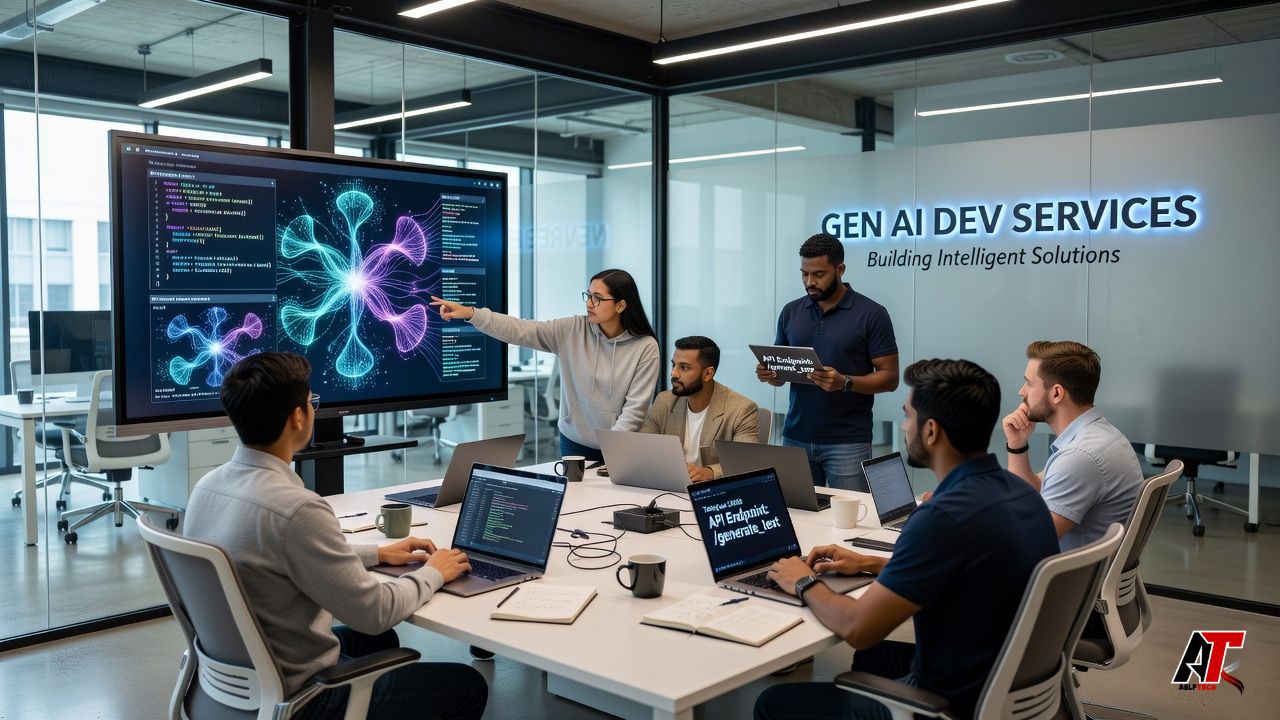
The digital landscape shifts rapidly as businesses seek innovative ways to automate complex workflows. Consequently, organizations turn to specialized providers for generative AI development services to build custom models and intelligent applications. Furthermore, these tailored solutions enable companies to generate text, code, and imagery at scale. Therefore, partnering with experts ensures robust deployment and unmatched competitive advantage.
Core Components of generative AI development services
Building generative models requires deep technical expertise and specialized infrastructure. Off-the-shelf APIs often fail to meet specific enterprise security or contextual needs. Therefore, custom development focuses on fine-tuning existing large language models or building proprietary architectures. Developers utilize advanced frameworks to orchestrate complex AI behaviors. Consequently, businesses gain highly accurate tools tailored to their unique data ecosystems. Thus, custom model development forms the bedrock of enterprise AI strategy.
Custom LLM Fine-Tuning in generative AI development services
Base models possess broad knowledge but lack niche industry context. Developers utilize parameter-efficient fine-tuning methods like LoRA to adapt these models using proprietary corporate data. This process requires significantly less compute power than training from scratch. Furthermore, it prevents the model from hallucinating facts about specific business operations. Therefore, fine-tuning delivers highly relevant and accurate outputs for specialized tasks. Consequently, enterprises deploy intelligent assistants that truly understand their domain.
Retrieval-Augmented Generation Architecture
Even fine-tuned models occasionally produce incorrect outputs. To solve this, developers implement Retrieval-Augmented Generation pipelines. The system queries a secure vector database containing company documents before generating a response. The model then bases its answer strictly on retrieved facts. Therefore, RAG architecture grounds the model in verifiable truth. Consequently, businesses eliminate the dangerous hallucination problem that plagues public AI tools. Thus, RAG guarantees enterprise-grade reliability for critical operations.
Strategic Applications of generative AI development services
Enterprises apply generative models across various operational vectors. From automating customer support to generating marketing copy, the use cases expand daily. Furthermore, developers integrate these models into existing content management systems and CRMs. Therefore, employees experience seamless workflow augmentation rather than disruptive tool switching. Consequently, productivity rises organically across the organization.
Automating Content and Code Generation via generative AI development services
Software development teams benefit massively from AI pair programmers. Custom models trained on a company proprietary codebase suggest completions and identify bugs instantly. Furthermore, marketing teams use generative tools to draft product descriptions and email campaigns rapidly. These tools adhere strictly to brand voice guidelines. Therefore, creative teams spend less time on first drafts and more time on strategy. Thus, automation accelerates both technical and creative workflows efficiently.
Intelligent Document Processing
Enterprises process thousands of contracts, invoices, and reports daily. Traditional optical character recognition fails to understand contextual nuance. Generative AI extracts specific clauses, summarizes complex agreements, and flags compliance risks automatically. Therefore, legal and finance teams process documentation in minutes rather than days. Consequently, intelligent document processing drastically reduces administrative overhead. Thus, unstructured data transforms into structured, actionable intelligence.
Security and Compliance in generative AI development services
Feeding proprietary data into public models introduces severe intellectual property risks. Enterprises cannot afford to leak sensitive customer data to third-party training pools. Therefore, custom development services prioritize isolated, secure environments. Developers build private instances of models hosted on virtual private clouds. Consequently, all data processing and inference occur within the enterprise security perimeter. Thus, private deployment mitigates the biggest risk in enterprise AI adoption.
Data Privacy and On-Premise Deployment for generative AI development services
Regulated industries like healthcare and finance require strict data sovereignty. On-premise deployment allows organizations to run powerful models locally without transmitting data over the public internet. Furthermore, developers implement role-based access controls directly into the model inference layer. Therefore, only authorized personnel can query sensitive patient or financial data through the AI. Consequently, robust compliance protocols enable highly regulated sectors to leverage generative technology safely.
Mitigating Bias and Ensuring Alignment
Generative models often reflect biases present in their training data. Developers employ red-teaming techniques to identify and eliminate harmful outputs. Furthermore, they implement guardrails that prevent the model from discussing off-topic or inappropriate subjects. Therefore, the AI behaves consistently with corporate values and ethical guidelines. Consequently, proactive alignment prevents reputational damage caused by rogue AI outputs. Thus, ethical AI development remains a critical service component.
Evaluating generative AI development services Providers
Selecting the right development partner dictates the success of the AI initiative. Many agencies claim AI expertise but lack deep machine learning engineering capabilities. Therefore, enterprises must rigorously vet potential vendors. Buyers should look for proven experience in deploying production-grade LLMs, not just theoretical prototypes. Consequently, evaluating a vendor technical depth prevents costly project failures.
MLOps and Scalability in generative AI development services
Building a model is only the first step. Maintaining its accuracy over time requires robust Machine Learning Operations. Generative models can drift or degrade as user queries change. Therefore, development services must include automated monitoring pipelines. These pipelines track latency, token usage, and output quality. If the model begins hallucinating, the system alerts engineers to retrain it. Consequently, strong MLOps ensure the AI application remains reliable at scale. Thus, operational maintenance defines a premium development service.
Cloud Infrastructure Optimization
Running generative models demands massive graphical processing power. Inefficient code and poor architecture lead to exorbitant cloud billing. Expert developers optimize inference engines to maximize token throughput per GPU. Furthermore, they implement auto-scaling protocols that spin resources down during low traffic periods. Therefore, enterprises achieve high performance without wasting capital on idle servers. Consequently, infrastructure optimization makes continuous AI deployment financially viable. Thus, technical efficiency translates directly to bottom-line savings.
The Future of generative AI development services
The generative AI landscape evolves on a weekly basis. Context windows expand, and multimodal capabilities improve rapidly. Future development services will focus heavily on agentic workflows. These are systems where AI models autonomously execute multi-step tasks across different software applications. Therefore, businesses will transition from using AI as a chatbot to using it as an autonomous worker. Consequently, the operational landscape will shift dramatically over the next few years.
Agentic Workflows and Multimodal Models in generative AI development services
Developers are already building agents that can navigate web browsers, extract data, and populate spreadsheets without human intervention. Furthermore, multimodal models that process text, audio, and video simultaneously will redefine user interfaces. Therefore, generative AI development services will increasingly resemble systems integration and orchestration. Consequently, businesses will deploy complex networks of specialized AI agents working collaboratively. Thus, the future of enterprise AI lies in autonomous, interconnected intelligence.
Continuous Learning Systems
Static models quickly become outdated as business environments change. Future development services will implement continuous learning architectures. These systems ingest new data daily, updating their knowledge base without requiring full retraining. Therefore, the AI remains perpetually current with market trends and internal policy shifts. Consequently, enterprises maintain a persistent competitive edge through ever-evolving intelligence. Thus, continuous learning ensures long-term return on AI investments.
FAQs
1. What are generative AI development services?
They are specialized technical offerings where engineers build, fine-tune, and deploy custom artificial intelligence models for enterprise applications.
2. Why choose custom development over public AI APIs?
Custom development ensures data privacy, eliminates API token costs, and allows precise tuning to specific industry contexts and brand voice.
3. What is RAG in generative AI?
Retrieval-Augmented Generation grounds AI responses in verified company documents, eliminating hallucinations and ensuring highly accurate, factual outputs.
4. How do developers secure enterprise AI models?
They deploy models on private cloud instances or on-premise servers, utilizing strict role-based access controls and end-to-end encryption.
5. What is MLOps in generative AI?
MLOps involves the continuous monitoring, retraining, and deployment pipelines required to keep machine learning models accurate and scalable in production.
6. Can generative AI automate software development?
Yes, developers build custom AI pair programmers trained on proprietary codebases to suggest completions, write tests, and identify bugs instantly.
Conclusion
Integrating artificial intelligence into enterprise operations requires specialized expertise and rigorous security protocols. Generative AI development services provide the necessary framework to build, deploy, and manage custom models securely. By fine-tuning LLMs on proprietary data and implementing robust MLOps, organizations automate complex workflows while maintaining strict data privacy. Furthermore, as the industry moves toward autonomous agentic workflows, partnering with an experienced development team ensures businesses remain at the forefront of innovation. Ultimately, investing in custom generative AI solutions transforms theoretical technology into unmatched operational growth.
Leave a Reply